
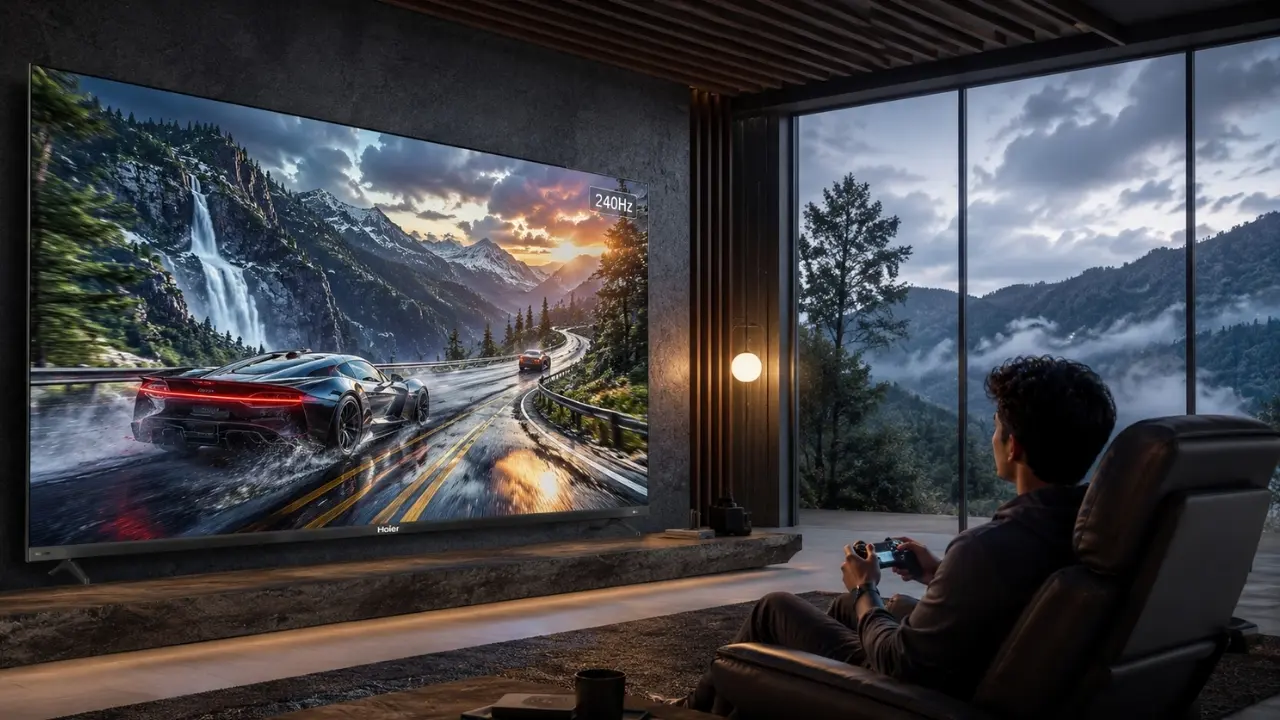

A racing game changes when the track seems to stretch across the wall. A football match feels different when players are large enough to follow without squinting. And in an open-world adventure, spotting a distant path, opponent or environmental detail becomes far more natural when the picture has room to breathe.
That is the real appeal of big screen gaming. Size is not simply about making everything larger. A larger television can occupy more of your field of view, make visual information easier to notice and give virtual environments a stronger sense of scale.
There is a catch, though. A large display alone cannot guarantee immersion. If motion looks messy, colours lack depth or controls feel disconnected from what happens on screen, those extra inches do very little. The complete gaming experience depends on how screen size works alongside picture quality, motion handling, responsiveness and sound.
That distinction matters when choosing a TV for modern gaming.
What Actually Makes a Bigger Screen Feel More Immersive?
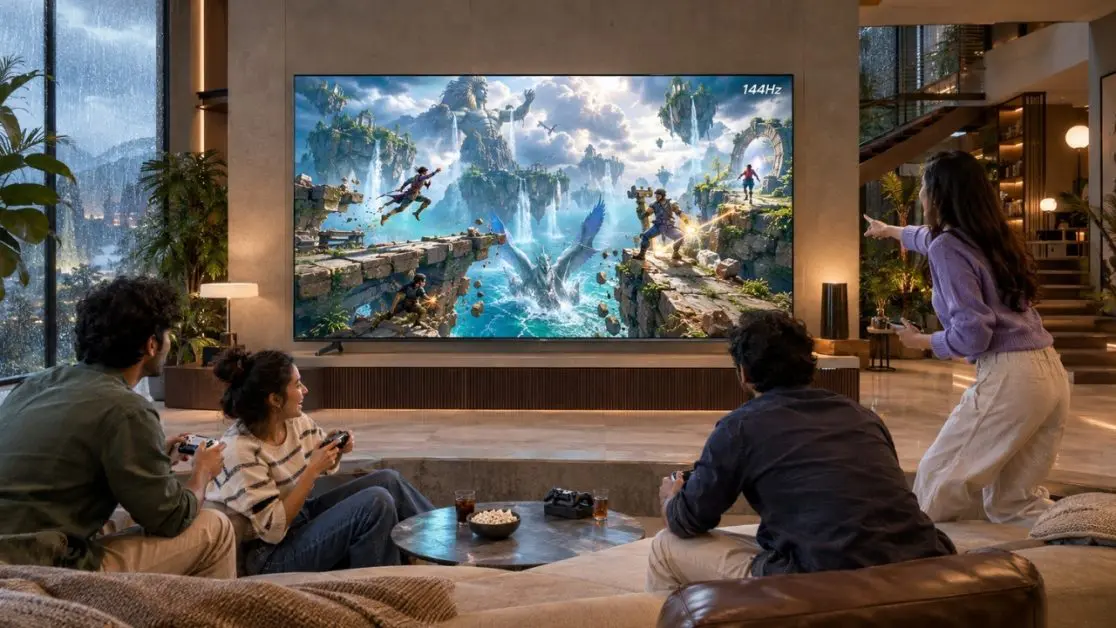
Think about what happens when you move from playing on a small display to a large television.
More of your vision is occupied by the game rather than the room around it. Objects become easier to distinguish. Landscapes gain scale. Small interface elements can become more readable from a comfortable sofa distance.
Essentially, there is less visual separation between watching the game and feeling involved in it.
This becomes particularly noticeable in games built around:
- large open environments and exploration
- racing and driving
- football and other sports
- cinematic action sequences
- adventure and role-playing
- local multiplayer sessions
- visually detailed 4K worlds
A sweeping mountain range on a small display may still look beautiful. Put the same environment across a 164 cm (65) or 189 cm (75) television and its sense of scale can become much more convincing.
Big screen gaming, however, exposes weaknesses too. Poor motion handling is easier to notice. Flat-looking colours remain flat, only bigger. This is precisely why screen technology deserves as much attention as screen dimensions.
Screen Size Gives Game Worlds Room to Breathe
Modern games pack enormous amounts of information into individual frames: textures, shadows, weather effects, HUD elements, distant objects, character animation and tiny environmental cues.
A bigger display gives those elements more physical screen space.
Imagine driving quickly through a detailed city. You are simultaneously watching the road, reading the environment, noticing other vehicles and reacting to movement around you. On a suitably sized large TV, these elements can be easier to distinguish without making the overall scene feel cramped.
The same logic applies to exploration. You might notice a pathway in the distance, movement near the edge of the frame or a small environmental clue that would otherwise demand more effort to see.
That extra visibility can make gaming feel less like looking through a window and more like looking into a world.
But Bigger Is Only Better When Motion Keeps Up
Here is where specifications become important.
Games move. Often very quickly.
Vehicles turn sharply, cameras pan across landscapes and players change direction within fractions of a second. If the television cannot present that movement smoothly, a large screen can actually make motion problems more noticeable.
For gaming, therefore, buyers should consider the combination of:
- screen size
- supported gaming refresh capabilities
- motion performance
- low-latency gaming features
- picture quality
- audio performance
This is also where the Haier P7 Pro Series HQLED AI Smart Google TV becomes relevant to the discussion.
Available in 139 cm (55), 164 cm (65) and 189 cm (75) screen options, the P7 Pro Series includes Gaming 120Hz, along with Game Mode, ALLM and VRR among its listed gaming features. Haier describes Gaming 120Hz as enabling smoother gameplay with reduced motion blur and responsive performance during fast-paced gaming.
Why ALLM and VRR Matter
Large-screen immersion can disappear rather quickly when the visual response does not feel connected to the controller.
ALLM (Auto Low Latency Mode) is designed around reducing latency during gaming, while VRR (Variable Refresh Rate) helps address visual disruption such as screen tearing when frame delivery varies.
Haier specifically positions ALLM and VRR on the P7 Pro Series as gaming technologies intended to keep gameplay smooth while reducing lag, blur and screen tearing. The gaming feature panel supplied for the series also highlights a dedicated Game Mode.
The important point is not the acronym collection. It is what these technologies are trying to achieve: keeping the display experience connected to what the player is doing.
Big Games Need More Than Smooth Motion
Suppose the motion is fluid, but a sunset looks washed out. Or a dark cave loses its shadow detail. Or a colourful fantasy world somehow appears dull.
The game is technically playable. Immersive? Not quite.
Visual richness becomes particularly noticeable on bigger televisions because there is simply more picture in front of you.
The P7 Pro Series uses HQLED/QLED technology, with Haier stating that its QLED technology delivers richer colours, enhanced brightness and lifelike picture quality. The range also supports HDR10+, Dolby Vision, Wide Colour Gamut and 93% DCI-P3 colour coverage.
For gaming, these capabilities matter because different titles place very different demands on a display.
A dark stealth sequence needs controlled contrast and visible detail. A bright racing environment needs colour and clarity. A fantasy landscape may depend heavily on saturated skies, foliage, lighting effects and subtle colour transitions.
AI Picture Quality Adds Another Layer
The P7 Pro Series also incorporates AI Picture Quality, designed to optimise brightness, contrast, colour and clarity according to the content.
The product material further identifies AI-HDR Enhancer, AI-Color-boost, AI-NR and AI-Motion capabilities, addressing different aspects of image processing and motion presentation.
In other words, the big-screen proposition here is not merely make the picture larger. It is about giving that larger picture enough visual substance to justify the scale.
Sound Is Half the Illusion
Gaming immersion is often discussed as though eyes do all the work. They don’t.
Hear an engine approaching from the game world and you react before consciously thinking about it. A heavy impact needs weight. Environmental sounds make an empty-looking landscape feel alive. Music changes the emotional temperature of a scene before anything important has even happened.
A large image paired with thin, underwhelming audio can feel strangely incomplete.
The Haier P7 Pro Series addresses this with a 2.1-channel audio system featuring an inbuilt subwoofer and 50W audio output, alongside Dolby Atmos. Haier positions the dedicated subwoofer as providing deeper bass and richer sound, while Dolby Atmos supports a more multidimensional listening experience.
That combination is especially relevant for big-screen gaming because the audio needs to carry some of the same scale as the picture.
An explosion should not feel tiny when it occupies half the screen.
55, 65 or 189 cm (75): Which Big Screen Makes Sense?
There is no universal answer. Bigger is not automatically better for every Indian home.
Room dimensions, seating distance and how the television will be used should influence the decision.
The Haier P7 Pro Series gives buyers three large-screen choices:
- 139 cm (55) – 55P7 Pro: a practical large-screen option where viewing distance or room dimensions are relatively contained.
- 164 cm (65) – 65P7 Pro: offers substantially more visual presence for gaming while remaining suitable for many contemporary living-room arrangements.
- 189 cm (75) – 75P7 Pro: designed for buyers looking for a much larger home-entertainment canvas where the room and viewing distance can accommodate it.
The core feature proposition remains closely aligned across these three sizes, including 4K resolution, QLED display technology, HDR10+, Dolby Vision, Gaming 120Hz, Game Mode, ALLM, VRR, Dolby Atmos and the 2.1-channel audio system.
That allows screen size to become a room-and-preference decision rather than forcing gamers to treat size as the only meaningful upgrade.
Where Big Screens Really Show Their Advantage
Not every game benefits in exactly the same way.
Racing and Driving
A large screen can strengthen the impression of speed because roads, vehicles and surrounding scenery occupy more of your field of vision. Smooth motion becomes particularly important here.
Open-World Adventures
Scale is the attraction. Distant mountains, dense cities and wide landscapes have more visual breathing room, making exploration feel more expansive.
Sports
Player movement and the wider playing area can become easier to follow, particularly when several people are watching or playing from the sofa.
Local Multiplayer
This is an underrated one.
When multiple people share one display, available screen space becomes valuable very quickly. A larger screen gives everyone a more comfortable view, especially in games that divide the display or fill it with multiple characters and interface elements.
What Should Gamers Look for Beyond Screen Size?
Before choosing a big-screen gaming TV, it helps to move past the simple question of “How many inches?”
Look at the complete system.
Ask whether the television offers:
- gaming-focused motion and responsiveness features
- a detailed 4K picture
- strong colour reproduction
- HDR support
- audio that complements the size of the display
- connectivity suited to gaming equipment
- smart entertainment features for use beyond gaming
The P7 Pro Series, for example, lists four HDMI inputs, including HDMI 2.1 eARC, as well as two USB 2.0 ports. It also runs Google TV and provides 2GB RAM with 32GB storage.
That wider feature mix matters because a living-room television rarely belongs to one person or one activity. One evening it is a gaming display; later it becomes the family’s entertainment screen.
Big Screen Gaming Is Really About Presence
The most convincing argument for a bigger gaming television is not the number on the specification sheet.
It is presence.
When the display fills more of your natural viewing area, movement has room to unfold, environments gain scale and details become easier to appreciate. Combine that size with smooth gaming performance, strong colour reproduction and appropriately powerful audio, and the experience becomes noticeably more involving.
That is the thinking behind the Haier P7 Pro Series HQLED AI Smart Google TV. Rather than relying on screen size alone, the range combines large 139 cm (55), 164 cm (65) and 189 cm (75) options with Gaming 120Hz, Game Mode, ALLM, VRR, HQLED picture technology, HDR10+, Dolby Vision and a 2.1-channel audio system with an inbuilt subwoofer.
Because when the race gets close, the landscape opens up or the action suddenly fills the frame, you should not be thinking about the television.
You should be thinking about what happens next.
Frequently Asked Questions
1. Why does gaming feel more immersive on a big-screen TV?
A larger television occupies more of the player’s field of view, giving game environments, characters and movement greater visual presence. Details can also become easier to notice from normal living-room viewing distances. The effect is particularly noticeable in racing, sports, open-world and cinematic games.
2. Is a bigger TV always better for gaming?
Not necessarily. Screen size should suit the room and viewing distance, while gaming performance matters just as much. Features such as smooth motion, responsive gameplay, good picture quality and capable audio determine whether the larger picture actually translates into a better gaming experience.
3. What gaming features are available on the Haier P7 Pro Series?
The Haier P7 Pro Series HQLED AI Smart Google TV lists Gaming 120Hz, Game Mode, ALLM and VRR among its gaming features. Haier positions these technologies around smoother gameplay and reducing issues such as lag, blur and screen tearing during gaming.
4. Which Haier P7 Pro screen sizes are available for big-screen gaming?
The Haier P7 Pro Series is available in 139 cm (55), 164 cm (65) and 189 cm (75) screen sizes. This gives buyers different large-screen options depending on room dimensions, viewing distance and personal preference.
5. Does picture quality matter more on a larger gaming TV?
Yes, because a larger screen makes both strengths and weaknesses in the picture easier to notice. The Haier P7 Pro Series combines its large display options with HQLED/QLED technology, HDR10+, Dolby Vision, Wide Colour Gamut and 93% DCI-P3 colour coverage to support richer and more detailed visuals.
6. How does sound contribute to immersive big-screen gaming?
Sound helps give visual action a stronger sense of scale and atmosphere. The Haier P7 Pro Series features a 50W, 2.1-channel audio system with an inbuilt subwoofer, along with Dolby Atmos. This combination is designed to provide greater depth, bass and dimensionality across gaming and other entertainment.