


Buying a television today involves far more choices than it did a few years ago. Screen size was usually the biggest call you had to make, and everything else followed from there. These days, the conversation often starts somewhere else entirely: resolution. You’ll spot terms like HD, Full HD resolution, Ultra HD and 4K resolution across almost every TV, but they don’t all give you the same viewing experience.
Here’s the reassuring part: choosing the right resolution isn’t about buying the biggest number . It really comes down to how you watch TV, how big your screen is, and what kind of content you tend to watch most. If you’ve ever stood comparing UHD vs HD vs FHD and wondered which one actually suits your home, you’re definitely not the only one.
This guide explains what each resolution means, where you’ll notice the difference, and how to decide which one is worth investing in.
What is HD?
HD, or High Definition, was the point where TV viewing first started feeling noticeably sharper than the old standard-definition broadcasts. An HD Ready TV typically offers a resolution of 1366 × 768 pixels, producing clear visuals for everyday entertainment.
On smaller screens, especially around the 32-inch mark, HD still delivers a comfortable viewing experience for news, regular TV channels and casual streaming.
A typical HD TV offers:
- Clear everyday picture quality
- Suitable performance on smaller screens
- Lower bandwidth requirements while streaming
- Good value for secondary rooms or compact spaces
Models like the Haier A900 HDR10 32-inch Google TV and K85 HDR 32-inch Google TV combine HD Ready resolution with HDR/HLG support, which helps improve brightness, colour and contrast beyond what basic HD TVs used to offer.
What is Full HD Resolution?
If HD is where it all started, Full HD resolution takes image clarity a step further.
With a resolution of 1920 × 1080 pixels, Full HD packs in a lot more detail than standard HD. Faces look sharper, text is easier to read at a glance, and whatever you’re streaming just looks cleaner overall, especially once you’re on a screen around 40 inches or bigger.
For a lot of households, Full HD still hits that comfortable middle ground between picture quality and affordability.
Compared to HD, here’s what you’re getting with Full HD:
- Sharper image detail
- Better clarity on larger screens
- Improved streaming quality
- A more immersive viewing experience
Our Smart Full HD Google TV 40-inch with HDR gives you crisp Full HD visuals backed by HDR and HLG, while the S80 QLED 32-inch Google TV pairs Full HD resolution with QLED technology for richer colours and extra brightness.
What is Ultra HD 4K?
This is where the jump starts to show.
Ultra HD 4K, often just called 4K, offers a resolution of 3840 × 2160 pixels. That’s four times the detail of Full HD, which means the picture stays sharp even on much bigger screens.
The extra detail becomes especially valuable when watching native 4K streaming content, live sport, wildlife documentaries, or films packed with fine texture and detail.
Modern 4K HDR TV models also pair higher resolution with HDR, so colours come through richer, and there’s more contrast between the bright and dark parts of the picture.
Some of the biggest advantages of Ultra HD 4K include:
- Sharper picture quality on larger displays
- Greater detail in movies and sports
- Better support for modern streaming platforms
- Improved compatibility with HDR content
Our P7GT 43-inch 4K Ultra HD Google TV brings Ultra HD 4K resolution together with hands-free voice control, while the K85 43-inch 4K Ultra HD Google TV pairs 4K resolution with HDR and HLG support for an even more detailed viewing experience.
UHD vs HD vs FHD: Understanding the Difference
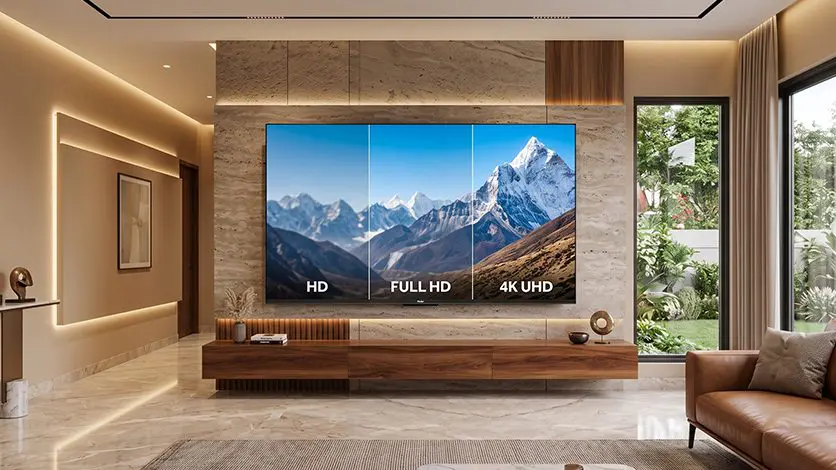
Rather than treating HD, Full HD and 4K as competing technologies, think of them as different levels of picture detail. Each step adds more pixels, allowing the screen to show a sharper, more refined image.
| Feature | HD | Full HD | Ultra HD 4K |
| Resolution | 1366 × 768 | 1920 × 1080 | 3840 × 2160 |
| Picture detail | Good | Sharper | Highest |
| Best screen sizes | Up to 32″ | 40–43″ | 43″ and above |
| Streaming quality | HD content | Full HD content | Native 4K streaming |
| Best suited for | Everyday viewing | Movies and regular streaming | Large-screen entertainment, sports and gaming |
The comparison between the UHD vs HD vs FHD isn’t really about crowning one universally better resolution. It’s about choosing enough detail for your screen size and the content you watch. A 32-inch bedroom TV probably doesn’t need Ultra HD, while a bigger living-room television usually makes good use of the extra clarity that 4K resolution brings.
Where the Difference Shows Up
Resolution becomes easier to understand once the TV is switched on. HD, Full HD and 4K can all look perfectly good in the right setting. The real difference depends on the size of the screen, how close you’re sitting, and the quality of the content you’re watching.
On a smaller TV used for everyday channels, HD still feels perfectly comfortable. Move to a larger screen and Full HD resolution starts showing its advantage with cleaner edges and sharper details. Step up to a 4K HDR TV, and you’ll notice the biggest improvement during sports, films and streaming content that has been created in 4K.
This is also why people often ask, Is 4K better than HD? The answer depends on where and how the TV is being used. On a compact bedroom television, the difference may be subtle. On a 43-inch or larger living-room TV, the additional detail becomes much easier to appreciate, especially when watching modern streaming platforms that already support 4K.
Rather than chasing the highest specification available, it’s worth matching the resolution to the screen size and the way your household actually watches television.
Haier’s Approach to Every Resolution Tier
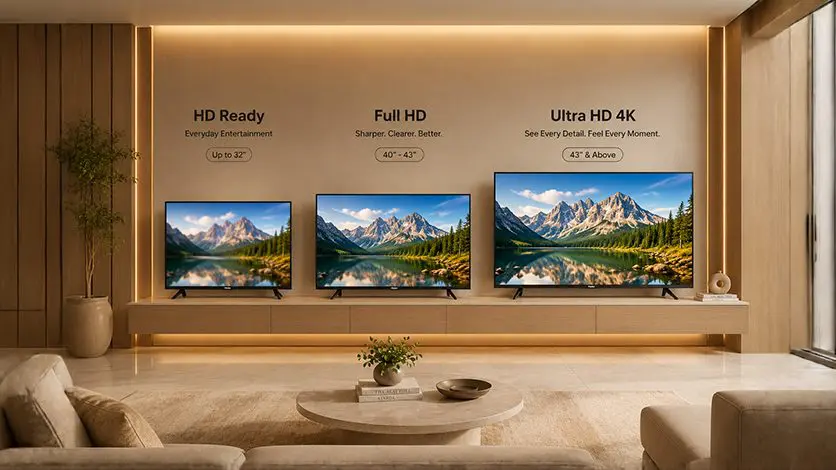
At Haier, we don’t believe every home needs the same resolution. Different households have different spaces, viewing habits and budgets, which is why our television range covers HD, Full HD and Ultra HD 4K models.
If you’re looking for a compact TV for a bedroom, study or guest room, models like the A900 HDR10 32-inch Google TV and K85 HDR 32-inch Google TV offer HD Ready picture quality with HDR/HLG support, making everyday viewing feel brighter and more detailed.
Stepping up to Full HD resolution, the Smart Full HD Google TV 40-inch delivers sharper visuals with HDR support, while the S80 QLED Full HD Google TV combines Full HD with Quantum Dot technology for richer colours and improved brightness.
For households ready to enjoy 4K resolution, the P7GT 43-inch 4K Ultra HD Google TV and K85 43-inch 4K Ultra HD Google TV bring Ultra HD 4K picture quality together with HDR support, making them well suited to larger living rooms and today’s growing library of 4K content.
Whether you’re buying your first television or upgrading to a larger screen, Haier’s TV range is designed to offer the right resolution for the way you watch.
Curious whether moving from Full HD to 4K really makes a noticeable difference? Read this blog: 4K vs Full HD – Which TV Resolution Actually Matters for You?
Conclusion
Choosing between HD, Full HD resolution, and Ultra HD 4K isn’t about picking one clear winner. Which one makes sense for you depends on your screen size, how you watch TV, and the kind of content your household reaches for most.
HD still does the job well for compact spaces and everyday entertainment. Full HD gives you a noticeable jump in clarity for regular streaming, while 4K brings the sharpest detail going for bigger screens and modern content.
At Haier, we build TVs across every one of these tiers, so whether you’re after a compact HD model, a crisp Full HD TV, or a feature-rich 4K HDR TV, there’s one built to match both your space and how you actually watch it.
FAQs
What is the difference between HD, Full HD, and UHD (4K)?
HD offers basic picture clarity, Full HD resolution delivers sharper detail, while Ultra HD 4K provides four times the pixels of Full HD for a much more detailed and lifelike viewing experience.
Is 4K the same as UHD?
For consumer televisions, 4K resolution and UHD are generally used interchangeably. UHD refers to a resolution of 3840 × 2160 pixels, which is the standard for most 4K HDR TV models.
Does screen size affect the difference between HD and 4K?
Yes, the larger the screen, the easier it is to notice the difference, making 4K resolution a more worthwhile choice on bigger TVs and when sitting closer to the screen.
Which is better: HD, Full HD, or UHD?
It depends on your needs. HD suits basic viewing, Full HD resolution is ideal for everyday entertainment, while Ultra HD 4K offers the sharpest picture for movies, streaming, sports, and gaming.
Is 4K UHD better for gaming?
Yes, a 4K HDR TV delivers sharper visuals and more detailed game environments, especially when paired with modern gaming consoles that support Ultra HD 4K output.