
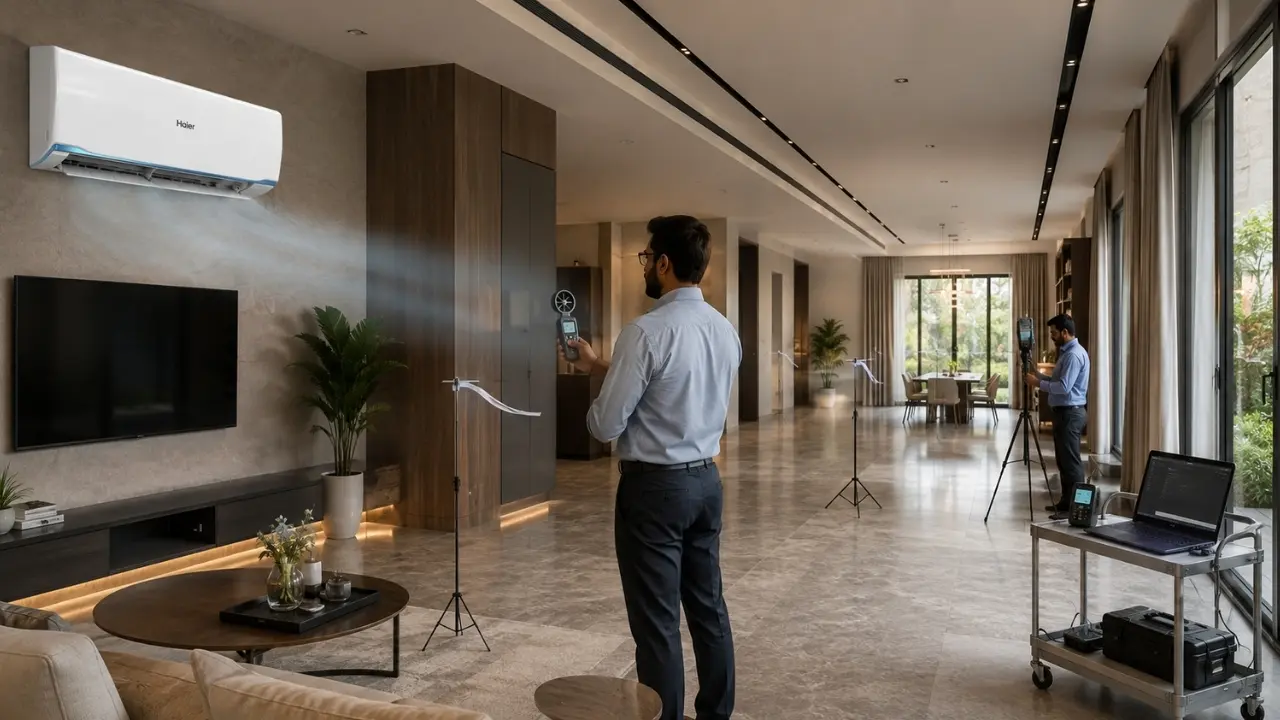

A split AC can have an efficient compressor, sophisticated electronics and intelligent controls, yet still feel underwhelming if the conditioned air does not travel effectively through the room.
That is why the fan is more than a spinning component hidden behind the indoor unit. Its design influences how much air moves through the AC, how effectively that air is distributed and, ultimately, how quickly occupants begin to feel comfortable.
For Indian homes, this becomes particularly relevant. A bedroom may need gentle airflow at night, while a larger living room can demand considerably wider and longer air distribution. So, how do manufacturers evaluate whether a fan and airflow system can actually perform as intended?
The answer involves looking at the entire air-delivery pathway, not simply how fast a fan rotates.
Fan Performance Is Really an Airflow Question
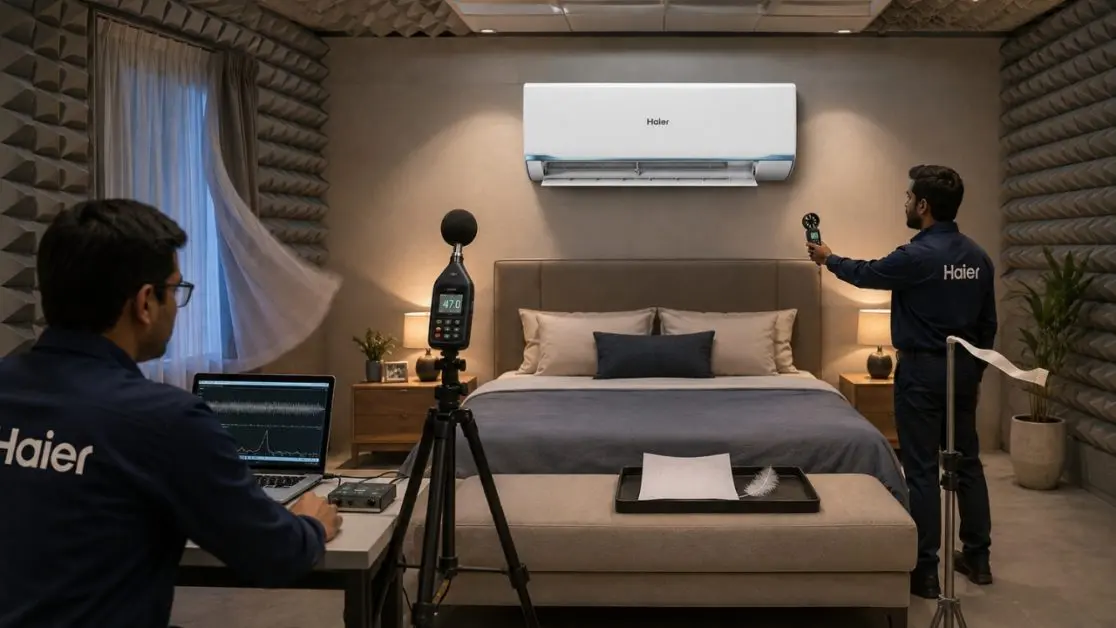
When evaluating an air conditioner’s fan system, manufacturers have to consider several interconnected factors.
The fan draws room air into the indoor unit, moves it across the heat exchanger and then sends conditioned air back into the room. Any restriction or poorly matched component along that journey can affect the final result.
Performance evaluation therefore commonly centres around aspects such as:
- Air volume: How much air can the system move?
- Air velocity: How effectively does the discharged air travel?
- Air flow: How far can conditioned air reach?
- Distribution: Does the airflow cover the intended area effectively?
- Operating consistency: Does airflow remain useful across different settings?
- Acoustic behaviour: Does stronger airflow come with an undesirable increase in operating sound?
It is this balance that matters. Simply pushing a large quantity of air is not the whole job.
What Actually Gets Evaluated?
1. Measuring the Volume of Moving Air
One fundamental performance consideration is the amount of air passing through the AC.
Here, the fan cannot really be judged on its own. The air inlet, cross-flow fan, motor and internal air duct have to function together. Change one part and the behaviour of the complete airflow system may change too.
A well-developed system aims to move sufficient conditioned air without creating an unnecessarily turbulent or uncomfortable experience.
This is especially important when an AC is expected to serve more than the immediate area directly beneath the indoor unit.
2. Checking How Far the Air Travels
Standing directly in front of an AC and feeling a strong breeze proves very little about what happens several metres away.
Air flow testing looks at how effectively the discharged airflow travels into the room.
Think about a typical Indian living room. One person may be sitting relatively close to the indoor unit, another could be across the room, and somebody else may be moving between connected spaces. Concentrating all the airflow in one small zone would hardly be ideal.
Fan, duct and motor engineering therefore needs to work as a system to achieve useful reach.
This is one area where the Haier 1.7 Ton 5 Star Desert Rose Air Conditioner (HSA20DSD-NAI5NB-I) offers a particularly relevant example. Haier specifies an improved fan, air duct and motor combination that delivers 25% more air volume and air flow of up to 20 metres.
The Hardware Behind Better Fan Performance
The interesting bit is that better airflow isn’t necessarily about making a fan spin furiously.
Manufacturers can work on several areas simultaneously.
Air Inlet Design
Before an AC can push air out, it has to take enough air in.
A restrictive inlet can limit the amount of air available to the fan. Haier’s Desert Rose product material, for instance, highlights a 17% larger air inlet, alongside a 7% increase in the cross-flow fan. The same product visual connects these developments with its 20-metre airflow design.
That is an important engineering relationship: inlet, fan and outlet behaviour are connected.
Cross-Flow Fan
The cross-flow fan inside a wall-mounted split AC helps move conditioned air across the width of the indoor unit.
Its dimensions and interaction with the surrounding air path influence how air eventually enters the room. Fan design consequently has to be considered together with the motor and duct rather than as an isolated specification.
Air-Duct Engineering
Even a capable fan can lose effectiveness when the path around it restricts airflow.
The internal duct helps guide air towards the outlet. Its geometry can influence flow direction and the way discharged air spreads into the room.
In other words, airflow performance is a team effort.
Different Cooling Demands Also Change What the Fan Must Do
A household does not require maximum cooling every minute the AC is switched on.
There are evenings when the room is full of people. Then there are quiet nights when only gentle cooling is needed. Monsoon conditions can create another requirement altogether.
This is where variable cooling becomes useful.
The Haier Desert Rose AC provides 7-in-1 Convertible modes, allowing cooling capacity to be adjusted between 40% and 110%. Its two Intelli modes can predict cooling capacity requirements and adjust fan speed accordingly.
Rather than treating airflow as a permanently fixed output, the system can therefore respond to changing cooling requirements.
A Quick Way to Understand Fan Performance
| Performance Area | What It Tells You | Why It Matters at Home |
| Air volume | Quantity of air being moved | Supports faster circulation |
| Air flow | Distance conditioned air can travel | Useful across larger spaces |
| Fan and motor coordination | How effectively components work together | Supports consistent airflow |
| Air-duct design | How air is guided towards the room | Influences distribution |
| Variable fan operation | Ability to respond to changing demand | Helps balance comfort and cooling needs |
| Operating noise | Sound produced while moving air | Important for bedrooms and quiet spaces |
A single number rarely tells the complete story. Looking at the system is more useful.
From Fan Performance to Real Cooling
Air movement also has to work alongside the refrigeration system.
The Haier 1.7 Ton 5 Star Desert Rose Air Conditioner combines its airflow architecture with HEXA Inverter technology and a stated 5,460 W cooling capacity. Haier also specifies Supersonic Cooling in 10 seconds, using KTS and PKC technology, for rapid cooling during extreme heat conditions.
The model is designed to cool even when outdoor ambient temperatures reach 60°C, while its 7-in-1 Convertible capability provides different capacity levels for changing conditions.
That combination matters because airflow without adequate cooling capacity would merely circulate air, while cooling capacity without effective distribution may leave parts of a room taking longer to feel comfortable.
Fan Engineering Continues Outside the Room Too
There is another fan that homeowners rarely think about: the one in the outdoor unit.
Haier’s ODU Cyclone Clean uses an intelligent programme that runs the outdoor fan in reverse after shutdown. According to the product information, this action helps remove debris from the condenser and heat-exchange fins, supporting efficient heat transfer and sustained energy savings.
It is a useful reminder that fan behaviour in an AC isn’t restricted to sending cool air across the living room.
Haier Desert Rose: Where Airflow Meets Intelligent Comfort
For buyers, engineering specifications become meaningful only when they translate into everyday comfort.
The Haier 1.7 Ton 5 Star Desert Rose Air Conditioner (HSA20DSD-NAI5NB-I) brings together a 20-metre air flow, 25% more air volume, HEXA Inverter technology and 7-in-1 Convertible cooling. It also includes AI-ATMOX features designed around comfort, energy management and service.
AI Human Detection monitors human activity, while AI ECO automatically selects suitable convertible modes with claimed energy savings of up to 56%. Users can also monitor and control the AC through the Hai Smart App, alongside supported Alexa and Google Assistant voice control.
For buyers who prefer a different visual finish, Haier also offers the 1.7 Ton 5 Star Desert Rose Air Conditioner (HSA20DSD-GAI5NB-I) with a Gold Deco Strip while retaining the core Desert Rose feature set described in the supplied product information.
Look Beyond the Fan-Speed Button
When choosing an air conditioner, fan speed alone doesn’t reveal much about airflow quality.
Look deeper. Consider air volume, air flow, duct design, fan architecture, variable cooling capability and how these elements work with the compressor and intelligent controls.
That is the more useful lesson behind fan-performance testing: good cooling isn’t only about making cold air. It is about delivering that air effectively to where people actually need it.
With the Desert Rose range, Haier brings this thinking into a feature set designed around the realities of Indian cooling, strong airflow when the room demands it, adaptable operation when it doesn’t, and intelligent controls working quietly behind the scenes.
Frequently Asked Questions
1. How do manufacturers test fan performance in an air conditioner?
Fan performance is evaluated by examining factors such as airflow volume, air velocity, air flow, distribution and operating consistency. Manufacturers also consider how the fan works with the motor, air inlet and internal duct because these components collectively determine how effectively conditioned air reaches different areas of a room.
2. Why is air flow important when choosing an AC?
Air flow indicates how far conditioned air can travel from the indoor unit. Longer and well-distributed airflow can be particularly useful in larger bedrooms and living spaces. The Haier 1.7 Ton 5 Star Desert Rose Air Conditioner (HSA20DSD-NAI5NB-I) offers air flow of up to 20 metres, supported by an improved fan, air duct and motor.
3. Does a bigger AC fan automatically mean better cooling?
Not necessarily. Fan dimensions are only one part of the airflow system. The inlet, motor, internal air duct, cooling capacity and airflow management also matter. Haier’s Desert Rose AC combines a 17% larger air inlet and 7% increased cross-flow fan as part of its airflow design.
4. How does the Haier Desert Rose AC manage different cooling requirements?
The Desert Rose AC features 7-in-1 Convertible cooling, allowing users to adjust cooling capacity from 40% to 110%. Its two Intelli modes can predict the required cooling capacity and adjust fan speed accordingly, helping the AC respond to changing comfort requirements.
5. Can intelligent technology help manage AC airflow and energy consumption?
Yes. The Haier Desert Rose incorporates AI-ATMOX, including AI Human Detection and AI ECO functionality. The product information states that AI ECO can automatically select an appropriate convertible mode and deliver energy savings of up to 56%, depending on operating conditions.
6. What is ODU Cyclone Clean in the Haier Desert Rose AC?
ODU Cyclone Clean is designed for the outdoor unit. After shutdown, intelligent programme control runs the outdoor fan in reverse to help remove debris from the condenser and heat-exchange fins. This supports efficient heat transfer and sustained energy-saving performance.