
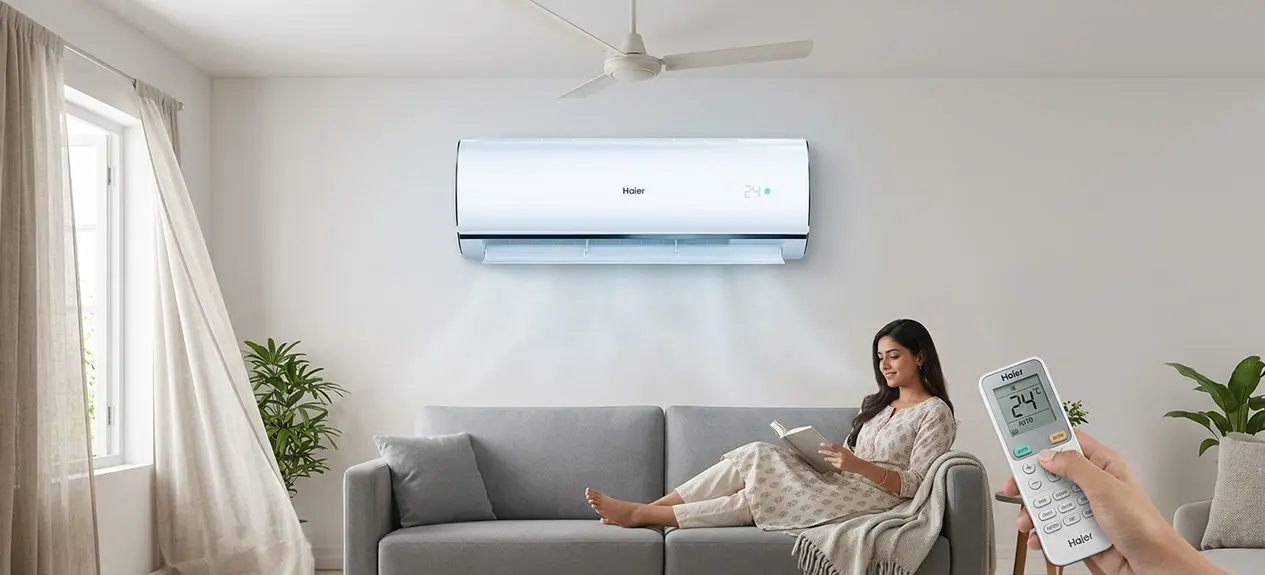

Before turning your AC down to 18°C, try setting it around 24°C and see how the room feels. A lower setting won’t necessarily cool the room much faster, but it can increase electricity use. If 24°C feels warm, lower it gradually until comfortable, instead of dropping it all at once.
Understanding the ideal AC temperature comes down to how cooling systems behave, what the Bureau of Energy Efficiency recommends, and a few smart adjustments that change your bill without touching your comfort.
What Is the Ideal AC Temperature?
In most Indian homes, especially in the warmer months, 24-26 degrees centigrade is the comfortable range. It’s easy to keep the room comfortable without overworking the air conditioner. It might feel good to get colder for a while, but it may lead to more energy use. The right setting is cooler, not unnecessarily cold.
People often search for what temperature to set the AC without realising the answer depends on more than personal taste. Room size, insulation, occupancy, and window direction shift the number by a degree or two. A shaded, north-facing bedroom cools faster than a west-facing living room catching afternoon sun. Even so, 24°C remains the sensible starting point.
Why 24°C Is the Recommended Setting (BEE)?
24°C may sound warmer than your usual AC setting, but it can make a real difference to energy use. The Bureau of Energy Efficiency has recommended 24°C as the default cooling temperature, based on energy data rather than personal preference. BEE estimates that every degree below 24°C can increase compressor load by around 6%.
That matters when the AC runs for hours, every day, through summer. The point is not to reduce comfort. A room set at 24°C can still cool quickly and feel comfortable once the temperature settles. Yet many people choose 18°C or 20°C out of habit, expecting faster cooling. It does not work that way. Once the room feels cool, those extra degrees offer little added comfort, while the electricity meter keeps counting. Small setting, noticeable difference.
Want the full breakdown of why 24°C works so well for Indian homes?
Read this blog: Why Setting Your AC to 24°C is the Key to Effective Cooling and Energy Savings
Temperature vs Electricity Bill
Your thermostat setting and your monthly bill are directly linked. Lower temperatures force the compressor to run longer and harder, while higher settings, within reason, let it rest more often. This single adjustment often separates a high bill from a manageable one.
1> How Each Degree Affects Consumption
BEE puts the number at roughly 6% additional power draw for every degree below 24°C. Run your AC at 18°C on a hot day, and you could pay nearly 35-40% more than at 24°C, for a comfort difference your body barely notices. This answers most searches for the best AC temperature for electricity savings: rarely extreme settings, mostly a sensible baseline held consistently.
2> Myth: A Lower Temperature Cools Faster
This is the most common misunderstanding about home cooling. Setting your AC to 16°C does not cool a room faster than setting it to 24°C. The compressor runs at the same speed regardless of target temperature, unless a dedicated turbo function is engaged. A lower setting only means the unit runs longer once the room already feels comfortable, chasing a number it never needed. Cooling speed depends on capacity, insulation, and airflow, not the dial.
Best AC Temperature for Different Situations
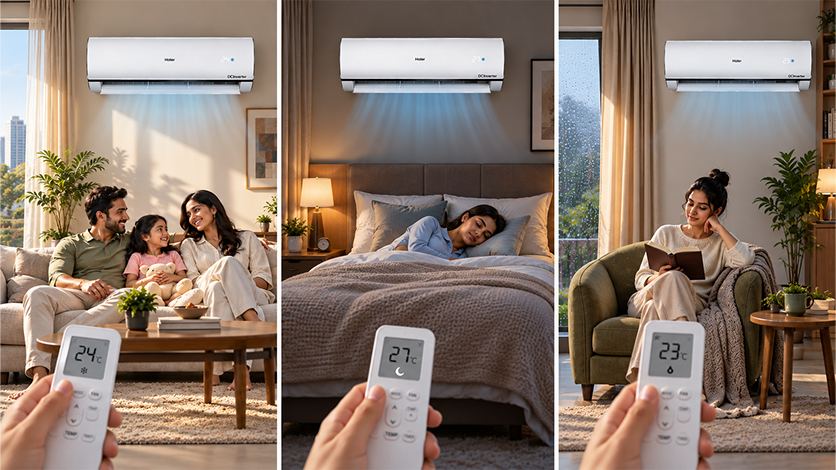
No single number suits every room, every time of day, or every season. Context changes what “ideal” really means.
- Daytime and Living Rooms
Shared spaces with more people, more sunlight, and frequent door movement need a firmer setting. 24°C to 25°C generally holds comfort through the hottest part of the day, especially in living rooms with large windows.
- Sleeping and Night Mode
Body temperature drops naturally during sleep, so rooms need not be as cold at night as during the day. The best AC temperature at night typically falls between 26°C and 28°C, paired with a sleep mode that gradually raises the setting further through the night. This mirrors how the body regulates heat and avoids the early-morning chill that sends people reaching for a blanket.
- Humid vs Dry Weather
Humidity changes how a temperature feels on your skin. 24 °C in a room can feel damp and not crisp in monsoon months. This is because the moisture in the air reduces sweat evaporation. In humid stretches, dry mode, run around 23°C, often handles comfort better than straight cooling. In drier months, 25°C to 26°C feels just as comfortable with less strain on the compressor.
Comfort vs Savings: Finding Your Balance
The debate between 24 vs 26 degrees AC settings comes down to how much comfort you trade for a lower bill, and the answer is barely any. Balance here does not mean sacrificing comfort. It means recognising where a colder setting stops adding real benefit.
| 24°C | 26°C | |
| How it feels | Comfortably cool, the common default | Still cool, closer to neutral once adjusted |
| Power consumption | Higher compressor load | 10-12% lower over a billing cycle |
| Best suited for | Daytime, peak heat, living rooms | Night, humid stretches, longer runtime |
| Noticeable comfort difference | Minimal once the body adjusts | Minimal once the body adjusts |
For most Indian households, 24°C during the day and 26-27°C at night hits that balance without anyone noticing.
Tips to Save Electricity Beyond Temperature
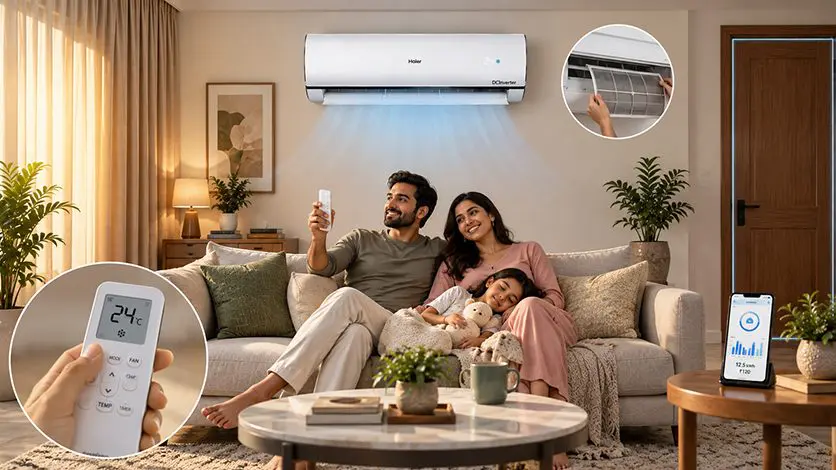
Temperature is one lever. It is not the only one.
- Keep fan speed on auto or medium instead of high, since the compressor does the real cooling work.
- Service filters and coils every few months, since dust buildup forces the compressor to work harder.
- Block direct sunlight with curtains during peak afternoon hours, especially on west-facing windows.
- Seal gaps around doors and windows so cooled air stays inside.
- Use a timer or sleep mode instead of running the unit all night at one fixed setting.
- Track actual consumption through an app rather than guessing at the bill each month.
Ideal Temperature Quick Guide
| Situation | Recommended Setting |
| Daytime / Living Room | 24°C to 25°C |
| Sleeping / Night | 26°C to 28°C |
| Humid Weather | 23°C to 24°C with Dry mode |
| Peak Summer Afternoon | 24°C |
The Haier Approach to Smarter Cooling
Your AC should adapt to your routine, not make you adjust it all day. Our AI Climate Control learns your household’s cooling preferences within the first seven days, picking up preferred modes and usage patterns. It then changes cooling automatically as the day moves on. Mornings, hot afternoons, evenings and nights each get suitable settings. There is no need to keep checking the remote. The system handles those changes, while you stay comfortable with less effort.
Our 7-in-1 Intelli Convertible technology matches capacity to the situation instead of running one fixed level. Summer Comfort runs full capacity for peak heat, Monsoon Comfort drops to 75% for humid stretches, Child Comfort holds at 55% for rooms with kids or the elderly, and Sleep Comfort trims airflow further for quiet rest. A bedroom at night and a living room at 3 PM are different cooling problems, and this treats them that way.

For anyone chasing the best AC temperature for electricity savings, our AI Eco mode delivers up to 56% more efficiency than conventional usage by continuously sensing room conditions and adjusting output instead of holding one static level. Paired with AI Electricity Monitoring in the Hai Smart App, users see real-time consumption in kWh and rupees, so savings show up on screen.
Our Triple Inverter+++ technology, built on PID inverter control, holds room temperature within ±0.1°C once it reaches the target, cutting the wasteful on-off cycling that comes from overshooting and undershooting. For larger living spaces, our Spartan Tower AC and Gravity Series models extend the same convertible technology to bigger rooms, where a standard split unit can struggle to hold consistent cooling.
None of this replaces good habits such as sealing windows or servicing filters. It works alongside them, so the technology and the small daily choices pull in the same direction.
Conclusion
The ideal AC temperature is not a fixed number carved in stone. It shifts with the room, the season, the time of day, and who is in the house. What stays constant is the principle: sensible settings around 24°C to 26°C deliver comfort that barely differs from colder extremes, while cutting consumption in a way that adds up over a full season. Pair that baseline with technology that adjusts automatically, and comfort versus savings stops being a real trade-off.
FAQs
What is the ideal AC temperature?
For most Indian homes, 24°C is considered the ideal baseline. It balances comfort with efficient power consumption, matches BEE’s recommended default, and keeps the compressor from overworking, unlike lower settings that add unnecessary strain and expense.
What AC temperature saves the most electricity?
Higher settings within a comfortable range save the most electricity. Around 24°C to 26°C meaningfully reduces compressor load compared to 18°C or 20°C, since every degree below 24°C adds roughly 6% more power consumption, per BEE data.
Is 24 degrees good for an AC?
Yes, 24°C is widely recommended as the optimal setting. It keeps rooms comfortably cool without overworking the compressor, aligns with BEE guidelines, and avoids the unnecessary energy draw that comes with chasing colder, barely noticeable temperature differences.
What is the best AC temperature for sleeping?
Between 26°C and 28°C works best for sleep, since body temperature naturally drops at night. Pairing this with sleep mode, which gradually raises the setting further, prevents the early-morning chill that often disturbs rest.
Does a lower AC temperature cool the room faster?
No, this is a common misconception. The compressor runs at the same speed regardless of the target temperature, unless a turbo function is engaged. A lower setting only means the unit runs longer once the room already feels comfortable.
What temperature should I set my AC to reduce the bill?
Setting your AC to 24°C rather than 18-20°C meaningfully reduces your bill. Combined with regular servicing, sealed windows, and auto fan speed, this single change often creates the biggest visible difference across a full billing cycle.
Is 26 degrees cold for an AC?
26°C is not considered cold, but comfortably cool for most Indian conditions, especially at night or in humid weather. It stays close to thermal neutrality for the human body indoors, while using noticeably less power than colder settings.