
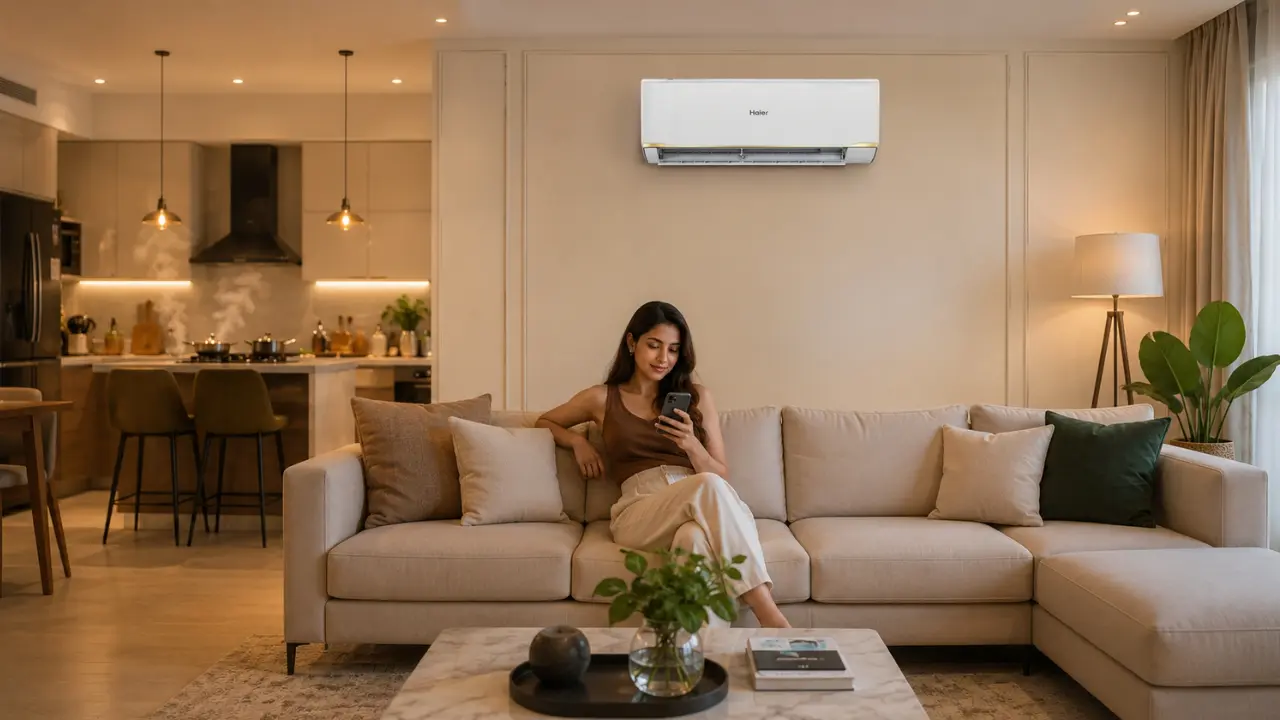

Proper cooling capacity is what separates real comfort from constant adjustment.
Choose it right, and your room cools evenly, quietly, and efficiently. Choose it wrong, and you spend every summer tweaking settings, waiting longer, and paying more than you should.
Why does your AC feel inconsistent even when it’s “working”?
It is a familiar scene.
You switch on the AC after stepping into a warm room.
Sometimes it takes forever to cool.
Sometimes it cools too fast, then suddenly stops.
Sometimes one corner feels perfect, the other still warm.
Same room. Same machine. Different experience.
This is not randomness.
This is the cooling capacity at work.
Cooling capacity is not a feature. It is the foundation.

Most people focus on star ratings, smart controls, or design.
Important. But secondary.
Cooling capacity decides whether those features even matter.
In simple terms:
- Cooling capacity is how much heat your AC can remove
- It is measured in tons
- It defines how effectively your room reaches and maintains comfort
The Bureau of Energy Efficiency in India recommends capacity based on room size. Globally, ASHRAE standards suggest about 20 BTU per square foot as a baseline.
But here is the real insight:
Capacity is not about size. It is about matching effort to need.
The hidden system behind every room
A room is not just a space.
It is a heat system.
And every system has inputs.
Three forces that decide your cooling needs
- External heat load
- Direct sunlight through windows
- Top-floor exposure
- Poor insulation
- Internal heat generation
- People in the room
- Devices like laptops, TVs, lights
- Kitchen proximity
- Air dynamics
- Door usage
- Ventilation leaks
- Ceiling height
Cooling is not about temperature. It is about managing heat flow.
Miss this, and capacity decisions become guesswork.
What happens when your AC capacity is too low?
An undersized AC is always working. It is rarely succeeding.
What you experience
- Slow cooling even after long usage
- AC running continuously without pause
- Hot patches in the room
What it costs you
- Higher electricity bills
- Faster wear on compressor
- Reduced lifespan
The system keeps chasing a finish line it cannot reach.
What happens when your AC capacity is too high?
This is where most people overcorrect.
They think: bigger AC, better cooling.
But systems do not work like that.
An oversized AC cools quickly. Then it fails quietly.
What actually happens
- The AC shuts off too soon
- Humidity remains high
- Cooling feels uneven
The hidden cost
- Frequent start-stop cycles damage components
- Electricity usage spikes in bursts
- Comfort becomes inconsistent
Fast cooling is not efficient cooling. It is incomplete cooling.
Right capacity is about balance, not extremes
Think of making tea.
Too little milk, it feels thin.
Too much milk, it loses flavour.
The right proportion makes it feel just right.
Cooling works the same way.
Perfect capacity does not feel powerful. It feels invisible.
How to choose the right cooling capacity
Start simple. Then refine.
| Room Size (sq. ft.) | Ideal Capacity |
| Up to 120 | 1 Ton |
| 120 to 180 | 1.5 Ton |
| 180 to 260 | 2 Ton |
But this is only step one.
Now layer real-life conditions
- Add capacity for direct sunlight exposure
- Add capacity for top-floor rooms
- Add capacity for higher occupancy
“Correct tonnage is not just about area. It must reflect heat load and usage patterns.”
That is where most decisions go wrong.
What if capacity could adjust itself?
This is where modern AC systems change the game.
Instead of locking you into one capacity, they adapt.
Take the Haier 1.8 Ton 5 Star Desert Rose Air Conditioner (HSA20DSD-NAI5NB-I).
It is built for flexibility, not rigidity.
What makes it different
- 7-in-1 Convertible Cooling adjusts capacity from 40% to 110% based on need
- It learns usage patterns and adjusts automatically
- It prevents both overcooling and undercooling
Capacity becomes dynamic. Not fixed.
That is the shift modern homes need.
When cooling becomes intelligent
Today’s ACs are not just cooling devices.
They are decision systems.
For instance:
- AI Human Detection avoids energy waste when no one is in the room
- AI Climate Control adapts to weather and indoor conditions in real time
- AI ECO Mode can deliver up to 56% energy savings by optimising usage
This changes the role of capacity.
You do not choose once. The system keeps choosing better.
Why this matters more in Indian homes
India is not a single climate story.
It is many.
- North India faces extreme dry heat
- Coastal cities deal with humidity
- Urban homes trap more heat due to dense construction
That is why ACs that:
- Cool efficiently even at 60°C ambient temperature
- Deliver long air throw up to 20 metres for uniform cooling
become practical, not premium.
Because real homes are complex.
Three ways people make capacity decisions

One option is: Follow standard charts
- Simple and quick
- Works for average rooms
- Limitation: ignores real usage patterns
The second option is: Oversize for safety
- Feels like a safer choice
- Delivers quick cooling
- Cost: inefficiency and discomfort
The third option is: Choose adaptive systems
- Uses convertible or AI-driven ACs
- Adjusts capacity in real time
- Result: balanced comfort and efficiency
The third option is where smart homes are heading.
Because adaptability beats assumption.
Cooling capacity is really about energy behaviour
Every mismatch shows up in your electricity bill.
Undersized AC
- Runs longer
- Consumes more power
- Struggles continuously
Oversized AC
- Starts and stops frequently
- Wastes energy bursts
- Reduces system life
Right or adaptive capacity
- Maintains steady cooling
- Optimises energy use
- Extends appliance life
Efficiency is not about using less power. It is about using the right amount at the right time.
A quick decision checklist
Before choosing your AC, ask:
- What is the exact room size?
- How much sunlight enters daily?
- How many people use the room regularly?
- Are doors and windows sealed well?
- Is the room used continuously or occasionally?
Answer these, and the right capacity becomes obvious.
Ignore them, and every choice feels uncertain.
The deeper insight: Comfort is a system outcome
Cooling capacity is not just technical.
It shapes daily life.
- Better sleep at night
- Less fatigue after work
- Stable indoor comfort during peak summer
A poorly matched AC does the opposite.
And often, you do not realise why.
Because discomfort rarely announces itself. It accumulates quietly.
Conclusion: The best cooling system is the one you stop noticing
People remember brands. Designs. Prices.
But the real decision sits deeper.
Cooling capacity defines everything that follows.
Choose it well, and your AC fades into the background.
No constant adjustments. No second thoughts.
Just consistent comfort.
Start with your space. Let the system do the rest
Before you buy your next AC, step back.
Observe your room. Understand how it heats up. Notice how you use it.
Then explore systems like the Haier 1.8 Ton 5 Star Desert Rose Air Conditioner (HSA20DSD-NAI5NB-I) that adapt to those realities instead of forcing you to adjust.
Because the goal is not more cooling.
The goal is effortless cooling that fits your life.
Frequently Asked Questions
How do I know what AC tonnage I actually need for my room?
Start with your room size, then factor in sunlight exposure, floor level (top floors get hotter), number of occupants, ceiling height, and heat from appliances like TVs or laptops.
I’m confused between 1.5 ton and 2 ton AC which one should I choose?
Go for a 2 ton AC only if your room is larger than average, gets intense sunlight, is on the top floor, or has a higher heat load. Bigger isn’t always better.
Should I buy a bigger AC just to be safe?
No. An oversized AC cools too quickly, shuts off early, and often leaves humidity behind making the room feel uncomfortable.
My room is around 150 sq. ft. Is 1.5 ton enough?
Yes, in most cases. But consider a higher capacity if the room gets strong sunlight, has multiple occupants, or lacks proper insulation.
I don’t want to keep adjusting my AC all summer. What should I look for?
Choose an AC with the right capacity, convertible cooling, AI climate control, and adaptive features that adjust automatically to room conditions.
Do convertible ACs really help with wrong capacity problems?
Yes. Convertible ACs can adjust their cooling capacity based on demand, helping avoid overcooling or undercooling.
What does 7-in-1 convertible cooling mean for my daily use?
It means the AC can run at multiple capacity levels instead of a fixed output, giving you flexibility depending on weather and usage.
How does AI climate control help in an AC?
It automatically adjusts cooling based on room temperature, humidity, and usage patterns, reducing the need for manual changes.
Is AI human detection useful or just a gimmick?
It can be useful. It helps save energy by reducing cooling when no one is in the room.
Why would an adaptive AC be better for Indian homes?
Because Indian conditions vary widely extreme heat, humidity, top-floor exposure, and dense construction. Adaptive ACs handle these changing conditions more efficiently.