

Sound is not just what you hear. It’s how you feel for a moment. KEF Audio technology brings clarity, depth, and direction to sound, turning everyday TV watching into an immersive experience where every voice, beat, and movement feels real, precise, and emotionally engaging.
Why does sound matter more than we think?
Picture this.
It’s a Sunday evening. India vs Pakistan. The room is full. Snacks are ready. The screen is big.
But something feels off.
The crowd noise is flat. The commentator sounds distant. The six that just got hit doesn’t land.
The picture is perfect. The experience isn’t.
That’s the hidden truth.
Visuals attract attention. Sound creates emotion.
Sound is not an add-on. It is the story.
What exactly is KEF Audio Technology?
KEF is not a TV brand.
It is a sound engineering legacy.
Founded in the UK, KEF has spent over 60 years refining how sound behaves in real spaces. Not studios. Not labs. Real rooms.
The goal is simple.
Make sound travel the way it does in real life.
When KEF Audio is integrated into TVs, it brings three core shifts:
- Precision: Voices sound like they are coming from the actor, not the speaker
- Depth: Bass feels grounded, not artificial
- Clarity: Every layer of sound becomes distinguishable
In Haier TVs, this integration translates into richer, more detailed audio performance.
The invisible system behind great sound
Most people think sound is about volume.
It isn’t.
It is about structure.
Three layers define how we hear sound
- Source clarity
The original sound signal. Dialogue, music, ambient noise. - Speaker design
How sound is distributed. Direction, balance, and spacing. - Room interaction
How sound reflects off walls, furniture, and space.
KEF focuses on all three.
That is why even at moderate volume, the experience feels fuller.
Loud sound fills a room. A good sound fills your attention.
How KEF transforms everyday TV moments
Let’s break this down into real-life scenarios.
1. Dialogue clarity during shows
You know this frustration.
Volume up. I still can’t hear the dialogue. Background music is overpowering.
KEF addresses this by separating frequencies more intelligently.
Result:
- Voices stay sharp
- Background sounds stay supportive
- No constant volume adjustments
2. Cricket and sports viewing
A stadium is not just visuals.
It is layers:
- Crowd noise
- Bat impact
- Commentary
- Ambient tension
With KEF-powered systems, these layers remain distinct.
Haier TVs with KEF Audio use multi-channel speaker setups like 2.1 channel systems with dedicated bass output, enhancing immersion.
3. Movie nights at home
Cinema is designed for surround sound.
Most TVs flatten it.
KEF, combined with technologies like Dolby Atmos, recreates spatial audio where sound moves around you, not just at you.
You stop watching the movie. You enter it.
What makes KEF sound different from standard TV audio?
Here’s a simple comparison.
| Feature | Standard TV Audio | KEF Audio Integration |
| Sound Direction | Flat, front-facing | Multi-dimensional |
| Bass | Weak or artificial | Deep and controlled |
| Dialogue | Often unclear | Crisp and focused |
| Sound Separation | Blended | Layered and distinct |
| Immersion | Limited | Cinematic |
Standard sound tells you what’s happening. The KEF sound makes you feel it.
The role of speaker architecture in KEF systems
Sound quality is not just software.
It is hardware.
Three design principles KEF brings into TVs
- Driver alignment
Ensures sound waves reach your ears simultaneously - Balanced frequency output
No overpowering bass or sharp treble - Dedicated channels
Systems like 2.1 channel or even 6.2.2 channel setups create depth
For example, higher-end Haier models use advanced speaker configurations that distribute sound horizontally and vertically, creating a true 3D audio field.
This is not a louder sound.
This is a smarter sound.
How KEF works with Dolby Atmos and modern audio tech
KEF does not work alone.
It works with ecosystems.
Key technologies that enhance KEF sound
- Dolby Atmos
Adds vertical sound layers. Rain feels like it’s falling above you. - DTS-X and Total Sonic systems
Improve spatial mapping and clarity - AI Sound Optimization
Adjusts audio based on content type
In Haier’s AI-powered TVs, sound and visuals are processed together, creating synchronized experiences across gaming, movies, and live TV.
When sound and visuals align, immersion becomes effortless.
Three ways Indian homes experience sound differently
Every home is different.
So is how sound behaves.
One option: Compact apartments
- Limited space
- Sound reflections from walls
- Need balanced output
Best fit: Controlled bass and clarity focused systems
Second option: Family living rooms
- Mixed seating positions
- Multiple viewers
- High usage for TV and OTT
Best fit: Multi-directional sound with strong dialogue clarity
Third option: Premium home setups
- Large rooms
- Dedicated entertainment zones
- Focus on cinematic experience
Best fit: Advanced multi-channel systems like 6.2.2 setups
Sound is not one-size-fits-all. It adapts to how you live.
The hidden cost of ignoring sound quality
Most buyers focus on:
- Screen size
- Resolution
- Smart features
Sound becomes an afterthought.
Here’s what that costs:
- Reduced engagement
You watch less, scroll more - Constant adjustments
Volume up and down during scenes - Missed detail
Background storytelling gets lost
It is like buying a luxury car with average speakers.
It works. But it never excites.
How Haier brings KEF into everyday homes
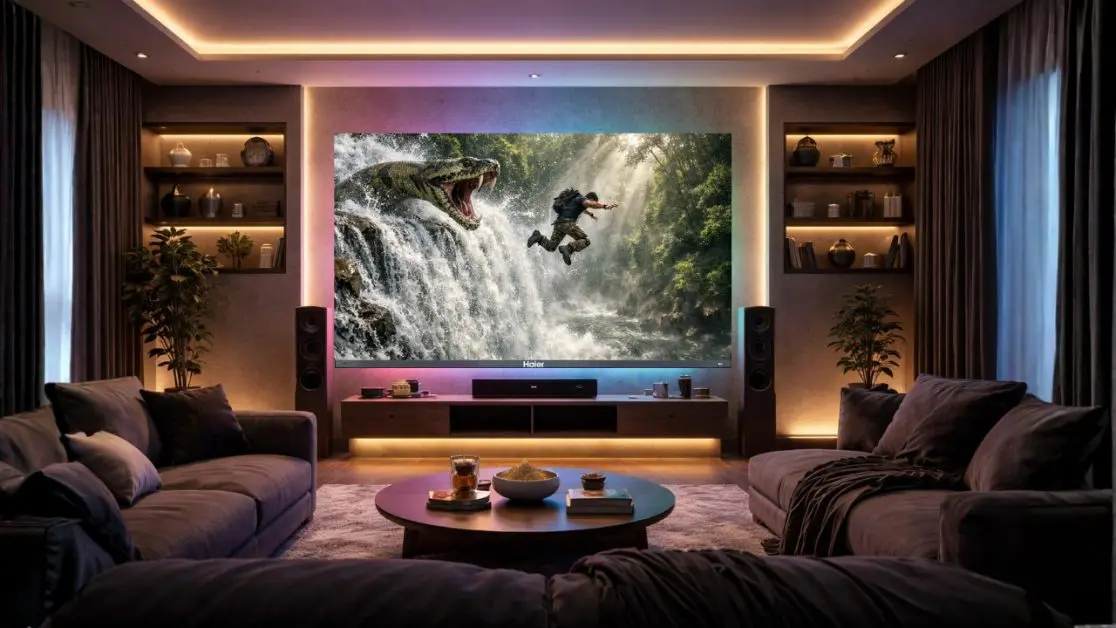
This is where things shift.
Haier integrates KEF Audio into its premium TV lineup, including models like:
- Haier M80F Mini LED 215 cm (85) Google TV
- Haier M92 Series QD-Mini LED AI Smart Google TV
- Haier M96 Series 254 cm (100) QD-Mini LED AI Smart Google TV
These TVs combine:
- KEF sound engineering
- Dolby Atmos spatial audio
- AI-based sound optimization
- Multi-channel speaker systems
The result is simple.
You don’t need a separate sound system to feel immersed.
A simple framework to choose the right sound experience
If you are thinking about upgrading your TV, start here.
Ask three questions
- What do you watch most?
Sports, movies, or daily TV - How big is your space?
Small room or open living area - What frustrates you today?
Low volume, unclear dialogue, weak bass
Then map your needs
- If dialogue is your issue → prioritize clarity
- If immersion matters → look for multi-channel sound
- If bass feels weak → check for dedicated woofers
Good buying decisions start with better questions.
The bigger idea: Sound is emotional infrastructure
We don’t talk about this enough.
Sound shapes how we remember moments.
- The cheer during a last-over win
- The background score of a late-night movie
- The laughter track during a sitcom
These are not just sounds.
They are emotional cues.
Sound is not heard. It is stored.
So what does this mean for how we choose?
It means we stop thinking in specs alone.
We start thinking about experiences.
Because in the end:
- A bigger screen impresses guests
- Better sound changes how you feel every day
And that is the real shift.
Great sound doesn’t ask for attention. It earns it quietly.
Frequently Asked Questions
I always focus on screen size and resolution… Am I making a mistake by ignoring sound?
Yes, you’re missing half the experience. Visuals grab attention, but sound creates emotional engagement. Poor audio can make even a stunning picture feel flat.
Do I really need premium audio like KEF Audio on my TV?
If you care about clarity, immersion, and not constantly adjusting volume then yes. It’s not about luxury, it’s about consistency and realism.
Is built-in TV sound ever enough, or do I always need a soundbar?
With TVs integrated with KEF (like Haier premium models), built-in sound can be powerful enough to skip external systems for most users.
What does AI sound optimization actually do?
It adjusts sound profiles automatically depending on content sports, movies, or news so you don’t manually tweak settings.
Is Dolby Atmos really noticeable on a TV?
Yes, especially with proper speaker design. It creates height and movement, making the sound feel like it surrounds you.
How does KEF work with modern audio tech?
KEF handles the hardware precision, while technologies like Dolby Atmos and DTS-X handle spatial processing. Together, they create immersive output.