
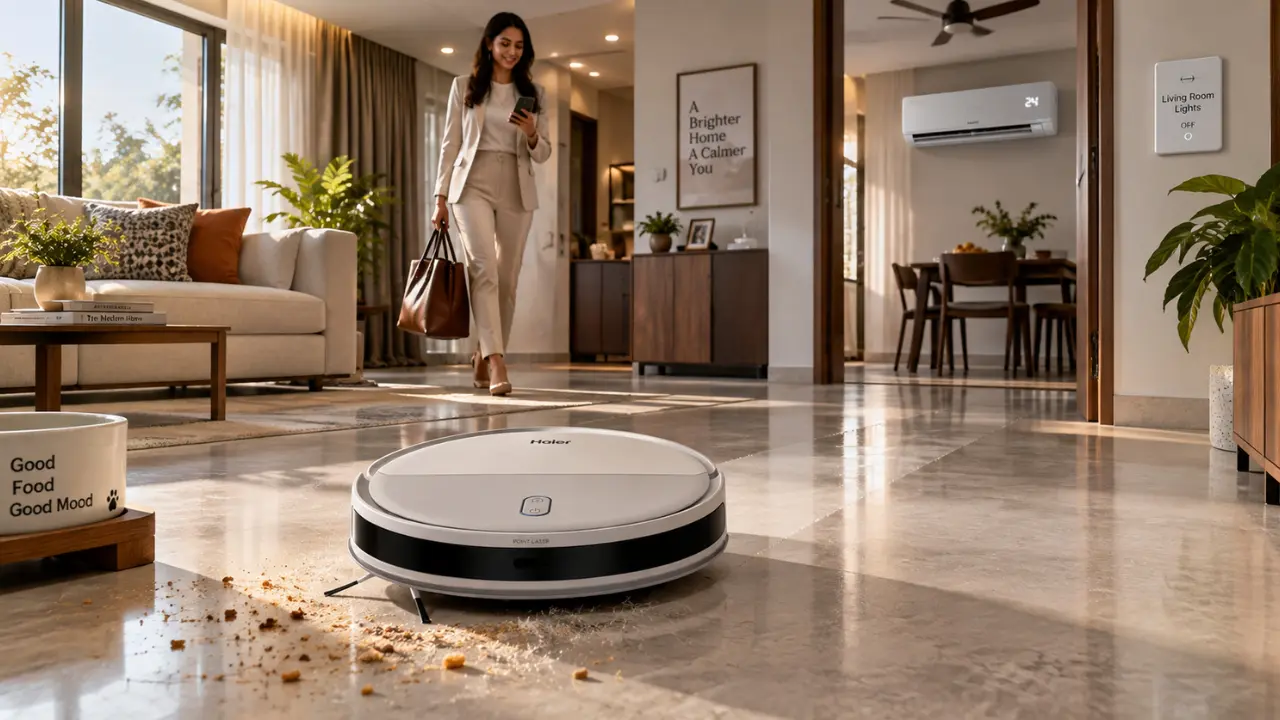

There is a small but important difference between a home filled with smart devices and a genuinely connected home.
The first has gadgets. The second has coordination.
That distinction becomes particularly noticeable with cleaning. Floors do not stay clean because somebody did one heroic Sunday-morning sweep. Dust returns. Hair collects along edges. Crumbs appear under the dining table. If there is a pet at home, well, the floor has its own schedule entirely.
This is where connected cleaning starts to make practical sense. A robot vacuum that can map rooms, follow schedules, respond to digital controls and manage routine cleaning with less supervision does more than automate one chore. It changes how cleaning fits into everyday life.
Haier’s CIVIC X11 and CIVIC X11 PRO Robot Vacuum Cleaners bring this thinking into Indian homes through laser navigation, multiple-map memory, 5000Pa suction, wet-and-dry cleaning capabilities and connected controls. The PRO model takes convenience a step further with an auto-empty dust box.
Connected Cleaning Is Really About Removing Repetitive Decisions
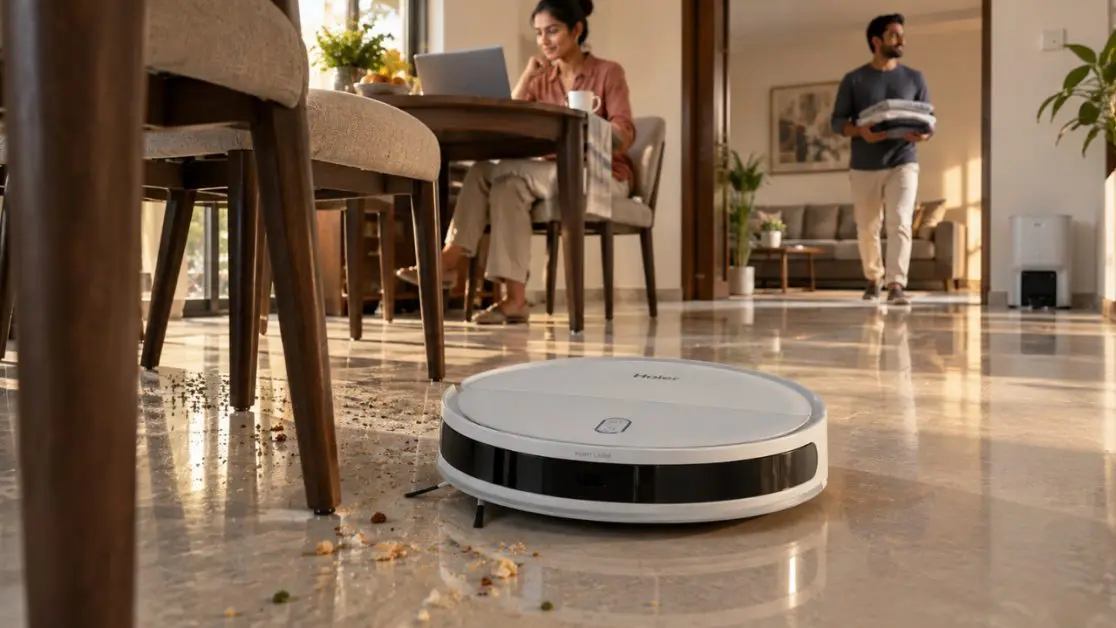
Consider what conventional floor cleaning involves.
Someone has to notice that the floor needs attention. Then find the vacuum or broom. Move through different rooms. Return later for mopping. Repeat the process when dust, crumbs or pet hair inevitably come back.
Smart cleaning devices approach the problem differently.
Instead of waiting for cleaning to become a visible task, connected devices can make routine maintenance more systematic. Mapping helps the cleaner understand the space. Scheduling decides when cleaning happens. Sensors support movement through the home. Connected controls let the user intervene when required.
In other words, intelligence is not simply in making a vacuum move by itself.
It is in reducing the number of times you have to think about making it move.
The Floor Map Becomes the Starting Point
A robot vacuum cannot clean intelligently if it simply wanders around hoping to cover everything.
That is why navigation matters.
Both the Haier CIVIC X11 and CIVIC X11 PRO use laser navigation, designed to support precise cleaning, obstacle avoidance and efficient floor coverage. Both models also feature five-map memory, enabling the cleaner to retain multiple mapped areas.
This becomes particularly useful in larger or multi-level Indian homes.
Think of a duplex where the ground floor contains the drawing room, dining area and kitchen, while bedrooms sit upstairs. Or a home where cleaning requirements differ between the living area and a pet-friendly section.
Rather than treating every cleaning run as completely new territory, map memory gives the device spatial context.
What does mapping contribute to connected cleaning?
It can help make cleaning:
- more systematic rather than random;
- suitable for different mapped areas of a home;
- easier to customise according to cleaning requirements;
- more efficient in navigating around obstacles;
- better suited to scheduled cleaning routines.
This is one of those features that may sound technical on a specification sheet but feels decidedly less technical when the cleaner is actually moving through the house without needing someone to guide it.
Then Comes the Actual Cleaning 5000Pa Makes a Difference
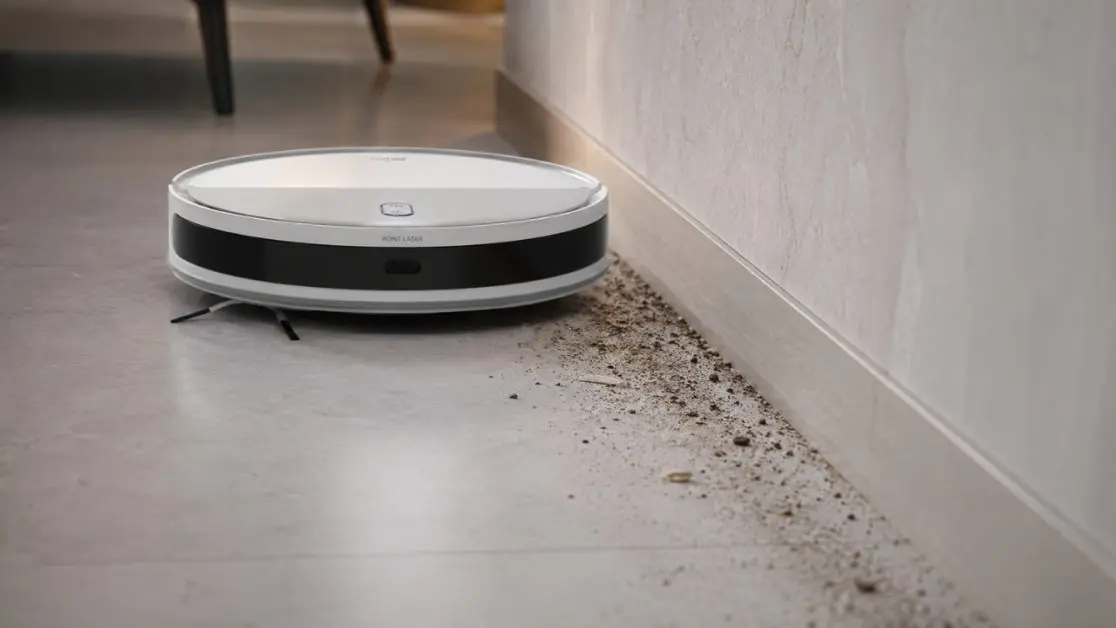
Connectivity would mean very little if the underlying appliance could not clean properly.
Both CIVIC models offer up to 5000Pa suction power. The CIVIC X11 product information specifies suitability across multiple floor types, including tiles, marble, hardwood, carpets, rustic flooring and linoleum.
That versatility matters in India because one home may contain several surfaces.
The living room could have marble. Bedrooms may use tiles or wooden flooring. A rug might sit beneath the coffee table. And the kitchen? That has its own collection of crumbs and fine particles by the end of the day.
The CIVIC X11 also combines mopping and sweeping in a 2-in-1 cleaning system, while product specifications for both models include wet and dry cleaning modes, a 250ml dust box and 300ml water tank.
That combination is important because connected cleaning should not create another chain of manual jobs afterwards.
Vacuum first, fetch something else, mop next that rather defeats the point.
The Interesting Part Happens When Cleaning Joins the Connected Home
A connected appliance becomes more useful when control is not tied to one physical button.
Haier’s CIVIC X11 and CIVIC X11 PRO support True IoT Control through mobile app, TV app, Google or Alexa, according to their product specifications. They also support scheduled or customised cleaning.
Picture an ordinary weekday.
Breakfast is finished, people are preparing for work or college, and the dining area has collected the usual evidence of a rushed morning. Instead of adding floor cleaning to an already crowded list, a scheduled cleaning routine can handle it at the chosen time.
Or perhaps guests are coming over and you notice the living-room floor needs another pass.
Connected control means the interaction can happen through the supported digital ecosystem rather than requiring you to physically start the appliance every time.
The product also shows voice control through Google Assistant and Alexa, allowing users to start, stop or schedule the robot vacuum through compatible voice commands.
And that is when “smart” begins feeling less like a label and more like convenience.
What Happens When the Robot Needs Power?
Automation tends to lose its charm rather quickly if somebody constantly has to rescue the appliance.
Both CIVIC models include auto-return-to-charge functionality. Their listed 2600mAh battery supports a runtime of up to 120 minutes, with a stated charging time of 240 minutes.
Multiple sensors, including anti-fall sensing, are also part of the system.
These details matter because autonomous cleaning depends on more than navigation. The cleaner needs to operate within the physical realities of a home: edges, furniture, different areas and battery limitations.
A useful smart appliance should demand less babysitting, not introduce a new kind of babysitting.
The CIVIC X11 PRO Pushes Automation One Step Further
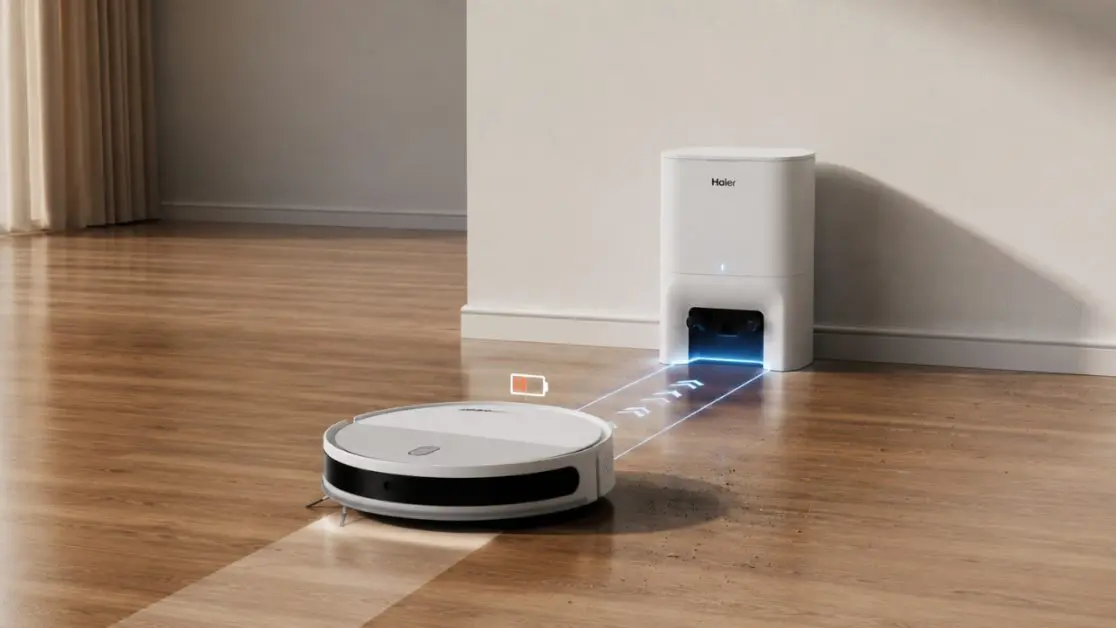
Here is where the two models separate.
The Haier CIVIC X11 PRO includes an auto-empty station, allowing the robot to automatically transfer collected dirt from its onboard dustbin into a larger dust box. Its specifications list dust capacities of 250ml and 3.5L.
It sounds like a relatively small upgrade.
In everyday use, though, this tackles one of the remaining manual interruptions associated with robot vacuuming: repeatedly emptying the onboard dust container.
The difference can be especially relevant for:
- homes where floor cleaning happens frequently;
- households with pets and recurring hair or dander;
- larger homes requiring longer cleaning routines;
- busy professionals who want fewer maintenance interventions;
- families trying to keep commonly used spaces routinely presentable.
The standard CIVIC X11 focuses on autonomous vacuuming and mopping with connected control. The CIVIC X11 PRO extends that proposition towards lower-intervention maintenance through its auto-empty station.
Pets Make a Pretty Convincing Case for Routine Automation
Anyone living with a dog or cat already knows this story.
You clean. The floor looks fine. A few hours pass. Somehow there is hair again.
Both CIVIC models are positioned for picking up pet hair and everyday pet-related messes. Combined with scheduled cleaning, this is precisely the sort of repetitive task where automation can be genuinely useful.
Rather than waiting for enough hair to accumulate that a full cleaning session becomes necessary, routine robot cleaning can help tackle the problem more regularly.
That changes the objective from cleaning a dirty floor to maintaining a cleaner one.
Subtle difference. Big practical effect.
What Should You Look for in a Connected Cleaning Device?
The phrase “smart appliance” gets used rather generously, so buyers should look beyond connectivity alone.
For a robot vacuum cleaner, practical intelligence should answer a few straightforward questions:
Can it understand space?
Laser navigation and map memory help provide the spatial awareness needed for structured cleaning.
Can it deal with different everyday floor conditions?
Suction performance, wet-and-dry capability and multi-surface suitability determine whether smart navigation actually leads to useful cleaning.
Can cleaning happen around your routine?
Scheduling and customised cleaning are what turn automation into something that works around household life.
Can you control it conveniently?
Mobile, TV and compatible voice controls provide different ways to interact with the appliance.
How much attention does it still demand?
Battery management, auto-return charging and, in the CIVIC X11 PRO, automatic dust emptying all influence how independent the cleaning process can become.
That last question is worth remembering. The best measure of useful home automation is often not how many features you interact with, but how many routine interventions you no longer need to make.
Haier CIVIC X11 or CIVIC X11 PRO: Where Does Each Fit?
The Haier CIVIC X11 brings together laser navigation, five-map memory, 5000Pa suction, simultaneous mopping and sweeping, connected controls, scheduling and up to 120 minutes of listed runtime. It suits households looking to move routine floor maintenance away from an entirely manual process.
The Haier CIVIC X11 PRO builds on that connected-cleaning approach while adding the auto-empty station. For users who place a higher value on reducing routine handling of collected dust, that addition becomes particularly meaningful.
Neither proposition is really about replacing the idea of home care with technology.
It is about deciding which repetitive parts of home care still need your time.
A Connected Home Should Give Time Back, Not Ask for More of It
Smart homes are becoming more interesting precisely because connectivity is moving beyond novelty.
A voice command is convenient. An app is useful. But the bigger benefit appears when navigation, mapping, scheduling, sensors, cleaning performance, charging behaviour and digital controls work as parts of one routine.
That is the direction represented by Haier’s CIVIC X11 and CIVIC X11 PRO Robot Vacuum Cleaners: intelligent floor cleaning designed to fit around the household rather than forcing the household to organise itself around cleaning.
And perhaps that is the better definition of a connected home.
Not a house where everything has an app.
A house where everyday things quietly require less effort.
Frequently Asked Questions
1. How do smart robot vacuum cleaners work in a connected home?
Smart robot vacuum cleaners combine navigation, sensors, mapping and connected controls to automate routine floor cleaning. The Haier CIVIC X11 and CIVIC X11 PRO support laser navigation, five-map memory, scheduled or customised cleaning and control through mobile app, TV app, Google or Alexa.
2. Can the Haier CIVIC X11 vacuum and mop at the same time?
Yes. The Haier CIVIC X11 features 2-in-1 mopping and sweeping, allowing it to perform both functions simultaneously. It supports wet and dry cleaning and comes with a 250ml dust box and 300ml water tank.
3. Can Haier robot vacuum cleaners remember different areas of a home?
Yes. Both the CIVIC X11 and CIVIC X11 PRO feature five-map memory. This can be particularly useful for homes where users want the robot vacuum to work across multiple mapped areas rather than treating every cleaning run as a completely new space.
4. What is the difference between the Haier CIVIC X11 and CIVIC X11 PRO?
Both models offer features such as laser navigation, 5000Pa suction, five-map memory, connected controls and a 2600mAh battery. A key difference is that the CIVIC X11 PRO includes an auto-empty station, which automatically transfers collected dust from the robot’s onboard dustbin into a larger dust box.
5. Can Haier CIVIC robot vacuum cleaners be controlled using voice commands?
Yes. The CIVIC X11 and CIVIC X11 PRO support voice control through Google and Alexa. Their specifications also list True IoT Control through a mobile app and TV app, giving users multiple ways to manage their cleaning routines.