
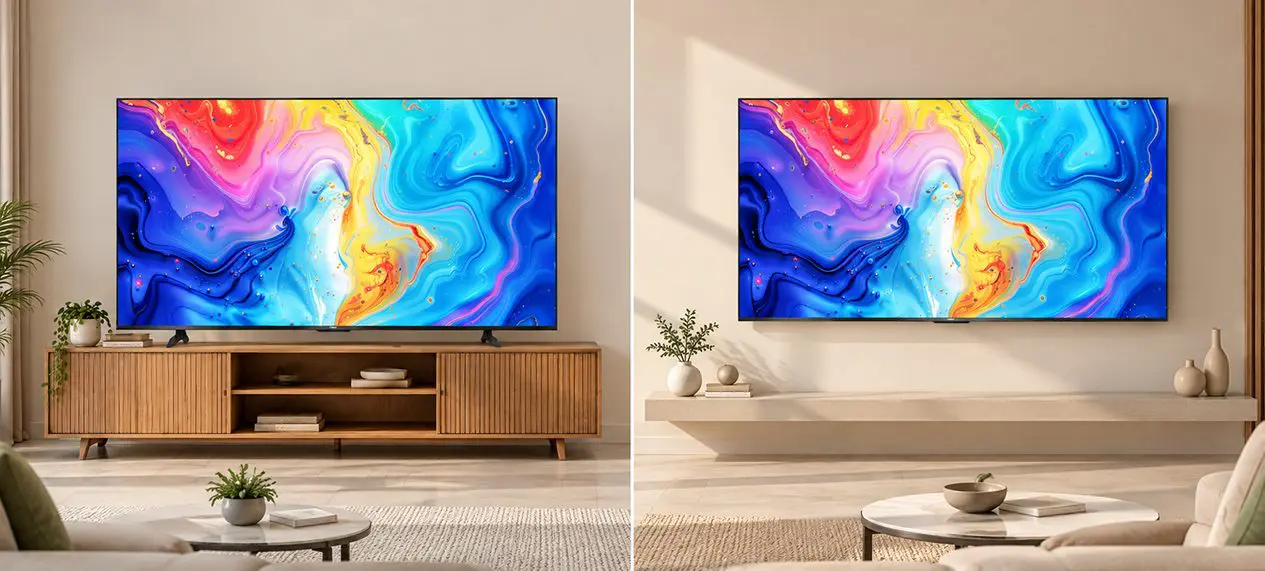

Once you have chosen a TV, the next real decision is how to place it. A TV floor stand vs wall mount choice shapes your room’s layout, viewing angle, and even your long-term maintenance routine.
Both options have genuine strengths, and neither is universally better. The right pick depends on your room, your wall type, whether you rent or own, and how often you plan to rearrange the space.
This guide breaks down the trade-offs, cost drivers, safety notes, and a simple decision framework, so you can settle the TV stand vs wall mount question for your own home with confidence.
Is It Better to Mount a TV or Use a Stand?
Neither option is a default winner. Wall mounting frees up floor space and gives a cleaner look, while a stand keeps the setup flexible and makes it easier to shift the TV around when the room layout changes.
Space, Safety and Room Layout
In compact rooms, a wall mount saves valuable floor area and often improves the viewing angle. A stand is safer in homes with young children or pets, since a wall-mounted TV can be pulled down, while a stand keeps the panel at a lower, more stable position
Flexibility, Height and Cable Management
A stand lets you move the TV between rooms or reposition it easily, which suits renters and anyone still deciding on their long-term layout. A wall mount fixes the height and viewing angle at installation, so it works better once the room layout is settled. Cables usually look cleaner on a wall mount, though a stand with a rear channel handles wiring well too.
TV Floor Stands: Pros and Cons
A TV floor stand is a freestanding metal or wooden structure that holds the TV upright without needing to be attached to a wall. It is a strong pick for rented homes, temporary setups, or rooms where drilling into the wall is not an option.
The main advantages of a best TV stand setup include:
- No wall damage or drilling required
- Easy to move between rooms or homes
- Adjustable height on many models
- Works with brick, drywall, or unfinished walls alike
The trade-offs to weigh:
- Takes up floor space in front of or against the wall
- Higher tipping risk if not weighted or anchored properly
- Fewer premium finishes compared to cabinet-style units
- Cable management usually needs a separate cover or channel
Are TV Floor Stands Good and Stable?
Are TV floor stands good for everyday use? For most homes, yes, provided you pick one rated for your TV’s screen size and weight. Look for a wide, weighted base, a VESA pattern matching your TV, and a load capacity rated at least 5 kg above your TV’s actual weight for a safety buffer.
For larger 55-inch and above panels, floor stands with a heavy metal base and a low centre of gravity are much safer than lightweight economy models.
Wall Mounts: Pros and Cons
A TV wall mount attaches the TV directly to the wall, freeing up floor space and delivering a cleaner, more integrated look. It is the popular choice for settled homes, dedicated TV walls, and rooms designed around the screen.
Main advantages:
- Saves floor space and improves the viewing angle
- Delivers a cleaner, more built-in look
- Cables can be routed inside the wall for a tidy finish
- Safer in homes where floor space is tight
Trade-offs to weigh:
- Needs a strong wall and permanent drilling
- Height and angle are fixed at install time
- Two-person installation is strongly recommended
- Difficult to reverse without visible wall damage
Fixed, Tilting and Full-Motion Mounts
The type of mount decides how much you can adjust the TV after installation:
- Fixed: the TV sits flat against the wall; lowest cost, no adjustment
- Tilting: allows a slight up-and-down angle, useful for higher placements
- Full-motion: extends, swivels, and tilts; ideal for corner setups or rooms with multiple seating zones
Full-motion mounts cost more but pay back in flexibility, especially in rooms where the seating is not always in the same spot.
Which Walls Can Safely Hold a TV?
Solid brick and concrete walls handle wall mounts safely, including large 55-inch and 65-inch panels. Drywall or hollow partition walls need stud-mounted brackets or additional reinforcement, and the safe load capacity should always exceed your TV’s actual weight by a comfortable margin.
Why Are TV Stands So Expensive?
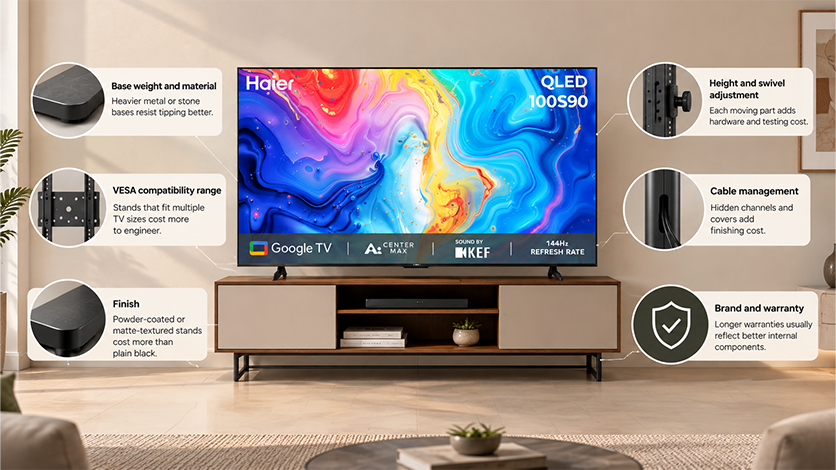
The cost of a premium TV stand is often driven less by the metal frame and more by finish quality, load rating, cable design, and brand markup. A well-built stand is engineered to safely hold a moving weight of 20 to 40 kg for years, and that engineering has a real cost.
Materials, Load Rating and Build Quality
The main cost drivers behind a well-priced stand:
- Base weight and material: heavier metal or stone bases resist tipping better
- VESA compatibility range: stands that fit multiple TV sizes cost more to engineer
- Height and swivel adjustment: each moving part adds hardware and testing cost
- Cable management: hidden channels and covers add finishing cost
- Finish: powder-coated or matte-textured stands cost more than plain black
- Brand and warranty: longer warranties usually reflect better internal components
You can find basic stands under ₹2,000, but a stand rated for a 55-inch panel, with adjustment and cable management, typically starts closer to ₹5,000 to ₹8,000.
Can a TV with a Stand Be Wall-Mounted?
Yes. Almost every modern TV that ships with a tabletop stand can also be wall-mounted, provided the panel has a standard VESA pattern at the back. The tabletop stand simply comes off, and a separate wall-mount bracket screws into the same VESA holes.
Confirm the VESA pattern on the product page or in the manual (commonly 200 x 200 mm for 43-inch models, 300 x 300 or 400 x 400 mm for 55-inch and 65-inch panels). You can also check Haier’s Google TV lineup, where each product page lists the VESA specification alongside dimensions and weight.
How to Choose Between a Stand and a Wall Mount?
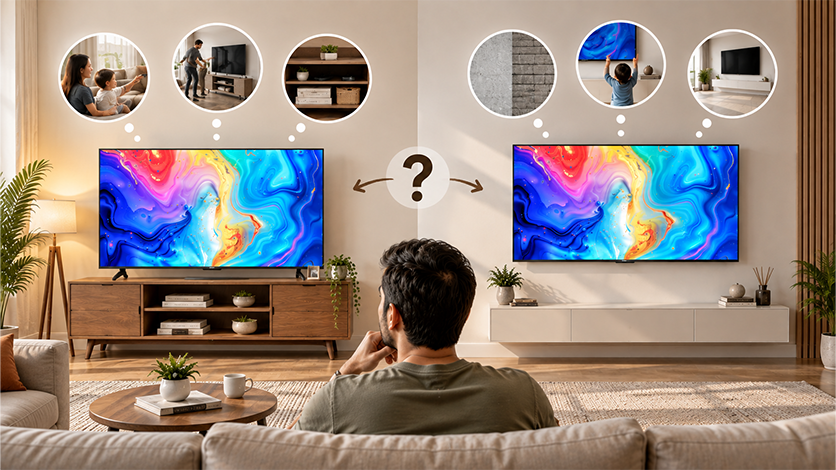
The wall-mount vs table-stand decision usually comes down to five practical questions. Answer them for your own home before you buy:
- Do you rent or own the space?
- Is the wall solid brick or concrete, or drywall?
- Are there young children or pets in the home?
- How often do you plan to rearrange the room?
- Do you want floor space free, or storage under the TV?
If you own the home, have a strong wall, and the layout is settled, wall mounting usually gives the cleaner result. If you rent, have soft walls, or expect to move soon, a good floor stand is often the smarter and safer choice.
Conclusion
Both wall mounts and floor stands have earned their place in Indian homes. One frees up floor space and looks built-in, while the other offers flexibility and works in almost any room without touching the wall.
The right choice comes down to your room, your wall, and your daily routine rather than a fixed rule. A little planning at the setup stage almost always pays back in years of trouble-free viewing.
FAQs
Is it better to mount a TV or use a stand?
Neither is universally better. Wall mounts save floor space and look cleaner, while stands offer flexibility, work on any wall type, and are safer in homes with young children or pets.
Are TV floor stands good?
Yes, when they are rated for your TV’s size and weight. Pick one with a wide, weighted base, matching VESA pattern, and a load capacity at least 5 kg above your TV’s actual weight.
Can a TV with a stand be wall mounted?
Yes. Almost every modern TV with a tabletop stand can be wall-mounted using a separate bracket that fits the TV’s VESA pattern at the back.
Is wall mounting a TV safe?
Yes, on brick or concrete walls, with a mount rated for more than your TV’s weight. Drywall or hollow partitions require stud-mounted brackets or reinforcement to safely support the load.
What is the difference between a fixed wall mount and a tilting wall mount?
A fixed mount holds the TV flat against the wall with no adjustment. A tilting mount allows a slight up-and-down angle, which helps when the TV is placed higher than eye level.
Do I need a professional to mount my TV?
For 43-inch and above, professional installation is strongly recommended. Larger panels are heavy and awkward to balance safely, and a poor mount can damage both the TV and the wall.