
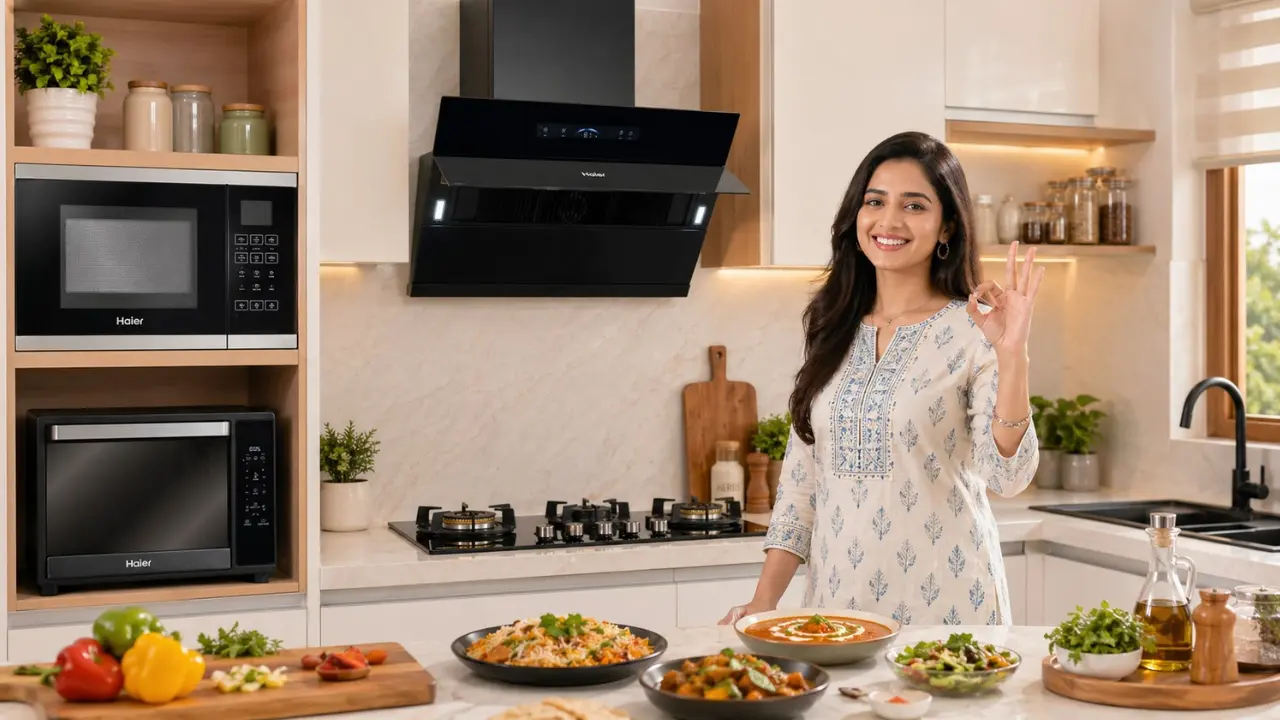

Kitchen appliances fall into three broad types: cooking, preparation, and cleaning. Choosing the right one depends on your lifestyle, kitchen size, and how often you cook.
The smartest choice is not the most advanced appliance. It is the one that reduces daily friction, saves time, and fits naturally into your routine.
Why does choosing kitchen appliances feel harder than it should?
It is Sunday evening.
The grocery bags are still on the counter. The sink is half full. The thought of cooking feels heavier than the actual cooking.
This is not a time problem.
It is a system problem.
Most Indian kitchens are built for effort, not efficiency.
You cook. You clean. You repeat.
Appliances change that equation. Not by doing more. But by removing decisions.
Good appliances do not add capability. They remove friction.
The three types of kitchen appliances that define modern kitchens
Every kitchen runs on three invisible systems.
1. Cooking Appliances: Where transformation happens
These are the heart of the kitchen.
They turn raw ingredients into meals.
Examples include:
- Gas stoves and hobs
- Microwave ovens
- OTGs
- Chimneys
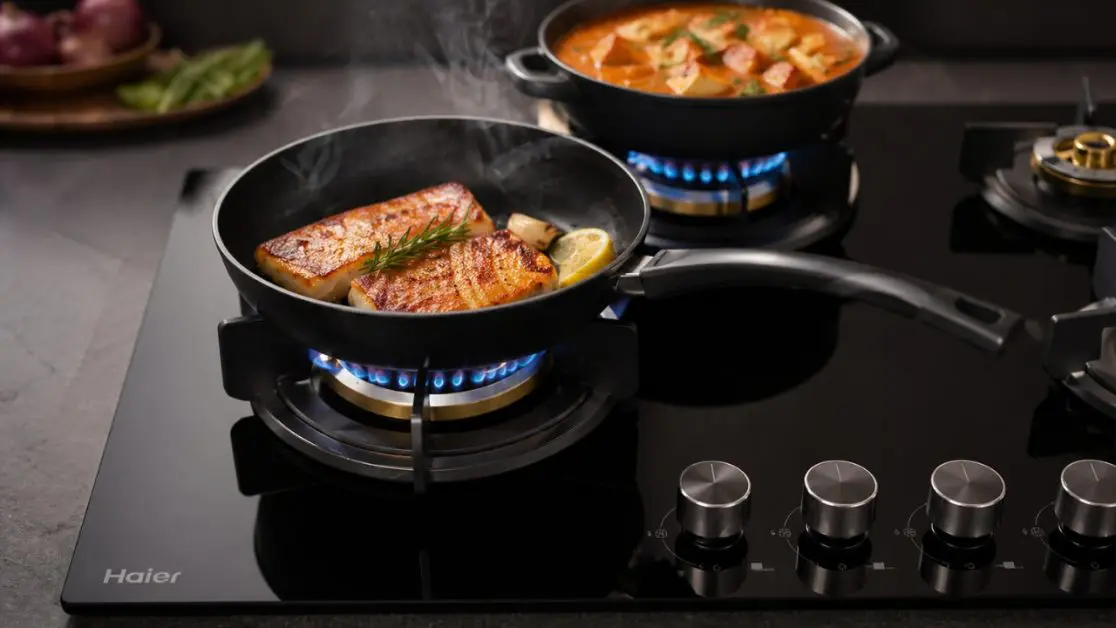
A modern hob is not just about flame. It is about control.
A Haier Auto Ignition Full Brass 5 Burner Hybrid Hob With Metal Knobs (HIC-Q89576F) removes the need for external lighters and gives precise heat zones.
That matters when you are making three dishes at once.
Similarly, a chimney is not just about removing smoke.
A Haier BLDC Chimney With 1650 M³H Suction Power Spin Clean Filterless (HIH-C1900-BLDC-IN) ensures your kitchen stays breathable even during heavy Indian cooking.
Because cooking here is layered. Continuous. Intense.
2. Preparation Appliances: Where time is saved
These appliances reduce effort before cooking begins.
They handle the repetitive parts.
Examples include:
- Mixers and grinders
- Food processors
- Electric kettles
- Blenders
Think of chopping onions for a week’s meals.
You can do it manually.
Or you can systematize it.
Preparation appliances compress time.
They turn 30 minutes into 5.
And in busy Indian homes, that difference compounds daily.
3. Cleaning Appliances: Where consistency is built
Cleaning is not hard.
Consistency is.
Examples include:
- Dishwashers
- Chimneys with auto-clean
- Self-clean ovens
A chimney with heat auto-clean technology melts grease buildup, reducing manual maintenance.
That is not a feature.
That is time returned.
Because most people do not quit cooking.
They quit cleaning.
The hidden system: Appliances are not products. They are workflows
Here is what most people miss.
They buy appliances individually.
But kitchens work as systems.
One appliance affects the other.
A simple example
- A powerful hob increases cooking speed
- Faster cooking creates more smoke
- More smoke requires a stronger chimney
If one part fails, the system slows down.
Efficiency is not about buying better products. It is about aligning them.
How to choose kitchen appliances that actually fit your life
Most buying guides talk about features.
But features do not cook meals.
Systems do.
Here is a better way to think about it.
Step 1: Define your cooking pattern
Not your aspiration. Your reality.
Three common patterns
1. Daily heavy cooking household
- 2 to 3 meals cooked daily
- Multiple dishes at once
- High oil and spice usage
What works:
- Multi burner hob like HIC-Q89576F
- High suction chimney like HIH-C1900-BLDC-IN
- Durable cookware systems
2. Light cooking or working professionals
- 1 meal daily or alternate days
- Reheating is frequent
- Convenience matters
What works:
- Microwave or grill microwave
- Compact appliances
- Low maintenance systems
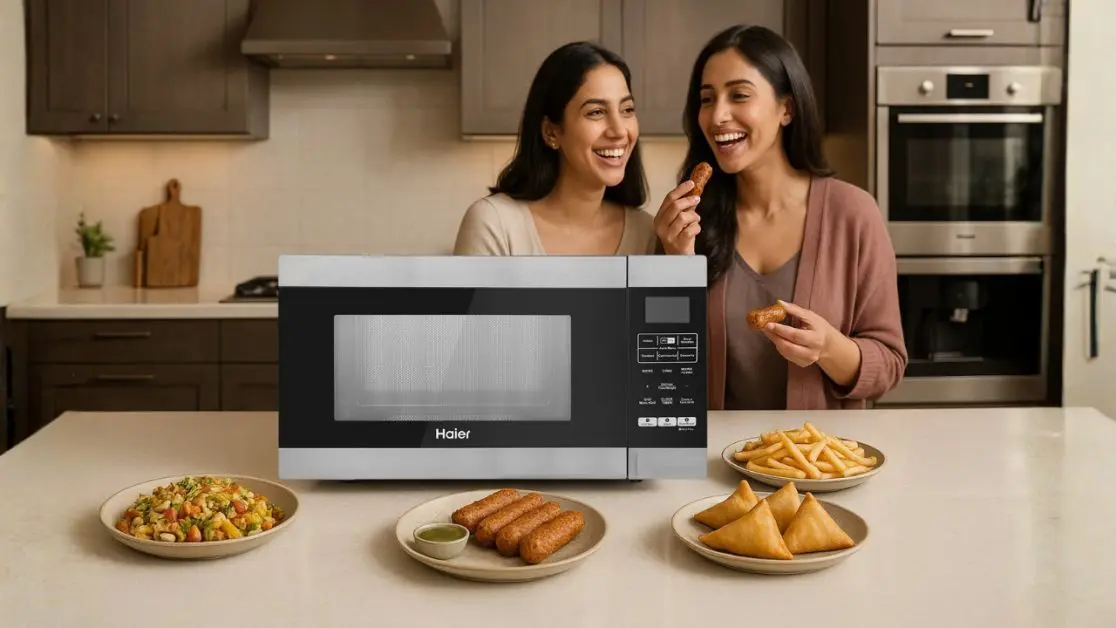
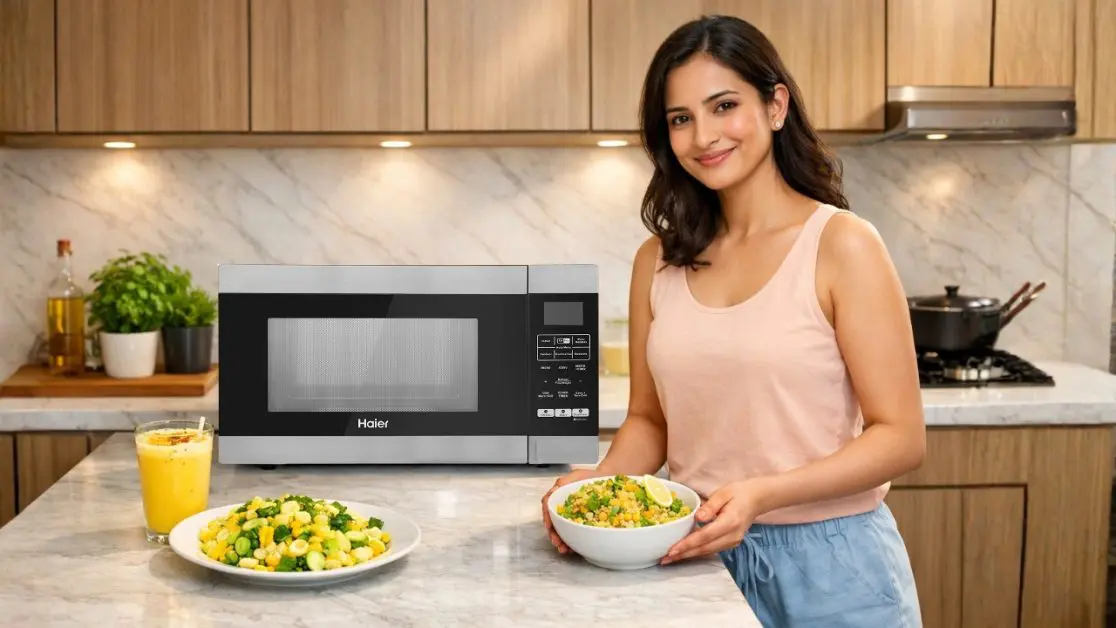
A Haier 20L Grill Microwave With Curvaceous Glass Door Design (HIL2002GSPB) allows cooking, browning, and baking in one cycle.
That is less switching. Less thinking.
3. Experimental or modern cooking
- Baking, grilling, trying new recipes
- Weekend cooking
- Hosting guests
What works:
- OTG with convection
- Rotisserie functions
- Larger capacity ovens
A Haier 35L OTG Microwave Oven (HILOTG3501GR) ensures even cooking and consistent grilling results.
Because experimentation needs control.
Step 2: Match appliances to kitchen size
Space is a constraint.
But constraints create clarity.
Small kitchens
- Prioritize multifunction appliances
- Avoid bulky installations
- Focus on vertical storage
Medium kitchens
- Balance between built-in and countertop
- Separate cooking and prep zones
Large kitchens
- Modular setups
- Dedicated appliances for each function
The rule is simple:
More space does not mean more appliances.
It means better organization.
Step 3: Evaluate cost vs value, not price
Price is immediate.
Value is cumulative.
A simple breakdown
| Appliance Type | Initial Cost | Long-term Benefit |
| Basic stove | Low | Limited efficiency |
| Advanced hob (HIC-Q89576F) | Medium | Faster cooking, precision |
| Chimney (HIH-C1900-BLDC-IN) | Medium | Saves cleaning time |
| OTG or microwave (HILOTG3501GR / HIL2002GSPB) | Medium | Expands cooking options |
The cost is what you pay once.
Friction is what you pay every day.
Step 4: Look for features that remove effort
Features often sound technical.
But their impact is simple.
Look for these
- Auto ignition for ease
- Convection for even cooking
- Multi power levels for flexibility
- Self-clean systems for maintenance
A microwave with multiple power levels and timed cooking, like HIL2002GSPB, allows better control across recipes.
That is not complexity.
That is adaptability.
The mistake most people make while buying kitchen appliances
They optimize for the wrong thing.
They optimize for features per rupee.
Instead of time saved per day.
Three common mistakes
1. Buying too many appliances
- Creates clutter
- Reduces usage
- Increases maintenance
2. Ignoring compatibility
- Mismatch between appliances
- Inefficient workflows
3. Overlooking maintenance
- High effort to clean
- Reduced long-term usage
A good appliance fits your life quietly.
A bad one demands attention constantly.
Why modern Indian homes are moving toward smarter kitchen systems
The shift is already happening.
- Dual income households are increasing
- Time for cooking is shrinking
- Convenience is becoming a priority
This is not about luxury.
It is about time economics.
Where Haier fits into this evolving kitchen system
Not as a product.
As a design philosophy.
The focus is simple.
Make appliances that:
- Reduce effort
- Save time
- Fit Indian cooking habits
A chimney like HIH-C1900-BLDC-IN with gesture control removes the need to touch panels while cooking.
A hob like HIC-Q89576F ensures consistent heat over years of use.
An OTG like HILOTG3501GR ensures uniform cooking without guesswork.
These are not features.
They are decisions made easier.
The real question is not what to buy. It is how you want your kitchen to feel
Calm or chaotic.
Effortless or exhausting.
Structured or reactive.
Because appliances shape behavior.
And behavior shapes daily life.
Final thought: A kitchen is a system. Design it like one
Most people think kitchens are about cooking.
They are not.
They are about flow.
Ingredients for preparation.
Preparation for cooking.
Cooking to cleaning.
When that flow works, everything feels easier.
When it does not, even simple meals feel heavy.
The best kitchen appliance is not the smartest one.
It is the one you forget is even there.
That is when a system is working.
Quietly. Consistently. Every single day.
Frequently Asked Questions
Why does buying kitchen appliances feel more exhausting than cooking itself?
Because you’re not just choosing a product you’re trying to fix a broken daily system. When your kitchen workflow is inefficient, every decision feels heavier. Appliances should reduce decisions, not add more.
I keep comparing features but still can’t decide. What am I missing?
You’re optimizing for specs instead of daily use. The right appliance is the one that saves you time every day, not the one with the longest feature list.
I avoid cooking because cleaning feels endless. What should I do?
Invest in cleaning appliances first. A dishwasher or auto-clean chimney removes the real barrier post-cooking fatigue.
Is a chimney really necessary in Indian kitchens?
Yes. Indian cooking generates heavy smoke and grease. A high-suction chimney keeps your kitchen breathable and reduces wall cleaning.
Are smart features like auto ignition or gesture control really useful?
Only if they remove friction. Auto ignition saves daily effort. Gesture control helps when your hands are messy. If a feature doesn’t simplify action, skip it.
How do I know if a feature is practical or just marketing?
Ask: Will this save me time or effort every day? If not, it’s optional.