
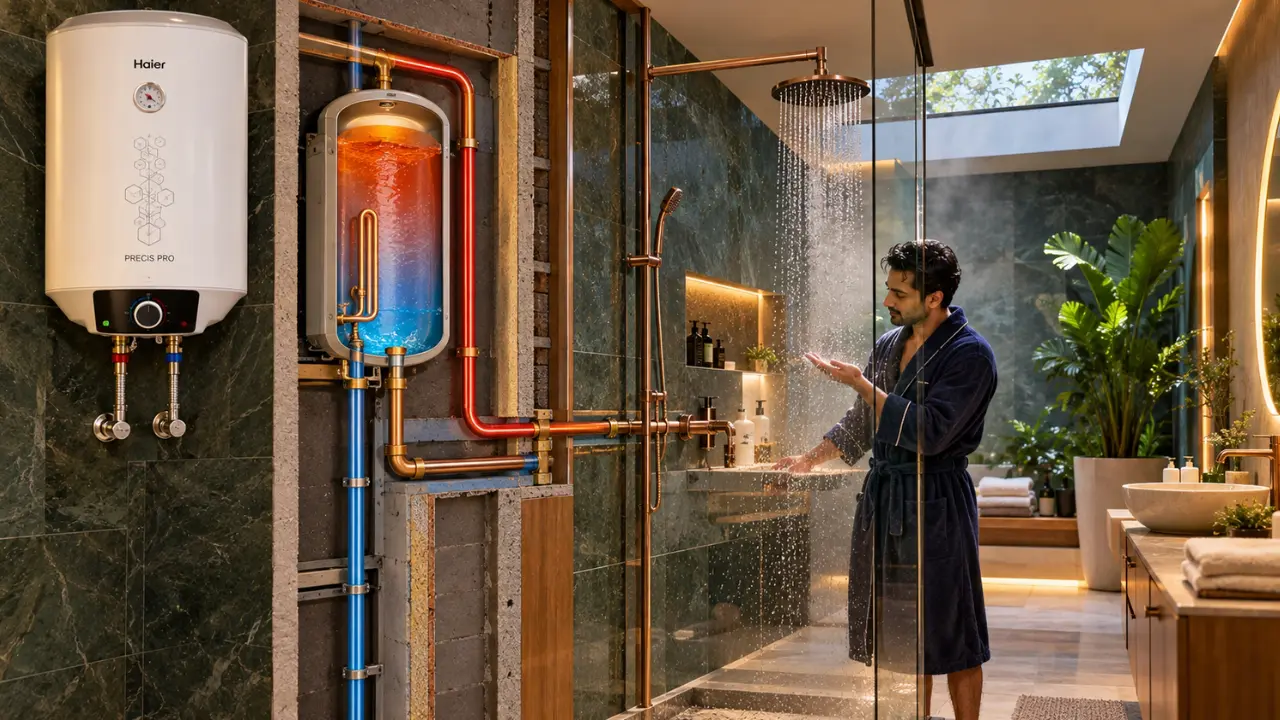

You turn on the geyser, wait a few minutes, and enjoy a warm shower. Simple enough. But have you ever wondered what actually happens inside that wall-mounted appliance?
A water geyser does more than heat water. It uses a heating element, temperature controls, insulation, and protective mechanisms to deliver hot water whenever you need it. And when winter mornings arrive in Delhi, Bengaluru, or other parts of India, having a dependable water heater becomes particularly useful.
Understanding how a geyser works can help you choose the right capacity, manage electricity consumption, and recognise which features matter.
Let’s look at the working process, the different types available, and how Haier India approaches everyday water heating.
What Is a Water Geyser?
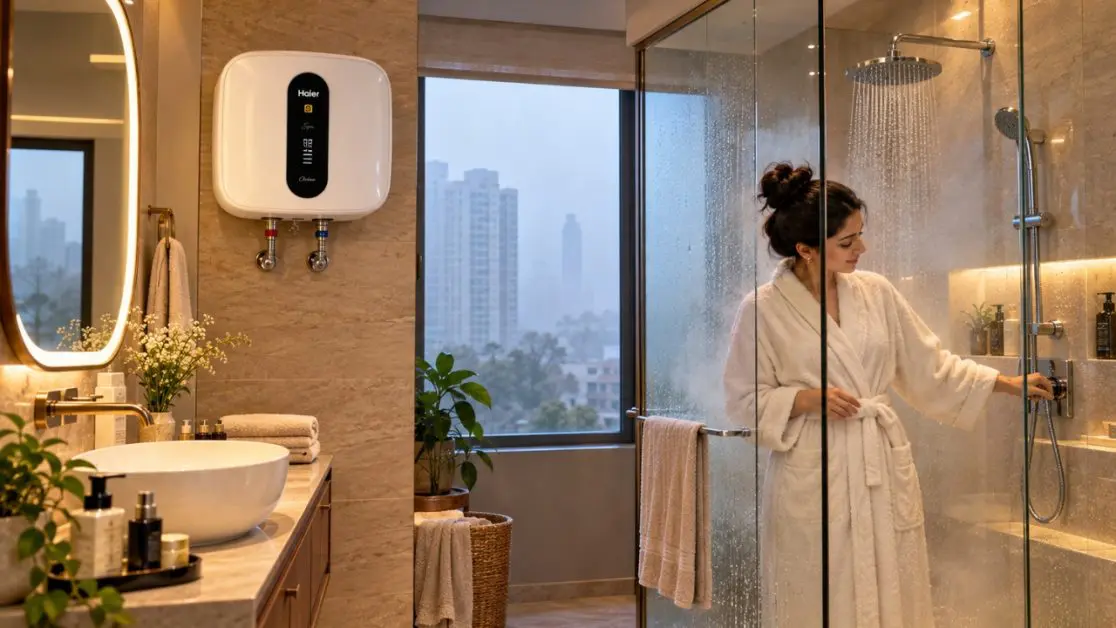
A water geyser is an appliance that heats water for bathing, washing, cleaning, and other household activities. In India, the term commonly refers to an electric water heater installed in bathrooms or kitchens.
Electric geysers convert electrical energy into heat through a heating element. Depending on the design, the appliance either stores heated water inside an insulated tank or heats a smaller quantity for immediate use.
Most modern electric water heaters contain several important components:
- Heating element: Converts electrical energy into heat.
- Thermostat: Monitors water temperature and controls heating.
- Inner tank: Holds water in storage-type geysers.
- Insulation: Slows heat loss from stored hot water.
- Safety valve: Helps manage excess pressure inside the system.
- Thermal cut-out: Provides additional protection against overheating.
Although these components work together, their design and specifications differ across geyser models.
How Does a Water Geyser Work?
The basic principle is straightforward. Electricity heats an element, the element transfers heat to water, and a thermostat regulates the temperature.
But there is a little more happening behind the scenes.
Step 1: Cold Water Enters the Geyser
When the water supply is connected, cold water enters the geyser through its inlet pipe.
In a storage geyser, the tank fills with water before the heating process begins. The tank must be properly filled before the appliance is switched on.
Step 2: The Heating Element Starts Working
Once the geyser receives electricity, its heating element begins generating heat through electrical resistance.
This heat transfers to the surrounding water, gradually increasing its temperature.
The heating time depends on:
- Water heater capacity
- Heating element wattage
- Initial water temperature
- Selected temperature setting
- Heat loss during operation
For instance, heating 25 litres of cold water generally takes longer than heating 15 litres when both appliances have the same heating power.
Step 3: The Thermostat Regulates Temperature
A geyser doesn’t need to keep heating continuously.
The thermostat monitors the water temperature. Once the selected temperature is reached, it switches off the heating element.
When the water cools below the control threshold, the thermostat may activate heating again.
This automatic regulation helps prevent unnecessary continuous heating.
Step 4: Hot Water Reaches the Tap
When you open the hot-water tap, heated water flows out through the outlet.
In a typical pressurised storage geyser, incoming cold water replaces the hot water being drawn from the tank.
Eventually, the available hot water becomes cooler as more cold water enters.
That explains why a long shower can sometimes end with lukewarm water.
What Are the Different Types of Water Geysers?

Not every household needs the same heating arrangement. A compact kitchen, a guest bathroom, and a family bathroom may have very different requirements.
1. Instant Water Geysers
Instant geysers are designed to heat small quantities of water quickly. Many compact electric models contain a small internal tank, rather than operating as completely tankless systems.
They are commonly considered for kitchens, washbasins, and locations with limited hot-water demand.
For example, the Haier 3L Instant Water Heater EI3V-C1(W)-P offers:
- 3-litre capacity
- 3 kW heating specification
- Enamelled tank construction
- Dual Thermal Proof (TTS)
- Multi-Usage Valve (MUV)
- 8-bar rated working pressure
Its compact capacity makes it worth considering where smaller quantities of hot water are required.
2. Storage Water Geysers
Storage geysers heat water inside an insulated tank and retain it for later use.
They are particularly useful when multiple people need hot water or when bathing requires a larger quantity at once.
Common capacities include 10L, 15L, and 25L, although availability varies by manufacturer.
Haier India offers storage models such as its 15L Square Ivory and 25L PRECIS PRO water heaters, giving households options for different usage patterns.
Instant vs Storage Geyser: What’s the Difference?
| Feature | Instant Geyser | Storage Geyser |
| Water capacity | Usually small | Larger tank capacities |
| Heating | Heats small volumes quickly | Heats stored water |
| Space requirement | Generally compact | Requires more installation space |
| Common application | Kitchen, washbasin, light usage | Bathroom and family bathing |
| Hot-water availability | Depends on heating power and flow | Limited by stored hot-water quantity |
| Heat retention | Limited storage | Insulated tank retains heat |
Neither design is automatically better.
The right choice depends on how much hot water you use, the available electrical connection, and your bathing habits.
What Makes a Modern Water Geyser Safe and Reliable?
Electricity and water require careful engineering. That’s why geyser safety deserves as much attention as heating speed.
Haier incorporates several protective and durability-focused features in selected water heaters.
Dual Thermal Proof for Overheating Protection
Haier’s Dual Thermal Proof (TTS) uses two levels of temperature protection.
The first control stops heating at its specified threshold. A secondary thermal protection mechanism provides a backup if the primary control fails.
This arrangement helps reduce overheating risks.
Multi-Usage Valve for Pressure Management
Water expands as it heats, which can increase pressure inside a closed system.
Haier’s Multi-Usage Valve combines functions including pressure relief, non-return protection, anti-vacuum operation, and drainage support.
These mechanisms help manage operating conditions within the water heater.
Glass-Lined Tank for Durability
The internal tank remains exposed to water for years. Over time, corrosion can become a concern, especially where water quality is challenging.
Selected Haier water heaters use glass-lined tanks designed to improve corrosion resistance and support durability.
Insulation for Better Heat Retention
A geyser that loses heat quickly may need to reheat its stored water more frequently.
Haier’s selected storage water heaters feature PUF/EPS insulation to reduce heat loss.
Better insulation helps retain stored heat, although actual electricity consumption still depends on usage and operating conditions.
Which Haier Water Geyser Should You Consider?

Choosing a water heater becomes easier when you match its capacity and features with your daily routine.
Haier India offers different options worth exploring.
Haier 3L Instant Water Heater EI3V-C1(W)-P
This compact water heater is suited to smaller hot-water requirements.
Its listed features include a 3 kW heating system, enamelled tank, Dual Thermal Proof, and 8-bar pressure rating.
For households that primarily need hot water at a kitchen sink or washbasin, its smaller capacity may be practical.
Haier 15L Square Ivory 5 Star Water Heater (ES15V-SDI)
The Haier 15L Square Ivory Water Heater combines a 15-litre capacity with a square-shaped design.
Its notable features include:
- 5-star energy rating
- Shock Proof technology
- Dual Thermal Proof
- Bacteria Proof System (BPS)
- RSC U-turn Flow Technology
- LED display, smart timer, and remote control
- 8-bar rated pressure capability
The BPS mode heats water to 80°C to help inhibit bacteria. Water at this temperature can cause severe burns, so it must not be used directly for bathing.
The model is worth considering for households seeking a 15L storage heater with additional control features.
Haier 25L PRECIS PRO ABS 5 Star Cylindrical Water Heater
For homes requiring a larger stored quantity, the Haier 25L PRECIS PRO offers a 25-litre capacity.
It features:
- 5-star energy rating
- Incoloy 800 heating element
- Glass-lined tank
- Dual Thermal Proof
- Shock Proof protection
- Bacteria Proof System
- PUF/EPS insulation
- 8-bar rated working pressure
The larger tank may be useful for family bathrooms where hot-water demand is higher.
Importantly, capacity alone doesn’t determine performance. Shower flow rate, incoming water temperature, and recovery time also matter.
How Much Electricity Does a Water Geyser Consume?
A common misconception is that a higher-wattage geyser always results in a higher electricity bill.
Not necessarily.
Electricity consumption depends on power rating and operating time.
Electricity consumed (kWh) = Power (kW) × Heating time (hours)
For example, a 2 kW heating element running continuously for 30 minutes consumes approximately 1 unit of electricity.
A 3 kW element operating for 20 minutes also consumes approximately 1 unit.
These are simplified calculations. Actual consumption depends on water temperature, heat loss, thermostat operation, and usage frequency.
Practical Ways to Reduce Electricity Consumption
- Set the thermostat to an appropriate temperature.
- Avoid heating more water than your household needs.
- Repair leaking hot-water taps.
- Choose a suitable capacity instead of automatically buying the largest geyser.
- Consider energy-efficient storage models with good insulation.
- Maintain the appliance according to the manufacturer’s instructions.
For storage water heaters, checking the applicable BEE star rating can also help compare energy performance within the relevant product category.
What Should You Check Before Installing a Water Geyser?
Installation affects both performance and safety.
Before purchasing, check these requirements:
- Electrical supply: Confirm that the circuit, wiring, earthing, and protective devices meet the appliance’s requirements.
- Water pressure: Choose a model compatible with the building’s water-pressure conditions.
- Wall strength: Ensure the mounting surface can support the filled appliance.
- Bathroom space: Allow adequate clearance for installation and servicing.
- Water quality: Hard water may increase scaling and maintenance requirements.
Always use a qualified technician and follow the manufacturer’s installation instructions. Never bypass pressure-relief or electrical safety devices.
Find the Right Water Heating Solution With Haier India
A dependable geyser should offer more than hot water. It should suit your household’s daily requirements while providing suitable temperature regulation, safety protection, and durable construction.
Haier India’s range includes compact 3L instant water heaters and larger 15L and 25L storage models, with features such as Dual Thermal Proof, corrosion-resistant tanks, and pressure-management systems across selected products.
Explore the Haier India official online store to compare water heater capacities, specifications, and available models before choosing one for your home.
Frequently Asked Questions
1. How long does a water geyser take to heat water?
Heating time depends on tank capacity, wattage, incoming water temperature, and thermostat setting. Small-capacity geysers generally heat their stored water faster than larger models with similar heating power.
2. Does a geyser automatically switch off after heating?
Most thermostatically controlled electric geysers stop heating once the set temperature is reached. Some storage models may restart heating when the stored water cools.
3. Can a geyser work without electricity?
A conventional electric geyser requires electricity to heat water. An insulated storage tank may retain previously heated water for some time during a power cut.
4. Is a 15L geyser enough for a family?
A 15L geyser may be suitable for a small family using bucket baths or taking shorter showers. Larger households and high-flow showers may require more capacity.
5. How many years does a water geyser last?
Its service life depends on water quality, maintenance, installation, usage, and component durability. Regular inspections and appropriate servicing can help maintain reliable operation.
6. Can a geyser be installed in a high-rise apartment?
Yes, provided the selected model is compatible with the building’s water pressure and installation requirements. Selected Haier water heaters offer an 8-bar rated working pressure.