
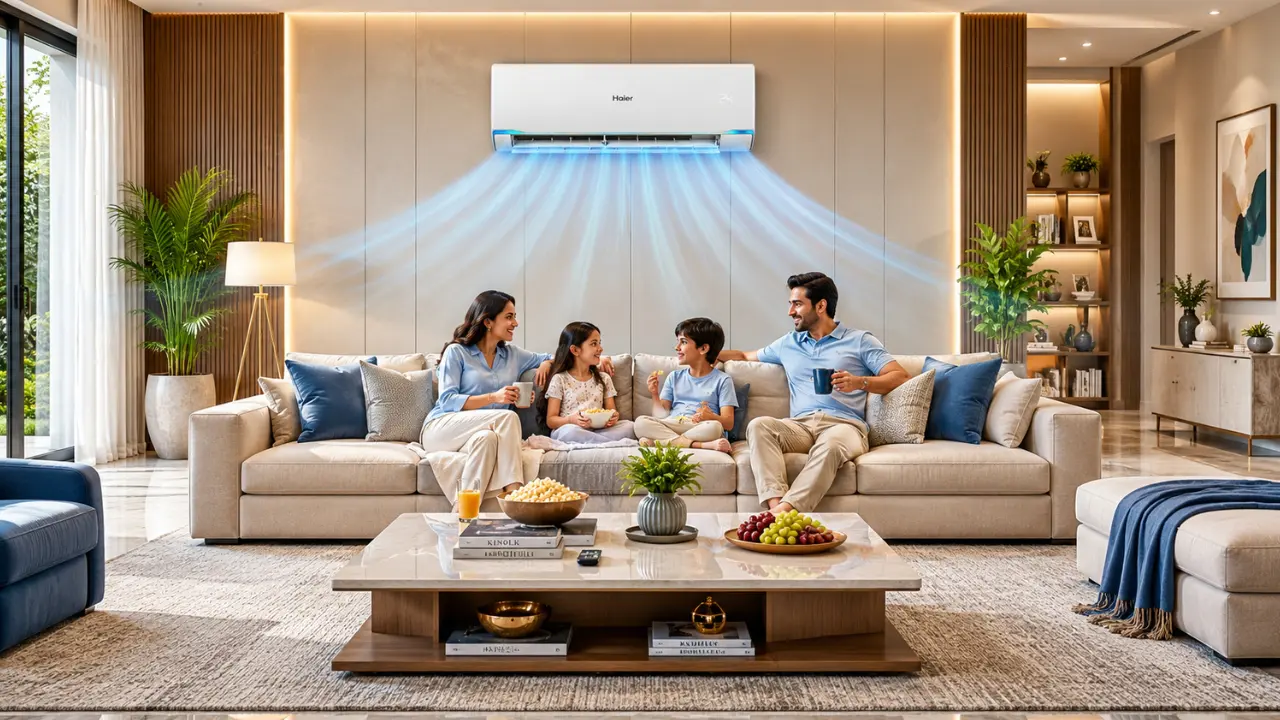

Bigger cooling capacity does not automatically mean better comfort
Most people buying an air conditioner in India make one assumption first.
Bigger AC equals faster cooling.
It sounds logical. A larger machine should cool better. A 2 Ton AC should outperform a 1.5 Ton AC. More power. More cooling. More comfort.
Except homes do not work like spec sheets.
An oversized AC often cools the room too quickly, shuts off too early, consumes unnecessary electricity, creates uneven cooling, and leaves humidity behind.
The result is a room that feels cold but strangely uncomfortable.
Cooling is not about brute force.
It is about balance.
And modern Indian homes are quietly discovering that the smartest AC is not always the biggest one. It is the one that understands the room.
+The “Bigger Is Better” trap starts with Indian summers.
Walk into an electronics store in May.
Outside temperature: 42°C.
Everyone is sweating.
Someone says:
“Take a bigger AC. At least cool fast.”
That advice sounds practical. But it ignores how air conditioners actually behave inside real homes.
A larger AC compressor is designed for larger thermal loads. Bigger rooms. More heat exposure. More people. More appliances.
When oversized for a smaller room, three things happen:
- The AC cools the room too fast
- The compressor switches off frequently
- Humidity removal becomes inconsistent
And that changes comfort entirely.
Because human comfort is not only about temperature.
It is also about moisture in the air.
A room at 24°C with balanced humidity feels comfortable.
A room at 21°C with trapped humidity feels sticky and unpleasant.
That is the hidden system most buyers miss.
An AC That Runs Longer Often Performs Better
This sounds backwards initially.
But it explains why many oversized ACs feel inefficient despite powerful cooling.
A correctly sized inverter AC runs steadily at optimised capacity. It maintains temperature gradually while managing humidity and airflow consistently.
An oversized AC behaves differently.
It cools aggressively. Then shuts down. Then restarts. Then it shuts down again.
That constant stop-start cycle creates:
- Higher power fluctuations
- Uneven room temperatures
- More compressor stress
- Reduced long-term efficiency
Think about city traffic.
A car moving steadily at 60 km/h consumes less fuel than one accelerating and braking every 20 seconds.
Air conditioners work similarly.
Consistency beats bursts.
Room Size Matters More Than Brand Marketing
One of the biggest mistakes people make is choosing tonnage emotionally instead of structurally.
Not every bedroom needs a 2 Ton AC.
Not every living room needs maximum capacity.
Here is the broader pattern.
Typical AC Sizing Logic for Indian Homes
- Small bedrooms (up to 120 sq ft): Usually 1 Ton to 1.2 Ton
- Medium rooms (120–180 sq ft): Usually 1.5 Ton
- Large living spaces (180–250 sq ft): Usually 1.7 Ton to 2 Ton
But even this changes based on:
- Floor height
- Sun exposure
- Number of windows
- Number of occupants
- Appliance heat load
- Insulation quality
A top-floor west-facing apartment in Ahmedabad behaves differently from a shaded Bengaluru bedroom.
The room decides the AC.
Not the ego of owning a “bigger” machine.
Modern ACs Are Becoming Smarter About This Problem
Older air conditioners worked in extremes.
Full power. Or no power.
Modern inverter systems are changing that logic completely.
That is where newer AI-driven cooling systems become relevant.
For example, the Haier India Desert Rose series focuses heavily on adaptive cooling instead of fixed behaviour. Features like AI Human Detection and AI Climate Control are designed to optimize cooling based on room conditions and occupancy instead of running aggressively all the time.
That shift matters.
Because the future of cooling is not maximum cooling.
It is context-aware cooling.
The best appliances increasingly behave less like machines and more like responsive systems.
The Real Cost of Oversized ACs
People usually calculate AC costs only once.
At purchase.
That is the wrong calculation.
The bigger cost arrives later.
What Oversized ACs Often Increase
- Electricity Bills
- Larger compressors consume more power during aggressive cooling cycles
- Humidity Problems
- Short cooling cycles reduce moisture removal
- Wear and Tear
- Frequent start-stop cycles stress components
- Noise Fluctuations
- Sudden compressor ramp-ups become noticeable
- Uneven Cooling
- One corner feels freezing while another remains warm
Comfort systems fail quietly.
Not dramatically.
And that is why many people blame “Indian heat” when the actual issue is incorrect tonnage selection.
Why Inverter Technology Changed the Conversation
Ten years ago, buyers often compensated by buying larger ACs because traditional compressors lacked flexibility.
Today, inverter technology changes that equation.
Modern inverter ACs adjust cooling dynamically based on load requirements.
That means:
- Lower energy use during partial loads
- Better temperature stability
- Smoother operation
- Reduced compressor stress
Haier’s Hexa Inverter technology, for instance, is designed to maintain powerful cooling while improving energy efficiency. The system also supports convertible cooling capacities that adapt between different performance levels instead of running at maximum output constantly.
That matters especially in Indian households where occupancy changes constantly through the day.
Morning.
Afternoon.
Guests arrive.
Children sleep.
Kitchen heat increases.
The cooling requirement never stays fixed.
A Smart AC Thinks Like a Ceiling Fan
This sounds strange. But stay with it.
The best ceiling fans are not the fastest ones.
They are the ones that circulate air naturally without making you notice them.
The same principle increasingly applies to air conditioners.
Good cooling disappears into the background.
Bad cooling keeps reminding you it exists.
Too cold.
Too dry.
Too loud.
Too uneven.
A well-sized AC creates what designers call invisible comfort.
You stop thinking about temperature entirely.
That is the real goal.
The Indian Home Has Changed Faster Than Cooling Advice
Most AC advice in India still comes from old assumptions.
But Indian homes themselves have evolved.
Today’s homes include:
- Open layouts
- Smart TVs generating heat
- Larger glass windows
- Hybrid work setups
- Longer AC usage hours
- Multiple people sharing compact urban apartments
At the same time, electricity awareness has increased sharply.
Families track monthly bills more carefully now.
Young professionals use app-based monitoring.
Parents increasingly prefer appliances that balance comfort with efficiency.
That is why modern cooling systems now integrate features like:
- AI energy optimisation
- Occupancy detection
- Convertible tonnage modes
- App-based energy tracking
- Smart pre-cooling
For instance, Haier’s AI-ATMOX powered systems focus on analysing environmental conditions and usage patterns to optimise cooling and energy savings dynamically.
The industry is slowly moving from “maximum cooling” to “intelligent cooling.”
That distinction matters more than people realise.
One Room. Three Different Cooling Strategies
Consider a couple setting up a new apartment in Gurgaon.
They have three options.
Option One: Buy the Biggest AC Possible
Short-term feeling:
- “Safe” decision
- Faster cooling initially
Long-term reality:
- Higher bills
- Humidity imbalance
- Inconsistent comfort
Option Two: Buy the Cheapest AC Available
Short-term feeling:
- Budget satisfaction
Long-term reality:
- Weak cooling during peak summers
- Limited efficiency
- Poor adaptability
Option Three: Match Cooling to Actual Lifestyle
This approach asks better questions:
- How large is the room?
- How much sunlight enters?
- How long will the AC run daily?
- Is energy saving important?
- Will occupancy vary frequently?
This usually leads to better long-term comfort.
Because systems perform best when designed for reality instead of fear.
Cooling Is Becoming Personal
The most important shift is not technological.
It is behavioural.
People no longer want appliances that simply function.
They want appliances that understand routines.
A working professional returning home at 8 PM wants quick comfort without energy waste.
Parents want stable nighttime temperatures for children.
Older family members prefer airflow that feels softer, not aggressive.
That is why features like AI Human Detection, smart app controls, and adaptive cooling modes are becoming more relevant in modern Indian ACs. Haier’s Desert Rose series, for example, combines AI-powered climate control, 7-in-1 convertible modes, and smart energy optimisation to adapt cooling based on changing usage conditions.
The machine is no longer just cooling air.
It is responding to behaviour.
The Bigger Insight Most Buyers Miss
People think they are buying an AC.
Usually, they are buying predictability.
They want to sleep comfortably during May nights.
They want stable electricity bills.
They want relief after long commutes.
They want homes that recover quickly from heat and noise and chaos.
And that changes the buying question entirely.
The question is no longer:
“How powerful is this AC?”
The better question is:
“How intelligently does this AC fit the way we actually live?”
Because comfort is not created by excess.
It is created by alignment.
And in cooling, just like in life, more is often easier to sell than right.
Frequently Asked Questions
Should I Buy a Bigger AC Just to Cool My Room Faster?
Not necessarily. An oversized AC may cool the room quickly, but it can switch off before removing enough humidity. The result is a room that feels cold yet uncomfortable. Proper sizing usually delivers better long-term comfort and efficiency.
Is a 2 Ton AC Always Better Than a 1.5 Ton AC?
Only if your room actually requires that capacity. A 2 Ton AC in a smaller room may increase electricity consumption, create uneven cooling, and cycle on and off too frequently.
How Do I Know What AC Tonnage Is Right for My Room?
Room size is only the starting point. You should also consider:
Ceiling height
Sunlight exposure
Number of windows
Occupancy levels
Heat-generating appliances
Insulation quality
My Room Is Around 150 Sq Ft. Should I Automatically Buy a 1.5 Ton AC?
In many cases, yes. However, a heavily sunlit top-floor room may require different sizing compared to a shaded room of the same size.
Is Buying a Larger AC a Safer Choice for Indian Summers?
It may feel safer initially, but oversizing often creates comfort and efficiency problems that become noticeable over time.
Why Does My Room Feel Sticky Even When the AC Temperature Is Low?
Humidity may not be getting removed effectively. Oversized ACs often complete cooling cycles too quickly, leaving excess moisture in the air.
Why Do I Still Feel Uncomfortable at 21°C?
Comfort depends on both temperature and humidity. A room at 24°C with balanced humidity can feel more comfortable than a colder room with trapped moisture.