
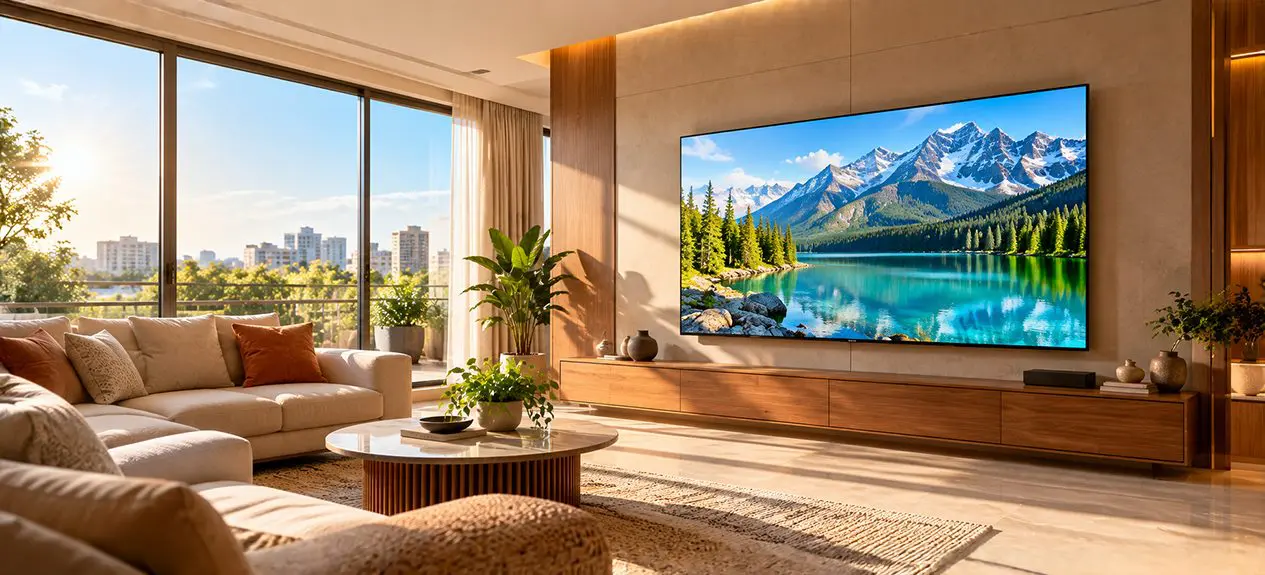

Indian living rooms rarely stay dark for long. Most have at least one large window pulling in strong daylight for a good chunk of the day, and picking a TV that holds up against all that light is a genuine part of the buying decision.
The 4K vs QLED vs OLED question doesn’t have one clean answer. It depends on where the TV sits, how bright the room gets through the day, and what you actually watch on it. A panel that looks stunning in a showroom under controlled lighting can look washed out on a Saturday afternoon in a real living room.
This guide walks through what each term actually means, which panel wins in a bright room, which one earns its keep in a darker home-theatre setup, and how to match the technology to the room you’re buying it for.
4K, QLED and OLED: What Each Term Actually Means
The confusion between 4K, QLED, and OLED is understandable. The terms sit at different layers of the display, but they’re often listed side by side on product pages. Sorting them out first makes the rest of the comparison much easier.
4K Is Resolution, Not Panel Type
4K describes how many pixels the panel has, not what kind of panel it is. A 4K display packs 3840 x 2160 pixels, four times the pixel count of Full HD, and it’s now the default at every screen size from 43-inch upwards.
So is 4K worth it in 2026? For most viewers, yes. Streaming platforms, gaming consoles, and Blu-ray sources all default to 4K content, and Full HD panels start looking soft on anything larger than a 43-inch screen.
How QLED Works
QLED stands for Quantum Dot Light Emitting Diode. Under the hood, it’s still an LCD panel with an LED backlight, but with an added quantum-dot layer that produces richer, more accurate colour and higher peak brightness than standard LED.
The main reason QLED matters in India is that it handles ambient light well. In rooms with strong daylight, that extra brightness keeps the picture looking punchy rather than washed out.
How OLED Works
OLED skips the backlight entirely. Each pixel emits its own light, which means it can also turn completely off, producing true blacks and pixel-level contrast that LCD-based panels can’t match, no matter the price point.
The trade-off is peak brightness. OLED has improved a lot in recent years, but it still doesn’t hit the same brightness ceilings as high-end QLED or Mini-LED, which matters in specific room conditions.
Which Is Better for a Bright, Sunlit Room?
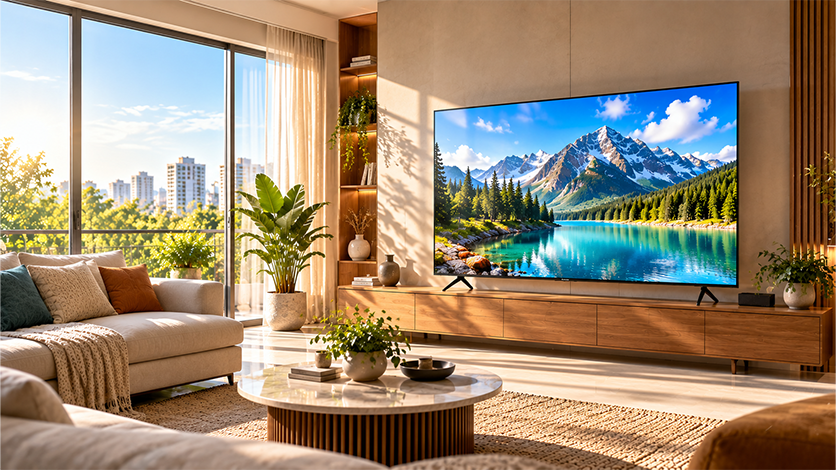
The OLED vs QLED for bright room question comes down to two things: how bright the panel can get, and how well it handles reflections from windows and lights.
Why Brightness and Anti-Glare Matter in Sunlight
A panel’s peak brightness is measured in nits. Rough benchmarks:
- Entry-level LED: 250 to 350 nits
- Mid-range QLED: 500 to 800 nits
- High-end QLED and Mini-LED: 1,000 to 2,000 nits
- OLED: typically 500 to 1,000 nits, with newer panels edging higher
The higher a panel’s peak brightness, the better it holds picture quality when the room is flooded with daylight. Anti-glare coatings also help matte or semi-matte finishes scatter reflections better than glossy ones, though every finish has its own trade-offs.
QLED vs OLED in Direct Light
For a sunlit living room, QLED is usually the safer pick. High peak brightness combined with a good anti-glare layer keeps the picture visible even when the sun is directly on the wall opposite the TV.
OLED can work in bright rooms too, but you’ll notice more reflections on the glossy screen surface, and the picture can look dimmer during peak daylight hours. If your seating shifts through the day and sunlight moves across the wall, QLED handles those changes more gracefully.
Which Is Better for a Dark Home-Theatre Room?
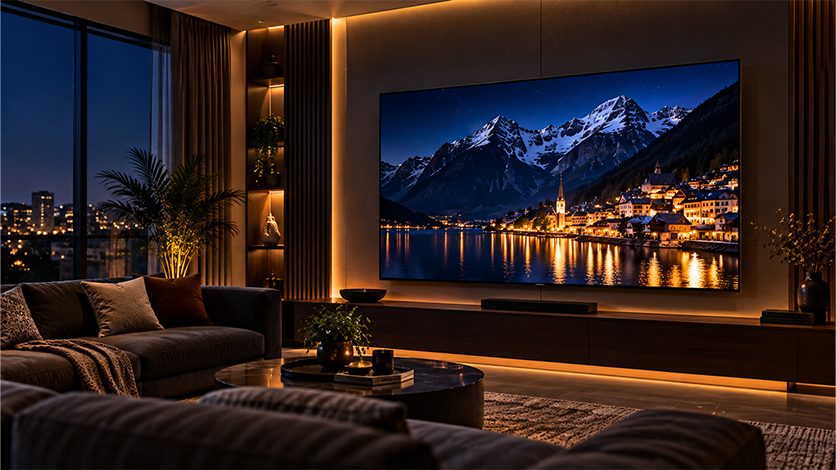
If your TV lives in a dedicated media room or a corner that stays dim through evening viewing, OLED changes the calculation entirely. Pixel-level contrast and true blacks make Dolby Vision and HDR10+ content look genuinely cinematic in a way QLED can’t quite match.
For dark rooms, the QLED vs OLED balance tips clearly toward OLED, especially if you watch a lot of movies or premium streaming content in the evening.
Mini-LED and Neo QLED: Where They Fit
Mini-LED sits between standard QLED and OLED in both price and picture quality. It uses the same LCD panel technology as regular LED, but with many more and much smaller backlight zones, which improves contrast and reduces the “halo” effect around bright objects on dark backgrounds.
A mini LED TV is often the practical middle ground for viewers who want stronger contrast than QLED offers, without paying OLED prices. “Neo QLED” is one industry term for Mini-LED implementations paired with a QLED layer, but the underlying technology is broadly the same across brands.
For a bright living room where movie nights also matter, Mini-LED often lands as the balanced pick: high peak brightness during the day, better contrast in the evening than plain QLED.
Which Should You Buy for Your Living Room?
The best TV for sunlight in an Indian home usually isn’t the priciest OLED; it’s a well-tuned QLED or Mini-LED that can hold picture quality through the brightest hours of the day.
Here’s a rough side-by-side guide for the most common room types:
| Room type | Best panel choice |
| Sunlit living room, all-day viewing | QLED or Mini-LED |
| Mixed lighting, evening viewing | Mini-LED |
| Bedroom with curtains, evening viewing | OLED or Mini-LED |
| Dedicated home-theatre setup | OLED |
| Casual bedroom or kitchen use | Standard LED or QLED |
Match the TV to Your Lighting and Budget
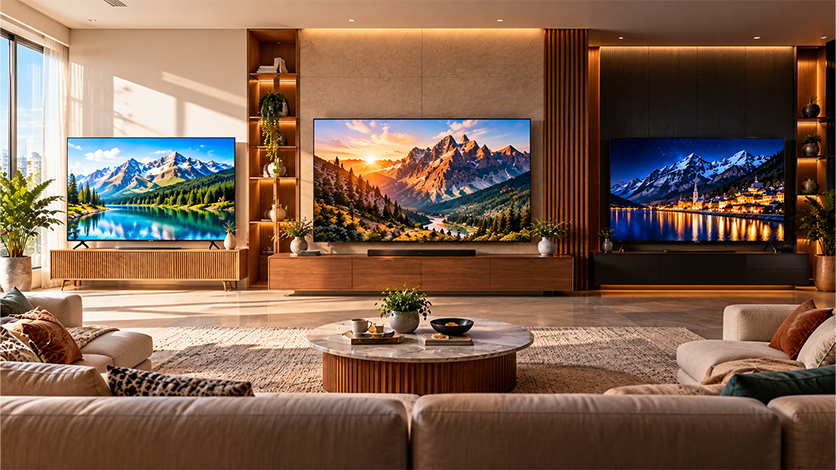
Before you commit, walk through your actual room:
- When does direct sunlight hit the TV wall, and for how long?
- Where does your seating sit relative to the windows?
- Do you watch mostly during the day, evening, or both?
- How often do curtains or blinds stay closed?
- What’s the primary content mix: sport, movies, streaming, gaming?
Explore Haier’s Google TV lineup in India for QLED, Mini-LED, and OLED options across sizes and price bands, so you can match the panel to your specific room.
Conclusion
The best TV for bright-room setups isn’t always the most expensive one. For most Indian living rooms with strong daylight, a well-specced QLED or Mini-LED handles the space better than an OLED that’s fighting reflections and dim light.
That said, if your viewing pattern skews toward evening movies in a dim space, OLED still holds the cinematic crown. The right pick comes down to matching the panel type to how and when you actually watch, not chasing the label with the most impressive spec sheet.
FAQs
Which is better, 4K, QLED or OLED?
They aren’t directly comparable. 4K is a resolution; QLED and OLED are panel technologies. Most QLED and OLED TVs sold today are also 4K. For picture quality alone, OLED wins in dim rooms, while QLED and Mini-LED handle bright rooms better.
Which TV is best for a bright, sunlit room?
A well-tuned QLED or Mini-LED with peak brightness of at least 1,000 nits and a good anti-glare coating. Both handle direct sunlight and daytime viewing better than OLED.
Is QLED or OLED better for a living room with lots of light?
QLED is usually the safer pick for bright, sunlit living rooms. Higher peak brightness and better anti-glare surfaces keep the picture visible in bright daylight. Mini-LED is also a strong option in this setting.
Is 4K the same as QLED or OLED?
No. 4K refers to the pixel count on a panel (3840 x 2160), while QLED and OLED describe how the panel is lit or how pixels emit light. Most modern QLED and OLED TVs are 4K, but the terms describe different things.
Is a QLED TV worth buying?
For most Indian homes, yes. QLED offers richer colour, higher brightness, and better daylight performance than standard LED, with prices now starting around ₹35,000 for a 43-inch panel.
Does OLED look washed out in sunlight?
It can, in very bright rooms with direct sunlight. OLED’s glossy surface reflects more light, and its peak brightness is lower than that of high-end QLED and Mini-LED, which makes daytime viewing less punchy in sunlit spaces.