
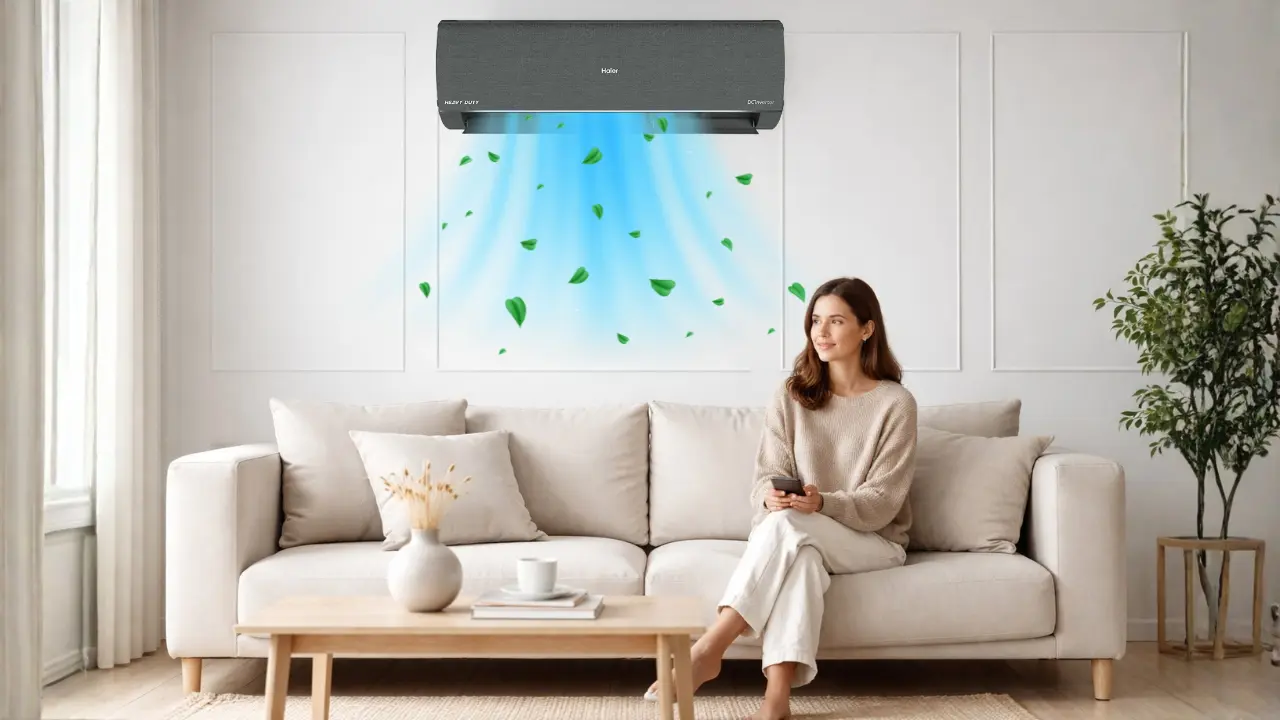

AI Eco 2.0 cuts cooling wastage by thinking in real time, not running on fixed rules.
AI Eco 2.0 uses smart sensors and temperature gap analysis to automatically adjust cooling levels. It shifts between L1, L2, and L3 ECO modes based on how far the room temperature is from your set temperature. The result is simple. Less overcooling. Lower electricity bills. Comfort without manual effort.
That is the short answer.
Now let us look at what is really happening behind the scenes.
Why does cooling wastage happen in the first place?
Picture this.
It is 6:30 pm in Mumbai. You return home after a long commute. You switch on the AC at 18°C because the room feels like an oven. Within 20 minutes, the room becomes cold enough. But the AC keeps pushing hard.
That is wastage.
Traditional air conditioners follow commands. They do not question them. If you set 18°C, they aim for 18°C with full force, even when the room stabilizes faster than expected.
According to the Bureau of Energy Efficiency, raising your AC temperature by just 1°C can reduce power consumption by up to 6 percent. Multiply that over 8 hours daily. Multiply that over 5 summer months. The numbers grow quietly.
Cooling wastage is rarely dramatic. It is incremental.
And incremental waste is the most expensive kind.
This is where AI Eco 2.0 changes the system.
What Exactly Is AI Eco 2.0 and How Does It Work?
AI Eco 2.0 is part of the AI Atmox climate ecosystem in select Haier air conditioners. It is designed to read the room, compare the set temperature with actual room temperature, and auto-adjust performance in levels instead of running at constant intensity.
From the AI Atmox technical brief :
- If the room–set temperature gap exceeds 3°C, it switches to L1 ECO mode
- If the gap is between 1°C and 3°C, it shifts to L2 mode
- If the gap is 1°C or less, it moves to L3 mode
Three levels. One purpose.
Prevent overcooling automatically.
Instead of blasting cold air all night, AI Eco 2.0 progressively reduces output as comfort stabilizes.
Think of it like a smart dimmer switch for cooling. Not just ON or OFF. But calibrated.
The Hidden System: Temperature Gap Intelligence
Most of us think cooling equals comfort.
But comfort is not about extremes. It is about balance.
The World Health Organization suggests indoor temperatures between 23°C and 26°C for optimal comfort in tropical climates. Yet many Indian homes run ACs at 18°C or 19°C.
Why?
Because we react emotionally to heat.
AI Eco 2.0 removes emotion from the equation. It focuses on temperature differences.
Here is how the logic works:
| Temperature Gap | AI Eco 2.0 Mode | What It Means |
| Above 3°C | L1 ECO | Strong cooling but optimized |
| 1–3°C | L2 ECO | Moderate cooling |
| 1°C or less | L3 ECO | Minimal power usage |
Instead of one aggressive cooling curve, AI Eco 2.0 uses dynamic scaling.
It is a system decision. Not a reaction.
And systems make fewer mistakes than moods.
What Happens When Nobody Is in the Room?
This is where intelligence becomes visible.
Select AI Atmox models include AI Human Detection. According to the product brief :
- If no activity is detected for 15 minutes, the system shifts to Auto L3
- If no activity continues for 30 minutes, it powers off
No reminders. No timers. No guilt.
Just logic.
Research from the International Energy Agency shows that residential cooling accounts for nearly 10 percent of global electricity use. A significant portion comes from empty-room operation.
AI Eco 2.0 addresses that gap directly.
It treats absence as data.
And data reduces waste.
Three Ways People Usually Manage Cooling
Let us zoom out.
There are typically three approaches Indian households follow.
One option is manual control.
Switch on when needed. Switch off when remembered.
Cost: Mental effort and inconsistency.
Benefit: Full control.
The second option is timer-based cooling.
Set a 2-hour or 4-hour timer.
Cost: Rigid schedules that do not adapt to real life.
Benefit: Predictable savings.
The third option is AI Eco 2.0 automation.
Let the system adjust dynamically.
Cost: Requires trust in technology.
Benefit: Real-time efficiency without constant intervention.
When life is busy, automation often wins.
Because the best system is the one that works when you forget.
Electricity monitoring 2.0 Makes Waste Visible
Savings feel abstract until you see numbers.
AI Atmox models include Electricity monitoring 2.0 and Atmox Power Manager . This allows:
- Graphical tracking of power usage
- Calendar-based history
- Normal vs ECO mode comparison
- Cost display in currency
- Custom energy-saving targets
When cooling waste becomes visible, behavior shifts.
Behavior shifts create habits.
Habit reduces bills.
According to India’s Ministry of Power, households that actively monitor energy consumption reduce usage by 5 to 15 percent.
Awareness alone creates savings.
AI Eco 2.0 pairs awareness with automation.
AI Eco 2.0 Is Not About Less Cooling. It Is About Smarter Cooling
There is a misconception.
Energy saving equals compromise.
That is outdated thinking.
AI Eco 2.0 does not reduce comfort. It refines delivery.
Consider this parallel.
In business, growth without optimization leads to burnout.
In cooling, power without calibration leads to waste.
Optimization is not a restriction. It is alignment.
AI Eco 2.0 aligns output with need.
Real-Life Scenario: The Working Professional
A solo professional in Bengaluru works hybrid.
Morning: AC runs while getting ready.
Afternoon: Leaves home for office.
Evening: Returns tired.
Without AI Eco 2.0, the AC might run longer than needed. Or cool aggressively for too long.
With AI Eco 2.0:
- It scales down as the room stabilizes
- It reduces output when the gap narrows
- It powers down during inactivity
Over a summer season, even a 10 percent reduction in usage can translate to noticeable savings on electricity bills.
Small shifts. Big compounding impact.
Connecting the Dots: AI Climate Control as a System
AI Eco 2.0 is not standalone.
It sits inside a larger AI Climate Control framework that includes:
- AI Pre-Cooling
- AI Target Cooling
- AI Human Detection
- Atmox Power Manager
Together, they create a feedback loop.
Data in. Decision made. Adjustment executed.
That is what modern systems do.
They observe patterns. They adapt. They optimize.
Why This Matters Beyond Cooling
Energy efficiency is no longer just a utility concern.
India’s cooling demand is expected to grow nearly eightfold by 2050, according to projections from The Energy and Resources Institute.
That scale demands intelligent systems.
Individual choices add up to national impact.
Every kilowatt saved reduces strain on grids. Every optimized cycle reduces emissions.
AI Eco 2.0 operates quietly inside homes.
But its implications scale outward.
The Memorable Insight
Here is the idea worth keeping.
Cooling should respond to reality, not just commands.
AI Eco 2.0 represents a shift from instruction-based appliances to decision-based appliances.
That shift changes everything.
Because intelligence does not shout. It adjusts.
So What Does This Mean for Modern Indian Homes?
It means comfort no longer requires constant supervision.
It means cooling waste can be reduced automatically.
It means appliances can participate in decision-making, not just execution.
For families managing rising power bills.
For couples setting up new homes.
For professionals balancing work and life.
AI Eco 2.0 offers something subtle.
Relief from micro-management.
And in today’s homes, relief is luxury.
Final Thought: Automation Is the New Discipline
In the past, saving electricity required discipline.
Now, it requires design.
AI Eco 2.0 uses temperature gap intelligence, occupancy sensing, and real-time optimization to cut cooling wastage automatically. No reminders. No constant adjustments. Just calibrated comfort.
When systems think, people breathe easier.
And that is the future of cooling.
Frequently Asked Questions
I’m tired of constantly adjusting my AC temperature. Can AI Eco 2.0 really manage cooling without me thinking about it?
Yes. AI Eco 2.0 automatically shifts between L1, L2, and L3 ECO modes based on the temperature gap between your set temperature and the actual room temperature. As the gap narrows, it reduces output. You don’t need to manually fine-tune settings throughout the evening.
I always set my AC to 18°C when I walk in because it’s too hot. Am I wasting electricity?
Most likely, yes. Traditional ACs keep pushing aggressively even after the room cools down. AI Eco 2.0 detects when the room stabilizes and scales cooling down progressively to prevent overcooling.
I forget to switch off my AC before leaving for work. Will AI Eco 2.0 help with that?
In select models with AI Human Detection, if no movement is detected for 15 minutes, it shifts to Auto L3 mode. After 30 minutes of inactivity, it powers off automatically. That reduces empty-room waste.
Is automation better than setting a timer?
Timers are fixed. Real life is not. AI Eco 2.0 adapts in real time based on temperature gaps and room activity, making it more flexible than rigid 2-hour or 4-hour timers.
I feel guilty about electricity bills every summer. Can this system reduce that stress?
Yes. Because it removes the need for constant monitoring and adjusts cooling intelligently, it helps reduce incremental wastage, the kind that quietly inflates your bill.
Is AI Eco 2.0 part of something bigger?
Yes. It operates within the AI Atmox ecosystem in select Haier air conditioners, alongside AI Pre-Cooling, AI Target Cooling, AI Human Detection, and Atmox Power Manager.
Does it reduce comfort to save electricity?
No. It refines cooling delivery rather than cutting it. Comfort remains stable while excess output is minimized.
Is this just marketing, or does temperature adjustment actually save power?
Even raising AC temperature by 1°C can reduce power consumption by up to 6%, according to India’s Bureau of Energy Efficiency. AI Eco 2.0 works by managing temperature intensity more intelligently.