

Sound by KEF audio transforms television sound into a cinematic experience. Instead of relying on basic TV speakers, it uses precision acoustic engineering to deliver deeper bass, clearer dialogue, and immersive spatial audio.
That is the simple explanation.
The deeper story begins in a moment many Indian homes recognize.
The Friday night living room test.
Picture this.
It is 9:45 pm.
Dinner plates are stacked near the sink. Someone brings popcorn in a steel bowl. Someone else scrolls Netflix. A teenager asks if the IPL highlights are available.
The TV turns on.
The picture looks fantastic.
But the sound feels… ordinary.
Dialogue sounds thin. Stadium noise feels distant. Music lacks depth.
This happens because most televisions treat sound as a secondary feature.
Yet sound is half the experience.
Audio engineers often repeat a simple truth.
Great visuals attract attention. Great sound creates emotion.
And that is where Sound by KEF audio begins to matter.
Why Sound Shapes the Experience More Than We Realize
Many people focus on picture quality.
4K resolution. HDR. Mini LED brightness.
But our brains process sound faster than visuals. Audio often determines whether a scene feels immersive or artificial.
Think about three everyday viewing moments.
1. Movie Night
A quiet dialogue scene.
Without proper audio separation, background music swallows the conversation.
With Sound by KEF powered speakers and Dolby Atmos support, voices remain crisp while ambient sound fills the room.
2. Music Streaming
A Sunday morning playlist.
Basic TV speakers flatten instruments.
Sound by KEF engineered audio systems reproduce deeper bass and clearer detail so vocals and instruments feel balanced.
3. Live Sports
An IPL match.
Crowd energy matters.
High clarity speakers recreate the stadium atmosphere while keeping commentary sharp.
Sound stops being background noise.
It becomes part of the event.
What Sound by KEF Audio Actually Means
Sound by KEF is a globally respected audio engineering company known for high fidelity speaker design.
When televisions integrate Sound by KEF audio technology, the internal sound system follows principles usually reserved for premium speakers.
Instead of simple stereo speakers, the system may include:
- Precision tuned speaker drivers
- Dedicated bass channels
- Multi channel spatial audio
- Dolby Atmos compatibility
For example, the Haier M80F Mini LED 165cm (65) Google TV H65M80FUX includes a 2.1 channel speaker system with a 50W woofer configuration, producing fuller and richer sound compared to standard TV speakers.
This is not cosmetic.
It is an acoustic design.
Three Viewing Experiences That Reveal the Difference
Let us compare what happens in real homes.
| Scenario | Standard TV Audio | Sound by KEF Powered Audio |
| Movies | Dialogue merges with background music | Clear voices with spatial sound |
| Music | Flat soundstage | Balanced bass, mids and treble |
| Sports | Crowd noise dominates commentary | Clear commentary with immersive stadium ambience |
The difference may feel subtle at first.
Then it becomes obvious.
Once you experience balanced sound, ordinary audio feels incomplete.
How Sound by KEF Audio Enhances Movies
Cinema sound is layered.
Dialogue sits in the centre. Background music spreads across the room. Effects move through the soundstage.
Traditional televisions compress all of this into two small speakers.
But Sound by KEF powered televisions recreate a wider sound field.
Technologies like Dolby Atmos place audio in multiple directions around the listener.
This creates moments such as:
- Helicopters sounding like they move overhead
- Rain surrounding the room
- Dialogue staying anchored in the centre
Your living room begins behaving like a theatre.
Not louder.
More dimensional.
How Sound by KEF Audio Improves Music Listening
Music reveals audio quality faster than almost any other content.
Play a classic Bollywood song.
Or an Arijit Singh acoustic track.
Three improvements appear instantly.
1. Bass depth
The built in woofer produces deeper bass without distortion.
2. Vocal clarity
Precision tuned drivers keep vocals separated from instruments.
3. Instrument balance
Guitars, percussion, and strings remain distinct.
The result is not simply louder music.
It is a more faithful sound.
And faithful sound feels more emotional.
How Sound by KEF Audio Transforms Sports Viewing
Sports broadcasting depends heavily on ambient sound.
Crowd reactions.
Stadium echoes.
Commentary.
When these layers collapse into one audio channel, the match feels distant.
Sound by KEF powered speakers help maintain separation between these layers.
In televisions such as the Haier M80F Mini LED 189cm (75) Google TV H75M80FUX, advanced motion processing and immersive sound help synchronize fast visuals with audio cues.
That means:
- Bat hits the ball. Sound arrives instantly.
- Crowd cheers surround the room.
- Commentary stays clear.
The match stops feeling like background TV.
It becomes a shared experience.
The Hidden System Behind Great Home Audio
Great television sound depends on three systems working together.
1. Speaker architecture
Multi channel speakers expand the sound field.
2. Audio processing
AI processors adjust sound depending on whether you are watching movies, sports, or music.
3. Spatial sound technology
Dolby Atmos simulates three dimensional sound around the listener.
Premium televisions like the Haier M80F Mini LED 215cm (85) Google TV H85M80FUX integrate these technologies to deliver immersive sound without needing additional speakers.
When these layers align, something interesting happens.
You stop adjusting volume.
The system simply works.
How Big Screens and Sound by KEF Sound Work Together
Screen size influences how we experience sound.
A large display demands equally powerful audio.
For instance, the Haier New M96 Series 254cm (100) QD Mini LED AI Smart Google TV H100M96FUX combines a large cinematic screen with Sound by KEF engineered multi channel sound to maintain balance between visual scale and audio depth.
Without strong sound, big screens feel incomplete.
Because scale demands immersion.
Choosing the Right Setup for Your Home
Different households experience audio differently.
Here are three common setups.
Option 1: Compact apartment living
Best for:
Working professionals or couples.
Benefits:
- Built in Sound by KEF speakers reduce the need for external soundbars
- Balanced sound without complex wiring
- Space efficient setup
Cost consideration: Economical and simple.
Option 2: Family living room
Best for:
Families watching movies and sports together.
Benefits:
- Multi channel sound improves dialogue clarity
- Dolby Atmos adds theatre style immersion
- Balanced audio across larger rooms
Cost consideration: Slightly higher investment but fewer upgrades later.
Option 3: Entertainment focused homes
Best for:
Movie lovers, gamers, and serious streamers.
Benefits:
- Advanced spatial sound
- Large screen compatibility
- Full cinematic experience
Cost consideration: Premium investment for maximum immersion.
Why Sound Technology Is Becoming Central to TVs
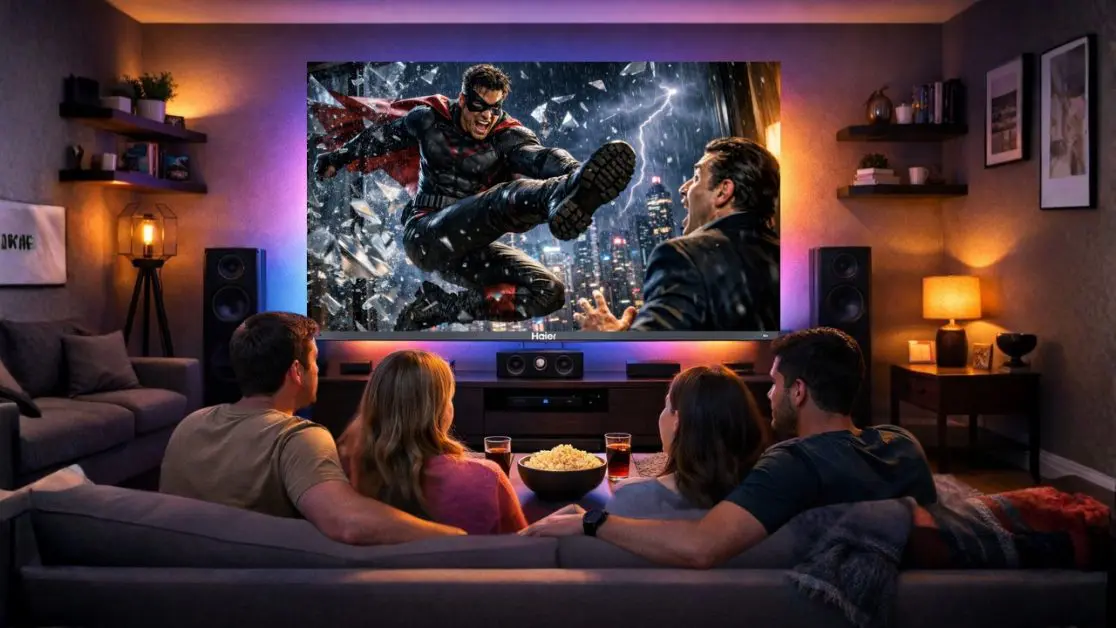
Television usage patterns have changed.
Today a single screen handles:
- OTT streaming
- Live sports
- Music streaming
- Gaming
- YouTube viewing
Modern televisions behave more like entertainment hubs.
Audio quality becomes essential.
The Real Insight: Sound Is the Shortcut to Immersion
Here is the hidden pattern.
People upgrade screens for clarity.
But they remember experiences because of sound.
A suspense scene feels tense because of subtle audio cues.
A cricket six feels thrilling because of the stadium roar.
A music performance feels emotional because vocals feel alive.
Sound is the emotional layer of entertainment.
When Sound by KEF engineered audio systems combine with modern televisions like the Haier M80F Mini LED Google TV Series and the Haier M96 Series QD Mini LED AI Smart Google TV, something interesting happens.
Your living room stops feeling like a room with a screen.
It becomes a space designed for experiences.
The Bigger Shift Happening in Indian Homes
Indian homes are evolving.
Living rooms are becoming entertainment hubs.
Families stream together. Couples watch movies after work. Friends gather for cricket nights.
Technology quietly adapts.
AI picture processing.
Immersive sound systems.
When these systems align, technology fades into the background.
The experience takes centre stage.
That is the real promise of modern home entertainment.
Not more devices.
Better moments.
Frequently Asked Questions
I just bought a 4K TV. Do I really need Sound by KEF audio too?
Yes, if you care about immersion. A great display without good sound feels incomplete. You’ll see the scene, but you won’t feel it.
Will I actually notice the difference in daily use or only in movies?
You’ll notice it everywhere especially in dialogue clarity (daily shows), music detail, and sports commentary.
I’m not an audiophile. Is this overkill for me?
Not really. This isn’t about technical perfection; it’s about making everyday watching less frustrating (no more “what did they say?” moments).
Should I get a soundbar instead of relying on built-in KEF audio?
If the TV has Sound by KEF with a woofer and multi-channel setup, you may not need a soundbar immediately. Try it first many users skip external speakers after experiencing it.
I watch TV at low volume at night. Will I still benefit from KEF audio?
Yes. Better sound systems improve clarity, not just loudness. Dialogue remains clear even at low volumes.
My family keeps changing volume during movies. Will this fix that?
Mostly yes. Balanced audio reduces sudden jumps between loud effects and quiet dialogue.
I mostly watch YouTube and OTT. Is this kind of sound wasted on me?
Not at all. In fact, streaming content benefits a lot from improved audio separation and clarity.
My living room is noisy. Will better speakers even matter?
Yes. Clearer sound cuts through background noise better than weak speakers.