

The basics of air conditioner buying come down to five decisions: right capacity, inverter efficiency, energy rating, climate suitability, and smart features.
Get these right, and your AC works with your life. Get them wrong, and you keep adjusting to the machine.
Why does buying an AC feel harder than it should?
It is 10:30 PM in May.
The ceiling fan is on full speed. Windows are open. The heat still sits in the room like it owns the place.
You open your phone. Search: best AC for home.
Hundreds of options. Same promise. Different specs.
The real problem is not lack of choice.
It is a lack of clarity.
Air conditioners are not products. They are systems.
And once you see the system, the decision becomes simpler.
Start here: What problem is your AC solving?
Every AC buying decision starts with a simple question.
What kind of heat are you dealing with?
Not all Indian homes face the same summer.
- Delhi summers hit 45 to 48°C with dry heat
- Mumbai deals with humidity above 70 percent
- Tier 2 cities often see both extremes
Cooling is not just temperature control. It is comfort control.
That changes everything.
Three types of cooling needs
One option is: Dry heat cooling
- Focus: fast temperature drop
- Priority: high tonnage + strong airflow
- Example: North India peak summers
Second option: Humidity control
- Focus: removing moisture
- Priority: stable cooling + consistent airflow
- Example: Coastal cities
Third option: Mixed conditions
- Focus: adaptability
- Priority: smart modes + variable capacity
- Example: most urban homes
Insight:
The best AC is not the most powerful one. It is the most appropriate one.
Capacity is not about size. It is about fit.
Most people choose tonnage like they choose T-shirt sizes.
1 ton. 1.5 tons. 2 tons.
Simple. But wrong.
Capacity is a function of three variables:
- Room size
- Sun exposure
- Number of people and appliances
A quick decision framework
- Up to 120 sq ft → 1 ton
- 120 to 180 sq ft → 1.5 ton
- 180 to 260 sq ft → 2 ton
But this is only the starting point.
If your room gets direct sunlight all day, increase capacity.
If it is shaded and insulated, you can optimize.
According to the Bureau of Energy Efficiency, incorrect AC sizing can increase power consumption by up to 20 percent.
Insight:
An oversized AC wastes energy. An undersized AC wastes patience.
Inverter vs Non-Inverter: What actually changes?
This is where most buying decisions go wrong.
Because the difference is not obvious.
But the impact is.
Two ways an AC can work
One option is: Non-inverter AC
- Turns compressor on and off
- Fixed speed operation
- Lower upfront cost
Second option: Inverter AC
- Adjusts compressor speed continuously
- Maintains consistent temperature
- Higher efficiency
The International Energy Agency notes that inverter ACs can reduce electricity consumption by 30 to 50 percent compared to traditional systems.
That is not a feature.
That is a long-term cost decision.
Real-life difference
A non-inverter feels like switching lights on and off.
The inverter feels like dimming the light smoothly.
Insight:
Comfort is not about reaching a temperature. It is about staying there.
Energy ratings: The number that decides your electricity bill
You have seen it.
The star rating sticker.
3 stars. 4 stars. 5 star.
But what does it actually mean?
Understanding energy efficiency
- Higher star rating = lower electricity consumption
- Measured by ISEER (Indian Seasonal Energy Efficiency Ratio)
- Example: A 5-star AC with ISEER 5.65 performs significantly better than lower-rated units
Cost vs savings breakdown
One option is: Lower star AC
- Lower upfront cost
- Higher monthly bills
Second option: Higher star AC
- Higher upfront investment
- Lower running cost
The hidden system
Most ACs run 6 to 10 hours daily in peak summers.
Over a season, the electricity cost difference can exceed thousands.
Insight:
You do not buy an AC once. You pay for it every month.
Climate durability: Can your AC survive Indian summers?
This is rarely discussed.
But it should be.
Because Indian summers are not mild.
They are extreme.
What to look for
- High ambient cooling capability
- Anti-corrosion coating
- Strong PCB protection
Some modern systems are designed to cool even at 60°C ambient temperature, maintaining performance under peak conditions .
That is not a luxury feature.
That is survival.
Why this matters
Think about peak June afternoons.
Your AC is not just cooling your room.
It is fighting external heat, dust, voltage fluctuations.
Insight:
A machine that survives extremes delivers consistency.
Smart features: Convenience or real value?
At first glance, smart AC features feel like extras.
App control. Voice commands. AI modes.
But look closer.
They are solving something deeper.
The real problem: Decision fatigue
Every day, you adjust:
- Temperature
- Fan speed
- Mode
It is small.
But repetitive.
And over time, it becomes friction.
How smart systems change this
Modern ACs now:
- Learn usage patterns
- Adjust settings automatically
- Detect human presence to avoid energy waste
For example, AI-powered systems can optimize cooling based on room conditions and usage habits, reducing energy consumption by up to 56 percent in certain modes .
Three levels of smart usage
One option is: Basic convenience
- Remote and timer functions
- Manual control
Second option: Connected comfort
- App control
- Voice integration
Third option: Intelligent systems
- AI learning
- Automatic adjustments
- Energy optimization
Insight:
Good technology adds features. Great technology removes decisions.
Airflow and cooling speed: What you feel first
This is the part you notice immediately.
Walk into a cooled room.
You do not check tonnage.
You feel airflow.
What defines effective cooling
- Air throw distance
- Fan strength
- Cooling speed
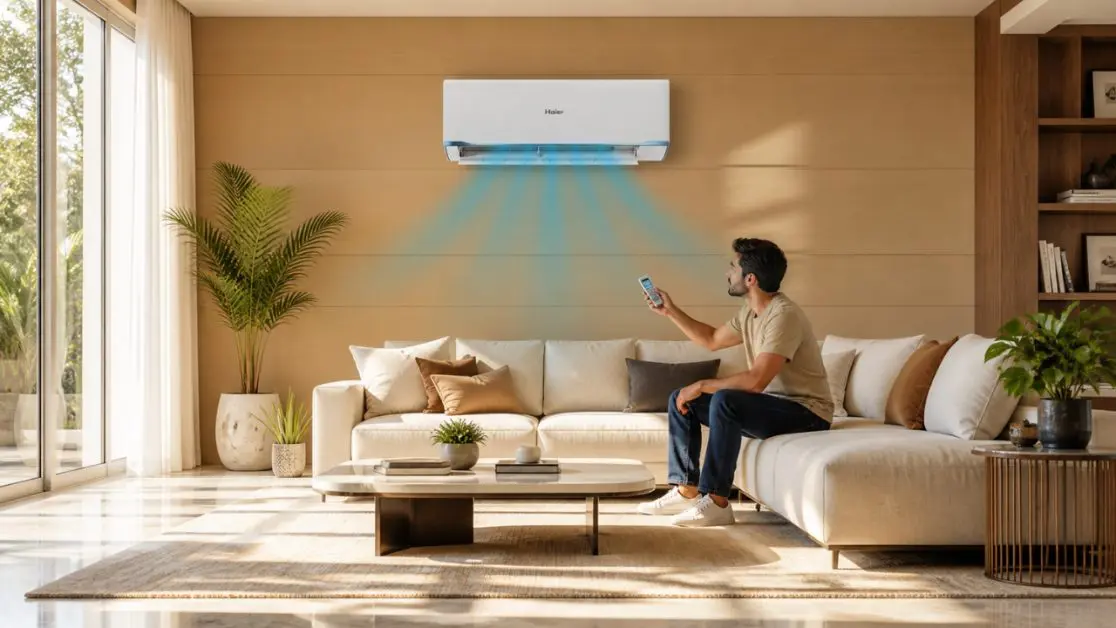
Some systems can deliver airflow up to 20 metres and provide rapid cooling within seconds, creating immediate comfort in extreme heat .
Why this matters
Fast cooling is not about luxury.
It is about recovery.
Coming back from 45°C heat into a room that cools instantly changes how you experience your home.
Insight:
Speed shapes perception. Consistency builds comfort.
Convertible capacity: Flexibility for real life
Life is not static.
Rooms change.
People move.
Usage shifts.
Your AC should adapt.
What convertible modes offer
- Adjustable cooling capacity
- Lower energy use during mild weather
- Higher performance during peak heat
Some systems allow capacity adjustments from 40 percent to 110 percent, balancing performance and efficiency based on need .
Real-world example
- Afternoon heat → full capacity
- Late night → reduced capacity
- Monsoon → minimal cooling
Insight:
Flexibility is efficiency in disguise.
A simple checklist before you buy
To simplify everything, here is a practical decision system.
Your AC buying framework
- Room size and heat exposure
- Inverter technology for efficiency
- 5-star rating for long-term savings
- High ambient cooling capability
- Smart features for automation
- Strong airflow for faster comfort
- Convertible modes for flexibility
Where Haier fits into this system
Not as a brand pushing features.
But as a system builder.
Take something like the Haier 1.8 Ton 5 Star Desert Rose Air Conditioner (HSA20DSD-NAI5NB-I).
It combines:
- AI-driven cooling and energy optimisation
- Human detection to reduce waste
- Cooling even at 60°C conditions
- Convertible capacity for flexibility
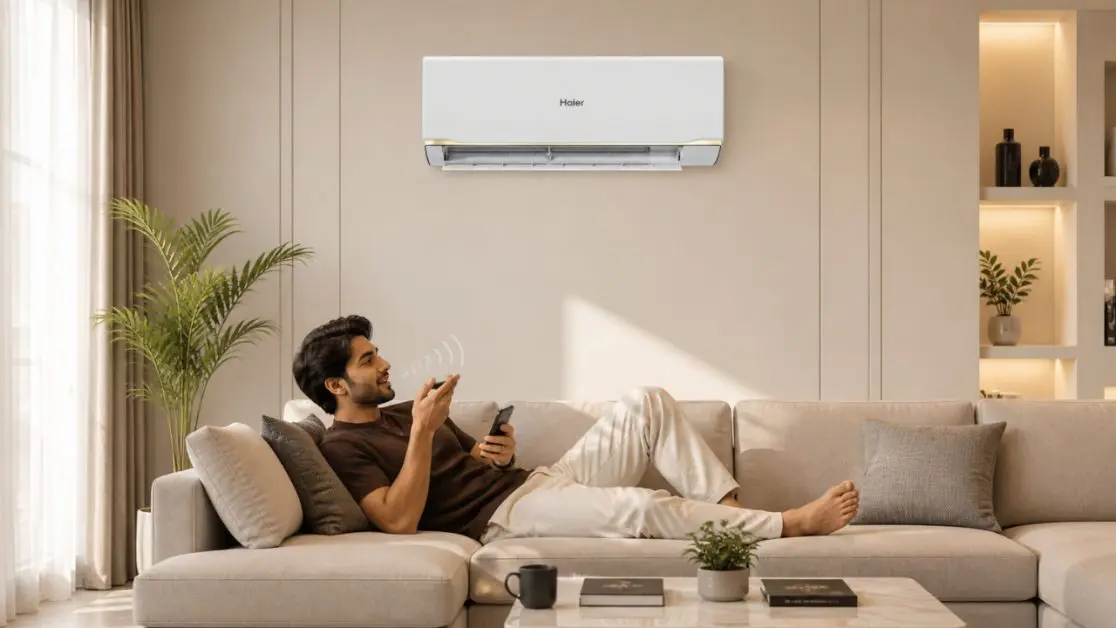
- Smart app and voice control
All working together.
Not as separate features.
But as a system.
You can explore the full feature set here:
The bigger shift: From appliances to intelligent environments
The way we buy ACs is changing.
Earlier, we asked:
- How powerful is it?
- How much does it cost?
Now the better questions are:
- How well does it adapt?
- How much does it simplify life?
Because the goal is not cooling.
The goal is comfort without effort.
Conclusion: The one decision that matters most
Here is the truth most people miss.
Buying an AC is not about choosing a machine.
It is about choosing a system that will run every day, quietly shaping your comfort, your electricity bill, and your routines.
The best AC is the one you do not have to think about.
It just works.
It adjusts.
It fits into your life without asking for attention.
And once you experience that, you do not go back.
Because the real upgrade is not colder air.
It is a home that feels sorted, without you constantly managing it.
Frequently Asked Questions
Why does buying an AC feel so overwhelming at night when you just want relief?
Because you’re not just buying a product you’re trying to solve discomfort quickly. The overload of specs (tonnage, inverter, stars) doesn’t map clearly to your real problem: heat vs humidity vs mixed conditions. Once you identify your specific cooling need, decisions become simpler.
I searched “best AC for home” and got hundreds of options. How do I even start?
Start with your use case, not the product:
Dry heat → prioritize fast cooling + higher capacity
Humid climate → focus on moisture removal + steady cooling
Mixed conditions → go for adaptive / smart ACs
I come home from extreme heat. Why does some AC cooling feel slow and frustrating?
Because airflow and cooling speed matter more than specs at that moment. ACs with:
High air throw (15–20m)
Turbo / fast cooling modes
Help your body recover faster from heat shock.
Do you actually need smart features, or are they just marketing?
They solve a real problem: constant manual adjustments.
Smart ACs:
Auto-adjust temperature
Learn your patterns
Reduce energy waste
They reduce daily friction, not just add features.
Will you actually use app control and voice features in daily life?
Yes especially in routines like:
Turning AC on before reaching home
Adjusting settings without getting out of bed
Integrating with smart home systems
What does “AI cooling” actually mean for you?
It means:
Learning your habits
Adjusting temperature automatically
Optimizing energy use
It removes decision-making rather than adding complexity.