
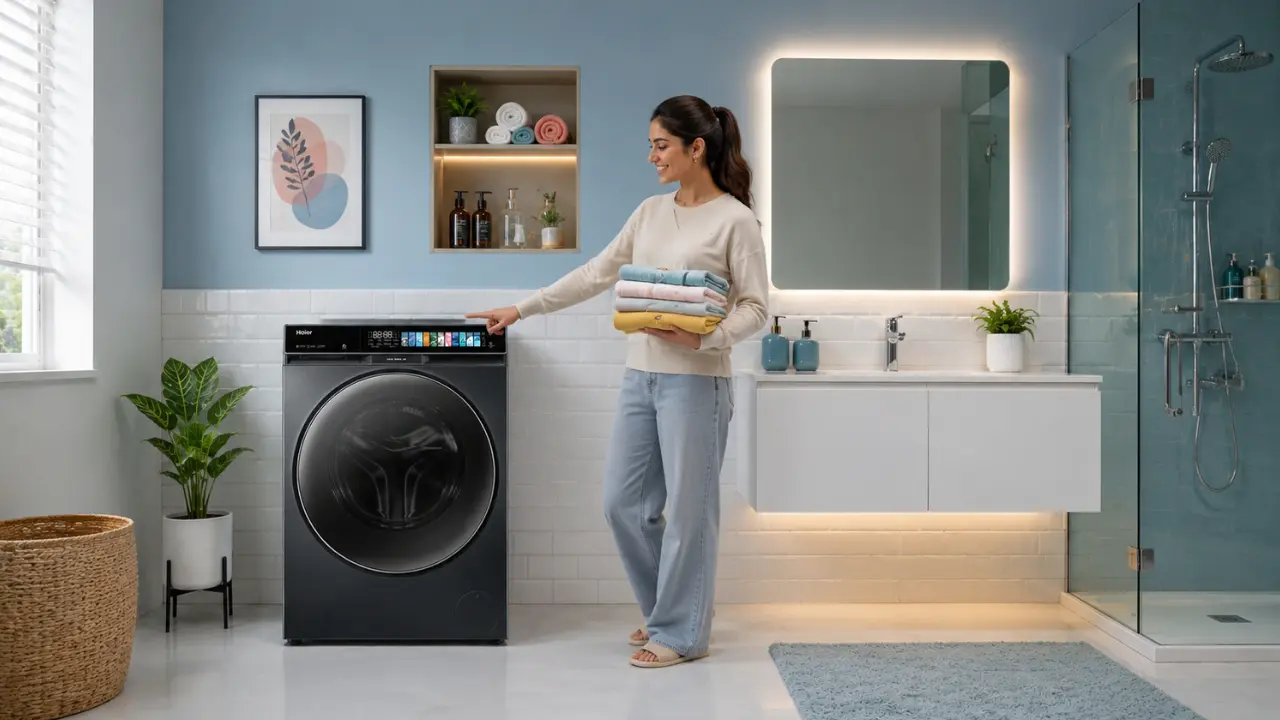

Color changes behaviour faster than instructions do
Colorful display panels make appliances easier to understand, faster to use, and more intuitive during everyday routines. In Indian homes where mornings move quickly and multiple people use the same appliance differently, visual displays reduce confusion, improve accessibility, and make technology feel less mechanical. Good design does not just look modern. It reduces friction.
A washing machine used to speak in symbols.
Tiny icons. Hard knobs. Confusing abbreviations.
Most people learned through trial and error.
Someone pressed the wrong setting.
Someone restarted the cycle.
Someone called another family member for help.
That was normal.
But something changed when appliances started becoming visual instead of mechanical.
Suddenly, screens began guiding behaviour instead of merely responding to buttons.
And that matters more than people realise.
Because most household stress does not come from big problems.
It comes from repeated micro-confusion.
Which button?
Which mode?
How much time is left?
Did the machine actually start?
A colorful display panel quietly solves these invisible questions.
Not dramatically.
Systematically.
Modern homes run on visual clarity
A modern Indian kitchen or laundry area is no longer a “utility corner.”
It is part of the living experience.
Young couples setting up apartments in Bengaluru.
Parents managing school uniforms before 7 AM.
Working professionals reheating dinner after late office calls.
Everyone interacts with appliances while distracted.
That changes what good design means.
People do not read manuals anymore
They scan.
They glance.
They interpret colour faster than text.
That is not laziness. It is human behaviour.
Research from the Nielsen Norman Group repeatedly shows that visual hierarchy improves task completion speed and lowers user confusion in digital interfaces.
The same principle applies inside homes.
A blue cooling indicator feels calmer.
A red heat icon signals urgency immediately.
Green signals confirmation faster than words ever could.
Colour compresses information.
That is why airport systems, traffic lights, cricket score graphics, and food delivery apps rely heavily on colour-based guidance.
Appliances are evolving the same way.
A colorful display panel reduces decision fatigue
Decision fatigue sounds like a workplace concept.
It is not.
It lives inside homes too.
Especially Indian homes.
Small decisions pile up faster than people notice
Which wash mode should run today?
How much cooling is enough?
Is eco-mode active?
How long until dinner reheats?
Individually, these questions feel tiny.
Collectively, they drain attention.
A well-designed colorful display panel reduces that mental load.
Instead of decoding symbols, users recognise patterns instantly.
For example:
- Blue often communicates cooling or freshness
- Orange or red signals heating or active cooking
- Green usually confirms completion or energy-efficient operation
- Animated indicators create real-time reassurance
The machine feels responsive.
Alive, almost.
That emotional response matters because appliances now live in open spaces, not hidden utility rooms.
Technology adoption depends on emotional comfort
People assume smart appliances succeed because of specifications.
Not entirely.
They succeed because they feel understandable.
That distinction changes everything.
One option is complexity disguised as innovation.
The second option is simplicity disguised as elegance.
The second one wins long term.
Always.
Colorful displays help multi-generational households
Indian households rarely operate like single-user systems.
Parents.
Grandparents.
Teenagers.
Domestic helpers.
Guests.
Everyone interacts differently with appliances.
That creates friction.
Good interfaces reduce dependency between family members
Older appliance systems often created “knowledge bottlenecks.”
One person knew how everything worked.
Everyone else depended on them.
You still see this in many homes.
“Wait till Papa comes.”
“Ask your brother.”
“Don’t touch that button.”
A colorful display changes that dynamic.
Visual cues create confidence.
Even first-time users can interpret functions faster because colour reduces ambiguity.
This matters particularly in appliances like:
- Front-load washing machines
- Microwaves
- Air conditioners
- Refrigerators with smart modes
The interface becomes instructional without feeling instructional.
That is a powerful design.
Haier’s modern appliance interfaces reflect this shift
Products like the Haier HW120-DM14F11BKU1 12 Kg Front Load Fully Automatic Washing Machine, Haier 12 Kg Front Load Washer and Dryer, and Haier 10 Kg F9 Pro Front Load Fully Automatic Washing Machine increasingly move toward cleaner digital interaction systems that prioritise visibility and usability for everyday households.
The colorful display panels on modern front-load washing machines do more than show numbers.
They create confidence during daily use.
Users can quickly understand wash progress, drying status, temperature selection, spin speed, child lock indicators, and smart program settings without constantly referring back to manuals.
That matters during real life.
During rushed office mornings.
During school uniform emergencies.
During late-night laundry cycles after long commutes.
Because homes function better when appliances communicate clearly.
That is the real upgrade.
The hidden benefit is speed
Most appliance conversations still revolve around performance metrics.
RPM.
Capacity.
Power consumption.
Star ratings.
Useful? Yes.
Complete? No.
Because speed inside homes is not only about machine speed.
It is about human speed.
Fast understanding changes daily routines
A display panel that instantly shows:
- Remaining wash time
- Water temperature
- Drying progress
- Energy-saving mode
- Delay timer status
reduces interruptions throughout the day.
The appliance stops demanding attention repeatedly.
That matters during office calls.
During school mornings.
During dinner preparation.
Every reduced interruption protects mental bandwidth.
And mental bandwidth is becoming one of the most valuable household resources.
Smart homes are really attention-management systems
That sounds abstract until you observe modern life closely.
Notifications everywhere.
Screens everywhere.
Multiple tasks overlapping constantly.
The best appliances reduce cognitive noise instead of adding to it.
A colorful display panel acts like a quiet traffic system.
Not loud.
Not flashy.
Just clear.
Good display design improves energy awareness
Most people want energy-efficient appliances.
Few people consistently track usage behaviour.
That gap matters.
Visual feedback changes consumption habits
When users can see eco modes, power indicators, or cycle optimisation visually, behaviour changes naturally.
This principle appears everywhere:
- Fitness apps use rings and colours
- Budget apps use red/green expense indicators
- Navigation apps use traffic colour mapping
Humans respond to visual systems emotionally before logically.
Appliances are beginning to use the same psychology.
A visible eco-mode indicator creates subtle accountability.
People begin noticing patterns:
- Which settings consume more energy
- Which cycles run longer
- Which temperature settings feel excessive
That awareness often reduces unnecessary consumption over time.
Not through lectures.
Through visibility.
Information only matters when people notice it
That is the hidden problem with many older appliances.
The information technically existed.
But nobody saw it.
Or understood it quickly enough.
A colorful display solves this by making information emotionally legible.
That phrase matters.
Emotionally legible.
Because people do not interact with appliances as engineers.
They interact as tired humans trying to make life smoother.
Colorful display panels also change aesthetics
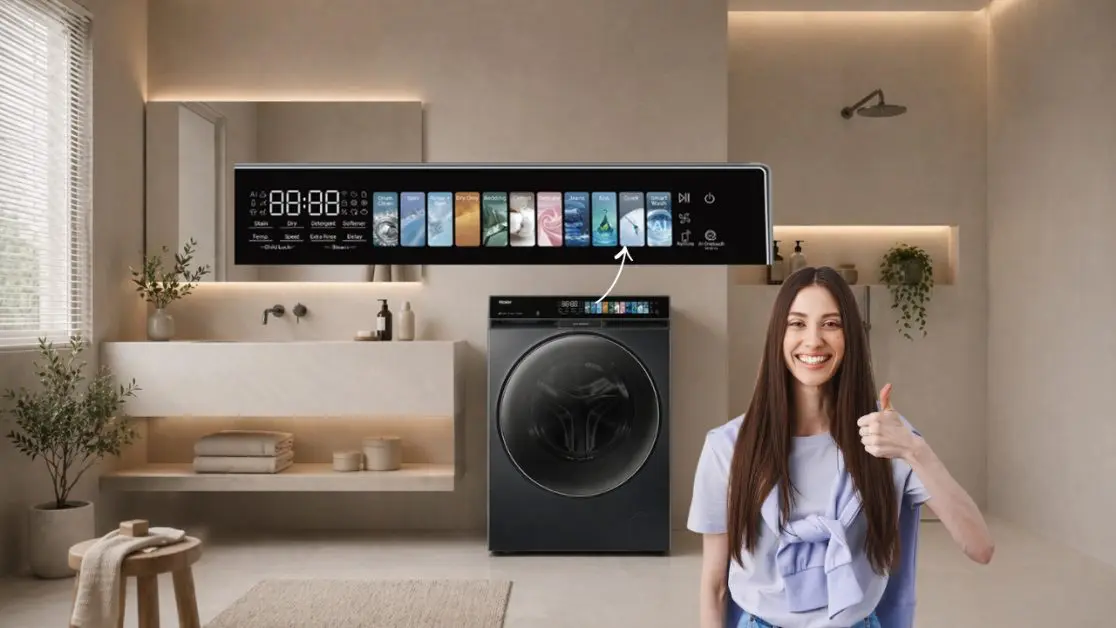
There is another shift happening quietly inside Indian homes.
Appliances are no longer hidden.
They are displayed.
The appliance became part of interior design
Open kitchens changed this.
Studio apartments accelerated it.
Instagram finished the job.
Now the microwave sits visibly beside ceramic jars.
The washing machine occupies designed utility balconies.
The refrigerator becomes part of kitchen aesthetics.
That changes expectations.
People no longer want machines that merely function.
They want appliances that feel aligned with their home environment.
A colorful display contributes surprisingly strongly to that feeling.
Soft illumination.
Minimal layouts.
Balanced colour tones.
The appliance feels intentional instead of industrial.
That emotional shift influences buying decisions more than many brands admit.
Modern households buy systems, not standalone products
That is the broader pattern.
People do not buy a washing machine separately from their lifestyle anymore.
They buy:
- Reduced stress
- Better routines
- Cleaner aesthetics
- Faster interaction
- Easier decision-making
The appliance becomes part of the emotional architecture of the home.
And interfaces matter inside emotional systems.
The future of appliances is not more buttons
There are fewer explanations.
That is where colorful display panels matter most.
The best technology does not show intelligence aggressively.
It removes confusion quietly.
A smart display panel does not merely tell users what the machine is doing.
It reassures them.
And reassurance is underrated in modern life.
Especially in homes where everything already competes for attention.
The future appliance is not the loudest machine.
Not the most complicated one.
Not even the one with the longest feature list.
It is the one that feels easiest to live with every single day.
That is the real role of colorful display panels.
Not decoration.
Clarity.
And clarity is one of the rare technologies that improves almost every system it touches.
Frequently Asked Questions
How does a colorful display panel make appliances easier to use?
A colorful display panel communicates information visually, helping users understand appliance status, settings, and progress at a glance. Instead of decoding symbols or abbreviations, users can quickly interpret colors, icons, and animations.
Can a colorful display panel actually reduce decision fatigue?
Yes. By clearly highlighting active modes, cycle progress, temperatures, and recommended settings, colorful displays reduce the number of small decisions users must make throughout the day, making appliance interaction faster and less mentally demanding.
Why do I find appliances with colorful displays less confusing than traditional models?
Humans process visual information faster than text. Colors create instant recognition, green often means complete, blue suggests cooling, and red indicates heat or activity, making operation feel more intuitive.
I am always rushing in the morning. Can a colorful display save me time?
Absolutely. A clear display shows cycle status, remaining time, and active settings immediately, reducing the need to check manuals or restart cycles because of incorrect selections.
Are colorful display panels useful for families with older adults?
Yes. Large icons, clear color indicators, and simplified visual feedback help older adults understand appliance functions without memorizing complex button combinations.
Can grandparents or first-time users operate modern appliances more confidently?
In many cases, yes. Visual cues reduce ambiguity and make it easier to understand what the appliance is doing, even without prior experience.
How do colorful displays help in households where multiple people use the same appliance?
They reduce dependence on a single “expert” family member by making settings and machine status easier for everyone to understand.