
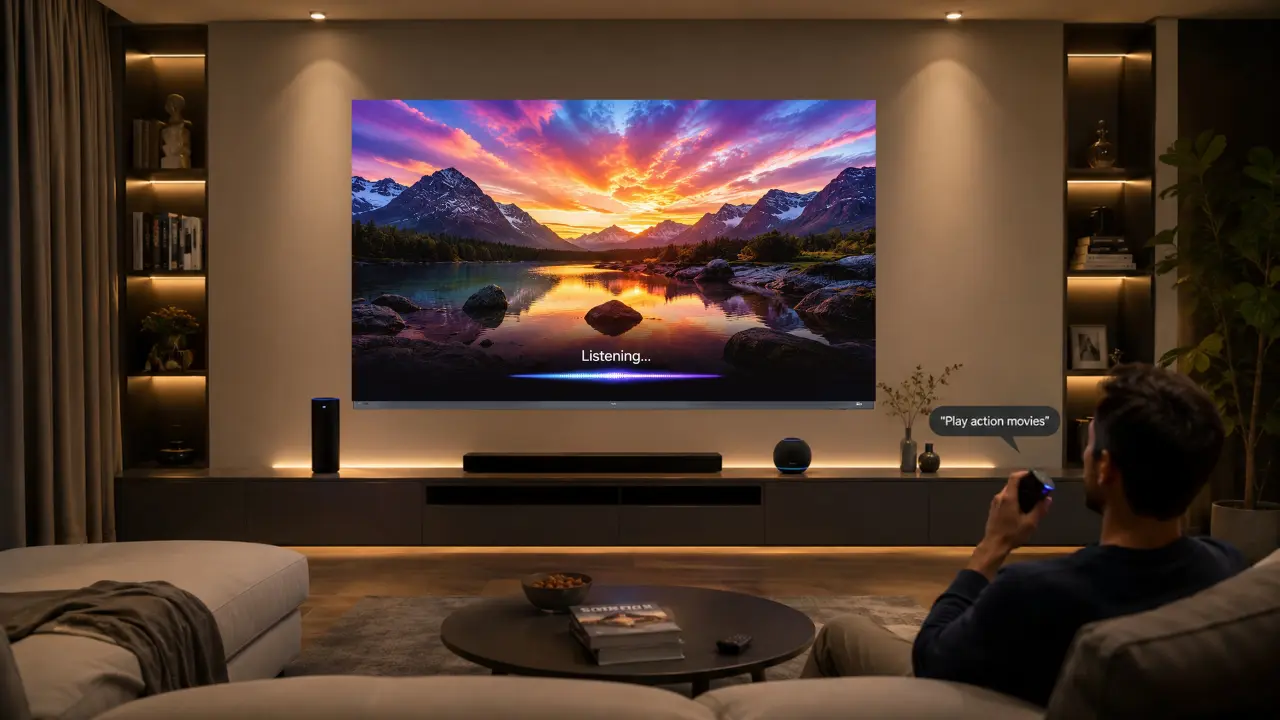

For years, the television remote ruled the living room.
Then something interesting happened.
People stopped wanting to press buttons.
A child wants cartoons. A parent wants cricket highlights. Someone else wants a thriller on an OTT platform they can barely remember the name of. Nobody wants to scroll endlessly through menus anymore.
So they talk.
“Play IPL highlights.”
“Open YouTube.”
“Show action movies.”
“Turn up the volume”
With that simple phrase, entertainment consumption begins.
It’s a small shift, but it’s quietly revolutionizing the way Indian families are interacting with technology. Voice is no longer an experimental feature locked away in high-end devices. Voice is rapidly becoming the main way consumers discover, access, and control entertainment.
Say hello to voice-first entertainment.
And good-bye with AI-powered televisions leading the charge.
Entertainment is going conversational
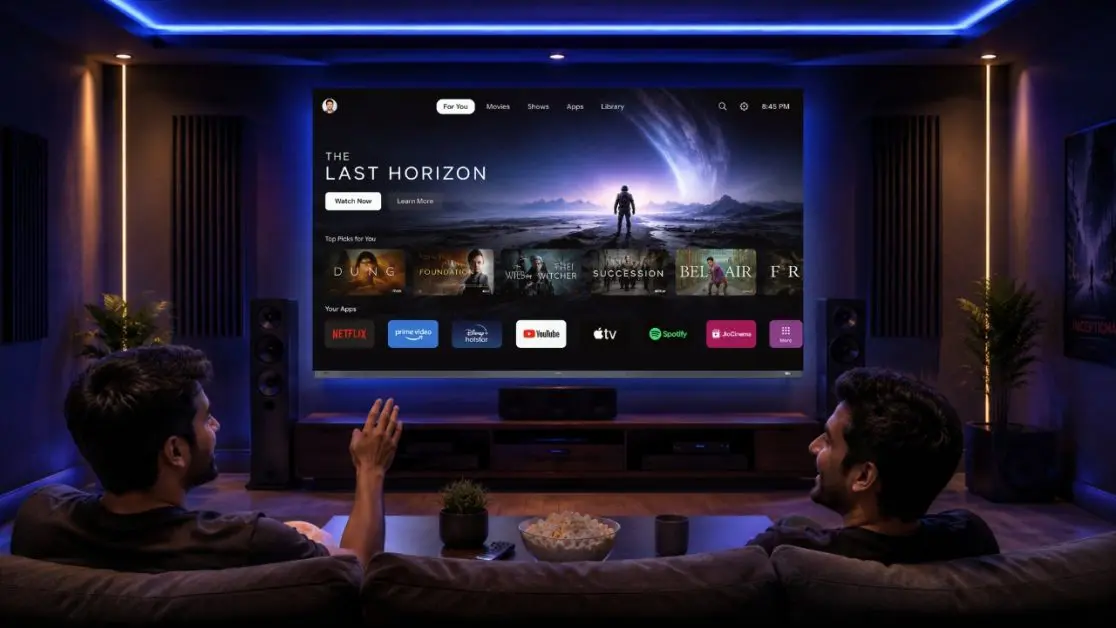
Let’s start with a little thought exercise.
Picture your day-to-day life.
You talk to a lot of people face-to-face all day long. You ask questions. You issue commands. You expect answers.
Slowly but surely, technology is molding itself around that behavior.
Instead of humans learning how to operate devices…these devices are learning how we communicate.
That changes everything.
Traditional television interactions looked like this:
- Pick up remote
- Open menu
- Navigate applications
- Search manually
- Select content
- Adjust settings
Voice-first entertainment removes many of those steps.
Instead, users simply speak.
The experience feels less like operating a machine and more like interacting with an assistant.
For Indian households where multiple generations share one television, this convenience becomes especially valuable.
Grandparents who may not be comfortable navigating complex menus can simply ask for devotional content.
Children can quickly access educational videos.
Parents can switch between streaming platforms without searching through dozens of applications.
The technology becomes accessible to everyone.
Not just the tech-savvy members of the family.
Why AI Is the Real Engine Behind Voice-First TV Experiences
Voice control alone is not the story.
Artificial Intelligence is.
A television that merely hears commands is useful.
A television that understands context, recognises preferences, improves recommendations, adjusts picture settings, and enhances sound automatically becomes something entirely different.
Modern AI-powered televisions process multiple layers of information simultaneously.
These include:
Content Recognition
The TV identifies what is playing and optimises viewing settings accordingly.
Picture Enhancement
AI analyses scenes and adjusts:
- Contrast
- Brightness
- Colour accuracy
- Depth perception
- Motion clarity
Audio Optimisation
Different content requires different sound profiles.
A cricket match, a Bollywood blockbuster, and a wildlife documentary all benefit from unique audio tuning.
Personalised Recommendations
Over time, AI helps surface content that matches viewing preferences instead of forcing viewers to browse endlessly.
The result?
Less searching.
More watching.
And significantly less frustration.
The Growing Demand for Hands-Free Living Rooms

Something else is changing.
The television is no longer just a television.
It is becoming the centre of the connected home.
People stream movies.
Play games.
Attend virtual meetings.
Cast content from smartphones.
Control smart devices.
Listen to music.
Check information.
All from one screen.
Naturally, voice interaction becomes more important as responsibilities increase.
A voice-enabled TV allows users to perform everyday actions without interrupting what they are doing.
Common voice-first interactions now include:
- Launching OTT apps
- Playing music playlists
- Searching for movies
- Checking sports scores
- Adjusting volume
- Controlling connected smart devices
- Switching inputs
- Accessing personalised content recommendations
The convenience becomes surprisingly addictive.
After using voice controls regularly, going back to traditional navigation often feels unnecessarily complicated.
Where Haier Is Shaping the Next Generation of Voice Entertainment
The conversation around AI-powered televisions becomes far more meaningful when the underlying hardware can support intelligent experiences.
This is where Haier’s latest Mini LED television range stands out.
The new Haier Mini LED TV portfolio has been designed around a simple but powerful idea:
Technology should adapt to people.
Not the other way around.
The latest lineup includes:
Haier New M92 Series 164cm (65) QD-Mini LED AI Smart Google TV (H65M92FUX)
Haier New M92 Series 189cm (75) QD-Mini LED Smart AI Google TV (H75M92FUX)
Haier M96 Series 254cm (100)QD Mini LED Smart Google TV AI Enabled Led TVs (H100M96FUX)
From AI Smart Assistants, to voice commands, immersive sound and Premium Mini LED Displays. Here’s how these features come together to create a truly Smart TV.
Why are these Smart TVs designed for voice-first entertainment?
Voice Control (Hands Free)
First and foremost. You guessed it.
Smart TVs from the M92 and M96 series support hands-free voice control. You can control your TV, access your entertainment and communicate with your connected devices by talking instead of reaching for the remote.
Translation:
- Faster content discovery
- Easier navigation
- Improved accessibility
- More natural interaction
No searching.
No typing.
No endless scrolling.
AI Ultra Sense Processor
A voice-first experience only works when the television responds intelligently.
The AI Ultra Sense Processor helps achieve this by enabling:
- Fast scene recognition
- Intelligent picture tuning
- Motion enhancement
- Contrast optimisation
- Depth enhancement
The television continuously analyses content and adjusts output for a more refined viewing experience.
Voice Search Is Changing Content Discovery
Perhaps the biggest transformation isn’t control.
It’s a discovery.
People no longer search the way they used to.
Instead of typing:
“Best Hindi thriller movie”
They simply ask:
“Show me good Hindi thrillers.”
Voice search feels more human because it mirrors natural conversation.
This behavioural shift is why modern Google TV ecosystems are becoming increasingly important.
The Haier M92 and M96 Series integrate Google TV, helping users access personalized recommendations, curated content collections, and simplified navigation through voice-driven interaction.
The technology reduces friction.
And friction is often the hidden enemy of entertainment.
Beyond Voice: Why the Viewing Experience Still Matters
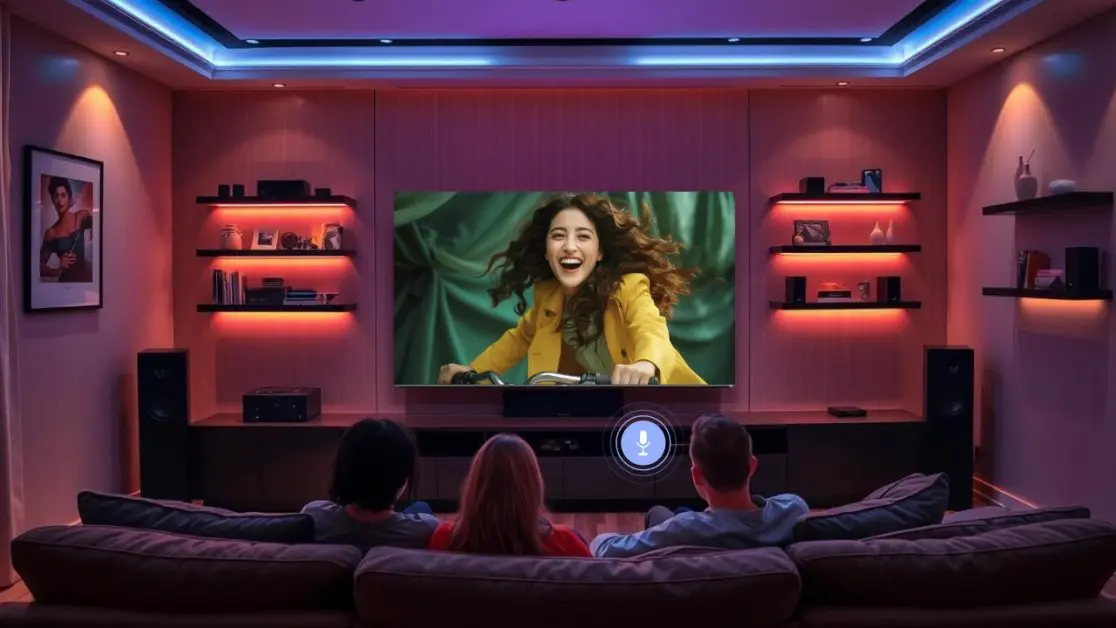
Voice control might get attention.
Picture quality keeps people engaged.
The latest Haier Mini LED televisions combine intelligent controls with premium display technologies such as:
- QD Mini LED technology
- Dolby Vision IQ
- HDR10+
- 144Hz refresh rate
- AI picture optimisation
This combination helps create deeper blacks, vibrant colours, improved contrast, and smoother motion handling for movies, sports, and gaming content.
Because let’s be honest.
Nobody buys an advanced television just to talk to it.
They buy it because they want a better entertainment experience.
Voice simply makes that experience easier to access.
Audio Matters More Than Most People Realise
A surprising number of TV buying decisions still focus entirely on screens.
Yet audio shapes immersion just as much.
Haier addresses this with:
- Sound by KEF
- Dolby Atmos
- 2.1 Channel Speaker Systems
Total Sonic Audio Technologies
The result is richer, more detailed sound designed to complement AI-enhanced visuals and voice-driven convenience.
When a television can hear you clearly and respond intelligently, it should also sound exceptional.
Fortunately, both sides of the equation are addressed.
The Future of Entertainment Sounds More Like a Conversation
Not long ago, televisions waited for instructions.
Now they anticipate needs.
They optimize content automatically.
Recommend what to watch.
Improve visuals in real time.
Connect with smart homes.
Respond to voice commands.
And increasingly, they fit naturally into everyday life.
Voice-first entertainment is not replacing traditional viewing.
It is removing unnecessary barriers between people and the content they enjoy.
For Indian consumers looking for a television that combines AI intelligence, premium Mini LED visuals, immersive sound, gaming capabilities, and hands-free convenience, Haier’s latest M92 and flagship M96 Series represent where television technology is heading next.
The future living room will not be controlled by buttons.
It will be guided by conversation.
And that future is already here.
Frequently Asked Questions
Why do movies feel more immersive on larger screens?
Larger screens fill more of your field of view, making visuals feel more engaging and cinematic.
Does a bigger TV improve cricket viewing?
Yes. Larger displays make it easier to follow player movements, ball trajectories, and on-screen statistics.
Are larger TVs better for OTT content?
High-resolution OTT content often benefits from larger displays because viewers can appreciate finer details and visual effects.
Why are gamers increasingly choosing larger televisions?
Bigger screens create a more immersive gaming experience and make environmental details easier to see.
Is there a point where a TV becomes too large for casual viewing?
If the screen dominates your field of view excessively or requires head movement to follow content, it may be larger than ideal for the space.