
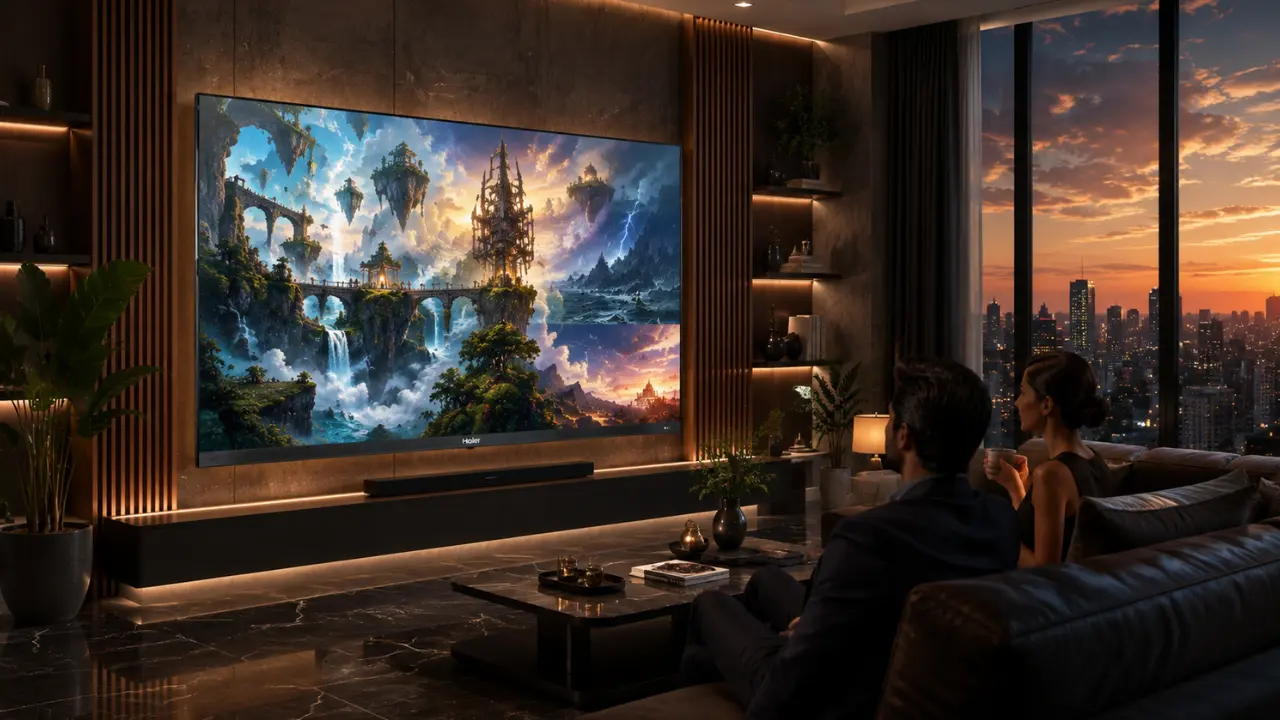

A footballer sprints across the field. Cut to a close-up of the crowd. A few seconds later, the broadcast switches to a slow-motion replay under bright stadium lights.
To a conventional television, these are simply changing frames.
To a television equipped with AI scene recognition, they are different visual situations that may require different picture adjustments. Fast motion needs better tracking. Faces need natural skin tones and sharper detail. Floodlit grass needs balanced colour rather than exaggerated green. The dark stands in the background should retain depth instead of turning into a flat black patch.
That continuous interpretation is where AI scene recognition begins.
What Is AI Scene Recognition in a TV?
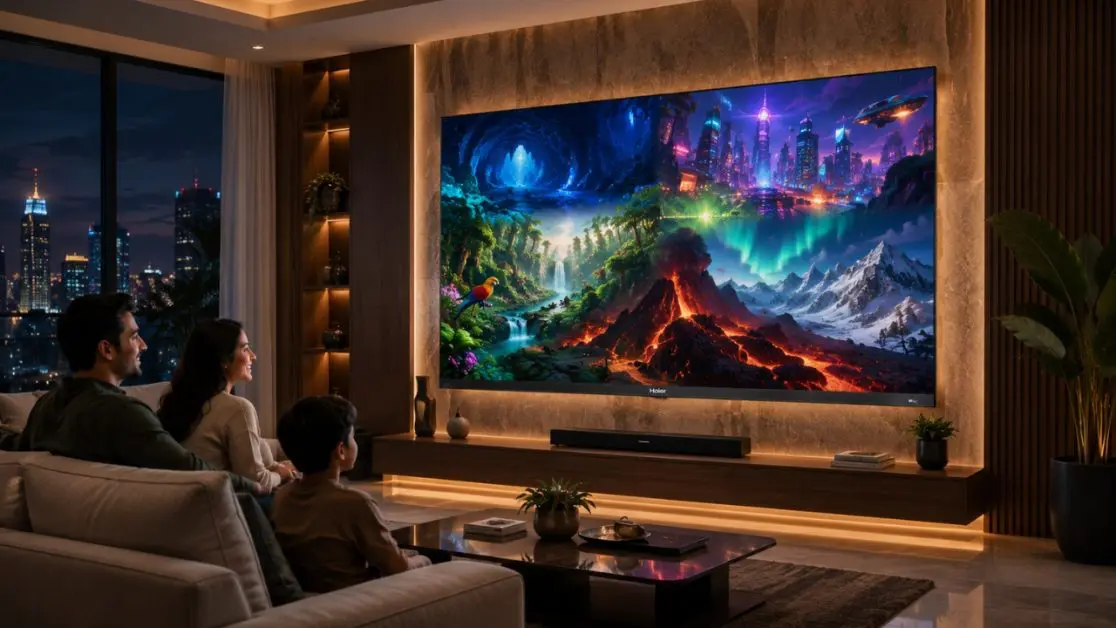
AI scene recognition is a picture-processing capability that analyses the content appearing on the screen and identifies the type of scene being displayed. The television’s processor then makes suitable adjustments to elements such as colour, contrast, sharpness, motion and depth.
The important word here is context.
A television should not treat a dimly lit thriller, a cricket match, an animated film and a wildlife documentary in exactly the same way. Each contains different visual information. AI-assisted processing helps the TV respond to those differences in real time rather than relying only on one fixed picture setting.
In the Haier M92 and M96 QD-Mini LED AI Smart Google TV series, the AI Ultra Sense Processor is designed to support fast scene recognition and intelligent tuning. Haier states that the processor works with enhanced AI picture technologies to improve motion, colour, contrast and depth according to the content being shown.
The Process Happens Before You Notice It
There is no need to pause a film and manually select a different picture mode whenever the camera angle changes. AI scene recognition operates in the background.
Broadly, the process involves four steps:
- The processor examines the incoming image.
It studies visual cues such as objects, faces, movement, brightness and colour distribution. - The scene is categorised.
The system determines whether the content resembles sport, scenery, a close-up, animation, a dark sequence or another recognisable scene type. - Relevant picture parameters are adjusted.
Colour saturation, highlight detail, shadow depth, motion handling or sharpness may be refined. - The process repeats continuously.
As the programme moves from one shot to another, the television keeps reassessing the image.
It sounds complicated. For the viewer, though, the intended outcome is fairly simple: a picture that looks more balanced without constant menu adjustments.
The Technologies Working Behind Scene Recognition
AI scene recognition is not one isolated feature. It becomes useful when it works alongside other picture-processing tools.
The Haier AI Ultra Sense Processor brings together several AI-led functions, including AI Scene Detection, AI-SR, AI-Colour Boost Pro, AI-HDR Enhancer Pro, AI-Depth and AI-Motion. The product material states that AI Scene Detection can recognise eight key scene types and apply real-time image improvements.
| AI picture function | What it is designed to improve | Where viewers may notice it |
| AI Scene Detection | Recognition of different scene types | Films, sport, travel content and everyday streaming |
| AI-SR | Enhancement of lower-resolution images | Older videos or content that is not native 4K |
| AI-Colour Boost Pro | Colour vibrancy and saturation | Nature scenes, animation and colourful entertainment |
| AI-HDR Enhancer Pro | Highlight detail and contrast | Bright skies, reflections, fire and shadow-heavy scenes |
| AI-Depth | Focus-area brightness, sharpness and detail | Portraits, close-ups and layered cinematic shots |
| AI-Motion | Tracking of moving objects and motion paths | Cricket, football, racing and action sequences |
Why Automatic Picture Tuning Matters
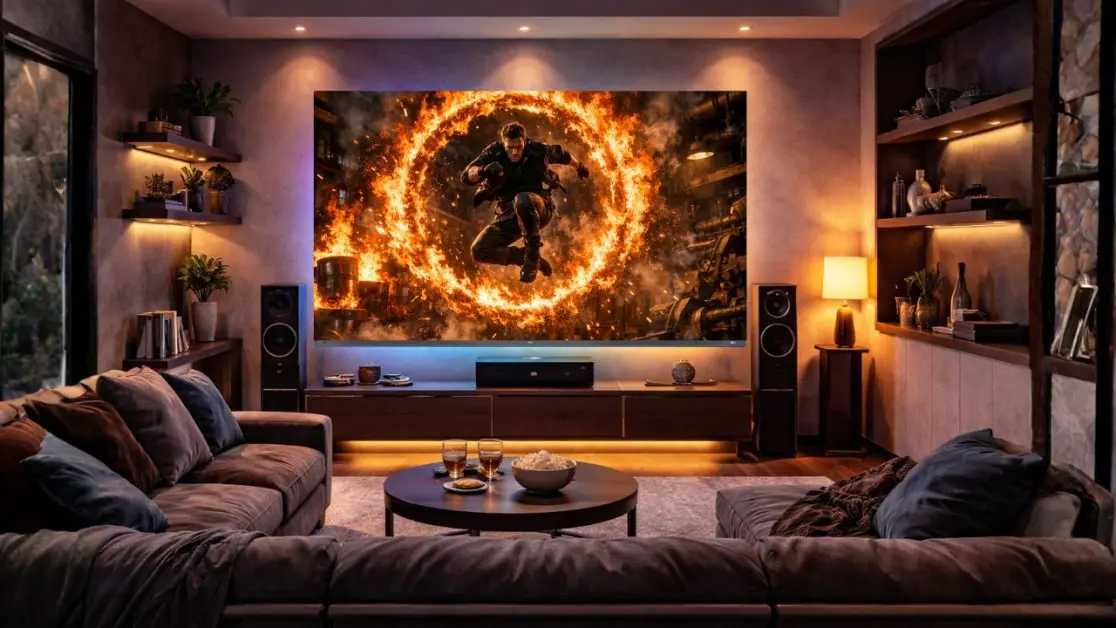
Most households do not watch one kind of content all day.
A typical Indian family may begin with morning news, switch to cartoons, stream a film in the afternoon and watch a live match at night. The room itself changes too. Daylight enters through the curtains, lights come on after sunset, and viewing conditions become darker later in the evening.
Manually correcting the television every time is possible. Realistically, very few people will bother.
AI scene recognition helps reduce that dependence on repeated adjustments. It allows the television to respond more intelligently as the visual material changes. This can be particularly useful on a large QD-Mini LED display, where weak motion handling, artificial colours or lost shadow detail become easier to notice.
The idea is not to make every frame excessively bright or unnaturally sharp. Good processing should preserve the character of the content while making important details easier to see.
And that distinction matters. A smart television should not merely display more effects; it should make better decisions about when those effects are actually needed.
AI Scene Recognition Meets Intelligent Viewing
Picture quality alone doesn’t tell the whole story anymore.
A premium television also needs the intelligence to respond when your environment changes. Maybe sunlight is pouring into the living room during an afternoon cricket match. A few hours later, you’re watching a suspense thriller with the lights switched off. The screen shouldn’t force you to keep reaching for the settings menu.
This is where AI-powered processing becomes even more practical.
For example, the Haier M92 Series pairs AI Scene Recognition with Dolby Vision IQ, allowing picture performance to adapt according to ambient lighting. Alongside this, AI Ambient Sense is designed to automatically increase brightness and colour temperature in brighter surroundings while reducing them in darker environments for a more comfortable viewing experience.
The result is a television that doesn’t simply recognise what’s playing it also considers where you’re watching it.
Everyday Situations Where AI Scene Recognition Makes a Difference
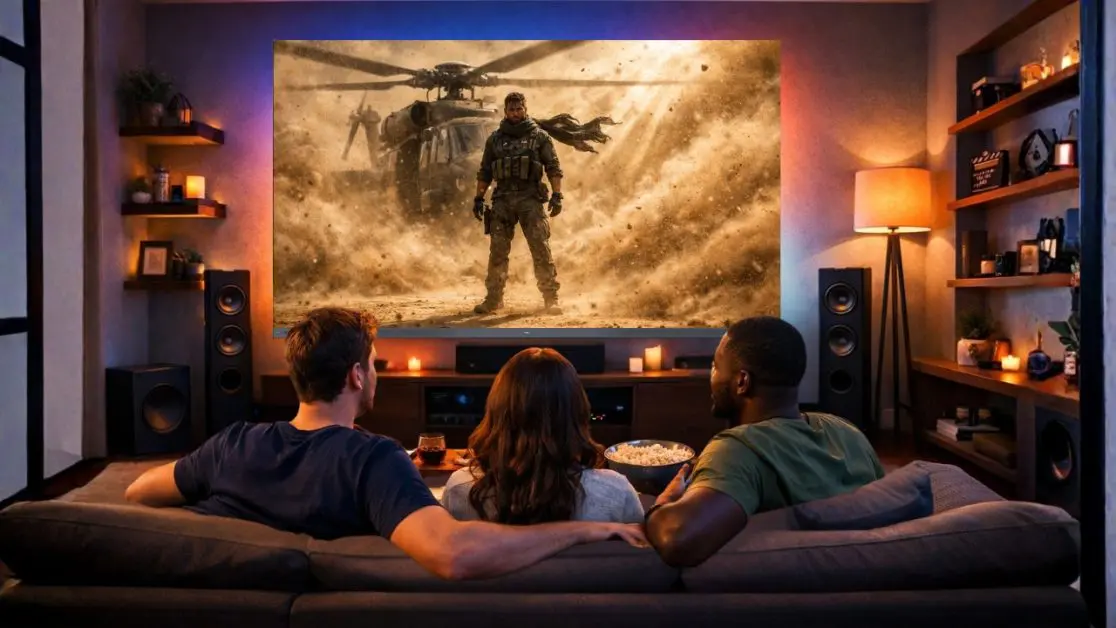
Most people don’t buy a television just for movie nights.
It becomes part of everyday life, handling everything from YouTube recipes to IPL matches, OTT marathons and gaming sessions. AI scene recognition is useful because it quietly adapts across these different experiences.
While Watching Live Sports
Fast-moving action demands smooth motion and consistent detail.
Whether it’s football, Formula 1 or cricket, the television needs to follow quick movement without excessive blur.
Combined with the 144Hz refresh rate, AI Motion processing helps maintain smoother movement during fast-paced content, making action sequences feel more fluid.
During Movie Nights
Films often shift between bright outdoor landscapes and dim interior scenes.
Instead of crushing dark details or overexposing highlights, AI picture optimisation works alongside HDR technologies to balance contrast more naturally.
This becomes particularly noticeable during:
- Night-time city scenes
- Sci-fi movies with bright visual effects
- Historical dramas with candle-lit interiors
- Nature documentaries featuring both sunlight and deep forests
Streaming Older Content
Not everything we watch is native 4K.
Classic films, archived television shows and older online videos often contain lower-resolution footage.
Features such as AI-SR are designed to enhance lower-resolution images, helping older content appear cleaner on today’s large-screen televisions.
Casual Gaming
Gaming visuals change constantly.
One moment you’re exploring bright open worlds. The next, you’re racing through dark tunnels or engaging in fast multiplayer action.
Working alongside gaming technologies such as VRR, ALLM and AMD FreeSync Premium Pro, AI picture optimisation helps maintain responsive visuals while adapting to changing scenes.
What Should You Look For in an AI-Powered Television?
Not every TV that mentions “AI” delivers the same experience.
When comparing premium models, consider whether the television includes features that genuinely improve day-to-day viewing rather than simply adding another marketing label.
Some practical checkpoints include:
- Dedicated AI picture processor
- Real-time scene recognition
- Motion enhancement for sports
- HDR optimisation
- Intelligent colour enhancement
- Ambient light adaptation
- High refresh rate support
- Quality audio system to complement picture performance
The more these technologies work together, the more natural the viewing experience becomes.
Why the Haier M92 and M96 Series Stand Out
If you’re planning to upgrade to a premium large-screen television, processing intelligence deserves just as much attention as screen size.
Haier’s latest M92 QD-Mini LED AI Smart Google TV Series and flagship M96 QD-Mini LED AI Smart Google TV Series bring together multiple technologies instead of relying on one headline feature.
Some of the highlights include:
AI-Centric Picture Processing
- AI Ultra Sense Processor for intelligent scene recognition and image tuning
- AI Scene Detection
- AI Motion
- AI Colour Boost Pro
- AI HDR Enhancer Pro
- AI Depth
Premium Visual Experience
- QD-Mini LED display technology
- Dolby Vision IQ
- HDR10+
- High refresh rate support
- Google TV platform
- Hands-Free Voice Control
Audio Designed for Immersion
Picture tells only half the story.
The M92 Series features Sound by KEF, 2.1-channel speakers and Dolby Atmos, while the flagship M96 Series enhances the experience further with a 6.2.2-channel speaker system, delivering a more expansive three-dimensional soundstage according to the product specifications.
Rather than functioning as separate technologies, these features are designed to work together so the television continuously adapts both picture and sound according to what you’re watching.
The Bigger Picture
Technology is gradually moving away from fixed settings.
Instead of expecting users to understand picture calibration, colour temperature or motion processing, modern televisions are becoming capable of making many of those adjustments automatically.
That’s really what AI scene recognition represents.
It isn’t there to replace your viewing preferences. It’s there to reduce the amount of manual tweaking required while helping each scene look closer to the way it was intended.
For viewers who stream different genres every day, enjoy live sports, play games or simply want consistently impressive picture quality without constantly changing settings, intelligent processing can make a noticeable difference.
With innovations like AI Ultra Sense Processor, QD-Mini LED display technology, Dolby Vision IQ, Google TV and premium audio powered by KEF, the Haier M92 Series QD-Mini LED AI Smart Google TV and Haier M96 Series QD-Mini LED AI Smart Google TV showcase how AI can move beyond buzzwords and become a meaningful part of everyday entertainment.
Frequently Asked Questions
What does AI scene recognition actually do on my TV?
AI scene recognition analyses what is appearing on the screen, identifies the type of scene, and adjusts picture elements such as colour, contrast, sharpness, motion, brightness, and depth in real time.
Is AI scene recognition useful, or is it just a marketing term?
It is useful when the television has a capable processor and the adjustments are subtle and accurate. Its main benefit is reducing the need to change picture modes manually for sports, films, animation, older videos, and other content.
Will AI scene recognition make every programme look better?
Not necessarily. The result depends on the quality of the processor, the original video, and the TV’s implementation. Good processing should improve clarity and balance without making colours or sharpness look artificial.
Do I still need to choose a picture mode if my TV has AI scene recognition?
You may still want to select a basic preference such as Standard, Cinema, or Game mode. AI scene recognition can then make smaller real-time adjustments within that viewing context.
Is a dedicated AI processor more important than screen size?
Both matter, but processing becomes especially important on large screens because poor motion, noise, weak contrast, and low-resolution content are easier to notice.