
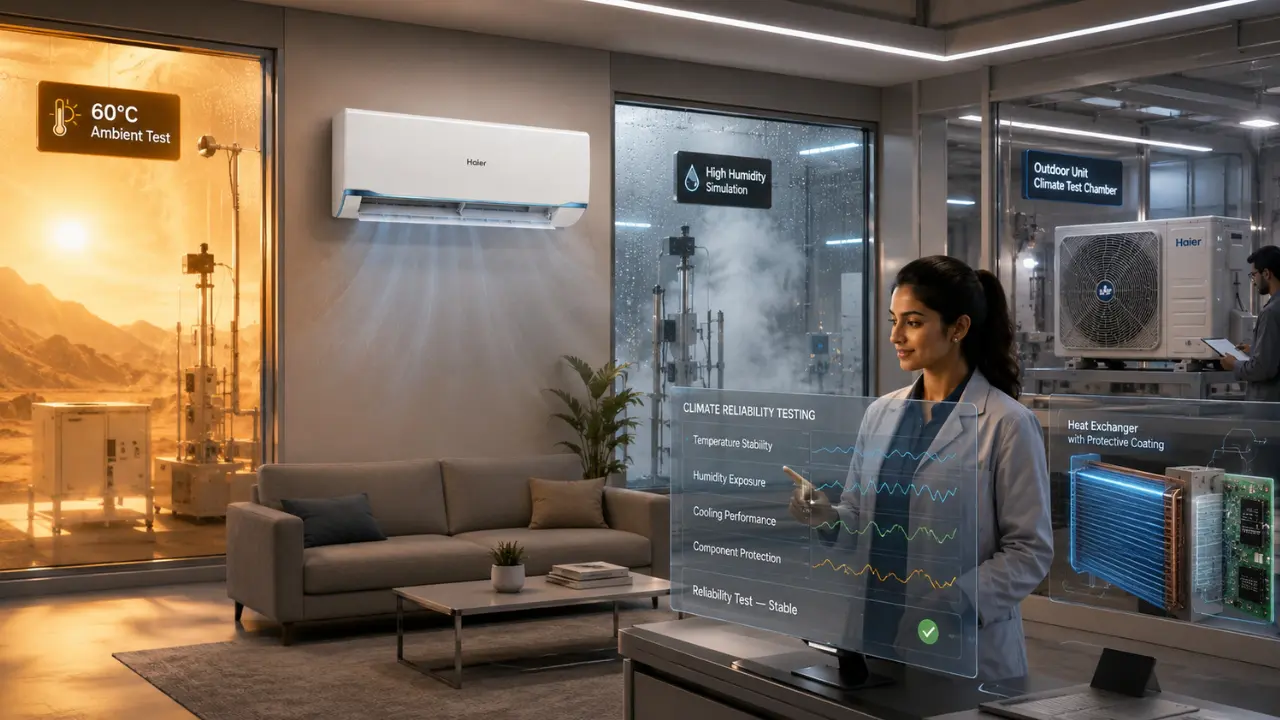

An air conditioner does not get to choose its weather.
One outdoor unit may spend May facing brutal afternoon heat. Another sits through months of humid monsoon air. Somewhere else, dust keeps settling around the condenser, while temperature and operating load rise together. That is precisely why product reliability cannot be judged only by how well an appliance performs in comfortable laboratory-like surroundings.
Climate testing matters because appliances need to remain dependable when their surroundings become difficult.
For Indian homes, this is especially relevant. Summers can be punishing, seasonal conditions change sharply, and an AC may operate for long hours just when outdoor temperatures are at their least forgiving.
So, what does climate testing actually tell us and what should buyers look for when choosing an air conditioner designed for demanding conditions?
Climate Testing Looks Beyond the First Blast of Cool Air
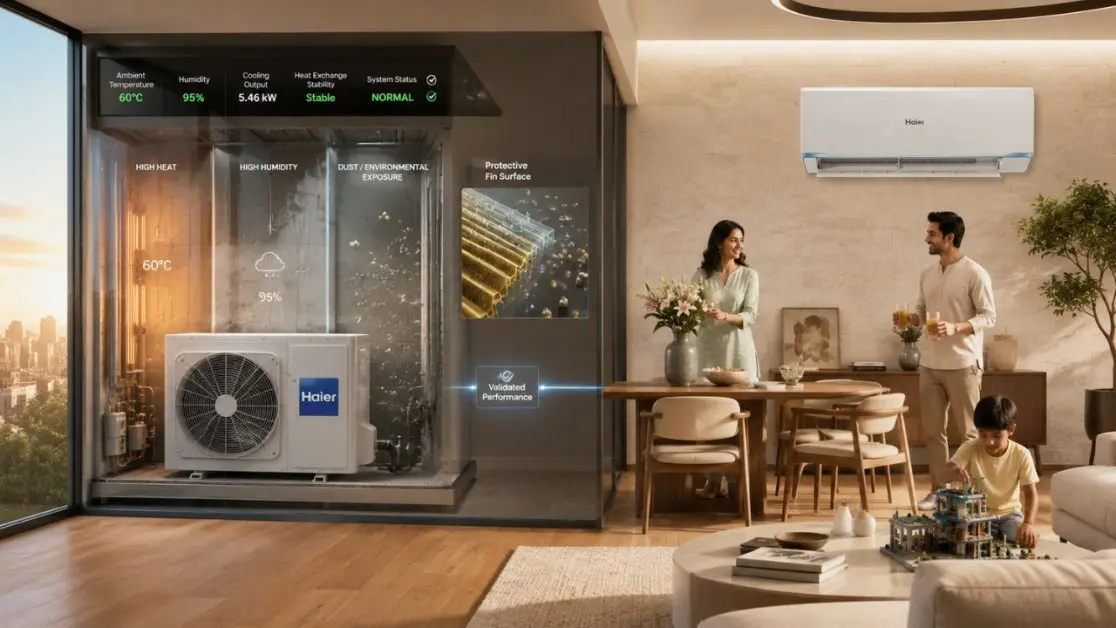
Most people naturally notice cooling first. Switch on the AC, the room becomes comfortable, job done.
Not quite.
Reliability asks a more difficult question: can the appliance continue performing when environmental conditions put extra pressure on its components?
Climate-oriented product evaluation can involve examining how materials, electronics, heat-exchange systems and protective elements respond to challenging surroundings. High heat, humidity, airborne particles and changing operating conditions can all influence how an appliance behaves over time.
That makes climate resilience a system-level issue rather than a single-feature story.
An AC built for demanding conditions may therefore need attention across areas such as:
- electronic component protection
- heat-exchange performance
- corrosion resistance
- airflow management
- condenser cleanliness
- inverter operation
- material durability
- cooling stability during high ambient temperatures
The point is simple: reliability depends on how these elements work together.
Why Indian Weather Makes This More Important
India does not have one standard summer.
Delhi and parts of North India can experience severe dry heat. Coastal regions bring moisture and corrosion concerns into the picture. Dust accumulation can become an everyday reality in several cities, while long operating hours during peak summer can place additional demand on the system.
This is where specifications related to environmental endurance deserve more attention than they usually receive.
Imagine two ACs producing similar comfort on a moderate evening. Their real difference may only become visible when the outdoor temperature climbs sharply, the condenser becomes dusty or the equipment remains exposed to changing weather for extended periods.
Reliability is often revealed under stress, not convenience.
High-Ambient Cooling Is One Practical Indicator
For buyers looking at an AC for intense Indian summers, high-temperature operating capability is worth examining carefully.
A relevant example is the Haier (~1.5) 5 Star Moonstone Grey Gravity Series Heavy Duty AI Smart AC, 5.13KW (HSA19GHD-SAI5NB-I).
Haier specifies that this Gravity Series model can cool at an ambient temperature of up to 60°C. The product information attributes this capability to protective measures that include conformal coating and the Hyper PCB.
That matters because the outdoor unit is doing its hardest work when the weather outside is already extremely hot.
The product material also highlights 90% cooling capacity at 48°C with stable operation at 60°C, giving buyers a more useful performance perspective than simply knowing the rated cooling capacity.
For Indian households dealing with prolonged high-temperature periods, specifications of this nature provide a clearer picture of how an AC has been engineered for demanding surroundings.
Electronics Need Protection Too
Cooling hardware tends to receive most of the attention. Electronics quietly do a lot of the work behind the scenes.
The PCB manages critical AC functions, so environmental protection around it becomes important when discussing reliability.
Haier’s Gravity Series uses a Hyper & Stronger PCB, while the product information also highlights protective design intended to support stable operation in demanding conditions.
There is another reason this matters. Modern air conditioners are doing considerably more than switching a compressor on and off. Smart control, variable cooling, monitoring and automated functions all depend on electronic systems functioning properly.
In the Gravity Series, that electronic intelligence powers features including:
- AI for Air powered by AI-ATMOX
- AI Climate Control
- AI ECO
- electricity monitoring
- 7-in-1 Intelli Convertible cooling
- app-based control through the Hai Smart App
A dependable smart appliance therefore needs both intelligence and hardware designed to support that intelligence when conditions become challenging.
Weather Resistance Is Also About Corrosion
Heat is obvious. Corrosion is quieter.
Moisture, pollutants and environmental exposure can gradually affect parts of an outdoor unit, which is why protective materials and coatings deserve a place in the reliability discussion.
Haier lists Super Anti Corrosion with Indoor & Outdoor Blue Fins among the Gravity Series features. The range also incorporates 100% grooved copper and protection around the outdoor unit.
These details are particularly relevant because the outdoor unit does exactly what its name suggests it lives outside.
Balconies, building exteriors and utility areas rarely provide perfectly controlled environments. Protection at material and component level can therefore be just as meaningful as headline cooling specifications when evaluating an AC for longer-term household use.
Dirt Is a Climate Problem More Often Than We Admit
Dust does not arrive dramatically. It simply keeps arriving.
Over time, debris around the outdoor heat-exchange surfaces can interfere with efficient heat transfer. Haier addresses this in the Gravity Series through ODU Cyclone Clean.
After shutdown, intelligent programme control allows the outdoor fan to run in reverse to help remove debris from the condenser and heat-exchange fins.
There is also Frost Self-Clean for the indoor unit, while AI for Service is designed to automatically clean the indoor and outdoor units to support efficiency and cleaner operation.
That makes climate resilience more practical. It is not only about surviving one extreme day; it is also about dealing with what everyday surroundings leave behind.
Reliability Should Not Come at the Expense of Comfort
A rugged appliance that is unpleasant to use would solve only half the problem.
That is where engineering has to balance reliability with everyday comfort.
The Haier Gravity Series combines its heavy-duty attributes with features designed around real household use. Supersonic Cooling is specified to deliver rapid cooling in 10 seconds through KTS and PKC technology, while an improved motor, fan and air duct enable up to a 20-metre air throw.
The HEXA Inverter adjusts performance through advanced DC inverter technology, while the 7-in-1 Intelli Convertible system allows cooling capacity to range from 40% to 110% according to requirements.
And then there is AI-ATMOX.
Instead of treating every hour of the day in exactly the same manner, AI Climate Control analyses indoor conditions, real-time weather and usage habits before selecting an operating mode suited to the situation. AI ECO adds energy monitoring and automatic adjustment when consumption rises.
In other words, resilience and intelligence do not need to sit on opposite sides of the AC.
Where Haier Gravity Series Fits Into the Reliability Conversation
The Haier Gravity Series Heavy Duty AI Smart AC brings together several features that directly relate to demanding Indian operating conditions: cooling at ambient temperatures up to 60°C, Hyper PCB protection, anti-corrosion measures, grooved copper, ODU Cyclone Clean and HEXA Inverter technology.
Alongside these are AI-ATMOX climate intelligence, 7-in-1 convertible cooling, long air throw, Supersonic Cooling and smart control through the Hai Smart App.
The range is also available in distinctive finishes, including Moonstone Grey, Galaxy Slate, Morning Mist and Midnight Dream, allowing the appliance to play a more considered role in contemporary interiors rather than disappearing into the usual plain-white appliance template.
That combination is important.
Because the point of climate-conscious engineering is not to create an appliance that merely survives difficult surroundings. The better outcome is an AC that continues delivering the comfort, control and convenience the household bought it for in the first place.
Reliability Starts Before the Weather Gets Difficult
Nobody buys an air conditioner hoping to discover its limitations during the hottest week of the year.
That is why specifications connected with high-temperature operation, electronic protection, corrosion resistance, cleaning and adaptive inverter performance deserve attention at the buying stage itself.
For Indian households looking beyond immediate cooling and towards sustained performance, the Haier Gravity Series offers a compelling combination of heavy-duty engineering and AI-powered comfort.
When summer turns harsh, that preparation stops being a technical detail.
It becomes the difference you actually feel.
Frequently Asked Questions
1. What is climate testing in air conditioners?
Climate testing generally evaluates how an appliance and its components respond to challenging environmental conditions such as high temperature, humidity and other operating stresses. It helps engineers assess whether performance remains dependable outside mild conditions.
2. Why is high-ambient cooling important in India?
During peak summer, outdoor temperatures can become extremely high in several parts of India. An AC designed to operate under high ambient temperatures is better aligned with these demanding seasonal conditions.
3. Can the Haier Gravity Series AC cool at very high outdoor temperatures?
Yes. Haier specifies cooling at ambient temperatures of up to 60°C for the featured Gravity Series Heavy Duty AI Smart AC models.
4. What is the purpose of the Hyper PCB in Haier Gravity Series ACs?
The Gravity Series incorporates a Hyper & Stronger PCB as part of its approach to protecting essential electronics and supporting stable operation under demanding conditions.
5. How does ODU Cyclone Clean help the outdoor unit?
ODU Cyclone Clean reverses the outdoor fan after shutdown through intelligent programme control, helping remove debris from the condenser and heat-exchange fins and supporting efficient heat transfer.
6. Which Haier AC is suitable for buyers looking for heavy-duty cooling with smart features?
The Haier (~1.5) 5 Star Gravity Series Heavy Duty AI Smart AC, 5.13KW range combines high-ambient cooling capability with HEXA Inverter technology, AI-ATMOX, 7-in-1 Intelli Convertible cooling, smart control, ODU Cyclone Clean and multiple protective features designed for demanding use.