
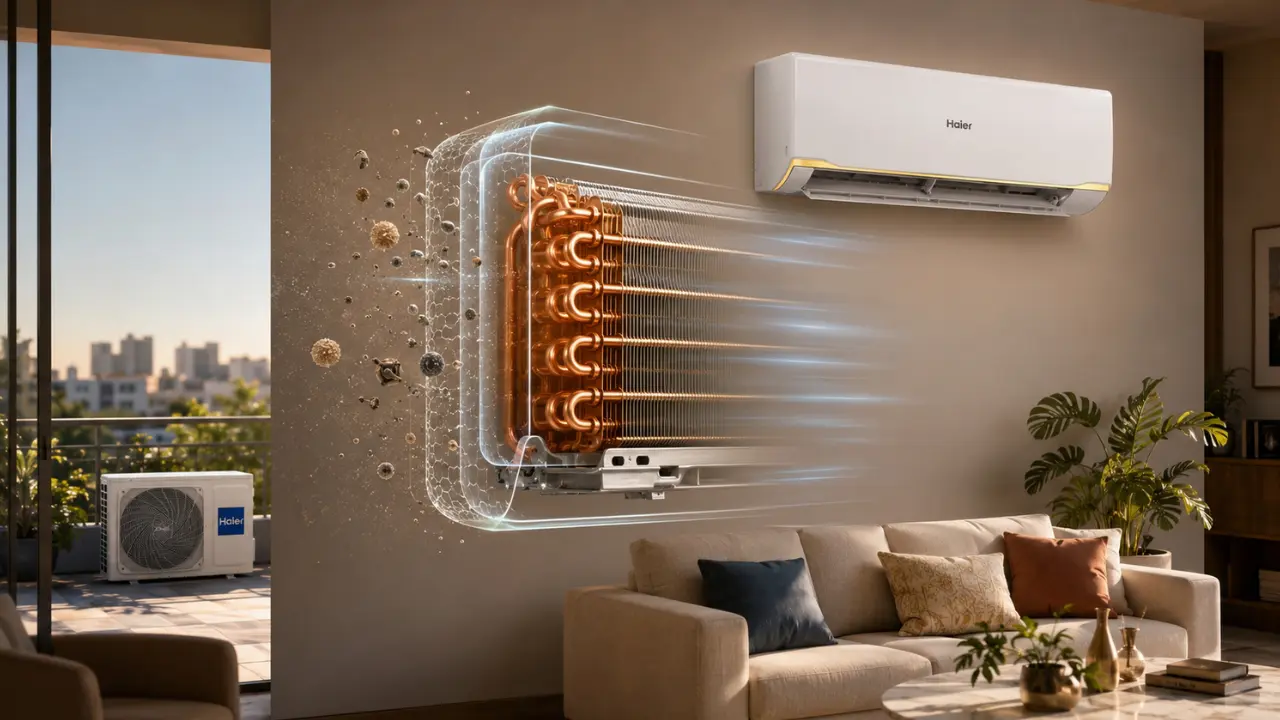

You rarely notice the copper coils inside an air conditioner. They’re hidden away, doing the hard work while the indoor unit quietly cools your room. Yet, here’s the interesting part: these coils are among the most critical components in the entire cooling system. If they begin to corrode, cooling performance gradually drops, energy consumption can rise, and the lifespan of the AC may be affected.
For Indian households, this isn’t just a technical discussion. Our climate can be harsh. Coastal humidity, dust storms, industrial pollution, monsoon moisture, and soaring summer temperatures all create conditions that challenge an air conditioner’s durability. That’s exactly why copper coils need more than just excellent conductivity; they need protection.
Modern air conditioners are increasingly being designed with anti-corrosion technologies that help preserve copper components for longer-term performance. Haier’s 1.7 Ton 5 Star Desert Rose Air Conditioner reflects this approach by combining 100% Grooved Copper, Super Anti-Corrosion with Indoor & Outdoor Blue Fins, and additional protective technologies designed for demanding Indian conditions.
Copper Is Excellent But It Isn’t Invincible
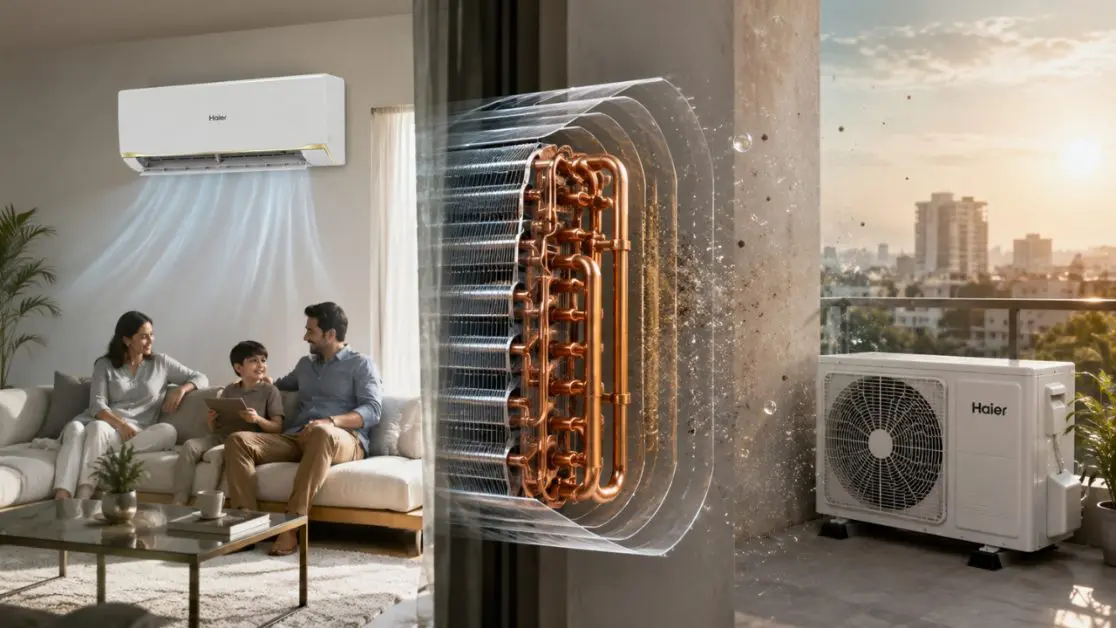
Copper has remained a preferred material for air conditioner heat exchangers because it transfers heat efficiently and supports faster cooling.
But performance isn’t the whole story.
Copper constantly interacts with:
- Moisture
- Airborne pollutants
- Salt-laden coastal air
- Dust particles
- Chemical contaminants
Over time, these elements may contribute to corrosion if the metal remains unprotected.
Think of it like owning a premium car. The engine may be outstanding, but if the body receives no protective coating, rust eventually becomes a concern. Air conditioners work in a similar way.
What Actually Happens When Copper Coils Corrode?
Corrosion doesn’t usually appear overnight.
It develops gradually.
As protective surfaces weaken, heat transfer efficiency may reduce. The AC then works harder to achieve the same cooling result.
Possible outcomes include:
- Reduced cooling efficiency
- Higher electricity consumption
- Additional load on internal components
- Increased maintenance requirements
- Shorter operational life of critical parts
These issues often build up slowly, making them difficult to notice until cooling performance changes.
Indian Weather Makes Protection Even More Important
An air conditioner operating in India faces very different environmental conditions compared to many other countries.
Different regions present different challenges.
Coastal Cities
Salt-rich air accelerates corrosion on exposed outdoor components.
Industrial Areas
Chemical pollutants and airborne contaminants can settle on heat exchangers.
Dust-Prone Regions
Dust blocks airflow and traps moisture around sensitive parts.
Heavy Monsoon Conditions
Continuous humidity creates an environment where corrosion becomes more likely.
No single climate is easy on an outdoor AC unit.
That’s why manufacturers increasingly focus not only on cooling performance but also on long-term durability.
Quick Comparison: Standard Copper vs Protected Copper
| Standard Copper Coil | Protected Copper Coil |
| Excellent heat transfer | Excellent heat transfer with added durability |
| More exposed to environmental damage | Additional protective layers help resist corrosion |
| Requires favourable operating conditions | Better suited for varied Indian climates |
| Long-lasting with maintenance | Designed for improved long-term protection |
It’s Not Just the Copper The Entire Heat Exchange System Matters
Many buyers only look for the words “Copper Condenser.”
That’s only one part of the picture.
The surrounding protective technologies are equally important because corrosion doesn’t affect only the copper tubing.
The fins attached to the heat exchanger also face continuous exposure.
A well-designed protection system considers:
- Copper tubing
- Aluminium fins
- Outdoor condenser
- Indoor evaporator
- Protective surface coatings
The idea is simple.
Protect the complete cooling system, not just one component.
How Haier Adds Extra Protection
Haier’s 1.7 Ton 5 Star Desert Rose Air Conditioner combines several protective features specifically designed to improve durability alongside cooling performance.
Some notable highlights include:
100% Grooved Copper
The air conditioner uses 100% Grooved Copper as part of its cooling system for efficient heat exchange.
Super Anti-Corrosion Protection
Both the indoor and outdoor units feature Blue Fins designed to provide enhanced corrosion resistance.
Protection Coatings
The product visuals also highlight multiple protective elements including:
- Protection lacquer coating
- High-level cover coating
- Anti-corrosive tube plate
- Blue Fin coating
These work together to improve resistance against environmental exposure.
Protection Isn’t Only About Rust
Here’s something many people overlook.
When coils stay cleaner and remain in better condition, airflow and heat exchange can remain more consistent.
That’s where Haier adds another layer of convenience.
The Desert Rose Air Conditioner includes:
- AI for Service
- Indoor Frost Self Clean
- ODU Cyclone Clean
The indoor unit performs automatic self-cleaning, while the outdoor fan can reverse after shutdown to help remove debris from the condenser and heat-exchange fins, supporting efficient heat transfer over time.
That means protection isn’t limited to coatings alone; it also includes intelligent cleaning support.
Strong Protection Supports Better Cooling
Cooling performance depends on much more than compressor capacity.
Protected coils help the system continue transferring heat efficiently.
Haier complements this with features such as:
- Hexa Inverter technology
- Supersonic Cooling in 10 seconds
- Cooling capability even at ambient temperatures up to 60°C
- Long 20-metre air flow
- 7-in-1 Convertible modes
Together, these features are designed to deliver dependable cooling while the protected copper system helps maintain efficiency over extended use.
Signs Your Air Conditioner Benefits From Better Coil Protection
If your home experiences any of these conditions, extra protection becomes even more valuable:
- You live close to the sea.
- Your city experiences heavy pollution.
- Dust accumulates frequently on outdoor units.
- The AC operates for long hours during summer.
- Humidity remains high for several months.
These situations increase environmental exposure, making corrosion-resistant construction a practical consideration rather than an optional feature.
Buying an AC? Look Beyond the Copper Label
Before finalising an air conditioner, ask a few additional questions.
- Does it use copper coils?
- Are protective coatings provided?
- Is the outdoor unit protected against corrosion?
- Does it include self-cleaning features?
- Has the system been designed for Indian weather conditions?
These details often influence long-term ownership just as much as cooling capacity or star rating.
Choosing Protection That Lasts
Cooling performance gets the attention during purchase. Durability often earns appreciation years later.
The Haier 1.7 Ton 5 Star Desert Rose Air Conditioner combines efficient cooling with multiple protection technologies, including 100% Grooved Copper, Super Anti-Corrosion with Indoor & Outdoor Blue Fins, ODU Cyclone Clean, and Indoor Frost Self Clean. Alongside AI-powered climate control, these features are designed to help the system maintain dependable performance in varied Indian conditions.
When copper coils receive the protection they deserve, you’re not simply investing in today’s cooling, you are choosing an air conditioner engineered to keep performing season after season.
Frequently Asked Questions
1. Why are copper coils preferred in air conditioners?
Copper coils are widely used because they offer excellent heat transfer, helping the air conditioner cool rooms efficiently. They also contribute to consistent performance when combined with appropriate protective technologies.
2. Why do copper coils need extra protection?
Copper coils are continuously exposed to moisture, dust, pollution, and changing weather conditions. Protective coatings help reduce the impact of corrosion, supporting better cooling efficiency and longer-lasting performance over time.
3. How does Haier protect the copper coils in its Desert Rose Air Conditioner?
The Haier 1.7 Ton 5 Star Desert Rose Air Conditioner features 100% Grooved Copper, Super Anti-Corrosion with Indoor & Outdoor Blue Fins, and additional protective elements designed to improve resistance against corrosion in Indian conditions.
4. Does anti-corrosion protection improve the lifespan of an AC?
Protective coatings help shield important cooling components from environmental exposure. By reducing the effects of corrosion, they can help maintain cooling efficiency and support reliable long-term operation.
5. Is copper coil protection useful for homes near coastal areas?
Yes. Coastal regions often experience high humidity and salt-laden air, which can accelerate corrosion. Air conditioners equipped with anti-corrosion protection are better suited for such environments.
6. Does the Haier Desert Rose AC include features that help keep the coils clean?
Yes. The air conditioner includes Indoor Frost Self Clean and ODU Cyclone Clean, which help clean the indoor unit and remove debris from the outdoor condenser, supporting efficient heat transfer and cleaner operation.