
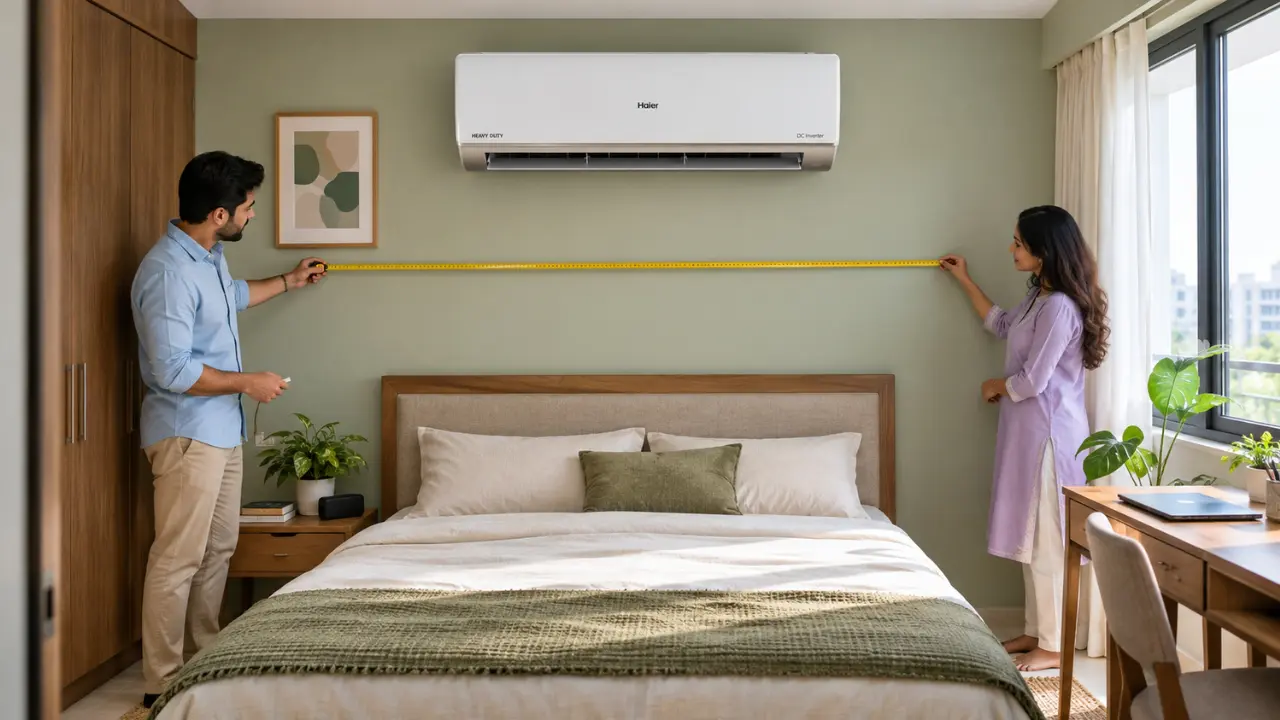

A 1-ton AC can be perfectly capable in a compact bedroom and still feel hopelessly inadequate in a large, sun-facing living room. That is because AC tonnage is essentially a measure of cooling capacity, not simply the physical size of the appliance. For many Indian homes, roughly 1 ton suits smaller rooms, 1.5 ton suits medium-sized spaces, and around 2 ton is considered for larger rooms. But square footage alone should never make the final decision.
Floor level, direct sunlight, ceiling height, windows, occupancy and even the number of heat-producing appliances can change the cooling load considerably.
So, before comparing star ratings, smart features or finishes, get the capacity question right.
What Does AC Tonnage Actually Mean?
The word “ton” sounds oddly industrial when you are shopping for something that hangs on a bedroom wall. It has nothing to do with the AC’s weight.
AC tonnage describes how much heat an air conditioner can remove from a room over a given period. A higher-tonnage AC has greater cooling capacity.
This matters because both extremes can create problems.
An undersized AC may run for long periods while struggling to bring the room to the desired temperature. Choosing a substantially larger capacity than the room requires is not automatically better either. The objective is to select an AC whose cooling capacity is reasonably matched to the room’s actual heat load.
Think of it less as “How powerful an AC can I buy?” and more as “How much cooling does this particular room need?”
That small change in thinking usually leads to a better purchase.
AC Tonnage by Room Size: A Practical Starting Point
There is no room-size chart that can account for every Indian home. Still, floor area gives you a useful first estimate.
| Approximate Room Size | AC Capacity to Consider | Common Use Case |
| Up to around 120 sq. ft. | Around 1 ton | Compact bedroom, study or home office |
| Around 120–180 sq. ft. | Around 1.5 ton | Medium bedroom or living space |
| Around 180–250 sq. ft. | Around 2 ton | Larger bedroom, living room or family area |
| Above 250 sq. ft. | Detailed assessment recommended | Large/open-plan spaces |
Treat these ranges as selection guidance, not a fixed engineering formula. A 160 sq. ft. ground-floor bedroom shaded by another building and a 160 sq. ft. top-floor room facing the afternoon sun do not present the AC with the same job.
That is where the second part of AC sizing begins.
Why Can Two Rooms of the Same Size Need Different AC Capacities?
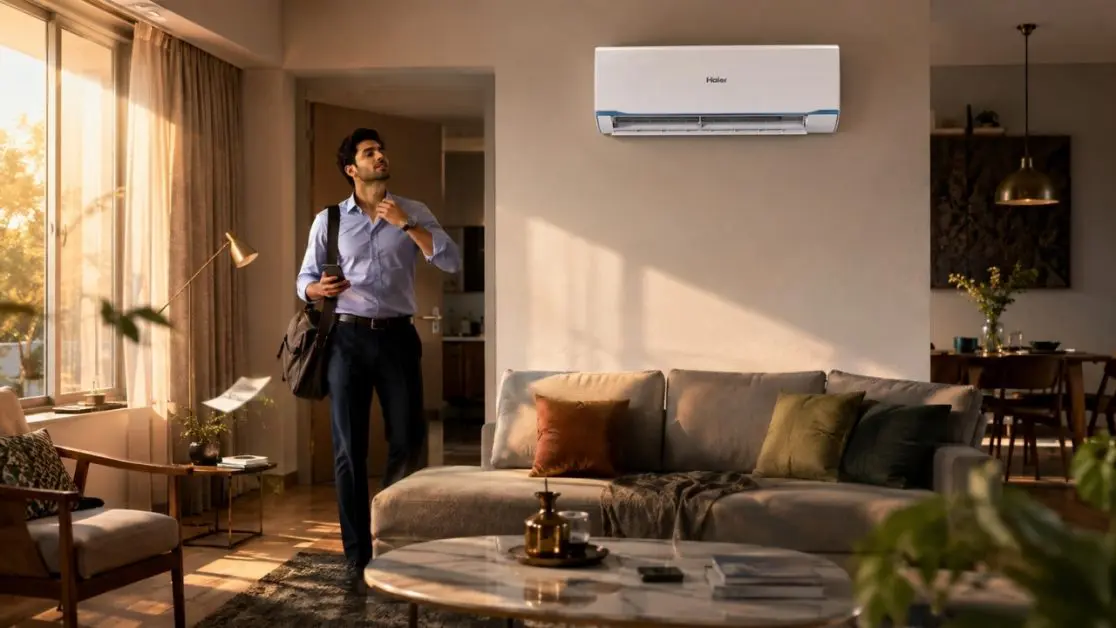
Because your AC does not cool square feet. It deals with heat entering and being generated inside the room.
A few factors can push cooling requirements upwards.
Direct sunlight
A west-facing room can absorb substantial heat during the afternoon. Large windows and glass doors can add to this effect, particularly when there is little external shading.
Top-floor location
If the roof is exposed to the sun for hours, the room beneath it may remain noticeably warmer than a similar room on a lower floor.
Ceiling height
Most quick AC sizing estimates assume fairly conventional residential ceiling heights. A room with an unusually high ceiling contains a larger volume of air, so floor area alone becomes a less reliable indicator.
Number of occupants
People generate heat. It is not particularly noticeable when one person is reading in a bedroom; it becomes rather more relevant when several family members regularly use the same living room.
Windows and doors
Large glazed surfaces, frequent door opening and gaps that allow outdoor air into the room can increase the cooling load.
Electronics and appliances
A television, gaming system, desktop computer and other electronics all release some heat. Individually, perhaps not dramatic. Together, they can matter.
This is why moving from 140 to 150 sq. ft. does not magically mean that you must jump to the next tonnage category. Room conditions matter alongside dimensions.
When Does a 1-Ton AC Make Sense?
For a compact room with a relatively manageable cooling load, the 1-ton class is often the sensible place to begin.
Haier offers options such as the Haier Kinouchi Ultra Series AI Smart AC, 3.4 kW (HSA14KU-GAI5NB-I). Its listed specifications include 0.97-ton capacity, 5-star rating and ISEER 5.65.
There is also the Haier Elegate Series Heavy Duty AI Smart AC, 3.4 kW (HSA14EHD-GAI5NB-I), which is similarly specified at 0.97 ton with a 5-star rating and ISEER 5.65.
These are worth considering for spaces such as:
- Compact bedrooms
- Study rooms
- Smaller home offices
- Guest bedrooms with moderate heat exposure
Capacity, though, is only part of the story. Haier lists features including AI-ATMOX-powered climate control, Supersonic Cooling, 20-metre air flow, 7-in-1 Convertible cooling and operation at ambient temperatures up to 60°C on these models.
For Indian summers, that combination addresses something beyond a number on a specification sheet: changing cooling requirements across different hours, seasons and usage patterns.
Is a 1.5-Ton AC the Right Choice for a Medium-Sized Room?
Often, yes. The 1.5-ton category occupies a useful middle ground for many Indian bedrooms and living spaces, provided the room conditions support that selection.
Haier’s Galaxy Slate Gravity Series Heavy Duty AI Smart AC,(HSA19GHD-DAI5NB-I) has a listed capacity of 1.46 ton and a 5-star rating.
This is where choosing capacity first and features second starts to pay off.
Once the room genuinely calls for roughly this cooling class, features such as AI Climate Control, Hexa Inverter, 7-in-1 Convertible cooling, 20-metre air flow and Supersonic Cooling become meaningful additions rather than reasons to overlook incorrect sizing.
The Galaxy Slate model also supports control through the Hai Smart App and voice control through Alexa and Google Assistant.
In other words, choose the right engine before getting excited about what is on the dashboard.
When Should You Move Towards a 2-Ton AC?
Larger living rooms, spacious bedrooms and areas with greater heat loads may require something closer to the 2-ton category.
The Haier Kinouchi Series Heavy Duty AI Smart AC, 6.3 kW (HSA24KHD-RAI3NB-I), for example, with 2-ton capacity and a 3-star rating.
A higher-capacity option becomes particularly relevant when several load factors come together: more floor area, strong solar exposure, frequent occupancy or a particularly demanding room layout.
The Kinouchi model also offers 20-metre air flow, with Haier stating that its motor, fan and air-duct design supplies 25% more air volume. Its listed features include cooling operation at ambient temperatures up to 60°C, Supersonic Cooling and 7-in-1 Convertible capacity control.
That makes the selection less about simply buying “a bigger AC” and more about having sufficient cooling capability for a genuinely demanding space.
Should You Buy a Bigger AC Just to Be Safe?

Not automatically.
It is tempting to think that extra capacity means extra comfort. AC sizing does not work quite that neatly.
The better approach is:
- Measure the room accurately. Calculate length × width rather than estimating by eye.
- Check heat exposure. Pay attention to afternoon sun, roof exposure and large windows.
- Consider normal occupancy. Size the AC for how the room is actually used.
- Look at the room layout. Open passages or connected areas can affect cooling requirements.
- Then compare efficiency and features. Star rating, ISEER, inverter technology and intelligent controls make more sense once capacity is in the right range.
For unusual rooms, professional assessment is preferable to blindly following a square-foot chart.
What Else Should You Check Apart From Tonnage?
Once you have narrowed down the appropriate cooling capacity, the buying decision becomes much more interesting.
Energy efficiency
If the AC will operate for several hours every day, especially through a long summer, efficiency deserves close attention. Compare the model’s current star rating and ISEER rather than judging it on tonnage alone.
Variable cooling requirements
A bedroom occupied by one person at night and a living room used by several people in the evening have very different usage patterns.
Haier’s listed 7-in-1 Convertible functionality allows cooling capacity to be adjusted according to requirement, while its Intelli modes can predict cooling capacity and alter fan speed.
Air distribution
Cooling capacity means little if conditioned air does not travel effectively through the usable space. Room shape, AC position and air flow all deserve attention, particularly in longer living rooms.
Smart control
Remote app control can be genuinely useful rather than merely decorative technology. Selected Haier AI Smart ACs allow users to change modes, adjust temperature and monitor status through the Hai Smart App, alongside supported voice controls.
Which AC Size Should You Finally Choose?
Start with this simple framework: around 1 ton for compact rooms, around 1.5 ton for medium-sized rooms and around 2 ton for larger spaces then adjust your decision according to the room’s actual cooling load.
Do not let the room-size chart do all the thinking.
A sun-heavy top-floor bedroom may need more cooling consideration than its square footage suggests. A shaded, well-contained room may be less demanding. And when the room sits close to the boundary between two capacity ranges, installation conditions and a proper cooling-load assessment become especially important.
Haier India currently sells AC models in different capacities that can suit these different room-size/cooling requirements, including 3.4 kW models in the 1-ton class, the 5.13 kW Galaxy Slate Gravity model in the 1.5-ton class, and the 6.3 kW Kinouchi model for higher-capacity requirements. The useful part is that you do not have to treat tonnage as the finish line.
Get the tonnage right first. Then choose the Haier AC whose efficiency, intelligent cooling controls, airflow and everyday usability fit the way your room and your household actually works.
Frequently Asked Questions
What size AC is suitable for a small room?
An AC of around 1 ton is a practical starting point for rooms up to roughly 120 sq. ft., such as compact bedrooms, studies and smaller home offices. However, sunlight, ceiling height, windows and occupancy can change the actual cooling requirement.
Is a 1.5-ton AC suitable for a medium-sized room?
A 1.5-ton AC is often considered for rooms of around 120–180 sq. ft., including medium-sized bedrooms and living spaces. Room conditions should still be considered before making the final choice.
When should you choose a 2-ton AC?
Around 2 tons can be considered for larger rooms of approximately 180–250 sq. ft., particularly when the space has a higher cooling load. Larger or open-plan areas above 250 sq. ft. may require a more detailed assessment.
Does room size alone determine AC tonnage?
No. Room size is only a starting point. Direct sunlight, floor level, ceiling height, windows, occupancy, doors and heat-producing appliances can all affect the cooling load.
Is a bigger AC always better?
Not necessarily. An undersized AC may struggle to cool the room, while substantially oversizing the AC is not automatically better. The aim is to match cooling capacity to the room’s actual heat load.
How do I choose between a 1-ton and 1.5-ton AC?
Start by measuring the room and assessing its heat exposure, occupancy and layout. Around 1 ton is a starting point for compact rooms, while around 1.5 tons is commonly considered for medium-sized spaces.