
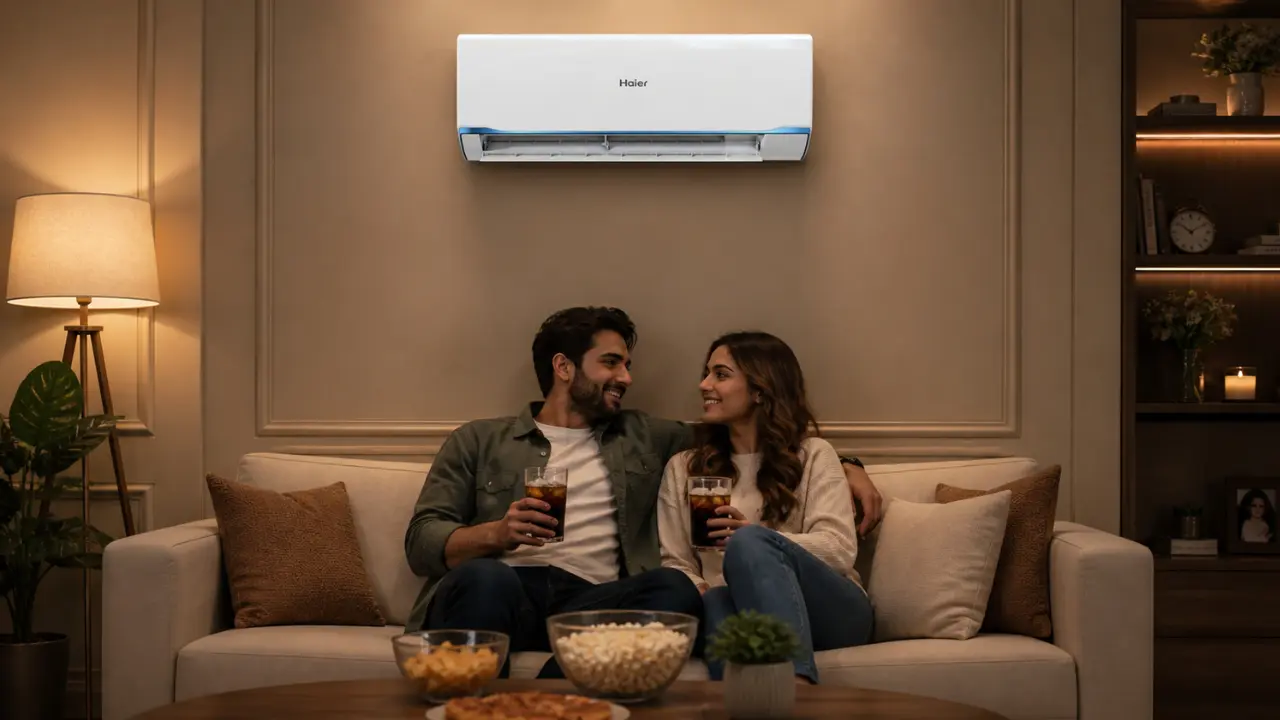

Comparing AC models is not about choosing the “best” AC. It is about choosing the right cooling system for the way your home actually lives.
A bedroom used at night needs a different AC than a sun-facing living room. A work-from-home setup behaves differently from a guest room used twice a month. The smartest AC comparison starts with lifestyle, not specifications.
It usually begins the same way.
Three browser tabs open.
Five AC models shortlisted.
Every product page says “fast cooling,” “energy saving,” and “smart features.”
And suddenly, buying an air conditioner feels less like shopping and more like decoding exam notes.
The problem is not the number of options.
The problem is that most people compare ACs like gadgets when they should compare them like systems.
An AC does not just cool a room.
It shapes sleep quality. Electricity bills. Noise levels. Summer routines. Even how often people argue over the remote.
Cooling is invisible until it goes wrong.
That is why comparing AC models properly changes everything.
Most AC comparisons fail because people compare features, not usage patterns

A family in Jaipur faces a different cooling problem than a couple in Bengaluru.
A top-floor apartment behaves differently from a shaded independent house.
Yet many buyers still compare ACs using only:
- Price
- Star rating
- Brand
- Tonnage
Those matter. But they are only surface indicators.
The real comparison starts deeper.
The hidden system behind AC comparison
Every AC decision sits on five invisible variables:
| Variable | Why It Matters |
| Room size | Determines cooling load |
| Heat exposure | Impacts compressor stress |
| Usage duration | Changes electricity cost |
| Occupancy | Affects airflow needs |
| Lifestyle habits | Decides which smart features matter |
For example:
A couple using the AC only at night has different needs from a family running it 14 hours daily during summer vacations.
One needs silent consistency.
The other needs energy optimization.
Same product category.
Different systems.
That is why “best AC” is often the wrong question.
The better question is:
Best AC for what kind of living?
Step One: Compare cooling capacity before comparing features
People often fall in love with features before checking cooling logic.
That creates expensive mistakes.
Understand tonnage properly
Tonnage is not weight. It has a cooling capacity.
Here is a simple breakdown:
| Room Size | Recommended AC Capacity |
| Up to 120 sq ft | 1 Ton |
| 120–180 sq ft | 1.5 Ton |
| 180–260 sq ft | 2 Ton |
But room size alone is incomplete.
A west-facing room with afternoon sunlight behaves hotter than a shaded room of the same size.
A room with large windows traps more heat.
A top-floor apartment absorbs terrace heat throughout the day.
The room changes the machine.
That is why two families in identical apartments often experience completely different cooling.
Bigger is not always better
Many buyers assume a larger AC cools faster and therefore performs better.
Not always.
Oversized ACs shut on and off too frequently. This wastes power and reduces humidity control.
Undersized ACs run continuously and struggle during peak heat.
Efficient cooling is not maximum cooling.
It is balanced cooling.
Step Two: Compare inverter technology, not just star ratings
A 5-star sticker tells only part of the story.
The real question is:
How intelligently does the AC manage power?
Fixed-speed vs inverter AC
| Type | How It Works | Best For |
| Fixed-speed AC | Compressor turns fully on/off | Limited usage |
| Inverter AC | Compressor adjusts speed dynamically | Daily long-hour usage |
Inverter systems reduce sudden power spikes.
That matters in Indian summers where AC usage often stretches across entire nights.
Why inverter intelligence matters now
Modern ACs increasingly behave like adaptive systems.
Some newer models learn cooling patterns, monitor room conditions, and optimize energy use automatically.
For example, Haier’s AI-powered Desert Rose series uses AI Atmox technology to analyse environmental conditions, usage habits, and energy consumption patterns for smarter climate control.
The larger shift here matters more than the feature itself.
Air conditioners are moving from manual appliances to decision-making systems.
That changes how comparisons should happen.
Step Three: Compare electricity behavior, not just electricity claims
Every AC promises “energy savings.”
Few people calculate what that means over five summers.
Look at ISEER ratings carefully
ISEER stands for Indian Seasonal Energy Efficiency Ratio.
Higher ISEER generally means better seasonal efficiency.
For example, the Haier Desert Rose 1.8 Ton 5 Star AC carries an ISEER rating of 5.65.
But raw ratings are incomplete without understanding usage.
One option is lower upfront cost
Cheaper AC. Lower efficiency.
Good for:
- Guest rooms
- Low-frequency use
- Limited budgets
Tradeoff:
- Higher electricity bills long-term
The second option is efficiency-first
Higher-rated inverter AC.
Good for:
- Daily users
- Families
- Work-from-home setups
Tradeoff:
- Higher upfront investment
The third option is adaptive smart cooling
AI-assisted systems that dynamically adjust energy usage.
For example, Haier’s AI for Savings mode tracks energy use and shifts into AI ECO mode when consumption rises, claiming energy savings up to 56%.
This matters because electricity waste often comes from human behaviour, not machine inefficiency.
People forget settings.
Rooms stay empty.
Temperatures stay unnecessarily low.
Smart systems now compensate for that.
A good AC cools the room.
A smarter AC corrects habits.
Step Four: Compare airflow and comfort, not just temperature
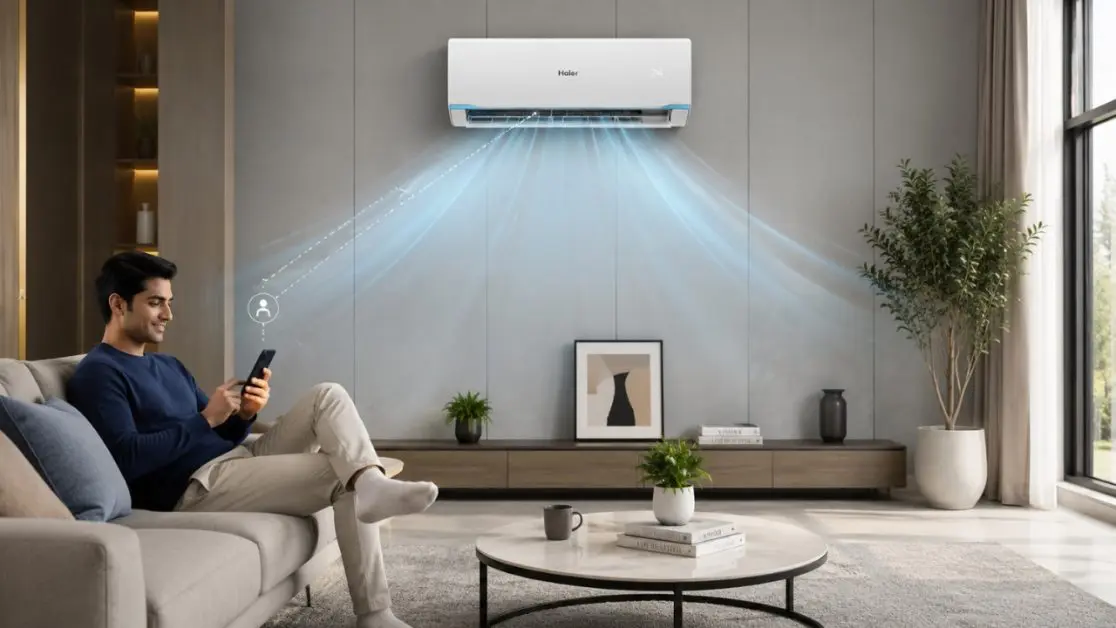
Cooling is emotional.
Two rooms at 24°C can feel completely different.
Why?
Airflow.
What actually affects comfort
- Air throw distance
- Fan design
- Humidity control
- Cooling speed
- Noise level
For larger Indian living rooms, long air throws become important.
Some modern ACs now offer airflow distances up to 20 metres for wider cooling coverage.
That changes how quickly large rooms cool during peak summer afternoons.
Cooling speed also matters differently now
There was a time when ACs were mostly nighttime appliances.
Now they are also:
- Midday work companions
- Weekend entertainment systems
- Quick-relief cooling systems after commutes
That is why rapid cooling features matter more today.
Haier’s Supersonic Cooling technology claims cooling in 10 seconds using KTS and PKC technology.
The point is not the number.
The point is behavioural.
Modern cooling expectations have changed.
People no longer wait patiently for comfort.
Step Five: Compare smart features based on real life, not novelty
Not every smart feature deserves attention.
Some are gimmicks.
Others quietly improve everyday life.
Useful smart features actually solve friction
Here are the ones worth comparing:
| Feature | Why It Matters |
| App control | Adjust cooling remotely |
| Voice assistant support | Hands-free convenience |
| AI human detection | Reduces wasted cooling |
| Convertible modes | Flexible power usage |
| Self-cleaning systems | Lower maintenance effort |
For example, AI Human Detection technology can identify room occupancy and reduce unnecessary cooling when no one is present.
That sounds small.
Until you remember how often people leave ACs running in empty rooms.
Convertible modes are underrated
One of the smartest comparisons buyers ignore is flexible capacity control.
Convertible ACs allow users to adjust cooling intensity based on weather and occupancy.
Haier’s 7-in-1 Convertible system allows capacity adjustment from 40% to 110%.
This matters because Indian weather is inconsistent.
Many heatwaves behave differently from monsoon humidity.
The same room does not need identical cooling every day.
Step Six: Compare durability like someone paying future repair bills

An AC purchase is not a one-day decision.
It is a 7 to 10-year relationship.
Durability matters.
Especially in Indian conditions where:
- Voltage fluctuations are common
- Dust levels are high
- Summer temperatures cross 45°C in many cities
Look for these durability signals
- Copper condenser coils
- Anti-corrosion coatings
- Strong PCB protection
- Self-cleaning systems
- Long compressor warranties
For example, Haier’s Desert Rose series includes Hyper PCB protection, anti-corrosion blue fins, copper heat exchangers, and cooling support up to 60°C ambient temperature.
These are not glamorous features.
But hidden systems rarely look glamorous.
They simply prevent future headaches.
That makes durability even more important.
An AC today is no longer occasional infrastructure.
It is daily infrastructure.
The smartest AC comparison starts with your life, not the catalogue
Here is the real shift.
Most buyers compare products.
Experienced buyers compare patterns.
Patterns of heat.
Patterns of usage.
Patterns of comfort.
Patterns of electricity consumption.
The right AC is not the one with the most features.
It is the one whose design quietly matches the rhythm of your home.
A silent bedroom AC.
A powerful living room AC.
An adaptive system for unpredictable summers.
Different homes create different definitions of comfort.
That is the hidden system most comparisons miss.
And once you start comparing ACs through that lens, the decision becomes surprisingly clear.
Frequently Asked Questions
I have five AC models shortlisted and all claim fast cooling and energy savings. How do I choose?
Start with your room usage, not the claims. Compare room size, sunlight, usage hours, occupancy, and electricity behaviour first.
Should I buy the “best AC” online or the one that fits my home routine?
The right AC is the one that matches your lifestyle, room heat, and daily usage pattern.
I’m confused between 1.5 ton and 2 ton AC. Which one should I pick?
Match tonnage to room size and heat exposure. Bigger is not always better; oversized ACs may waste power.
My bedroom AC needs are different from my living room. Should I compare them separately?
Yes. A bedroom needs silent, steady cooling, while a sunny living room may need stronger airflow and faster cooling.
My room gets direct afternoon sunlight. Should I choose a higher-capacity AC?
Possibly. Sun-facing rooms, top floors, and large windows increase cooling load.
I live on the top floor. Why does my AC struggle more than expected?
Terrace heat adds extra load, so the room may need better capacity, airflow, and durability features.
I use my AC only in a guest room. Do I really need a 5-star inverter model?
Not always. For low usage, a lower-cost model may be enough, though electricity bills may be higher per hour.