
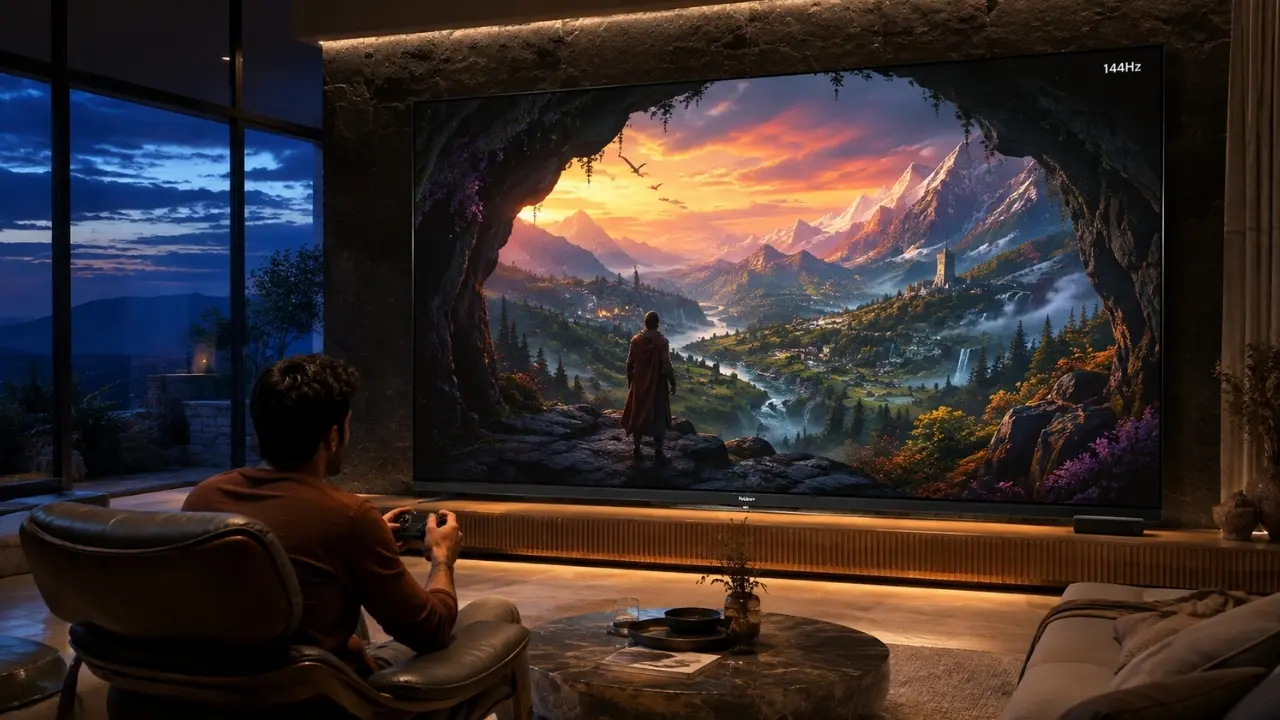

You leave a dark cave, step into an open valley and, suddenly, the entire visual language of the game changes. The shadows lift. Distant mountains appear through haze. Grass shifts between several shades of green, while the evening sky gradually moves from warm orange to deep blue.
That transition is part of the game.
Yet there is a catch. If the television cannot reproduce those colours convincingly, much of the visual work behind that world can get lost. A forest may look aggressively green instead of naturally layered. Skin tones can appear strange. Dark terrain may merge into one muddy patch. Bright skies can lose their subtle gradients.
This is why colour accuracy in open-world games deserves considerably more attention than it usually gets. Resolution matters. Smooth motion matters. Responsiveness certainly matters. But when a game asks you to spend dozens or perhaps hundreds of hours exploring a carefully designed world, the quality of colour reproduction has a direct bearing on how believable that world feels.
Open-World Games Put a TV Through a Different Kind of Test
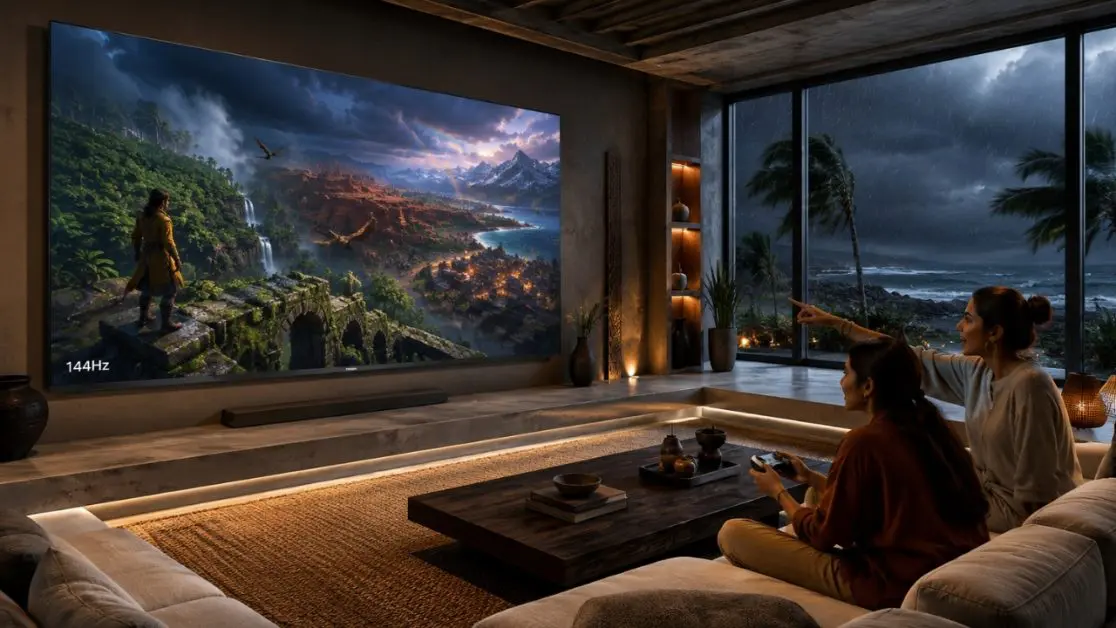
A conventional game can control what the player sees relatively tightly. Open-world titles cannot.
One minute, the player may be riding across a sunlit desert. Minutes later, the same screen has to reproduce a dim interior, wet city streets, dense vegetation or a snow-covered mountain under an overcast sky. Then night arrives.
The television has to keep up with all of it.
Good colour reproduction helps preserve distinctions between:
- different shades of vegetation and terrain;
- warm and cool lighting;
- daylight, sunset and night environments;
- character skin tones and clothing;
- weather effects such as fog, rain and dust;
- brightly coloured interface elements against complex backgrounds;
- subtle environmental details that could otherwise disappear.
That last point matters more than it sounds. Open-world gaming is built around exploration, and exploration depends heavily on visual information.
A slightly different colour on a distant structure can attract attention. A change in terrain may indicate where the player can travel. A warm light in an otherwise dark settlement can become an intuitive visual landmark.
Colour, basically, is doing more work than simply making the game look attractive.
Accurate Does Not Mean Over-Saturated
There is an important distinction here.
A television producing more colour is not automatically producing better colour.
Push saturation too far and grass begins looking fluorescent, faces can become unnaturally warm and carefully designed atmospheric effects lose their subtlety. Open-world games are particularly unforgiving because so many natural environments appear on screen at once.
The goal is believable differentiation.
Think of a large forest. It is not really “green”. There may be olive leaves in shadow, yellow-green grass catching sunlight, dark moss, blue-green vegetation in the distance and warmer foliage near sunset.
When those shades remain distinguishable, the environment develops depth.
When they collapse into roughly the same exaggerated green? The world starts looking flatter.
Why Wide Colour Gamut Becomes Important
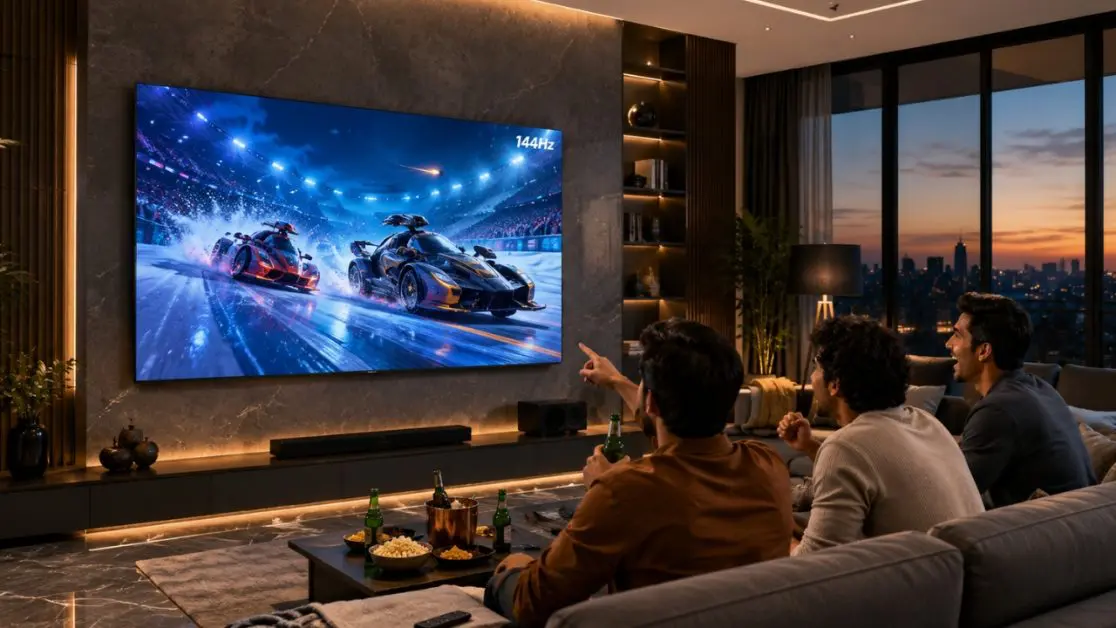
This brings us to the colour gamut.
In simple terms, colour gamut describes the range of colours a display is capable of reproducing. A wider colour gamut gives a capable television more room to represent variations between hues rather than compressing them into a narrower visual range.
For gamers, the practical benefit is easy to understand.
Imagine three environments:
A Tropical Landscape
There may be vivid flowers, deep green foliage, blue water, earthy paths and strong sunlight in the same frame. Wider colour reproduction can help maintain separation between these elements.
A Neon-Lit City
Here the challenge changes completely. Bright signage, coloured reflections, dark buildings and artificial lighting all compete for attention. Rich colour capability helps maintain the intended visual contrast.
A Sunset Over an Open Landscape
This is where poor colour handling can become obvious. A sunset is not simply orange. It can move through yellow, amber, red, magenta, violet and blue across a relatively small portion of the screen.
Smooth, convincing transitions make the sky feel expansive rather than digitally painted.
Where the Haier P7 Pro Series Fits Into This Picture
For gamers who care about this visual side of the experience, the Haier New P7 Pro Series HQLED AI Smart Google TV brings together several technologies that are directly relevant to open-world gaming.
Available in 139 cm (55), 164 cm (65) and 189 cm (75) screen sizes, the P7 Pro Series uses Haier’s QLED technology, which is designed to deliver richer colours, enhanced brightness and lifelike picture quality. The series also supports a Wide Colour Gamut and 93% DCI-P3 colour coverage, giving the display access to a broad colour range for more natural and richly differentiated visuals.
That specification is especially relevant to expansive games. When the screen is simultaneously dealing with sky, vegetation, water, characters, lighting effects and distant scenery, a broad colour range gives the picture system more visual information to work with.
And this is not simply about making everything louder or brighter.
It is about giving individual colours room to breathe.
AI Picture Quality Has a Role Too
Colour does not exist independently of brightness, contrast and clarity.
Change one and the perception of another can shift. A colour that looks rich in a well-balanced scene can appear washed out when brightness is poorly controlled, for example.
The Haier P7 Pro Series features AI Picture Quality, designed to optimise brightness, contrast, colour and clarity in real time according to the content being displayed. Its AI visual processing also includes AI-Color-boost, alongside AI-HDR Enhancer, AI-NR and AI-Motion capabilities.
That combination becomes useful when a game keeps changing its visual conditions.
And open worlds do that constantly.
You are not sitting inside one carefully lit arena for three hours. You may move from sunlight into shadow, enter a building, return outside during rain and eventually continue playing after the in-game sun has disappeared.
The picture needs to remain coherent through those changes.
HDR Adds Another Layer to the World
Colour accuracy becomes even more meaningful when it works alongside strong contrast and HDR handling.
The P7 Pro Series supports HDR10+ and Dolby Vision. HDR10+ dynamically enhances contrast and detail scene by scene, while Dolby Vision contributes to the television’s cinematic picture capabilities.
For open-world gaming, think about what that means visually rather than technically.
A bright sun should feel bright without destroying cloud detail. A dark alley should remain atmospheric without swallowing everything inside it. Reflections on wet roads, flames against a night sky, headlights, windows and distant illuminated buildings all depend on the relationship between colour, brightness and darkness.
This relationship creates visual depth.
Without it, even a technically detailed 4K world can look surprisingly flat.
Colour Is Only Half the Gaming Equation
A gorgeous landscape is less impressive when camera movement turns it into a blur.
That is why evaluating a gaming television solely on colour performance misses part of the picture. Open-world games involve constant camera movement: turning, driving, flying, sprinting, combat and rapid changes in perspective.
The P7 Pro Series combines its picture technologies with Gaming 120Hz, designed for smoother visuals and reduced motion blur during fast-paced gameplay. The series also includes Game Mode, ALLM and VRR gaming features.
These technologies address a different part of the experience:
- Gaming 120Hz supports smoother gaming visuals.
- VRR helps reduce screen tearing as frame behaviour changes.
- ALLM supports lower-latency gaming operation.
- Game Mode provides a gaming-focused viewing environment.
- MEMC is included for smoother handling of fast-moving visual content.
Colour makes the world convincing. Motion handling helps it remain convincing while you move through it.
You really want both.
Bigger Screens Make Colour Differences Easier to Appreciate
Screen size changes the character of an open-world game as well.
On a larger display, environmental detail occupies more of your field of view. Distant scenery feels more substantial. Landscapes become something you visually enter rather than merely observe.
This is one reason the three size choices within the P7 Pro range can be useful for different Indian living spaces.
The 139 cm (55) P7 Pro can suit more compact entertainment arrangements, while the 164 cm (65) and 189 cm (75) variants provide progressively larger canvases for cinematic gaming setups. The core proposition remains consistent across these models: HQLED/QLED picture technology, 4K resolution, HDR10+, Dolby Vision, Wide Colour Gamut with 93% DCI-P3 coverage and the gaming-focused feature set.
Choose the screen according to the room and viewing distance rather than chasing size alone. Bigger is impressive, yes, but a well-matched screen is the better investment.
Do Not Forget Sound While Looking at the Picture
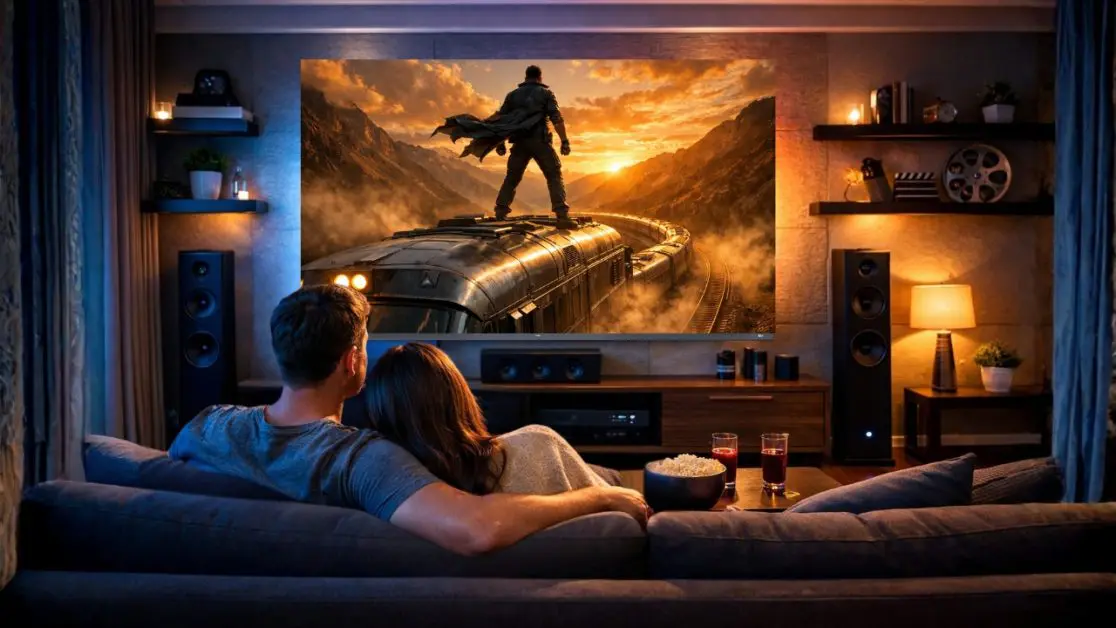
Open-world immersion is visual, but never entirely visual.
Wind through a landscape, approaching vehicles, distant activity, environmental effects and the low-frequency impact of action all contribute to the sense that the world extends beyond the character standing in front of you.
The P7 Pro Series pairs its visual capabilities with 50W audio output, a 2.1-channel system with an inbuilt subwoofer and Dolby Atmos.
That makes the product proposition more complete. Instead of treating picture quality, gaming responsiveness and audio as unrelated specifications, the television brings them together around the same entertainment experience.
What Should Gamers Actually Look for in a TV?
Ignore the temptation to judge a gaming television by one headline number.
For visually ambitious open-world titles, look at the complete picture system:
- Can it reproduce a broad range of colours?
- Does it maintain natural-looking colour rather than merely increasing saturation?
- Can it preserve detail across bright and dark scenes?
- Does HDR complement the display’s colour capability?
- Is motion sufficiently smooth when the camera moves quickly?
- Are gaming features such as VRR and ALLM available?
- Is the screen size appropriate for the room?
- Does the audio have enough depth to support the scale of the visuals?
This is where the Haier P7 Pro Series becomes an interesting proposition for Indian gamers. Its QLED display, 93% DCI-P3 colour gamut, AI Picture Quality, HDR10+, Dolby Vision, Gaming 120Hz, ALLM, VRR and 2.1-channel 50W audio system with an inbuilt subwoofer are not isolated additions. Together, they address several of the qualities that determine whether an expansive game world actually feels expansive.
When the World Looks Right, You Notice the Game Instead of the Screen
The best display technology eventually gets out of the way.
You stop thinking about whether the grass is the right shade. You stop noticing that a sunset has several colour transitions. You simply recognise the landscape, follow the road, spot something unusual in the distance and head towards it.
That is the real value of colour accuracy in open-world gaming.
Developers can build enormous worlds, fill them with changing weather, dramatic lighting and tiny environmental cues but the television still has to deliver that information convincingly to the player.
For gamers looking to build a more visually immersive home setup, the Haier New P7 Pro Series HQLED AI Smart Google TV, available across 139 cm (55), 164 cm (65) and 189 cm (75) options, brings colour reproduction, HDR capability, AI picture optimisation and gaming-focused performance into one large-screen entertainment experience.
Because in an open-world game, seeing more of the world is useful.
Seeing it the way it deserves to look is better.
Frequently Asked Questions
1. Why is colour accuracy important for open-world gaming?
Open-world games contain varied environments, changing weather, different lighting conditions and large landscapes. Accurate colour reproduction helps preserve distinctions between elements such as vegetation, terrain, skies, shadows and character details. Rather than simply making colours brighter, a capable display helps different shades appear more natural and distinguishable.
2. What does Wide Colour Gamut mean for gaming?
Wide Colour Gamut refers to a display’s ability to reproduce a broader range of colours. This can be particularly useful in visually detailed games containing everything from natural landscapes and sunsets to brightly illuminated cities. The Haier P7 Pro Series supports Wide Colour Gamut with 93% DCI-P3 colour coverage, designed for richer and more true-to-life colour reproduction.
3. Does QLED technology improve colours in games?
QLED technology is designed to deliver richer colours, enhanced brightness and lifelike picture quality. On the Haier New P7 Pro Series HQLED AI Smart Google TV, QLED works alongside Wide Colour Gamut and 93% DCI-P3 coverage, making colour performance a central part of the television’s picture capabilities.
4. How does AI Picture Quality help while gaming?
The Haier P7 Pro Series features AI Picture Quality, which intelligently optimises brightness, contrast, colour and clarity according to the content being displayed. The series also includes AI-Color-boost, AI-HDR Enhancer, AI-NR and AI-Motion capabilities for different aspects of picture processing.
5. What gaming features are available on the Haier P7 Pro Series?
The Haier P7 Pro Series includes Gaming 120Hz, Game Mode, ALLM and VRR. These features are designed to support smoother and more responsive gameplay while helping reduce issues such as motion blur and screen tearing. This complements the television’s colour and HDR capabilities during fast-moving gaming sequences.
6. Which screen sizes are available in the Haier P7 Pro Series?
The P7 Pro Series covered here is available in 139 cm (55), 164 cm (65) and 189 cm (75) screen sizes. All three models combine 4K resolution with QLED/HQLED picture technology, HDR10+, Dolby Vision, 93% DCI-P3 colour coverage and gaming-focused features, allowing buyers to select a size that suits their room and viewing arrangement.