


The wash cycle has finished. You put dirty clothes in the washing machine, only to come out of the machine with them being abnormally damp. There are clothes that are dripping, others feel heavier than they are supposed to.
The obvious question is now. What is the problem with the washing machine?
The spin cycle does as the name suggests, it spins the clothes to take the excess water out of the garments before drying. This will make laundry drying take longer when it is not working correctly, and you could run a cycle unnecessarily.
The interesting part? Not all faulty motors are to blame. In some cases, the issue is as straightforward as an unequal load, the appropriation of the wrong wash setting, or water which has not dried out completely.
If you are aware of what is happening while the washing machine is in the Spin Cycle, you will be able to spot the issue before attempting any costly repairs.
When a Washing Machine Spins, What Happens?

An understanding of what the machine is doing helps in determining possible faults.
In the spin cycle, the drum spins at a high speed, producing centrifugal force to squeeze the water from the clothes. The water withdrawn goes through the drum openings and is taken away via the drainage system.
The higher the drum speed, the more water that can be extracted, but the amount also depends on the type of fabric, loading and programme settings.
For example, a heavy cotton towel will hold more water than a lightweight synthetic. In the same way, delicate fabrics should be spun at slower spins per minute.
This is why in the same washing machine, different loads can emerge with varying levels of dampness.
But if clothing still gets too damp even after choosing a suitable programme, there is need to further investigate.
This article identifies seven common causes of washing machine failure. The following seven points refer to washing machine troubleshooting.
7 Reasons Your Washing Machine Is Not Spinning Properly
1. The Drum Is Overloaded
Imagine a regular Sunday wash day.
Nobody wants to do another load, so the washing machine gets bedsheets, some jeans, office clothes, towels, and a couple of other clothes.
Convenient? Perhaps. Effective? Not necessarily.
All washers have a suggested load limit. If it exceeds this capacity then the fabric will be restricted in its ability to move and the drum will have difficulty to maintain a balanced spin.
When a machine is overloaded, it might:
- Difficulty in getting into a spin.
- Produce excessive vibration.
- Leave clothing to be wetter than anticipated.
- Stop the spin cycle due to imbalance.
The answer is simple. Empty some clothes out and toss them around in the other clothes before the spin cycle again.
Keep in mind that the “rated capacity” of a washing machine is the maximum allowable dry laundry weight under certain conditions. There may be lower load limits for individual programmes.
2. There Are Unequal Shares of Clothes
In other cases, it’s not about the amount of laundry that’s loaded. It is the way that the laundry is placed in the drum.
A large bedsheet can be used to twist around smaller clothes. Bath towels can get stuck on one side, causing imbalance.
In this case, the washing machine might decrease the spin speed or stop spinning to prevent too much vibration.
It may seem the drum is trying to speed up and up and up, but it never gets to a normal spinning speed.
What should you do?
- Stop the programme until the door is safely unlocked.
- Separate tangled garments.
- Evenly distribute the laundry in the drum.
- Restart the appropriate spin programme.
When washing a large load, be sure to follow the manufacturer’s guidelines for balancing the load.
For a drum to perform consistently, a balance is crucial.
3. The End Goal of the Drainage System Is Blocked
There is one thing that many people don’t see.
If the water hasn’t been properly drained, the washing machine may not go into high spin mode.
Why?
The machine must be able to drain the wash water prior to the final spin safely.
This can be disrupted if there is a clogged drain filter, blocked hose or drainage pump issue.
Signs of warning include:
- Water that is still in the drum.
- Abnormal noises upon draining.
- Clothes leaving very damp.
- The program halts prior to the last spin.
- An error code that has been identified with a drainage problem that is displayed on the screen.
Test to see if the drain hose is bent or kinked behind the appliance.
When using a user accessible drain filter, it may be necessary to clean it before use, depending on your machine, please consult the instructions. Turn off and unplug the appliance and prevent water from spilling over.
Do not disassemble the internal components of the pump.
Arrange for professional servicing if there is still a problem.
4. The Selected Programme Is on a Lower Spin Speed
Not all wash programmes are intended to spin the clothes at a high speed.
Consider a lightweight saree and a pair of denim jeans. They both require cleaning, but in very different ways as far as their fabrics.
Light fabrics can be spun more softly and may require less drum motion in order to reduce stress on the fabric.
Certain programmes also include features for the user to adjust the spin speed manually.
If your clothes are consistently wetter than you’d expect, check:
- If a low spin speed was chosen, whether it was used correctly.
- Does the programme allow for restriction of spinning?
- It is possible that the spin function was turned off by accident.
- If supported, whether or not a rinse-hold is active.
Choosing the right programme can make a difference without repairs if any.
How Haier F5 Front Load Washing Machines Support Better Laundry Management
Haier F5 front load washing machine plays a crucial role in optimizing laundry management. The Haier F5 front load washing machine contributes to laundry management in a significant way.
It can be easy to run a washing machine every day to get clothes clean, if you pick the right machine, with the right capacity, and use the proper setting for the spin cycle.
Haier India F5 wide range of front load washing machines offers Haier F5 9KG Front Load Washing Machine (HW90-IM14F5BKU1) and Haier F5 10KG Front Load Washing Machine (HW100-IM14F5BKU1).
Both models have a maximum spin speed of 1400 RPM, enabling users to choose appropriate spinning speeds based on the programmes and fabric conditions.
Haier F5 9KG Front Load Washing Machine
Haier F5 9KG Front Load Washing Machine is available for purchase. Haier F5 9KG Front Load Washing Machine is available on sale.
If you’re looking for washing machine options in India that offer a balance between washing capacity and convenient fabric care, the Haier F5 9KG Front Load Washing Machine (HW90-IM14F5BKU1) is a great choice.
Having a capacity of 9 kg, it can hold the laundry needs of the family regularly and its drum capacity of 525 mm will help in moving the fabric during washing.
Some salient points are:
- When appropriate settings are used, the maximum spin rate is 1400 RPM for the best water extraction.
- In-built washing technology to optimize the washing cycles.
- 525 mm drum with a feature that facilitates better garment movement and minimizes tangling.
- Inverter Motor to operate quietly and efficiently.
- Full colour touch display for easy selection of programmes.
- Special Spin and Rinse+Spin cycles to accommodate extra laundry needs.
The machine also features adjustable spinning speeds, enabling users to control the spinning process based on their laundry needs.
These capabilities can help streamline laundry tasks for households that wash clothing for the office, children, bedsheets, and daily wear and tear.
Haier F5 10KG Front Load Washing Machine
The Haier F5 10KG front load washing machine is a new model. Haier F5 10KG front load washing machine is a new washing machine.
With larger wash loads, it is necessary to do a little more planning, especially in families with several members using the washing machine every day.
For larger households with higher washing needs, the Haier F5 10KG Front Load Washing Machine (HW100-IM14F5BKU1) might be a good choice.
It has the same drum size of 525 mm and max spin speed of 1400 RPM as the 9 kg version.
It is characterized by a number of features, such as:
- AI Wash for intelligent wash cycle optimisation.
- 14 washing programmes for various washing demands.
- Smooth and quieter running with Inverter Motor.
- Convenient smart control via the Wi-Fi.
- Specific services for cotton, jeans, delicate textiles, Sarees and other laundry services.
- The ability to adjust speed for more control over spinning.
They also feature a 5-star energy rating, and a 4-year comprehensive warranty and a 12-year motor warranty (applicable terms and conditions apply).
Important note: These features enable the user to more effectively manage their laundry. They don’t replace the need for proper loading, drainage or appliance maintenance.
5. The Washing Machine Isn’t in the Proper Location

Have you ever seen a washing machine shake too much at the end of the spin cycle?
It is okay to have a little bit of movement. But if the machine is vibrating heavily, if it is repeatedly knocking or if it is moving from side to side on the floor, it means there is something that needs to be attended to.
This may be due to incorrect leveling.
If the feet of the washing machine are not set properly, the washing machine might be unbalanced during high speed spinning.
This impacts on spinning performance and puts undue stress on internal components.
How to Check the Machine’s Position
To check the machine’s position:
Here are some basic observations to begin with:
- Ensure that the appliance is stable on the floor.
- Check for sight lines under its pivoting feet.
- Make sure that the washing machine does not rock when lightly pushed.
- Check if the floor is firm and somewhat even.
- Verify that transportation bolts have been removed during installation (as per manufacturer’s instructions).
Adjust the setting if necessary, according to the installation guide or consult an authorised technician.
Don’t put makeshift supports under the appliance.
A washing machine that is set up correctly will probably spin the clothes without any problems.
6. There Is Too Much Detergent in the Cycle
The more detergent, the cleaner clothes are not necessarily.
Especially those low sudsing detergents used in front load washing machines, excessive amount of detergent can cause excessive foam.
If too many suds are used, it can cause trouble rinsing and spinning. Some machines will either alter the programme or lengthen certain parts of the programme.
This can cause users to ask themselves why the washing machine is taking so long.
To avoid the problem:
- Wash according to the type of washing machine detergent used.
- Use the amount of detergent recommended by the detergent manufacturer.
- Fill as needed based on soil load and size of laundry.
- When selecting the detergent dosage, take into account the hardness of the local water.
If there is too much foam proceed with a suitable rinse cycle according to the appliance instructions.
7. A Mechanical or Electrical Component Needs Attention
However, not all spinning problems can be solved at home.
If its machine consistently fails to spin after a proper loading and draining and the proper programme is selected, the machine may need a check of the internal components.
These may be caused by motor, drive mechanism, sensor, wiring, or electronic control system issues.
Depending on the washing machine model, the exact pieces of equipment and materials will differ.
Be aware of indications that include:
- Many programmes where the drum does not rotate.
- Repeated error messages.
- Unusual grinding noises or knocks.
- A burning smell.
- Unexpected stoppage of the appliance.
When a burning smell, smoke or electrical fault is observed, stop the use of the appliance immediately and withdraw safely from the area if it is possible.
The most important thing to note is that any type of internal repair should be carried out by a qualified service specialist.
When to Call a Washing Machine Technician?
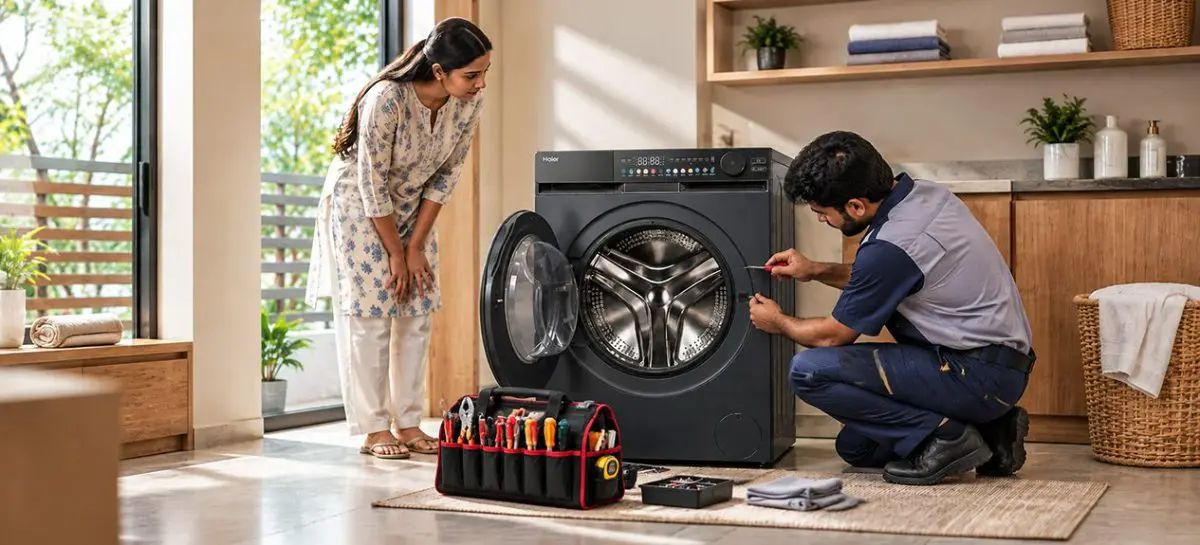
Sometimes the load is not balanced and this does not mean that there is a serious fault.
But, when spinning fails repeatedly it should not be overlooked.
When adding professional assistance to the mix, think of hiring a specialist if you experience:
- The drum is unable to spin with a balanced load.
- Water continually circulates within the machine.
- Mechanical sounds are heard while spinning.
- Recurring error codes are shown on the appliance.
- The machine shuts down the power or electricity.
- After basic troubleshooting the spinning problem persists.
If any problem in the washing machine occurs, the best route of action for Haier washing machine owners is to reach out to Haier India after-sales.
Don’t try electrical or mechanical repairs if you’re not qualified to do so.
How to Prevent Washing Machine Spinning Problems
Some simple laundry tips can keep the spinning going.
Follow the Recommended Load Capacity
Do not exceed recommended load capacity.
Do not overfill the drum as per the recommended limits for the desired programme.
Separate Bulky Laundry
Bedsheets, heavy towels and thick clothing require adequate space to move around freely without getting knotted.
Select the Correct Spin Speed
Select the proper spin speed for the attachment. Select the correct attachment spin speed.
Only use higher spinning speeds if this is allowed by the garment care label and the chosen programme.
Keep the Drainage System in Good Repair
The Drainage System should be kept in good repair.
Check exposed drainage parts as per manufacturer’s maintenance schedule.
Ensure the Machine Is Level
Ensure the machine is level. Do not allow the machine to be unbalanced.
During spinning, an unstable appliance can produce the needless vibration.
These practices work with any kind of washing machine, from a small washing machine to a front loading washing machine that has a large capacity.
Make Everyday Laundry Easier With Haier India
Having problems with everyday laundry? Let Haier India ease the task for you.
If the washing machine isn’t spinning correctly, it can make doing laundry an unnecessarily long process. Luckily, knowing the common causes can help you determine if it’s a minor adjustment or one that needs professionals.
If you are looking to buy a new appliance, Haier India’s F5 9KG and F5 10KG Front Load Washing Machines have a maximum spinning speed of 1400 RPM, AI Wash technology, adjustable speed settings and multiple fabric-specific programmes.
See the F5 front load washing machine range by Haier India and choose the washing machine according to the washing capacity and your daily washing needs.
Frequently Asked Questions
Why Is My Washing Machine Washing but Not Spinning?
Could be due to unbalanced load, drainage blockage, programme selection problems or problems with internal components. First check the load distribution and if water has fully drained.
Why Is It That My Clothes Still Cling to My Body After They Have Been Put Through the Spin Cycle?
Wet clothes can be due to insufficient spin speed or insufficient drum capacity or because the machine has not finished spinning. Fabrics that are heavier also hold more moisture than lighter fabrics.
Does an Overloaded Washing Machine Cause Any Damage?
Excessive vibration, wash performance problems and mechanical strain are potential problems when overloaded repeatedly. Always adhere to the recommended capacity for the programme selected.
Why Is 1400 RPM a Good Choice for Daily Washers?
The maximum spin speed of 1400 RPM offers flexibility in the type of fabric you can use, especially for tough cotton clothes. But for delicate cloths, slower speeds might be necessary. Be sure to read the care labels and programme advice on garments.
If Your Washing Machine Stops Spinning, Consider Replacing It
Not immediately. Corrective problems like load balancing or drainage can cause many spinning problems. If the issue continues, then seek professional advice before deciding if it is a repair or replacement.