
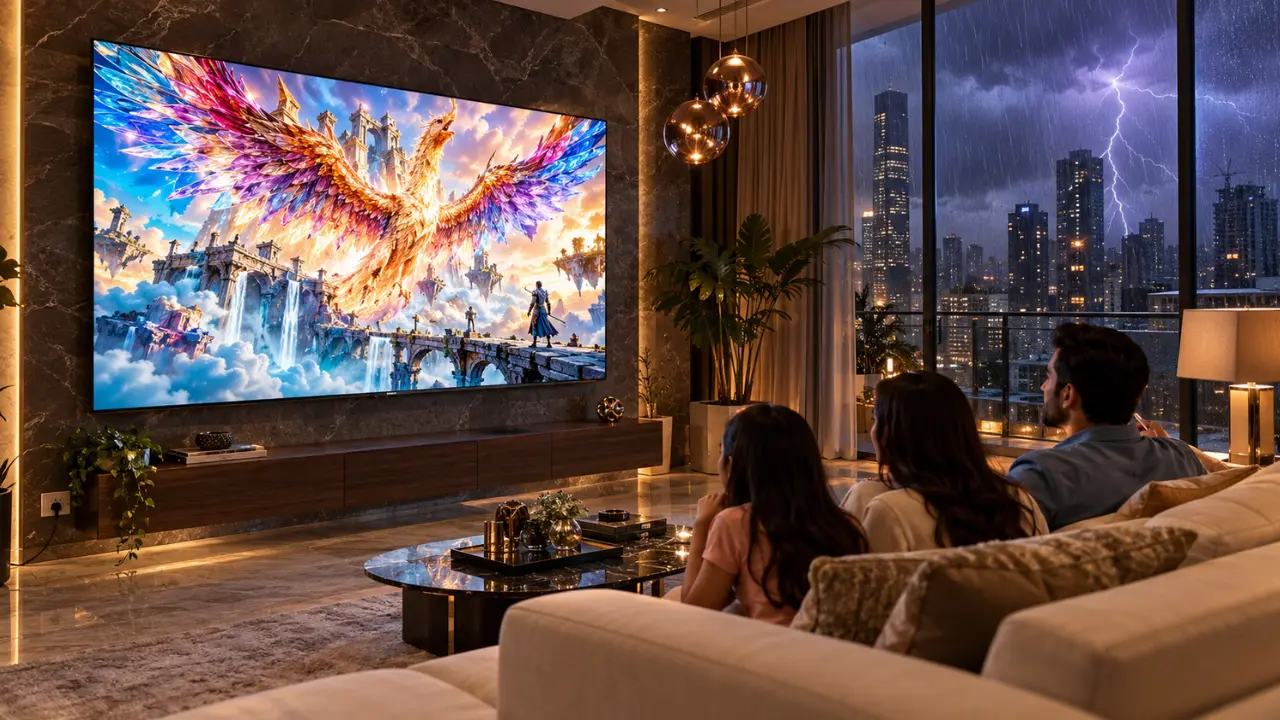

The lights flicker for a second. Your ceiling fan slows down, picks up speed again, and the television suddenly switches off. A few moments later, everything seems normal.
Should you be worried about your TV?
Power fluctuations are familiar to many Indian households, particularly during the monsoon, peak summer electricity demand, or unexpected power interruptions. While modern televisions are designed to handle a range of operating voltages, that doesn’t mean every electrical disturbance is harmless.
So, does your TV need a voltage stabilizer? Not necessarily. It depends on the television’s supported voltage range, the quality of your home’s electricity supply, and the type of electrical protection already installed.
Before spending money on another device, it helps to understand what your television can handle on its own.
Do Modern Smart TVs Really Need a Voltage Stabilizer?
Older televisions were often paired with bulky stabilizers because their electrical components were more vulnerable to voltage variations.
Modern LED, QLED, Mini LED, and OLED televisions generally use electronic power supplies designed to operate across specified input voltage ranges.
For instance, several Haier televisions, including the S80 QLED, C95 OLED, and M70 Mini LED models, specify an AC power input of 100–240V, 50/60Hz.
This means these particular models are designed to operate within that voltage range under normal specified conditions.
However, there’s an important distinction.
A wide operating voltage range is not the same as complete protection against power surges.
A television may continue working during moderate voltage changes but remain vulnerable to sudden electrical spikes, severe overvoltage, or faults in household wiring.
Therefore, the decision to install a stabilizer should depend on your actual power conditions rather than the assumption that every television requires one.
What Happens to Your TV When Voltage Fluctuates?
Think about a typical summer evening in an Indian residential building.
Several air conditioners are running, the water pump starts, and electricity demand increases. Depending on the condition of the local supply and wiring, voltage may fluctuate.
Not every fluctuation damages a television. The severity, duration, and frequency of the disturbance matter.
1. Low Voltage Can Interrupt Operation
When the incoming voltage drops below a television’s supported operating range, its power supply may struggle to maintain normal operation.
Possible symptoms include:
- The television unexpectedly switching off.
- Repeated restarting during voltage drops.
- Difficulty switching on.
- Intermittent operation during unstable power conditions.
These symptoms aren’t always caused by low voltage. Faulty sockets, loose connections, and internal electrical problems can produce similar behaviour.
2. High Voltage Can Stress Electronic Components
Excessively high voltage is another concern.
If the supply exceeds the television’s rated limits, internal power circuits may experience electrical stress.
Depending on the severity, this could result in protective shutdowns or component damage.
3. Sudden Power Surges Can Be More Dangerous
A power surge is a brief increase in electrical voltage.
Surges can occur because of switching events, electrical faults, or lightning-related disturbances.
Unlike gradual voltage variations, some surges happen extremely quickly.
A conventional voltage stabilizer may not respond fast enough to suppress every transient surge. That’s why surge protection and voltage regulation should be treated as different requirements.
How Can You Tell Whether Your TV Needs a Stabilizer?
Rather than buying a stabilizer immediately, examine how electricity behaves in your home.
Here are a few practical situations worth considering.
Your Television Works Without Any Power Interruptions
If your home has a stable electricity supply and your television operates comfortably within its specified voltage range, an external stabilizer may be unnecessary.
However, a suitable surge protection arrangement may still be worth considering.
Your Area Experiences Frequent Voltage Fluctuations
Perhaps the lights regularly dim, appliances restart unexpectedly, or voltage drops occur during peak electricity demand.
In such circumstances, a properly selected voltage stabilizer may help maintain a suitable supply to your television.
Have a qualified electrician assess the electrical conditions before choosing one.
Your TV Keeps Restarting After Power Returns
Repeated restarting could indicate an unstable supply, but it might also point towards a defective power adapter, damaged wiring, or an internal television fault.
Don’t assume a stabilizer will automatically solve the problem.
Check the power connection and arrange professional inspection if the issue continues.
Your Home Has Old Electrical Wiring
Ageing electrical installations deserve particular attention.
Loose connections, inadequate earthing, and overloaded circuits can create problems that a stabilizer cannot correct.
Electrical safety comes first. A stabilizer should never be considered a substitute for properly maintained household wiring.
Voltage Stabilizer vs Surge Protector vs UPS: What’s the Difference?
These devices are often discussed together, although they perform different functions.
Voltage Stabilizer
A voltage stabilizer regulates variations in the incoming electricity supply to keep its output within a specified range.
It can be useful where voltage regularly rises or falls beyond acceptable operating limits.
However, its effectiveness depends on the device’s design, input range, response time, and protection features.
Surge Protector
A surge protector is designed to limit certain short-duration voltage spikes.
It does not necessarily correct prolonged low-voltage or high-voltage conditions.
Also, not every extension board marketed as a power strip provides meaningful surge protection.
Uninterruptible Power Supply (UPS)
A UPS provides temporary backup power when the main electricity supply fails.
Some UPS models also offer voltage regulation and surge protection.
However, compatibility matters. The UPS must be suitable for the television’s electrical requirements and any connected equipment.
Which should you choose?
- Stable voltage with occasional switching surges: Consider suitable surge protection.
- Frequent sustained voltage variations: Consider a compatible voltage stabilizer.
- Frequent power cuts requiring temporary backup: Evaluate an appropriately rated UPS.
- Suspected wiring or earthing problems: Arrange electrical inspection before purchasing protective equipment.
No single accessory guarantees protection against every electrical fault.
How Do Haier Smart TVs Handle Different Input Voltages?
When choosing a modern television, picture quality usually gets the most attention.
Buyers compare display technologies, screen sizes, sound systems, and smart features. Electrical compatibility often gets overlooked.
Yet it’s an important specification, particularly for Indian households where power conditions can vary between locations.
Haier offers televisions across different display technologies, with selected models supporting a broad AC input range.
Haier S80 QLED 43-Inch Google TV
The Haier S80 QLED 109 cm (43) Google TV (H43S80FUX) combines 4K UHD resolution with QLED display technology.
Its listed AC power input is 100–240V, 50/60Hz.
Beyond electrical compatibility, the television offers several entertainment-focused features:
- 4K UHD QLED: Delivers vibrant colours and detailed visuals.
- HDR10 and HLG: Support enhanced contrast and picture detail.
- Dolby Audio: Provides enhanced audio clarity.
- Google TV: Brings personalised entertainment recommendations.
- Variable Refresh Rate (VRR): Helps reduce screen tearing with compatible content.
For households looking to upgrade their everyday entertainment setup, the S80 offers a combination of picture quality and smart functionality.
Its broad input voltage specification is useful, but it should not be mistaken for a guarantee against electrical surges.
Haier M70 Mini LED 43-Inch Google TV
The Haier M70 Series Mini LED 109 cm (43) AI Smart Google TV (43M70UHMINI LED) is another option worth exploring.
It also lists an AC input requirement of 100–240V, 50/60Hz.
The M70 focuses on a more refined viewing experience through features such as:
- Mini LED with Micro Dimming: Optimises light levels for improved contrast and deeper blacks.
- AI Picture Quality: Adjusts picture parameters according to content.
- Dolby Vision and Dolby Atmos: Enhance visual detail and immersive audio.
- MEMC: Helps smooth fast-moving scenes.
- Google TV with Gemini: Supports AI-assisted entertainment discovery.
- 30W Audio Output: Delivers powerful sound for everyday viewing.
Whether you’re watching a cricket match or enjoying a weekend film, these features contribute to the overall experience.
The electrical protection requirements, meanwhile, should still be assessed separately.
Haier C95 OLED 55-Inch Google TV
For viewers interested in a premium display, the Haier C95 OLED 140 cm (55) Google TV (H55C95EUX) offers a different experience.
Its OLED display produces deep blacks and vibrant colours, while the 144Hz refresh rate supports smoother motion.
Other notable features include:
- Dolby Vision IQ and HDR10+: Enhance picture reproduction.
- 50W Sound by Harman Kardon: Delivers rich, balanced audio.
- Dolby Atmos: Creates a more immersive listening experience.
- Hands-Free Voice Control: Allows convenient voice-based operation.
- AMD FreeSync Premium: Supports smoother gaming with compatible devices.
The C95 also specifies 100–240V, 50/60Hz AC input.
Given the investment involved in a premium OLED television, checking household electrical safety and suitable surge protection is particularly sensible.
What Should You Check Before Buying a TV Stabilizer?
If your electricity supply genuinely requires voltage regulation, choosing the correct stabilizer becomes important.
Don’t purchase one based only on the television’s screen size.
Check the Input Voltage Range
The stabilizer should accommodate the voltage variations experienced at your location.
Its regulated output must remain compatible with your television’s specified input requirements.
Confirm the Power Rating
Check the television’s rated power consumption and consider any additional connected equipment.
The stabilizer should have sufficient capacity for the intended load.
Look for Suitable Safety Features
Depending on the model, useful features may include:
- High-voltage and low-voltage cut-off.
- Overload protection.
- Automatic restart delay.
- Thermal protection.
- Surge protection, where specifically provided.
Not every stabilizer includes all these features.
Prioritise Electrical Compatibility
Choose equipment from a reputable manufacturer and follow the installation instructions.
For persistent electrical problems, consult a qualified electrician rather than experimenting with different accessories.
Can You Protect Your Smart TV Without a Stabilizer?
Yes, depending on the electrical conditions in your home.
A few sensible precautions can reduce avoidable risks.
Use a properly installed electrical socket. Avoid loose plugs, damaged extension boards, and overloaded connections.
Check household earthing. Proper earthing is an important part of electrical safety and the effectiveness of certain protective devices.
Consider surge protection. A suitable surge protective device can help address certain transient voltage spikes.
Avoid switching the TV on repeatedly during unstable power conditions. Wait until the supply stabilises.
Disconnect equipment during severe thunderstorms when safe to do so. This may reduce exposure to certain surge risks, although it cannot eliminate every hazard.
Most importantly, follow the television manufacturer’s electrical and installation instructions.
Should You Buy a Modern Haier TV Without a Stabilizer?
For many households with reasonably stable electricity, a compatible modern television may operate without an external voltage stabilizer.
Selected Haier televisions, including the S80 QLED, M70 Mini LED, and C95 OLED, support an AC input range of 100–240V, 50/60Hz.
That specification provides useful flexibility within the stated operating limits.
However, voltage compatibility should not be confused with guaranteed protection against electrical faults.
If your home experiences repeated voltage disturbances, the sensible approach is to identify the underlying problem and select appropriate protection.
When you’re ready to upgrade, explore Haier India’s television range to compare display technologies, smart features, screen sizes, and electrical specifications.
A television should deliver the entertainment experience you’re paying for. Making sure it receives a suitable electricity supply is part of looking after that investment.
Frequently Asked Questions
1. Does a 4K Smart TV Need a Voltage Stabilizer?
Not always. Many modern 4K televisions support a broad input voltage range. Check the manufacturer’s specifications and consider a stabilizer if your electricity supply frequently falls outside the supported limits.
2. Can Voltage Fluctuations Damage an LED TV?
Yes. Severe or repeated voltage disturbances can potentially damage electronic components. However, minor fluctuations within the television’s rated operating range are generally accommodated by its power supply.
3. Do Haier Smart TVs Work Without an External Stabilizer?
Selected Haier models, including the S80 QLED, M70 Mini LED, and C95 OLED, specify an AC input range of 100–240V, 50/60Hz. They can operate within their specified conditions without necessarily requiring an external stabilizer. Additional protection depends on local electrical conditions.
4. Is a Surge Protector Better Than a Voltage Stabilizer for a TV?
Neither is universally better. A surge protector addresses certain brief voltage spikes, while a stabilizer regulates sustained voltage variations. The appropriate choice depends on the electrical problem you’re trying to manage.
5. Can I Connect My Smart TV Directly to a Wall Socket?
Yes, provided the socket is properly installed, the electrical supply meets the television’s requirements, and the manufacturer’s instructions permit direct connection. Avoid damaged sockets and overloaded extension boards.
6. Does a Voltage Stabilizer Protect a TV During Lightning?
Not necessarily. A conventional stabilizer cannot guarantee protection against lightning-induced surges. Suitable surge protective devices and a properly designed electrical installation offer more appropriate protection, although no system can eliminate every lightning-related risk.