


The chaklis are getting golden, the shankarpalis are nearing completion, and someone in the living room has begun arranging the Diwali decorations. Things are going so well, it seems.
Until you smell the hot oil on the sofa.
These days, open kitchens are popular in modern Indian homes. They make the living area feel spacious, enable family members to communicate with each other while working in the kitchen, and create a welcoming atmosphere during celebrations. But if Diwali celebrations involve hours of frying, the absence of a physical separation between the kitchen and living room can pose a challenge.
Oil fumes, cooking smoke and other lingering odours can spread beyond the cooktop and potentially settle on curtains, upholstery and other furnishings.
So, how can you cook festively without filling the house with the smell of a frying pan?
The solution is to control fumes at their source, improve kitchen ventilation and choose a kitchen chimney that can handle the demands of intensive Indian cooking.
Why Does Diwali Cooking Create More Fumes in Open Kitchens?

A tadka or a few rotis may be part of everyday cooking. Diwali preparations are different.
Families often make several batches of traditional snacks over a period of several hours. Chakli, namak para, mathri and shankarpali require sustained frying, generating oil vapours and airborne particles that enter the surrounding air.
Walls and doors can help prevent these fumes from spreading quickly in an enclosed kitchen. With an open kitchen, there is no such separation.
What Happens When Cooking Oil Gets Hot?
As cooking oil heats up, it releases vapours and fine particles. The amount varies depending on the oil, temperature, ingredients and cooking technique.
If the oil becomes excessively hot or starts smoking, airborne emissions increase.
These emissions may:
- Travel towards the dining and living rooms.
- Leave greasy deposits on nearby surfaces.
- Create lingering frying smells in soft furnishings.
- Make the kitchen feel stuffy during extended cooking sessions.
- Affect indoor air quality, especially in areas with inadequate ventilation.
The issue becomes more prominent when multiple dishes are prepared consecutively without sufficient extraction.
The Most Important Rule: Don’t Let Oil Fumes Spread
If there is a lingering smell, opening a window after cooking may help. However, it is generally more effective to prevent fumes from spreading in the first place.
A properly installed kitchen chimney can prove very useful here.
A ducted kitchen chimney draws cooking fumes from above the hob and directs the extracted air outdoors through an exhaust duct.
For open kitchens, the goal is simple: capture as much of the rising cooking plume as possible before it reaches the living room.
Why Does Chimney Suction Power Matter During Festive Cooking?
Suction capacity is commonly expressed in cubic metres per hour (m³/h). It indicates the volume of air a chimney is designed to move under specified conditions.
A high-suction kitchen chimney can help during Diwali, when frying continues for longer periods.
Haier India offers several chimney models designed for Indian cooking requirements, including:
- Haier Unique Pyramid Filter 1800 m³/h Suction Power Heat Auto Clean Chimney (HIH-T1903).
- Haier Unique Butterfly Filter 1800 m³/h Suction Power Heat Auto Clean Chimney (HIH-T3903).
- Haier Unique Pyramid Filter 2000 m³/h Suction Power Heat Auto Clean Chimney (HIH-T5905).
These models offer high rated suction capacities and adjustable speed settings, making them worth considering for kitchens where frying and other intensive cooking activities are frequent.
However, suction capacity alone does not guarantee effective smoke removal. Chimney positioning, duct length, airflow restrictions and installation quality also influence actual performance.
Six Ways Haier Kitchen Chimneys Help Control Diwali Cooking Fumes
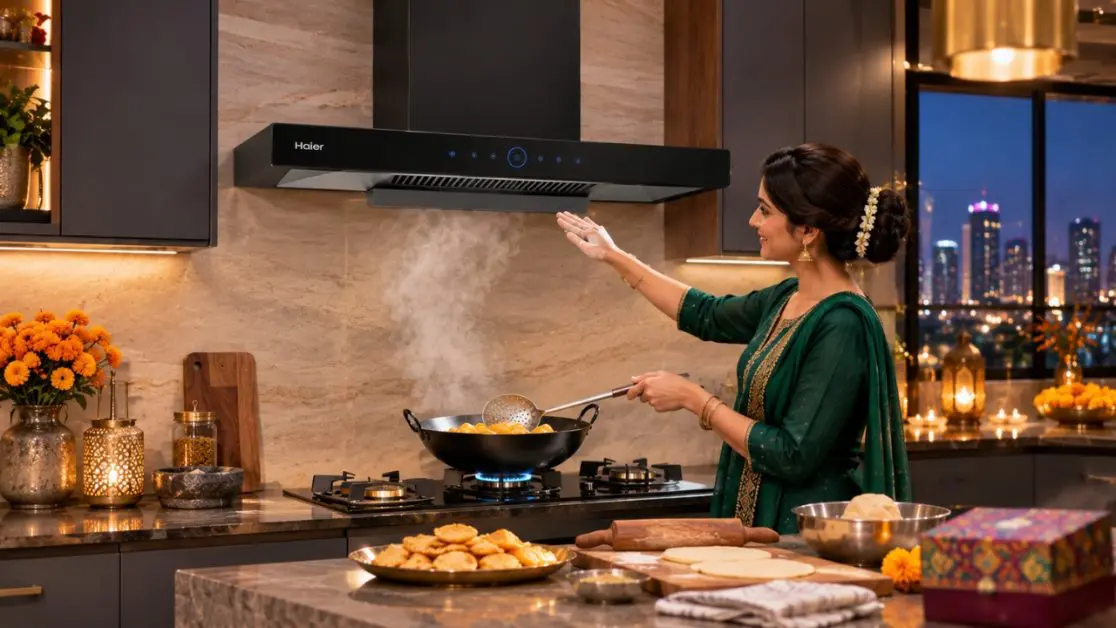
Imagine preparing a large batch of mathri while guests are sitting just a few metres away.
You need extraction that responds to the level of cooking activity without making the process unnecessarily complicated.
Haier’s HIH-T1903, HIH-T3903 and HIH-T5905 chimneys offer several features that can help in this situation.
1. Strong Suction Power for Intensive Indian Cooking
The Haier HIH-T5905 offers a rated suction capacity of 2000 m³/h, while the HIH-T1903 and HIH-T3903 offer 1800 m³/h.
These capacities make the models suitable candidates for kitchens that generate substantial cooking fumes.
For households that regularly prepare fried snacks, tadka-heavy dishes and festive meals, effective extraction can help reduce the amount of cooking fumes entering neighbouring rooms.
2. Three Speed Settings and Grand Turbo
Not every cooking activity requires the same extraction level.
The cooking plume created when boiling potatoes for samosas is different from the plume created when frying the samosas themselves.
The three Haier chimney models feature three speed settings and a Grand Turbo function that provides an additional airflow boost for 100 seconds.
This flexibility allows users to adjust extraction according to their cooking requirements.
For instance:
- Low speed: For lighter cooking with limited fumes.
- Medium speed: For regular cooking activities.
- High speed: For intensive cooking that produces noticeable fumes.
- Grand Turbo: For a short additional boost when cooking activity becomes particularly demanding.
The most appropriate setting depends on the fumes generated and the kitchen’s airflow conditions.
3. Touch and Gesture Controls for Convenient Operation
During Diwali preparations, hands are frequently covered in flour, dough or oil.
Repeatedly touching appliance controls can be inconvenient.
Haier’s HIH-T1903, HIH-T3903 and HIH-T5905 chimneys feature touch and gesture controls, allowing users to operate supported functions with a simple hand movement.
This makes adjusting the chimney more convenient while preparing festive snacks.
4. Heat Auto Clean for Grease Maintenance
Extended frying sessions can contribute to grease accumulation inside a chimney.
Haier’s Heat Auto Clean technology uses heat to help loosen accumulated grease, directing it towards the oil collector.
The three models also feature an oil collector and a cleaning reminder after 15 cumulative operating hours.
These features can simplify routine maintenance, although the oil collector and accessible surfaces still need to be cleaned according to the manufacturer’s instructions.
Your Diwali Cooking Schedule Can Also Reduce Fume Build-Up
Even with a kitchen chimney, organising your cooking makes a difference.
Instead of preparing everything continuously at maximum heat, plan your cooking sequence to manage both temperature and fumes.
| Cooking activity | Recommended approach |
| Preparing chakli | Switch on the chimney before frying begins. |
| Frying shankarpali | Maintain a suitable oil temperature and avoid overheating. |
| Making mathri | Adjust chimney speed according to visible fumes. |
| Preparing festive tadka | Keep the pan beneath the chimney’s extraction area. |
| Finishing the last batch | Allow extraction to continue briefly after cooking. |
A little planning can prevent the kitchen from becoming overwhelmed by consecutive frying sessions.
Keep the Frying Pan Within the Chimney’s Coverage Area
This sounds obvious, but it can easily be overlooked.
If the frying pan is not positioned close to the extraction area, some fumes may escape before reaching the chimney.
Position cookware appropriately beneath the hood and follow the installation instructions for the correct chimney height and hob clearance.
Don’t Ignore Airflow Between the Kitchen and Living Room

A chimney cannot function independently of the surrounding airflow.
For ducted extraction to work effectively, replacement air must enter the house as air is exhausted outdoors.
However, opening every window and switching on every fan is not necessarily helpful.
Strong cross-draughts can push cooking fumes sideways, away from the chimney.
Practical Ventilation Tips for Open Kitchens
- Provide a suitable source of replacement air without creating strong draughts across the hob.
- Avoid positioning pedestal fans directly towards the cooking area.
- Keep the chimney’s outdoor exhaust path unobstructed.
- Use a properly designed ducting arrangement with minimal unnecessary bends.
- Avoid placing decorative items near the chimney’s intake.
- Ensure adequate ventilation when cooking with gas.
One important distinction: a kitchen chimney helps extract cooking fumes, but it does not replace safe gas-appliance operation or adequate fresh-air ventilation.
Small Cooking Habits That Make a Noticeable Difference
The chimney handles extraction. Your cooking habits can help reduce the fumes being generated.
Avoid Heating Oil Beyond the Required Temperature
Oil that starts smoking is generally hotter than necessary for many frying applications.
Maintain an appropriate frying temperature and lower the heat if the oil begins smoking.
Overheated oil can generate additional fumes and affect the flavour and colour of festive snacks.
Fry in Manageable Batches
If a kadai is overcrowded, the oil temperature can drop, leading to uneven cooking.
Smaller batches help maintain more consistent frying conditions.
Keep Used Oil and Greasy Utensils Covered
Once frying is complete, allow the oil to cool safely before transferring or disposing of it appropriately.
Avoid leaving greasy utensils and uncovered used oil near the living area for extended periods.
Additionally, wipe down nearby surfaces after cooking to minimise grease deposits.
Choosing a Haier Chimney for Your Open Kitchen
The three Haier models offer different filter designs and suction capacities.
| Haier chimney model | Rated suction | Filter design |
| HIH-T1903 | 1800 m³/h | Filterless double-layered pyramid |
| HIH-T3903 | 1800 m³/h | Filterless butterfly |
| HIH-T5905 | 2000 m³/h | Filterless double-layered pyramid |
All three models feature a 90 cm T-shaped design, Heat Auto Clean technology, touch and gesture controls, three speed settings with Grand Turbo, and an oil collector.
The HIH-T5905 offers the highest rated suction capacity among these three models, making it worth considering for households looking for greater extraction capacity.
The HIH-T1903 and HIH-T3903 offer 1800 m³/h suction with different internal filter designs.
When making a selection, consider the hob width, available wall space, ducting route and cooking frequency. A professional installation assessment can help determine which model is best suited to your kitchen layout.
Keep the Festive Atmosphere, Not the Frying Smell
An open kitchen should bring the family together during Diwali, not allow cooking fumes to take over the living room.
Maintaining appropriate cooking temperatures, organising cooking sessions and ensuring proper ventilation can make a meaningful difference.
Haier India’s range of high-suction, Heat Auto Clean chimneys offers practical options for households looking to improve kitchen extraction during intensive Indian cooking.
Explore the Haier HIH-T1903, HIH-T3903 and HIH-T5905 kitchen chimneys to find a model that suits your cooking requirements and kitchen layout.
After all, freshly prepared Diwali snacks are wonderful to smell. Having that smell linger in the sofa cushions long after the festivities? Not quite.
Frequently Asked Questions
How can I stop frying smells from entering my living room?
Use a properly installed ducted kitchen chimney, switch it on before frying, maintain suitable oil temperatures and provide adequate replacement air without strong cross-draughts.
Is a 2000 m³/h chimney suitable for an open kitchen?
A chimney with a rated suction capacity of 2000 m³/h, such as the Haier HIH-T5905, may be worth considering for intensive cooking. Actual suitability depends on the kitchen layout, ducting arrangement, hob dimensions and installation conditions.
Should I keep the chimney running after frying?
Yes. Continuing extraction briefly after cooking can help remove residual fumes. The Haier HIH-T1903, HIH-T3903 and HIH-T5905 also feature a three-minute delay-off function.
Does Heat Auto Clean remove the need for chimney cleaning?
No. Heat Auto Clean helps loosen accumulated grease, but the oil collector and accessible components still require routine maintenance as instructed by the manufacturer.
Can I use a ceiling fan while frying in an open kitchen?
Strong airflow from a ceiling fan may disturb the rising cooking plume and reduce chimney capture effectiveness. Avoid directing powerful airflow across the hob during frying.