
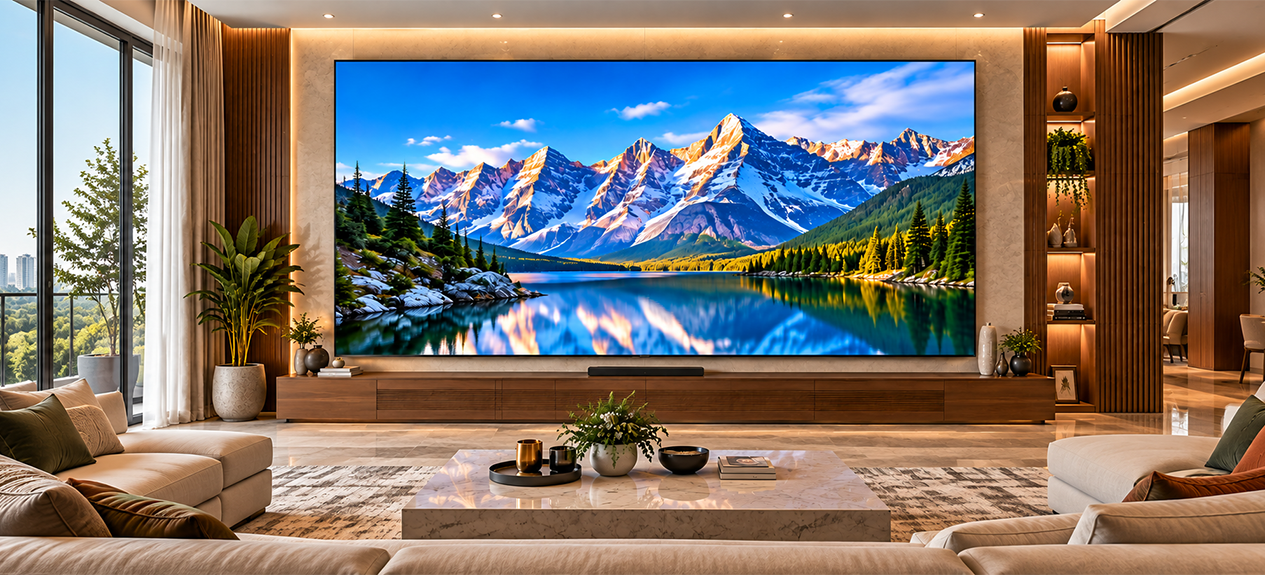

A few years ago, an 85-inch TV in an Indian living room felt like a stretch. Today, 100-inch panels are on shop floors, and 115-inch and 116-inch models have started appearing at global launches. What was once reserved for hotel lobbies and boardrooms is quietly working its way into homes.
The 100-inch TV category is the clearest sign of that shift. Prices have dropped enough for a genuine cinema-scale screen to be a realistic upgrade for buyers who already own a 65-inch or 75-inch TV, and Indian brands and importers are widening their giant-screen lineups every quarter.
This guide walks through how big these screens really are, what they cost in India today, whether they fit an average Indian home, and how a projector compares so you can decide whether a giant screen tv actually makes sense for your space, or whether an 85-inch is already as large as you’d want to go.
The Rise of Giant-Screen TVs in India
Big-screen viewing has come a long way. Where 55-inch used to be the aspirational size a decade back, 65-inch and 75-inch are now the popular upgrade categories, and 85-inch models sit within reach for many premium buyers.
The big-screen TV market in India is now expanding beyond 85-inch, into 98-inch and 100-inch territory. Two things have made this possible: panel manufacturing has matured enough to bring costs down at these sizes, and Indian broadband speeds have caught up to the point where streaming 4K content on a 100-inch screen looks the way it should.
At the very top of the market sit experimental models like the 115-inch and 116-inch panels shown at global exhibitions. Right now, the world’s largest TV available for consumer purchase floats around this range, though it comes with a price tag that keeps it firmly in the enthusiast bracket.
How Big Is a 100-Inch TV, Really?
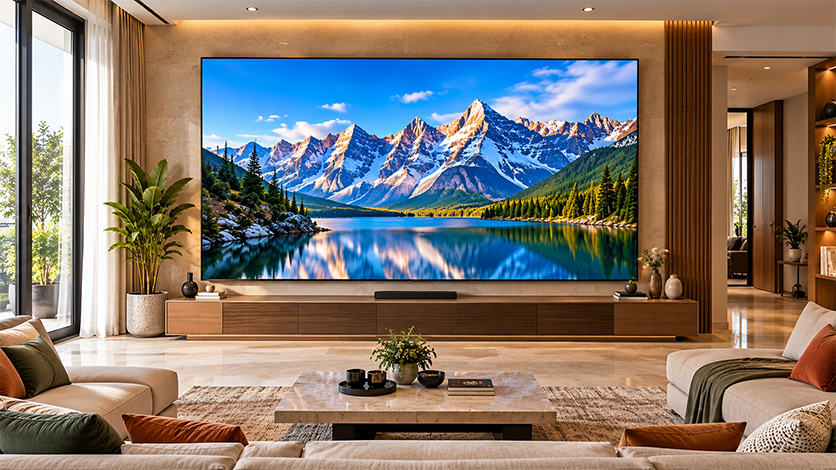
The size numbers on a TV describe the diagonal of the screen, not its width. That distinction becomes important once you cross 85 inches, where a small change in inches translates into a large change in wall coverage.
100-Inch TV Dimensions and Size in CM
For a 100-inch TV, the diagonal is roughly 254 cm. In practical terms:
- Screen width: about 221 cm (7 feet 3 inches)
- Screen height: about 124 cm (4 feet 1 inch)
- Weight without stand: typically 50 kg or more
- Wall area covered: roughly 2.7 square metres
Compared to smaller giant sizes:
- 85 inch tv: diagonal ~216 cm, width ~188 cm, height ~106 cm
- 98 inch tv: diagonal ~249 cm, width ~217 cm, height ~122 cm
- 100-inch: diagonal 254 cm, width ~221 cm, height ~124 cm
The gap between 85-inch and 100-inch is larger than the numbers suggest. You’re adding almost 35 cm of screen width, which is a full extra hand-span across the wall.
Room Size and Viewing Distance for 85, 98 and 100 Inches
For a 4K panel, the recommended viewing distance in metres is roughly:
- 85-inch: 2.7 to 3.6 m (about 9 to 12 feet)
- 98-inch: 3.1 to 4.2 m (about 10 to 13.5 feet)
- 100-inch: 3.2 to 4.3 m (about 10.5 to 14 feet)
That translates to room-size guidance:
- 85-inch: works in living rooms of about 12 x 14 feet or larger
- 98-inch or 100-inch: works in living rooms of 14 x 16 feet or larger, ideally with seating 10 feet away or more
So is an 85-inch TV too big? For a standard 10 x 12 ft bedroom, yes. For a 14 x 16 ft living room, with the sofa placed 9 feet back, it feels well proportioned.
How Much Do Giant-Screen TVs Cost?
The 100-inch TV price in India in 2026 varies widely by brand and panel type. Rough bands:
- 85-inch 4K LED: ₹1,50,000 to ₹3,00,000
- 98-inch 4K LED / QLED: ₹2,50,000 to ₹4,50,000
- 100-inch QLED: ₹3,00,000 to ₹5,00,000
- 100-inch Mini-LED and premium QLED: ₹4,00,000 to ₹7,00,000
- 115-inch and 116-inch flagship models: above ₹10,00,000
Festive offers, exchange discounts, and no-cost EMI plans can noticeably reduce effective costs in each band.
Why 100-Inch TVs Are So Expensive (For Now)
Giant panels are expensive for the same reason semiconductor wafers are: yield drops sharply as the panel gets larger. A 100-inch panel requires a single, perfect sheet of substrate, and any defect on that sheet can render the entire panel unusable.
On top of that:
- Larger panels need more advanced local dimming and more backlight zones
- Shipping and warehousing a 100-inch panel is significantly costlier per unit
- Installation requires specialised teams and equipment
- Warranty and service costs run higher on premium models
As panel yields improve and more brands enter the segment, prices at 100-inch have been trending down year on year, and that trend is likely to continue.
Are Giant TVs Practical for Indian Homes?
For urban Indian apartments, the honest answer is: it depends. A 100-inch TV works beautifully in a large duplex living room or a home theatre; in a compact 3 BHK, it can overwhelm the space and create more problems than it solves.
Doorways, Walls and Installation Challenges
Practical checks before ordering the largest TV in your city:
- Standard Indian apartment doorways are usually 90 to 100 cm wide, while a boxed 100-inch TV can be 240 cm wide and 150 cm tall
- Some buildings need lift access approvals, and many older lifts simply can’t fit the box
- The wall itself must be solid brick or reinforced concrete to safely hold 50+ kg
- A mount rated for 100-inch panels costs more, and installation usually needs a two- to four-person team
- Power sockets, HDMI runs, and network cabling should be routed before the panel is mounted
If the box can’t physically get to the room, no amount of budget solves the problem; always confirm access first.
You can review Haier’s Google TV lineup in India for both giant-screen options and more compact 55-inch and 65-inch alternatives.
When a Projector Might Make More Sense
For screen sizes of 100 inches and beyond, a projector remains a genuine alternative. Projectors cost less per inch, take up almost no wall space, and can throw a much larger image on a dedicated screen or a plain white wall.
The trade-offs are worth knowing: projectors need a darker room to look their best, throw distances have to be planned carefully, bulb replacement adds ongoing cost on older models, and picture quality in bright daylight rarely matches a good QLED or Mini-LED panel.
For a dedicated home theatre in a controlled room, projectors are still competitive. For a well-lit living room where the TV must work all day, the biggest TV in QLED or Mini-LED form remains the more practical choice.
What to Check Before Buying a Giant-Screen TV?
A short checklist before you commit to anything above 85-inch:
- Measure your seating distance and confirm it hits at least 3 metres
- Confirm your doorway, staircase, and lift can fit the packaged box
- Check that your primary viewing wall is solid brick or concrete
- Look for 4K resolution, high refresh rate (120Hz or 144Hz), and Dolby Vision or HDR10+
- Prioritise strong built-in audio, ideally tuned by an audio brand
- Confirm installation is included, and check warranty coverage on the panel
For most 100-inch buyers, matching two 100-inch options from the same brand tends to help clarify the value pick versus the flagship pick. Here’s how Haier’s two 100-inch models compare:
| Feature | Haier S90 QLED (100″) | Haier M96 QD-Mini LED (100″) |
| Panel | QLED | QD-Mini LED |
| Resolution | 4K UHD | 4K UHD |
| Refresh Rate | 144Hz | 144Hz |
| HDR | Dolby Vision IQ, HDR10+ | Dolby Vision IQ, HDR10+ |
| Dimming Zones | 432 | 2,160 |
| Sound | 55W 2.1Ch by KEF, Dolby Atmos | 90W 6.2.2Ch by KEF, Dolby Atmos |
| Smart Platform | Google TV, UltraSense AI | Google TV, UltraSense AI |
| Gaming | AMD FreeSync Premium Pro, VRR, ALLM | AMD FreeSync Premium Pro, VRR, ALLM |
| Warranty | 4 years (1+3) | 4 years (1+3) |
| Price | ₹3,22,990 | ₹4,19,990 |
Which 100-Inch Haier TV to Consider
For giant-screen buyers, the two Haier 100-inch options land at different ends of the segment:
- For value-focused giant-screen buyers: the Haier S90 QLED 100″ at ₹3,22,990 is one of the more accessibly priced 100-inch QLED models on the Indian market, and it still ships with 144Hz gaming, Dolby Vision IQ, and KEF-tuned audio.
- For premium home-theatre setups: the Haier M96 QD-Mini LED 100″ at ₹4,19,990 steps up to 2,160 dimming zones, a 6.2.2-channel KEF sound system, and QD-Mini LED contrast, a stronger fit if picture depth in dim viewing conditions matters most.
Will 100-Inch TVs Become Mainstream in India?
Not immediately, but the direction of travel is clear. Panel prices have dropped every year, brands are widening their giant-screen lineups, and Indian broadband can now handle 4K streaming on these sizes without stuttering.
Widespread adoption still faces two real barriers: apartment sizes in metros, and doorway and lift access. Until those loosen up through larger new-build homes and better delivery workflows, 100-inch will remain a category for buyers with genuinely large living rooms or dedicated home theatres.
Conclusion
Giant-screen TVs are no longer a novelty. They’re a legitimate purchase category with real options at 85, 98, and 100 inches from mainstream Indian brands, and the pricing gap versus premium 65-inch and 75-inch models keeps narrowing.
Whether one belongs in your home comes down to the honest answers to a few questions: how large is your room, how far back does the seating sit, and can the box physically reach the wall? Get those three right, and a 100-inch TV can genuinely transform the way a household watches; get them wrong, and even the best panel in the world will feel like a mistake.
FAQs
How big is a 100-inch TV in cm?
The diagonal is 254 cm. The screen width is about 221 cm and the height is about 124 cm, with a typical weight of 50 kg or more without the stand.
How much does a 100-inch TV cost in India?
Prices in 2026 start at around ₹3,00,000 for 100-inch QLED models and rise to ₹7,00,000 or more for premium QD-Mini LED variants. Festive offers can bring the effective cost down.
What is the biggest TV you can buy from Haier?
Haier’s largest TV in the Indian retail lineup is 100 inches (254 cm), available in both S90 QLED and M96 QD-Mini LED variants, priced at ₹3,22,990 and ₹4,19,990 respectively.
What room size do I need for a 100-inch TV?
A living room of at least 14 x 16 feet, with seating placed at least 10 feet from the screen. Smaller rooms will make the screen feel overwhelming and reduce comfort during long viewing sessions.
Why are giant-screen TVs so expensive?
Larger panels need bigger, defect-free substrates, more backlight zones, specialised shipping and installation, and higher warranty support costs. Yield drops sharply as panel size increases, which pushes unit costs up.
Is an 85-inch or 98-inch TV too big for a home?
For a standard 10 x 12 ft bedroom, yes. For a living room of 12 x 14 ft or larger, with seating 9 feet or more away, an 85-inch TV feels well proportioned. 98-inch TV needs a slightly larger room, closer to 14 x 15 feet minimum.
Are 100-inch TVs practical for Indian homes?
They work well in large duplex living rooms, dedicated home theatres, and villa-style setups. In compact urban apartments, doorway width, lift access, and wall strength often become bigger constraints than budget alone.
Is a giant TV better than a projector?
For a well-lit daytime living room, a giant TV wins on brightness and daily convenience. For a dedicated dark home theatre, a projector can deliver a larger image at a lower per-inch cost, though picture quality trade-offs apply in bright rooms.