

Ever noticed this? You switch between a cricket match, an old Bollywood classic on TV, a YouTube recipe, and a newly released OTT series all within half an hour. Strange thing is, none of them look the same. Some scenes appear incredibly detailed, while others feel dull, slightly blurry, or lacking depth.
Now here’s the part many people overlook.
It isn’t always the internet. And it isn’t always the display panel either.
Quite often, the television processor is doing the heavy lifting behind the scenes.
Think of it like the brain of your TV. The screen simply displays what it’s told, but the processor decides how every frame should appear. Colour, contrast, sharpness, motion, brightness even the way a low-resolution video looks on a 4K screen is influenced by the processor working silently in the background.
If you’re planning to upgrade your television, understanding what a TV processor actually does may matter more than you realise.
The Processor Is Working – Even When You Don’t Notice It
Years ago, televisions mostly displayed content exactly as it was received. Today’s viewing habits are very different.
A typical Indian family might watch:
- Live IPL or international cricket
- OTT platforms in 4K HDR
- YouTube videos recorded on smartphones
- Regional television channels
- News broadcasts
- Gaming sessions on consoles
- Family photos cast from mobile devices
Here’s the challenge.
None of these sources are produced in the same quality.
Some stream in Ultra HD. Others may still be Full HD or even lower. Without intelligent processing, switching between different content types would constantly expose differences in quality.
Modern AI-powered processors continuously analyse what you’re watching and optimise the picture before it reaches the display.
It’s happening in milliseconds. You don’t press any buttons. The TV simply adapts.
What Does a Modern TV Processor Actually Improve?
Instead of performing one task, today’s processors handle several visual adjustments simultaneously.
1. Smarter Scene Recognition
Imagine watching an action film.
One moment shows a bright desert. The next moves into a dim underground tunnel.
Rather than applying identical settings throughout the movie, an intelligent processor recognises scene changes and adjusts picture characteristics accordingly.
That can include:
- Brightness
- Contrast
- Colour intensity
- Shadow visibility
- Object clarity
The result feels more natural because each scene receives its own optimisation rather than a single fixed setting.
2. Better Motion Handling
Fast-moving scenes are often where televisions struggle.
Sports.
Car racing.
Action films.
Gaming.
Without advanced motion processing, objects can appear blurred, especially during rapid camera movement.
A capable processor predicts movement between frames and refines transitions, helping fast scenes remain smoother and easier to follow.
For everyday viewers, that means:
- Cleaner cricket ball tracking
- Sharper football passes
- Less blur during action sequences
- More comfortable sports viewing
3. Upscaling Lower-Resolution Content
Let’s be honest.
Not everything we watch is native 4K.
Older TV channels
Archived family videos
Classic movies
Certain YouTube uploads
If these are displayed without enhancement, they may look stretched or noticeably soft on a large television.
This is where AI upscaling becomes valuable.
Rather than simply enlarging the image, advanced processors intelligently rebuild detail, refine textures and improve edge definition so lower-resolution content appears more suitable for a modern 4K display.
4. Improved Colour Accuracy
Colour isn’t simply about making everything brighter.
Natural-looking colours require balance.
Too much saturation makes faces appear unrealistic.
Too little makes scenes feel lifeless.
Modern processors analyse colour information continuously, helping maintain richer yet realistic visuals across different types of content.
Whether it’s:
- Green cricket grounds
- Bright festival celebrations
- Nature documentaries
- Animated films
Colour optimisation works quietly in the background without constant manual adjustment.
5. Better Depth and Contrast
Ever noticed how premium televisions seem to have more “depth”?
Objects appear separated from the background.
Clouds show multiple shades instead of one flat colour.
Dark scenes reveal detail instead of becoming black patches.
Much of this comes from intelligent contrast optimisation.
The processor identifies highlights, darker regions and fine textures separately, helping create a picture that feels more dimensional.
Everyday Viewing Problems And How the Processor Helps
| Everyday Situation | How the Processor Responds |
| Watching older TV channels | Upscales lower-resolution content for improved clarity |
| Fast cricket matches | Optimises motion for smoother ball and player movement |
| Bright afternoon viewing | Adjusts brightness for improved visibility |
| Dark movie scenes | Enhances shadow detail while maintaining contrast |
| Animated content | Refines colours for richer visuals |
| OTT HDR movies | Dynamically optimises HDR scenes for balanced brightness and colour |
AI Processing Is Becoming More Personal
Televisions today aren’t simply displaying images anymore.
They’re beginning to understand viewing conditions.
For example:
- Bright sunlight entering the room in the afternoon
- Dim lighting during late-night movie sessions
- Mixed content watched one after another
- Different picture requirements for gaming and cinema
Instead of asking users to manually change settings every time, AI-powered processors increasingly automate these adjustments.
That creates a more consistent viewing experience throughout the day.
Why Processing Matters Even More on Large Screens
There’s something people often forget when buying a bigger TV.
The larger the screen, the easier it becomes to notice imperfections.
A 165 cm or 189 cm television can reveal:
- Compression artefacts
- Motion blur
- Poor scaling
- Noise in older videos
- Inconsistent colour
Without intelligent image processing, those flaws become far more obvious.
This is one reason premium televisions invest heavily in processor technology rather than focusing only on display resolution.
When Hardware Meets Intelligent Processing
A powerful display panel can only deliver its full potential when paired with an equally capable processor.
Take the Haier New M92 Series QD-Mini LED AI Smart Google TV, available in 164 cm (65) and 189 cm (75) screen sizes.
Instead of relying on raw hardware alone, the television with the AI Ultra Sense Processor, enabling real-time scene recognition and intelligent optimisation across picture, sound, gaming and entertainment. The processor works with AI-driven enhancements such as AI Scene Detection, AI Colour Boost Pro, AI HDR Enhancer Pro, AI Motion, AI Depth and AI Super Resolution (AI-SR), helping improve clarity, colour, contrast and motion across different types of content.
Beyond image processing, the television integrates technologies like Dolby Vision IQ, HDR10+, 144Hz refresh rate, Sound by KEF, Dolby Atmos, Google TV, hands-free voice control and AMD FreeSync Premium Pro, creating a viewing experience where both visuals and audio are intelligently tuned rather than simply displayed.
For those looking at an even more immersive home entertainment setup, the Haier New M96 Series 254 cm (100) QD-Mini LED AI Smart Google TV builds on the same AI processing foundation with an AI Ultra Sense Processor co-developed with MediaTek, advanced QD-Mini LED technology and premium multi-channel audio designed for large-screen viewing.
The Difference Becomes Obvious in Daily Life
Specifications are important. No doubt.
But what most families remember isn’t the processor name or the number of AI algorithms. It’s what they experience every evening after switching the TV on.
Here’s how processor intelligence quietly changes everyday viewing.
Weekend Movie Nights
Picture this.
The lights are dimmed. Snacks are ready. A thriller begins. Half the film takes place in dark locations.
A basic television often loses details in those shadow-heavy scenes.
An advanced processor continuously analyses contrast and brightness, helping reveal subtle details without making darker scenes look washed out. Combined with technologies like Dolby Vision IQ and HDR10+, compatible content can appear more balanced under different room lighting conditions.
Live Sports Become Easier to Follow
Cricket fans know this feeling.
The ball disappears during a fast delivery.
Camera pans become slightly blurry.
Crowd shots lose clarity.
Motion processing makes a genuine difference here.
By intelligently tracking movement and refining fast-moving objects, AI-assisted processors help maintain smoother visuals during high-speed sports and action content.
If you’re someone who rarely misses an IPL match or an India international game, that’s not a small improvement.
Streaming Isn’t Always Perfect
Internet speeds fluctuate.
Some OTT platforms automatically reduce video quality during slower connections.
Older sitcoms and classic films may never have been released in Ultra HD.
Instead of exposing every weakness in the source content, intelligent upscaling helps present these videos with improved sharpness and cleaner textures on a large 4K display.
It won’t magically create details that never existed but it can certainly make older content more enjoyable to watch.
Processor Features That Matter More Than Marketing Terms
Television brochures often list dozens of technologies.
Some are genuinely useful.
Others, well, they sound impressive but rarely influence everyday viewing.
When comparing televisions, these processor-related capabilities deserve closer attention.
| Feature | Why It Matters in Daily Use |
| AI Scene Recognition | Optimises different types of content automatically |
| AI Motion Processing | Smoother sports, action films and gaming |
| AI Super Resolution | Improves lower-resolution videos on large screens |
| AI Colour Optimisation | Delivers richer yet natural-looking colours |
| HDR Processing | Enhances highlights and darker scenes |
| Ambient Light Optimisation | Adapts picture settings according to room lighting |
Why the Haier AI Ultra Sense Processor Stands Out
A television processor shouldn’t only react to one element of the picture.
It should evaluate the viewing experience as a whole.
That’s the thinking behind the AI Ultra Sense Processor featured in the Haier New M92 Series and New M96 Series.
Rather than focusing only on picture enhancement, the processor works algorithms across visuals, sound, gaming and entertainment. Depending on the content being displayed, it performs functions such as:
- AI Scene Detection for recognising different viewing scenarios
- AI Motion for smoother movement
- AI Colour Boost Pro for richer colour optimisation
- AI HDR Enhancer Pro for improved highlight and contrast management
- AI Depth for enhanced visual layering
- AI Super Resolution (AI-SR) for improving lower-resolution content
Together, these technologies help deliver a viewing experience that adapts intelligently instead of relying on fixed picture presets.
More Than Just Better Pictures
Interestingly, the processor’s role doesn’t stop at visuals.
It also supports several connected experiences that modern families increasingly rely on.
Some of those include:
- Personalised recommendations through Google TV
- Hands-free voice control
- Seamless content discovery
- Gaming optimisation with AMD FreeSync Premium Pro
- Support for smoother gameplay through a 144Hz refresh rate and Game Mode
- Better synchronisation between picture and immersive sound technologies such as Dolby Atmos and Sound by KEF on supported models.
When multiple technologies communicate intelligently rather than operating independently, the overall experience feels far more refined.
Choosing the Right Screen Size
Different homes have different viewing requirements.
Haier’s latest Mini LED lineup offers options suitable for a range of spaces.
Haier New M92 Series 164 cm (65) QD-Mini LED AI Smart Google TV
Ideal for:
- Medium-sized living rooms
- Apartment entertainment setups
- Families upgrading from a standard LED TV
Highlights include:
- AI Ultra Sense Processor
- QD-Mini LED display
- 144Hz refresh rate
- Dolby Vision IQ and HDR10+
- Sound by KEF
- Dolby Atmos
- Google TV
- Hands-free voice control
- 2.1-channel speaker system with subwoofer.
Haier New M92 Series 189 cm (75) QD-Mini LED AI Smart Google TV
A great fit for:
- Larger family rooms
- Movie enthusiasts
- Sports lovers
- Gamers looking for a more immersive display
It builds on the same AI processing platform while offering a larger viewing canvas for cinematic entertainment.
Haier New M96 Series 254 cm (100) QD-Mini LED AI Smart Google TV
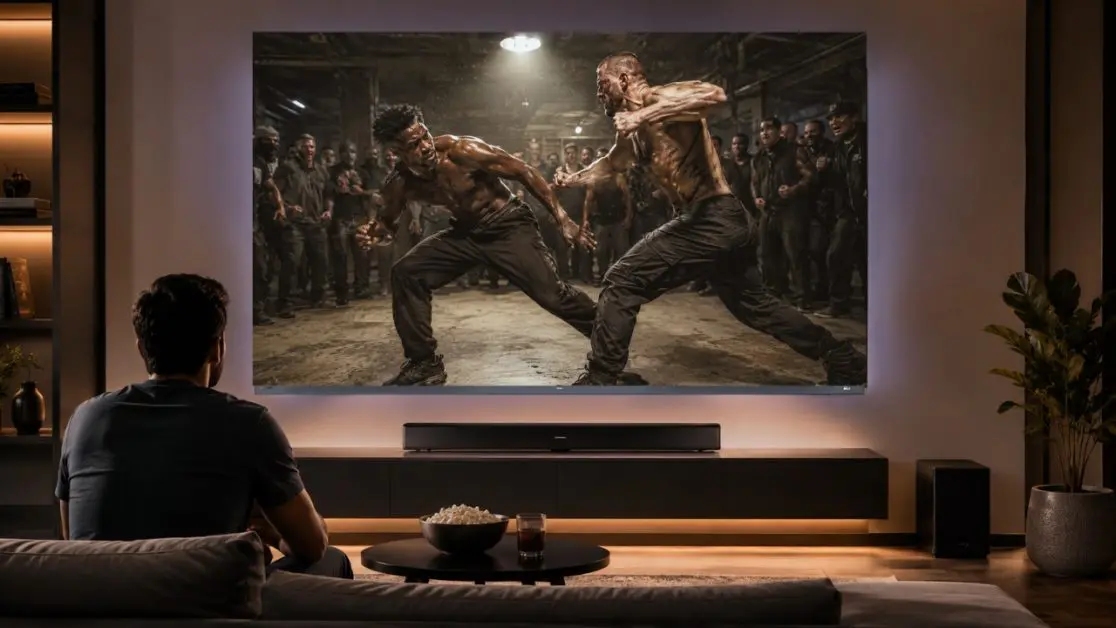
If you’re creating a premium entertainment space at home, this flagship model is designed for truly immersive viewing.
It combines:
- AI Ultra Sense Processor co-developed with MediaTek
- QD-Mini LED display
- Dolby Vision IQ
- HDR10+
- 144Hz refresh rate
- Google TV
- Sound by KEF
- Dolby Atmos
- A powerful 6.2.2-channel speaker system
- Hands-free voice control
- AMD FreeSync Premium Pro.
Before Buying Your Next Smart TV
Instead of asking only:
“How many inches is it?”
Try asking:
- Does it intelligently optimise different content?
- How well does it upscale older videos?
- Can it improve motion during sports?
- Does it adapt to room lighting?
- Is the processor designed to enhance both picture and sound?
- Will it continue delivering a premium viewing experience as my entertainment habits evolve?
Those answers often matter much more over the long term than simply choosing the biggest screen.
A Smarter Viewing Experience Starts at the Core
A premium display certainly grabs attention. Rich colours, impressive brightness and sharp details are easy to notice.
Yet, the real difference often comes from something you never actually see the processor working behind every frame.
Whether you’re streaming the latest blockbuster, watching a cricket match with friends, revisiting timeless classics or simply catching up on daily news, intelligent processing helps ensure every type of content receives the attention it deserves.
Haier’s New M92 Series QD-Mini LED AI Smart Google TV and New M96 Series QD-Mini LED AI Smart Google TV reflect this approach by combining AI-powered picture optimisation, immersive audio technologies, gaming enhancements and smart entertainment features into one integrated experience. Rather than expecting users to constantly fine-tune settings, these televisions are built to adapt intelligently to changing content and viewing conditions.
If you’re planning to upgrade your home entertainment setup, choosing a television with advanced processing capabilities can make a noticeable difference not just for premium 4K content, but for everything you watch every day.
Frequently Asked Questions
1. What does a TV processor do?
A TV processor analyses incoming content in real time and helps optimise picture quality by improving clarity, motion, colour, contrast and overall visual performance.
2. Can a processor improve older TV channels?
Yes. Modern AI-powered processors can upscale lower-resolution content, making it appear sharper and more suitable for today’s large 4K screens.
3. Does a TV processor help while watching sports?
Yes. Motion processing can reduce blur and improve the smoothness of fast-moving scenes, making sports and action content more comfortable to watch.
4. Why is AI processing important in a smart TV?
AI processing enables the television to automatically adjust picture and sound settings based on the type of content and, on supported models, ambient viewing conditions reducing the need for frequent manual adjustments.
5. Which Haier TVs feature the AI Ultra Sense Processor?
The uploaded product information lists the Haier New M92 Series QD-Mini LED AI Smart Google TV and the Haier New M96 Series QD-Mini LED AI Smart Google TV as featuring the AI Ultra Sense Processor along with intelligent picture, sound and entertainment optimisation.
6. Does a powerful processor benefit gaming as well?
Yes. A capable processor works alongside gaming-focused technologies to help deliver smoother visuals, reduced latency and a more responsive gaming experience on supported hardware.