
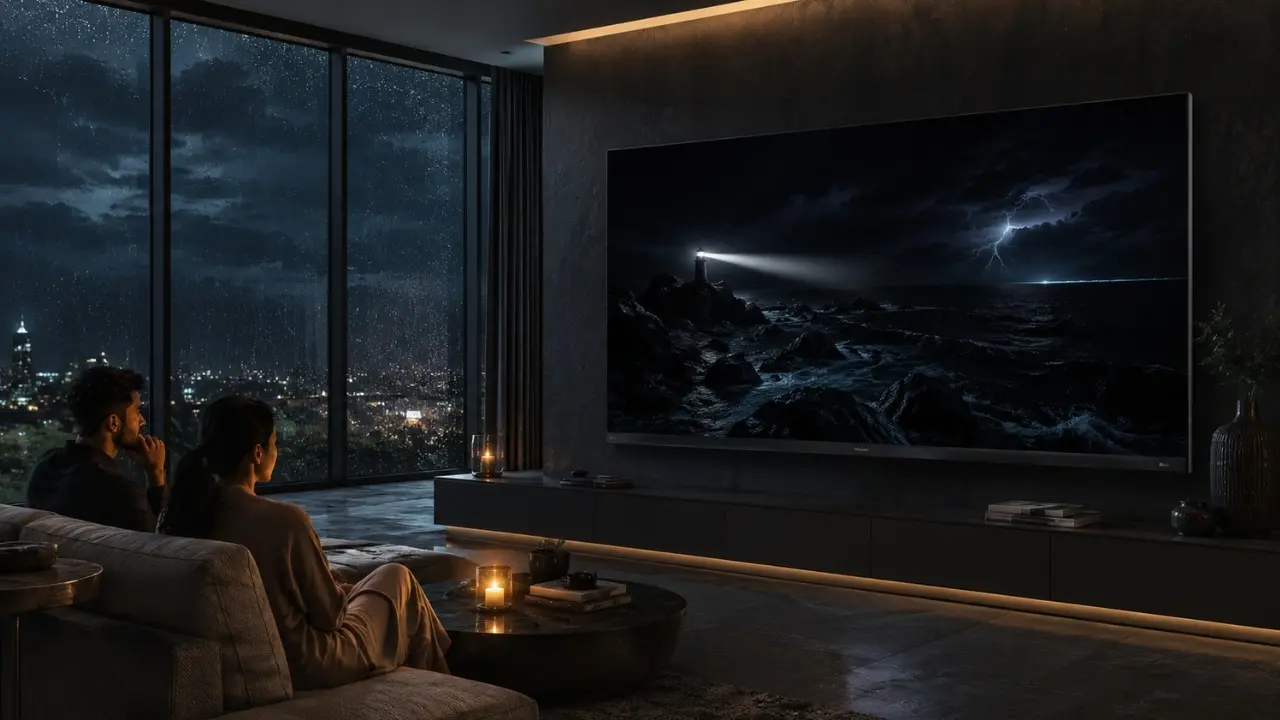

There is a simple scene that can expose a television’s picture quality surprisingly quickly: a dark room, a night sky, a black suit under dim lighting, or a shadowy corner with one bright lamp in the frame.
On an ordinary display, those blacks may appear slightly grey or washed out. Details inside shadows can disappear, while bright objects may spill light into surrounding dark areas. On a well-controlled premium TV, the same frame feels very different. Darkness has depth, highlights stand apart, and objects remain distinguishable even when much of the screen is nearly black.
So, what is actually happening behind the panel?
Deep blacks are not created simply by turning the brightness down. They depend on how precisely a television can manage light, contrast and picture information across different parts of the screen.
Black Is Really a Question of Light Control
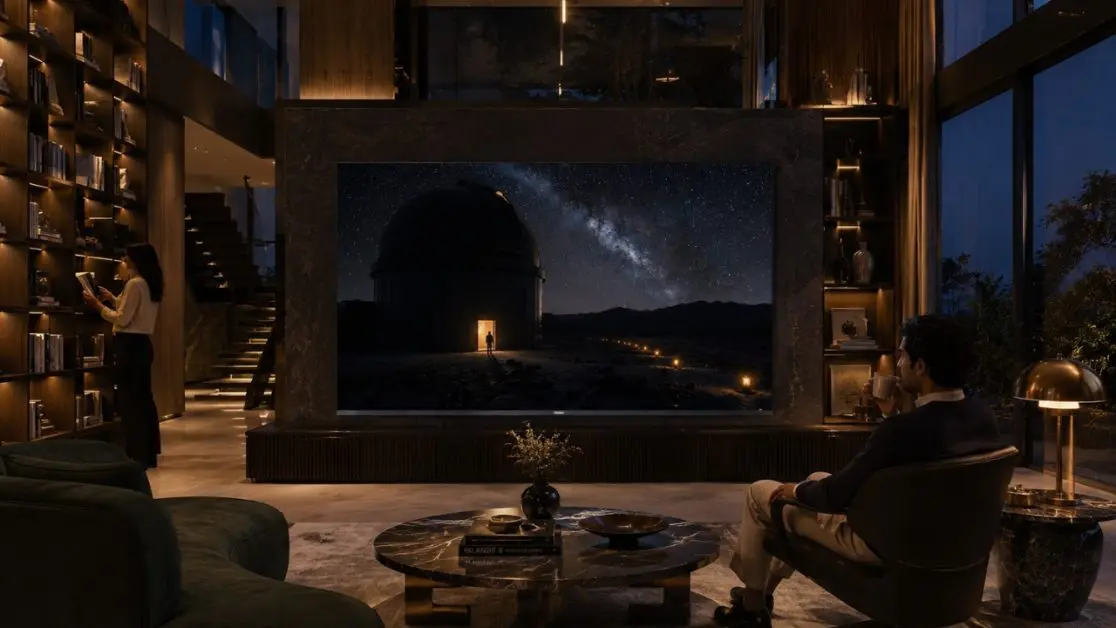
For a television, displaying a convincing black is surprisingly demanding. A bright image is comparatively straightforward because the screen needs to produce light. A dark scene requires something more delicate: light must be restrained in one area while remaining bright and detailed somewhere else.
Think about a night-time city scene. The sky needs to stay dark, windows may glow brightly, street lamps have small intense highlights, and people can still be standing in the shadows.
If the television treats the whole screen similarly, the darkness begins looking flat.
This is why contrast and precise light control matter so much. The greater the separation between bright and dark areas, the stronger the perceived depth of the image.
And this is where technologies such as Mini LED become particularly relevant.
Mini LED Gives the Backlight Finer Control
Traditional backlit televisions illuminate the screen using a relatively broad lighting system. Mini LED technology takes a more precise approach by using much smaller LEDs for illumination.
The important part isn’t simply that the LEDs are smaller. It is what finer control of illumination can do for the picture.
When dark and bright objects appear together, more precise backlight management can help maintain the separation between them. Instead of unnecessarily illuminating a large dark portion of an image, the television can control brightness more intelligently.
The practical benefits can include:
- Deeper-looking blacks in dark sequences
- Better distinction between highlights and shadows
- More convincing contrast
- Greater perceived depth
- Improved visibility of details within complicated scenes
For Indian viewers who regularly stream films and premium OTT series at night, this difference can become especially noticeable. Cinematography today often uses deliberately dark frames, subtle lighting and dramatic contrast. A television needs enough control to reproduce that intent effectively.
Micro Dimming Works Within the Scene
The next piece of the puzzle is Micro Dimming.
Instead of thinking about the screen as one uniformly illuminated surface, imagine the picture as multiple areas requiring different brightness levels.
A moon shouldn’t need the same illumination as the black sky around it. Neither should a brightly lit doorway force every shadow in the room to become brighter.
Micro Dimming analyses different areas of the picture and adjusts brightness to improve contrast between them.
This becomes valuable in scenes such as:
- space sequences with stars against a dark background;
- thrillers containing dimly illuminated interiors;
- night-time sporting events;
- games with caves, tunnels and shadow-heavy environments;
- films combining bright signage with dark streets.
The objective isn’t to make everything darker. Quite the opposite. Good black reproduction should retain information inside darkness rather than crushing it into one featureless patch.
Deep Blacks Mean Little If Shadow Detail Disappears
This distinction deserves attention.
An extremely dark screen can initially look impressive, but if the folds of a black jacket, texture of a wall or shape of an object disappears, information has been lost.
Premium picture quality requires balance.
You want darkness with detail.
Imagine watching a suspense sequence where somebody walks through a poorly lit corridor. There may be several shades between absolute black and medium grey. Those tiny differences reveal doors, furniture, clothing and facial contours.
If those shades collapse together, the scene becomes harder to read.
The best-looking dark sequences therefore depend on several picture technologies working together rather than one headline specification.
HDR Adds Another Layer to the Contrast Story
High Dynamic Range, or HDR, matters because modern films and streaming content can contain substantial variation between their darkest and brightest elements.
HDR10+, for example, can optimise picture information dynamically from scene to scene. That matters because a sunlit landscape and a candlelit room obviously shouldn’t be handled identically.
Then there is Dolby Vision, another technology designed to reproduce cinematic picture information with strong contrast, colour and detail.
Put simply, HDR isn’t merely about making bright things brighter.
It is about expanding the visual relationship between darkness, highlights, colour and detail.
A properly handled HDR sequence can make a small flame look striking precisely because the darkness surrounding it remains convincing.
Colour Has More to Do With Black Levels Than You Might Expect
Here is the slightly overlooked part.
We tend to discuss blacks as though they exist separately from colour. During actual viewing, however, our perception of contrast depends heavily on everything around the dark portion of an image.
Rich reds, subtle skin tones, blue night skies and bright highlights all influence how convincing black areas appear.
A broader colour range can therefore contribute to the overall sense of realism. More nuanced colour gradations also help scenes avoid looking overly processed.
The result is less about one colour being spectacular and more about the whole frame making visual sense.
AI Picture Processing Helps Manage Different Content
Not everything arriving on your TV is mastered in exactly the same way.
A 4K film, YouTube video, cricket match, console game and older television programme can all have noticeably different picture characteristics.
That makes intelligent processing increasingly useful.
AI-based picture optimisation can analyse content and adjust elements such as brightness, contrast, colour and clarity in real time. Instead of relying on one fixed approach for everything, picture processing can respond to what is actually appearing on screen.
This becomes particularly useful with dark content, where aggressive brightness or poor contrast adjustment can quickly make an image look unnatural.
The Haier M70 Series Brings These Elements Together
This is where the Haier New M70 Series MiniLED AI Smart Google TV with Gemini becomes relevant rather than simply ticking specification boxes.
The 189 cm (75) model, 75M70UHMINI LED, combines Mini LED technology with intelligent dimming designed to provide precise light control, stronger contrast, vivid highlights and deeper blacks. Haier also equips the model with AI Picture Quality, HDR10+, a Wide Colour Gamut, Dolby Vision and MEMC.
For viewers wanting an even larger cinematic canvas, the Haier New M70 Series MiniLED 215 cm (85) AI Smart Google TV with Gemini (85M70UHMINI LED) offers the M70 viewing experience on an expansive 215 cm (85) screen. Its listed picture features include AI Picture Quality, HDR10+, Wide Colour Gamut, 93% DCI-P3 coverage and Dolby Vision, alongside the series’ Micro Dimming presentation for controlled contrast.
That combination matters because premium viewing isn’t built around black levels alone. The M70 Series approaches the picture as a complete system.
What complements the picture experience?
The M70 Series also brings features that extend beyond movie watching:
- MEMC for smoother fast-moving sequences
- Gaming 120Hz for smoother gaming visuals
- Game Mode for more responsive gameplay
- Dolby Atmos for immersive audio
- 50W audio output
- 2.1-channel sound with an inbuilt subwoofer
- Google TV for smart entertainment
- Hands-free voice control
- 2GB RAM and 32GB storage
- Chromecast built-in
For a family television, that versatility matters. The same display may handle an afternoon cricket match, evening OTT viewing and late-night gaming within a few hours.
A Quick Test Before Judging Any Premium TV
Forget the spectacular demo footage for a moment.
When evaluating picture quality, pay attention to difficult scenes instead.
Watch a sequence containing a bright object against a predominantly dark background. Look around the bright object. Does the surrounding darkness remain convincing? Then examine a shadow. Can you still make out texture and shape?
Also check faces in low light. Skin tones should remain believable rather than becoming strangely bright simply because the rest of the frame is dark.
Those moments reveal considerably more about a television’s picture handling than an endlessly colourful landscape demo.
When Darkness Becomes Part of the Picture
Deep blacks are ultimately about more than producing a darker shade.
They create separation. They make highlights feel brighter without simply pushing brightness upwards. They reveal depth in night scenes and help cinematic lighting work the way it was intended to.
That is why Mini LED, Micro Dimming, HDR processing and intelligent picture optimisation are worth examining together when choosing a premium television.
For Indian households looking to move towards large-screen, cinema-style home entertainment, the Haier M70 Series MiniLED AI Smart Google TV with Gemini brings these picture technologies together with smart entertainment, gaming and immersive audio features.
Because when a television handles darkness properly, black stops looking like an empty part of the screen.
It becomes part of the story.
Frequently Asked Questions
1. What makes blacks look deeper on a premium TV?
Deep blacks largely depend on how precisely a TV controls light across the screen. Technologies such as Mini LED and Micro Dimming can improve the separation between bright and dark areas, creating stronger contrast and more convincing dark scenes.
2. How does Mini LED technology improve black levels?
Mini LED technology uses smaller LEDs for more precise illumination control. This helps the TV manage dark and bright portions of the same scene more effectively, resulting in deeper-looking blacks, vivid highlights and improved contrast.
3. What does Micro Dimming do on a TV?
Micro Dimming adjusts brightness across different areas of the picture rather than treating the entire screen uniformly. On the Haier M70 Series, it is designed to deliver deeper blacks, brighter highlights and richer contrast.
4. Does HDR10+ help improve dark scenes?
Yes. HDR10+ dynamically enhances contrast and detail scene by scene. This can help preserve the distinction between shadows and bright highlights, making complex scenes appear more realistic.
5. Which Haier TV is suitable for viewers looking for deeper blacks?
The Haier New M70 Series MiniLED AI Smart Google TV with Gemini is designed with technologies including Mini LED, Micro Dimming, AI Picture Quality, HDR10+ and Dolby Vision. The series is available in large-screen options including the 189 cm (75) and 215 cm (85) models.
6. Are deeper blacks useful only when watching movies?
No. Better contrast and controlled dark areas can also improve the viewing experience during OTT shows, gaming and other content containing night scenes, shadows or bright objects against dark backgrounds.