
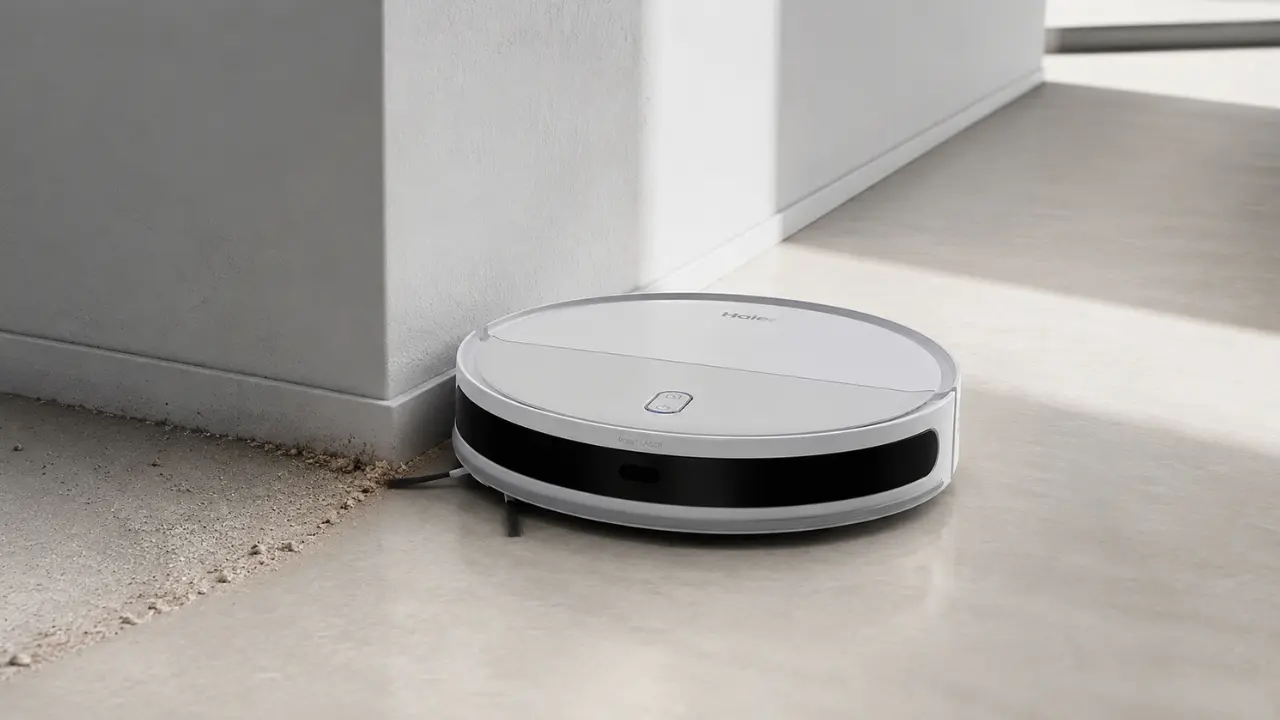

Yes robot vacuums can clean corners and edges however not all robot vacuums perform this task very well. Reasons why some robot vacuums perform this task better than others boil down to better designs, smarter navigation, stronger suction, side brushes and map awareness.
High quality robot vacuum cleaners know where they are going as they clean. They map your home, identify borders, deliberately run along edges and retry missed spots.
A corner may seem like a small detail.
But corners reveal whether a cleaning system is truly smart.
And that is where modern robot vacuum technology has quietly evolved.
Why are corners the hardest part of any home to clean?
Walk into any Indian home.
Look behind the dining table.
Check the space beside the TV unit.
Inspect the corners near the balcony door.
Dust behaves differently there.
Hair gathers there.
Tiny food particles settle there.
The reality is simple.
Open floor spaces are easy.
Corners are where cleaning gets tested.
This challenge exists because most robot vacuum cleaners are round. Corners are square. The geometry itself creates a problem.
A circular machine cannot physically place its entire body inside a 90-degree angle.
That sounds like a limitation.
But smart engineering changes the equation.
The Hidden System: How Robot Vacuums Actually Clean Edges
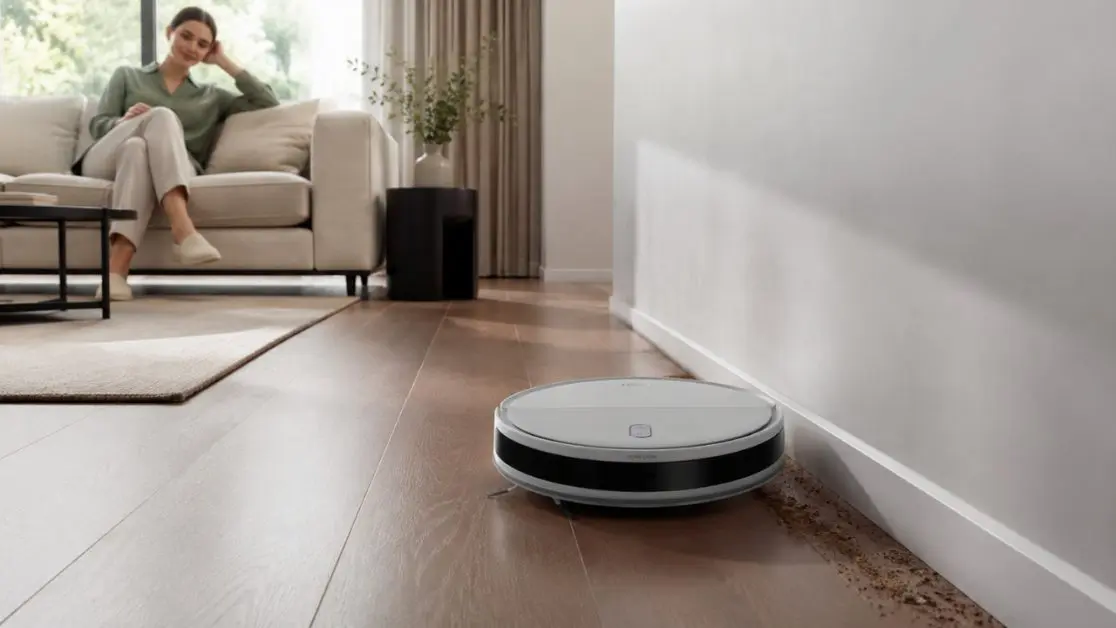
Many people assume a robot vacuum cleans using suction alone.
That is not how modern systems work.
Most advanced robot vacuum cleaners use a combination of:
- Side brushes
- Suction motors
- Mapping systems
- Edge detection algorithms
- Navigation sensors
Think of it like sweeping a room manually.
When people clean a room, they usually start from the edges and pull dust inward.
Robot vacuum cleaners follow a similar principle.
The side brush extends beyond the body of the machine and sweeps dirt from corners and wall edges toward the centre, where the suction system collects it.
The cleaning happens in two stages:
- Reach the dust.
- Remove the dust.
Many basic models succeed at the second step but struggle with the first.
That distinction matters.
Why Navigation Matters More Than Suction Power
Most buyers focus on suction power.
Understandable.
It sounds impressive.
But suction alone does not solve corner cleaning.
Imagine having a powerful vacuum that never reaches the dust.
The result stays the same.
Location beats power.
Modern robot vacuum cleaners increasingly rely on laser navigation systems that create detailed maps of the home and plan efficient cleaning routes.
This changes behaviour completely.
Instead of wandering randomly, the robot deliberately follows walls and edges before moving into open spaces.
The result is:
- Better edge coverage
- Reduced missed spots
- More consistent cleaning patterns
- Faster cleaning cycles
A robot that knows where it is will almost always outperform a robot that simply has more power.
Intelligence scales. Brute force doesn’t.
How Modern Homes Create New Cleaning Challenges
The typical Indian home looks very different today than it did ten years ago.
Furniture is lower.
Storage is smarter.
Open floor plans are more common.
There are more charging cables, side tables, pet accessories, indoor plants, and decorative furniture.
All of these create edge-heavy environments.
Consider a typical evening:
- Kids finish their snacks in the living room.
- Pet hair gathers near sofa legs.
- Dust enters through balconies.
- Kitchen crumbs settle beneath dining chairs.
Most of that debris ends up near boundaries.
Not in the middle of the room.
Which means edge cleaning is no longer a secondary feature.
It has become one of the most important measures of cleaning quality.
Can Robot Vacuum Cleaners Reach Every Corner?
No.
And any honest discussion should acknowledge that.
There are physical limitations.
Some extremely narrow gaps remain inaccessible.
Examples include:
- Tight furniture junctions
- Extremely sharp corners
- Spaces narrower than the robot itself
- Cluttered storage zones
But this limitation is often misunderstood.
The goal of a robot vacuum cleaner is not perfection.
The goal is consistency.
Manual cleaning may reach every corner once a week.
A robot vacuum may reach 95% of those spaces every day.
Which approach keeps the home cleaner overall?
Consistency usually wins.
A home cleaned daily often feels cleaner than a home cleaned perfectly once a week.
What Features Improve Corner and Edge Cleaning?
When evaluating a robot vacuum cleaner, look beyond marketing claims.
Focus on systems.
1. Laser Navigation
Laser navigation enables precise movement and structured cleaning routes.
It helps the robot recognise walls, corners, and room boundaries more accurately. The Haier CIVIC X11 and CIVIC X11 PRO use laser navigation technology designed for precise cleaning and obstacle management.
2. Multiple Map Memory
Many modern homes have multiple floors or complex layouts.
Multi-map memory allows the robot to remember different cleaning environments without relearning them repeatedly.
The Haier CIVIC series supports up to five map memories for efficient navigation across different areas.
3. Side Brush Design
The side brush is often the unsung hero of corner cleaning.
A good side brush extends beyond the robot body and actively pulls dust inward.
4. Strong Suction
Once debris is moved toward the centre, suction completes the job.
Advanced models offering up to 5000Pa suction can effectively collect fine dust, crumbs, hair, and pet fur from multiple floor surfaces.
5. Obstacle Detection
Cleaning is not just about movement.
It is about intelligent movement.
Obstacle detection prevents the robot from getting trapped while maintaining edge coverage.
Pet Owners Notice Edge Cleaning More Than Anyone Else
Pet owners understand this problem immediately.
Pet hair rarely stays in the centre of a room.
It drifts.
It gathers near furniture.
It accumulates along skirting boards.
It settles in corners.
This is why edge-cleaning performance becomes significantly more important in homes with pets.
A robot vacuum that follows wall boundaries consistently can reduce visible pet hair accumulation dramatically over time.
The goal is not one dramatic cleaning session.
The goal is preventing buildup before it becomes noticeable.
Small actions repeated daily create cleaner homes.
That principle applies to cleaning as much as anything else.
The Shift From Cleaning Machines to Cleaning Systems
The biggest misconception about robot vacuum cleaners is that people compare them to traditional vacuum cleaners.
That comparison misses the point.
A robot vacuum is not simply a vacuum.
It is a cleaning system.
Traditional cleaning works like an event.
Robot cleaning works like a process.
One happens occasionally.
The other happens continuously.
This shift changes how corners stay clean.
Instead of waiting for dust to accumulate, the robot addresses it repeatedly.
The system prevents problems rather than reacting to them.
That is a fundamentally different approach.
Why Smart Navigation Is Becoming the New Standard
A few years ago, robot vacuum cleaners were considered a luxury.
Today, they are increasingly becoming practical household tools.
The reason is simple.
Technology matured.
Laser mapping became more accurate.
Obstacle detection improved.
Mobile app control became easier.
Voice assistant integration became common.
Modern robot vacuum cleaners like the Haier CIVIC X11 and CIVIC X11 PRO combine laser navigation, multi-map memory, voice control compatibility, app-based management, and powerful suction to create a far more intelligent cleaning experience than earlier generations.
The result is not just cleaner floors.
It is less mental effort.
And often, that is the real value of smart appliances.
The Real Question Isn’t About Corners
People often ask:
“Can a robot vacuum clean corners properly?”
That is the visible question.
The deeper question is this:
“Can a cleaning system maintain a cleaner home without demanding constant attention?”
Modern robot vacuum cleaners are increasingly proving that they can.
Not because they are perfect.
But because they are consistent.
And consistency beats intensity in most household routines.
A corner is just a corner.
But it reveals something bigger.
The future of cleaning is not about working harder.
It is about creating systems that quietly work in the background while life continues in the foreground.
Frequently Asked Questions
Can my robot vacuum really clean corners properly?
Yes, but not perfectly. Most robot vacuums can clean along corners and edges using side brushes, suction, and navigation, but extremely tight 90-degree corners or narrow gaps may still need occasional manual cleaning.
Why do robot vacuums struggle with corners?
Most robot vacuums are round, while corners are square. This means the body cannot fully enter a sharp corner, so the side brush has to sweep dust inward for suction to collect it.
Should I expect my robot vacuum to replace manual corner cleaning completely?
Not completely. It can reduce dust buildup through regular cleaning, but deep corner cleaning may still be needed occasionally.
Can robot vacuums clean along wall edges?
Good robot vacuums can. Models with edge-following navigation deliberately move along walls and skirting boards instead of cleaning randomly.
Why does dust collect more near edges than in the middle of the room?
Air movement, foot traffic, pet hair, crumbs, and outdoor dust often push debris toward room boundaries, furniture legs, and corners.