
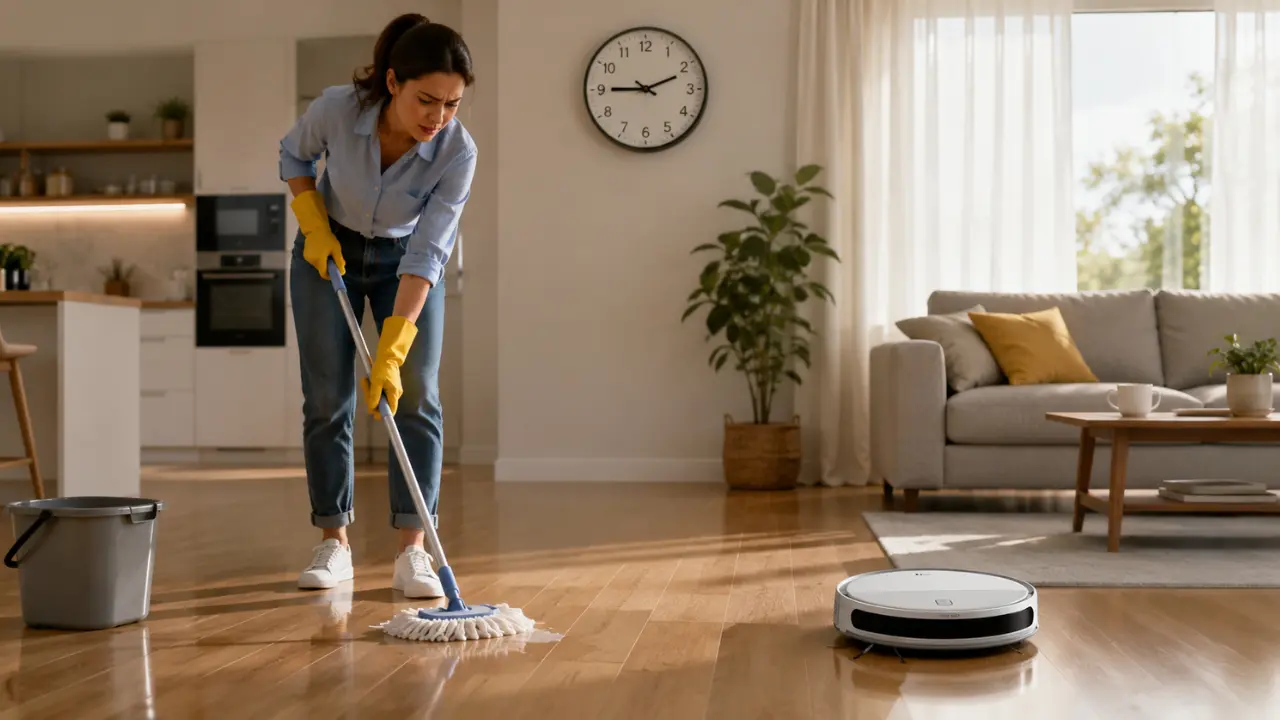

Manual cleaning still creates problems in Indian homes because dirt is no longer the challenge. Time is.
Modern households are busier, homes are larger, dust returns faster, and daily schedules leave very little room for repetitive chores. The issue is not whether people can clean manually. The issue is whether manual cleaning remains the most effective use of time in a world where smarter alternatives now exist.
A clean home matters.
But how we achieve that cleanliness is beginning to change.
The hidden cost nobody talks about.
Walk into an Indian home on a weekday evening.
One person is finishing work calls.
Someone else is helping with homework.
Dinner is on the stove.
Laundry is waiting.
And somewhere in between, the floor needs sweeping again.
Not because it was neglected.
Because it got dirty again.
Dust enters through balconies.
Foot traffic increases.
Hair accumulates.
Food crumbs appear under dining tables.
Life happens.
The traditional solution has always been simple.
Pick up a broom.
Sweep.
Repeat tomorrow.
Then repeat again.
And again.
The problem is not the effort of cleaning once.
The problem is the system of cleaning every single day.
A chore repeated endlessly eventually becomes invisible labour.
And invisible labour is often the most exhausting kind.
Indian Homes Generate More Dust Than Most People Realise
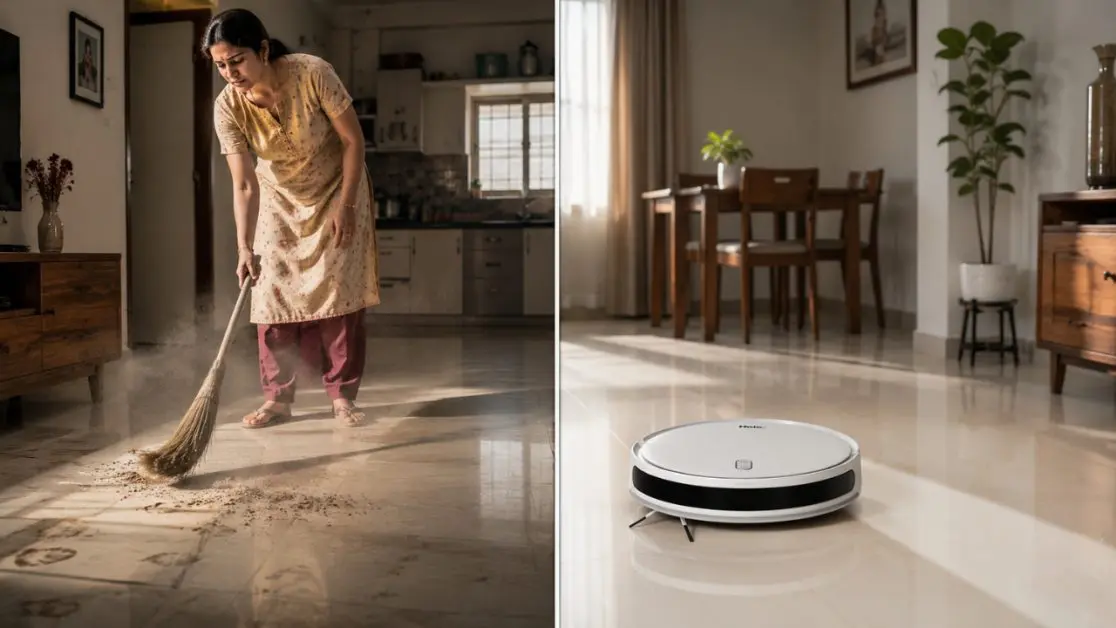
Many people assume cleaning once a day should be enough.
Reality disagrees.
Indian homes face unique challenges:
- Open windows for ventilation
- Construction activity in growing cities
- Pollution and traffic dust
- Seasonal changes
- Footwear movement
- Pet hair and dander
- Cooking-related particles
A home can look clean at 9 AM and visibly dusty by evening.
That is not a cleaning failure.
That is environmental reality.
The challenge becomes even larger in urban centres where construction never seems to stop.
Dust is not an event.
It is a continuous process.
And continuous problems require continuous systems.
The Problem Is Not Cleaning. It Is Consistency.
Most households know how to clean.
The bigger question is this:
Can they clean consistently?
That is where manual cleaning starts breaking down.
Consider three common scenarios.
Option 1: Clean Every Day
This creates the best results.
But it demands time.
A resource most households increasingly lack.
Option 2: Clean Every Alternate Day
Less effort.
More visible dust accumulation.
Especially under beds, sofas, dining tables, and corners.
Option 3: Weekend Deep Cleaning
Popular.
Practical.
But often reactive.
Instead of maintaining cleanliness, people spend weekends catching up.
The floor becomes a project.
The house becomes a task list.
And suddenly a day meant for recovery becomes a day spent cleaning.
Every household eventually chooses one of these systems.
The question is which system creates the least friction.
Manual Cleaning Misses Places You Rarely Notice
Look beneath a sofa.
Under a bed.
Behind a television unit.
Near furniture legs.
Inside corners.
These are not dramatic spaces.
Yet they collect a surprising amount of dust.
Most manual cleaning focuses on visible surfaces.
The hidden areas receive attention only occasionally.
The result is predictable.
Dust accumulates where people rarely look.
One of the oldest lessons in maintenance is simple:
What gets ignored gets accumulated.
The same principle applies inside homes.
Working Professionals Face a Different Challenge
For previous generations, cleaning routines were often distributed differently.
Today’s households operate differently.
Remote work.
Hybrid schedules.
Long commutes.
Dual-income families.
Freelancers working from home.
Young professionals living independently.
The modern home serves multiple functions:
- Office
- Living room
- Dining space
- Entertainment zone
- Family area
More usage means more cleaning requirements.
At the same time, available time keeps shrinking.
That creates an imbalance.
The home needs more maintenance.
People have less time to provide it.
That gap continues growing.
Pet Owners Experience the Problem Faster
Pets reveal the limitations of manual cleaning quickly.
A dog does not shed according to your schedule.
A cat does not wait until Sunday.
Hair appears daily.
Sometimes hourly.
Pet owners often find themselves sweeping multiple times a day.
Not because the house is dirty.
Because the environment changes constantly.
This is why cleaning systems matter more in pet-friendly homes.
A good system prevents accumulation.
A reactive system waits until accumulation becomes visible.
Those are two very different approaches.
The Future of Cleaning Is Quiet Automation
Most household innovations follow the same pattern.
First they seem unnecessary.
Then they become normal.
Washing machines followed that path.
Dishwashers followed that path.
Water purifiers followed that path.
The same shift is happening with floor cleaning.
People often imagine automation as a luxury.
In reality, automation usually emerges when repetitive work becomes inefficient.
A machine is not valuable because it works.
A machine is valuable because it frees attention.
And attention is becoming one of the most valuable resources inside modern households.
Why Smart Cleaning Systems Are Growing in Popularity
A robot vacuum is not replacing cleaning.
It is replacing repetitive cleaning.
That distinction matters.
Deep cleaning will always have a place.
Festive preparation will always happen.
Seasonal maintenance will always be necessary.
But daily dust management is increasingly becoming a task technology can handle efficiently.
Modern robot vacuum cleaners can:
- Navigate rooms intelligently
- Avoid obstacles
- Clean under furniture
- Return automatically for charging
- Follow scheduled routines
- Vacuum and mop simultaneously
The goal is not perfection.
The goal is consistency.
And consistency often beats occasional effort.
What Modern Indian Households Actually Need
Most people think they need stronger cleaning tools.
Often, they need better cleaning systems.
The difference is important.
A stronger broom does not solve a time problem.
A smarter process does.
The most effective household systems share three characteristics:
1. They Reduce Daily Effort
The best system is the one people actually use.
2. They Work Without Constant Supervision
Every task requiring repeated attention eventually creates friction.
3. They Fit Into Existing Routines
Technology succeeds when it adapts to life.
Not when life adapts to technology.
This is why automated cleaning solutions are becoming increasingly relevant.
They remove friction instead of adding complexity.
How Haier Is Reimagining Everyday Floor Cleaning
This shift towards smarter cleaning is reflected in products such as the Haier CIVIC X11 and Haier CIVIC X11 PRO Robot Vacuum Cleaners.
Designed for modern households, they combine laser navigation, multi-map memory, powerful suction, app-based controls, voice command compatibility, and wet-and-dry cleaning functionality to help maintain cleaner floors with minimal daily effort.
The CIVIC X11 PRO also includes an auto-empty dust collection station, reducing manual intervention even further.
What stands out is not a single feature.
It is the system.
Laser navigation helps create efficient cleaning paths.
Multiple map memory supports different floor layouts.
Voice control through Alexa and Google Assistant adds convenience.
Scheduled cleaning allows homes to stay maintained even when nobody is actively cleaning.
That is where smart home technology becomes useful.
Not because it feels futuristic.
Because it feels practical.
A Clean Home Is Really About Peace of Mind
Most people do not dream about cleaning floors.
They dream about what happens after the floors are clean.
Relaxing after work.
Spending time with family.
Watching a movie.
Reading a book.
Hosting friends.
Playing with children.
The goal has never been cleaning itself.
The goal is creating a space that feels calm, comfortable, and ready for life.
That changes how we should think about household chores.
Manual cleaning is not disappearing anytime soon.
But its limitations are becoming harder to ignore.
Because the real problem was never dust.
The real problem was asking busy people to spend their most valuable resource repeatedly fighting it.
And every meaningful innovation begins when we stop asking people to do repetitive work that a better system can handle instead.
Frequently Asked Questions
Why does my home get dusty again even after I clean it every day?
Dust is constantly entering Indian homes through open windows, balconies, ventilation, traffic pollution, construction activity, footwear, cooking, and daily movement. Cleaning once doesn’t stop new dust from accumulating. The real challenge isn’t cleaning it’s maintaining cleanliness consistently.
Why does cleaning feel like a never-ending chore?
Because it is repetitive work. Floors collect dust, crumbs, hair, and dirt every day. Manual cleaning requires repeating the same effort daily, which gradually becomes invisible labor that consumes time and energy.
Is daily sweeping really necessary in Indian homes?
For many homes, yes. Indian environments naturally generate more dust than many other countries due to pollution, open ventilation, seasonal weather, and ongoing urban construction. Skipping several days often leads to noticeable dust buildup.
Why is manual cleaning becoming difficult for working professionals?
Modern households balance remote work, office jobs, commuting, childcare, cooking, and other responsibilities. Daily floor cleaning competes with limited free time, making consistency harder to maintain.
How can I keep my house clean if I barely have time after work?
Rather than spending your evenings sweeping, consider systems that automate routine floor cleaning. Scheduled cleaning helps maintain floors while you focus on work, family, or rest.
Why does weekend cleaning always take so long?
Because dust has accumulated throughout the week. Weekend cleaning becomes reactive instead of preventive, turning your day off into a catch-up session rather than regular maintenance.