


AI selects the right wash cycle by sensing fabric type, load weight, and dirt level, then automatically adjusting water, detergent, temperature, and spin settings in real time.
It removes guesswork and ensures consistent cleaning while saving energy, water, and time.
Why does choosing a wash cycle still feel confusing?
It is 10:15 PM.
Dinner is done. The house is quieter now. You stand in front of the washing machine with a mixed pile.
Office shirts. Gym clothes. A saree worn once. Maybe a bedsheet.
You pause.
Cotton or delicate? Quick wash or eco? High spin or low?
Laundry is not difficult.
But deciding how to wash is.
That small pause. That hesitation.
That is where most of the friction lives.
AI does not add features. It removes decisions.
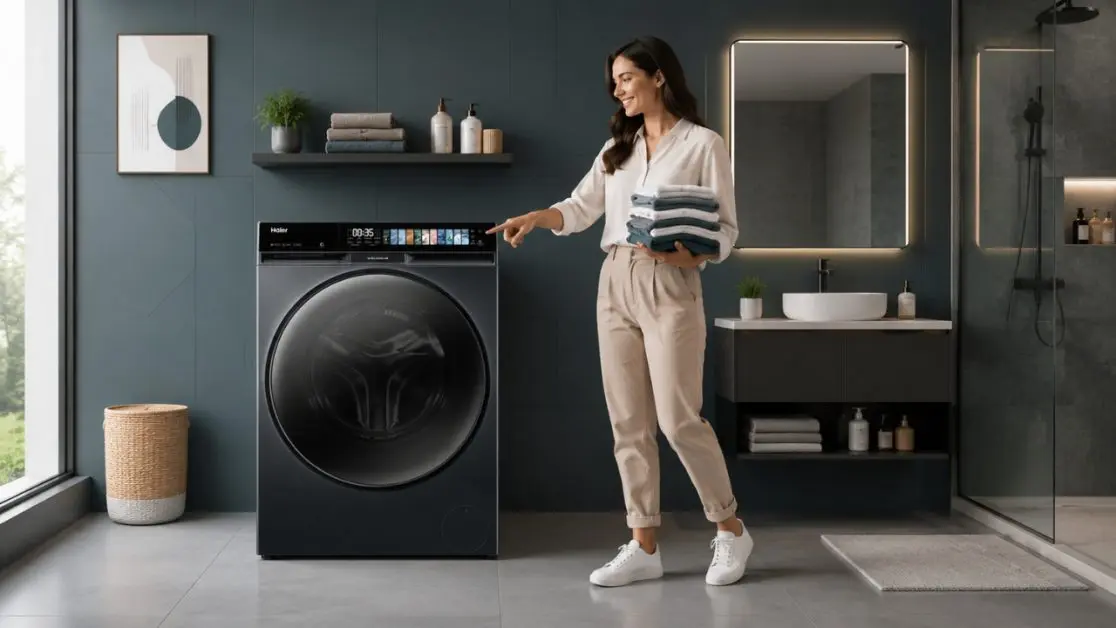
Most people think AI in washing machines means more options.
More buttons. More modes. More thinking.
The truth is simpler.
Good AI reduces choices.
Think about booking a cab.
Earlier, you called, negotiated, waited.
Now, you tap once. It happens.
Laundry is going through the same shift.
Machines like the Haier 10 Kg F9 Pro Front Load Washer Washing Machine (HW100-DM14F9PBKU1) and the Haier 12 Kg F11 Front Load Washer & Dryer Washing Machine (HWD120-DM14F11BKU1) are built around this idea.
You do not control every variable.
You start the system.
What exactly does AI look at before choosing a wash cycle?
AI is not guessing.
It is measuring.
Every wash becomes a data problem.
Key Inputs AI Uses
- Fabric Type Detection
- Cotton, denim, delicate fabrics behave differently
- AI reads movement and resistance patterns
- Load Weight
- Heavier loads need more water and longer cycles
- Lighter loads need speed, not intensity
- Dirt Level
- Sweat, oil, mud, food stains
- Each requires a different treatment approach
- Water Absorption Patterns
- How quickly fabric absorbs water
- Helps refine wash intensity
- Drum Balance
- Prevents vibration and uneven cleaning
Systems like One-Touch AI Wash automatically sense fabric type, load, and dirt level, then select the right settings instantly.
The hidden system: Washing is a balance equation
Every wash cycle is a balance between four variables.
| Factor | Too Low | Too High |
| Water | Incomplete cleaning | Wastage |
| Detergent | Stains remain | Residue on clothes |
| Time | Dirt not removed | Fabric wear |
| Spin Speed | Wet clothes | Fabric damage |
Manual washing forces you to guess this balance.
AI calculates it.
Precision replaces approximation.
Three ways people approach laundry today

Not all households use AI yet.
Most follow one of these patterns.
1. The Guesswork Approach
You rely on habit.
- Same mode every time
- Same detergent amount
- Same settings
Cost:
- Wasted water and detergent
- Inconsistent results
- Faster wear and tear
2. The Trial-and-Error Approach
You experiment.
- Adjust settings based on past outcomes
- Learn over time
Cost:
- Time spent figuring things out
- Occasional mistakes
- Mental effort every cycle
3. The AI-Driven Approach
You press one button.
Machines like the Haier 12 Kg F11 Front Load Washer Washing Machine (HW120-DM14F11BKU1) automatically detect fabric, load, and dirt level, then optimize the entire cycle in real time.
Benefit:
- Consistency
- Efficiency
- Zero decision fatigue
How AI actually selects the right wash cycle
Let us break it into simple steps.
Step 1: Load sensing
The machine calculates weight as soon as the drum moves.
This determines:
- Water level
- Cycle duration
- Energy usage
This is known as Auto Weight detection.
Step 2: Fabric mapping
AI observes how clothes move inside the drum.
Soft fabrics move differently than heavy ones.
It identifies:
- Cotton vs synthetic
- Delicate vs heavy
Step 3: Dirt analysis
AI identifies dirt patterns using predefined logic.
For example:
- Sweat stains need moderate heat
- Oil stains need stronger agitation
Specialized stain programs adjust washing parameters for different stain types like coffee, mud, and oil.
Step 4: Smart dosing
Detergent is calculated automatically.
No guesswork.
Systems like Smart Dosing determine the exact detergent quantity based on load and fabric type.
Result:
- Better cleaning
- Less residue
- Lower long-term cost
Step 5: Real-time adjustments
This is where AI becomes powerful.
It does not just set the cycle.
It adapts during the wash.
- Adjusts spin speed
- Refines rinse cycles
- Optimizes water use
It reacts, not just plans.
Why this matters in Indian homes

Laundry here is not simple.
It is diverse.
A single load can include:
- Office wear
- Kids’ uniforms
- Gym clothes
- Ethnic wear
- Bedsheets
Each fabric behaves differently.
Each needs different care.
AI handles this without asking you to think.
The real benefit is not cleaning. It is consistent.
Anyone can wash clothes.
Few can wash them right every single time.
AI does.
It does not rush.
It does not forget.
It follows a system.
Where AI saves the most value
1. Time
- No decision-making
- One-touch operation
2. Water and Energy
- Optimized per load
- Eco adjustments
3. Fabric Life
- Prevents over-washing
- Reduces damage
4. Mental Effort
- No second-guessing
- No repeated thinking
The biggest saving is invisible. It is a cognitive load.
The shift from machines to systems
Traditional machines are tools.
AI machines are systems.
A tool needs instructions.
A system needs input.
You give clothes.
It gives outcomes.
What most people misunderstand about AI washing
People assume more technology means more complexity.
The opposite is true.
- AI simplifies decisions
- Automation reduces friction
You are not losing control.
You are removing unnecessary decisions.
A simple way to understand it
Think of cooking rice.
Earlier:
- Measure water
- Watch the flame
- Adjust timing
Now:
- Use a rice cooker
- Press one button
Machines like the Haier 12 Kg F11 Front Load Washer & Dryer Washing Machine (HWD120-DM14F11BKU1) bring the same simplicity to laundry.
What this means for everyday life
Every home runs on silent systems.
- Refrigerators manage freshness
- ACs manage temperature
- Washing machines manage hygiene
When these systems become intelligent, something shifts.
Life feels easier.
Not dramatically.
Quietly.
So what should you actually look for?
If you are choosing an AI washing machine, focus on systems, not specs.
Look for:
- One-touch AI wash
- Smart dosing
- Load and fabric sensing
- Real-time adjustments
- Energy optimization
Machines like the Haier 10 Kg F9 Pro Front Load Washer Washing Machine (HW100-DM14F9PBKU1) combine these into a system that works without constant input.
The final thought
Laundry was never the hard part.
The decisions were.
How much detergent. Which cycle. What settings?
AI removes those decisions.
And when decisions disappear, effort disappears.
The future of washing is not smarter machines.
It is fewer choices, better outcomes, and one less thing to think about.
Frequently Asked Questions
Why is choosing the right wash cycle so confusing?
Different fabrics, soil levels, and load sizes require different washing conditions. Many people end up guessing which program to use. AI-powered washing machines simplify this by automatically selecting suitable settings based on the laundry load.
How does AI make doing laundry easier?
AI reduces manual decision-making by sensing the load, analyzing washing conditions, and automatically adjusting key settings like water level, detergent, temperature, and spin speed.
Do I still need to choose a wash program with AI?
In many cases, no. Features like One-Touch AI Wash automatically determine appropriate washing parameters, reducing the need to manually select programs.
Is AI replacing my control over the washing machine?
No. AI is designed to simplify routine decisions, not remove user control. You can still select programs manually when needed.
Who benefits most from AI washing?
AI washing is especially helpful for:
Busy professionals
Families with mixed laundry loads
First-time washing machine users