
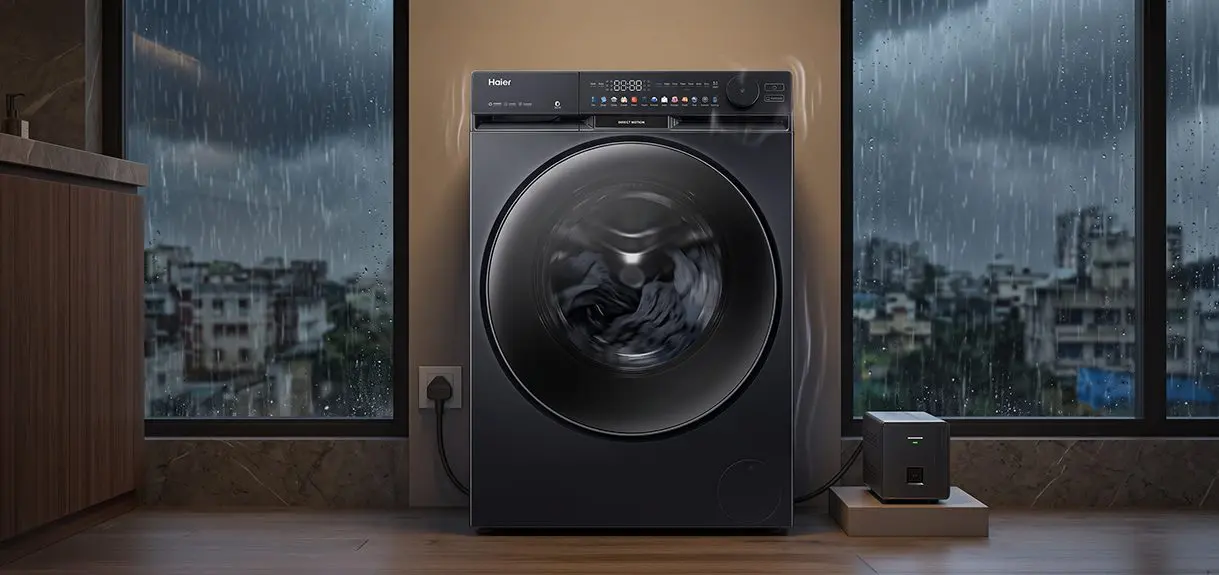

A washing machine motor needs steady power to work properly. Monsoon rarely gives it that. Heavy rainfall puts extra strain on local power grids, and voltage supply turns irregular across many Indian homes as a result. This is important for a machine that is meant to operate on stable electricity. It can affect the performance, safety and the life of the machine. Monsoons cause power fluctuations that washing machine motors face. Knowing what these are and what protective features are worth it, helps households when using one or buying one.
Why Monsoon Season Brings More Power Fluctuations?
Rainfall affects electrical infrastructure in more ways than most people realise. Transformers carry heavier loads as demand rises across a region. Underground and overhead lines get exposed to water seepage and wind damage. Local substations trip during storms. Power gets cut, then restored abruptly, often more than once in a single evening. Each of these events can produce a voltage sag, a voltage spike, or a short but complete outage. None of this is rare during the monsoon months. And if a washing machine happens to be mid-cycle when it hits, the effect is immediate. Not just electrical. Mechanical too.
Voltage Fluctuation Impact on Washing Machine Performance
When voltage drops below what the machine needs, the motor draws more current to compensate. That extra current generates heat inside the motor windings. One dip won’t do much damage. But repeated exposure, cycle after cycle through a rainy season, wears components down gradually. A voltage spike causes a different kind of stress. It pushes more energy into the system than the motor is built to handle, and that can affect control boards and sensitive circuitry as well. The voltage fluctuation impact on washing machine components goes beyond the motor. Timers, control panels, and internal wiring all sit in the path of a sudden surge or drop. A cycle interrupted by a power cut leaves clothes half washed. In some machines, it disturbs the programmed sequence entirely, and the user has to start over.
Washing Machine Motor Protection: What to Look For
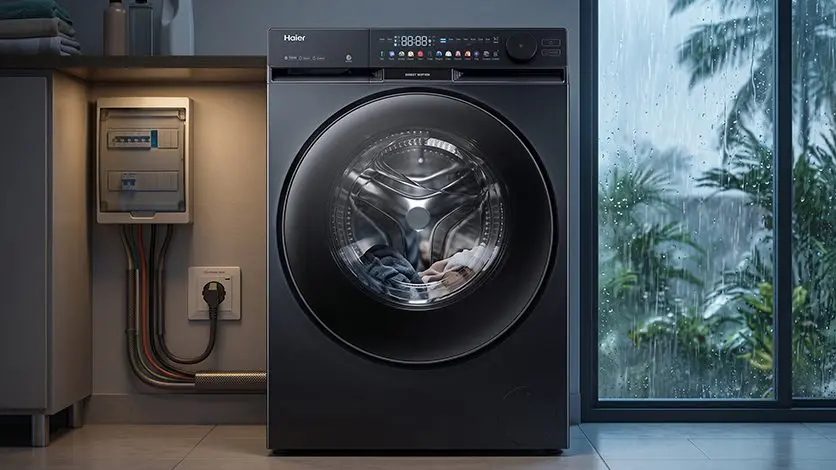
Not every washing machine responds to unstable power the same way. Some designs limit the damage. Others don’t. Buyers looking into washing machine motor protection ahead of monsoon season should pay attention to a few specific things before buying.
- A motor design that limits mechanical strain during variable power, rather than one that needs constant, uninterrupted torque to run smoothly
- An auto-restart function that picks the wash cycle back up from where it stopped, instead of forcing the user to begin again
- Sturdy internal construction, particularly how the drum and motor housing are welded, since repeated power cycling adds mechanical stress over time
- Build quality that accounts for humidity and moisture, particularly around electrical connections, since monsoon brings both in excess
These points matter more during monsoon than at any other time of year. Simply because power events happen more often.
Why Inverter Washing Machines Handle Fluctuations Better
Older motors, particularly belt-and-pulley designs, rely on constant mechanical transmission between the motor and the drum. Any break in power disrupts that transmission abruptly, and the machine feels it. An inverter washing machine works differently. It generally uses more precise electronic control over motor speed and torque, which lets it adjust output smoothly even when incoming power is inconsistent. Rather than reacting to instability with sudden mechanical strain, it absorbs it. Direct-drive motor systems take this further. The motor connects straight to the drum, no belt involved, removing an entire point of mechanical friction. Fewer moving parts between motor and drum usually means fewer components exposed to the stress fluctuating power creates.
Haier’s Approach to Power-Smart Laundry
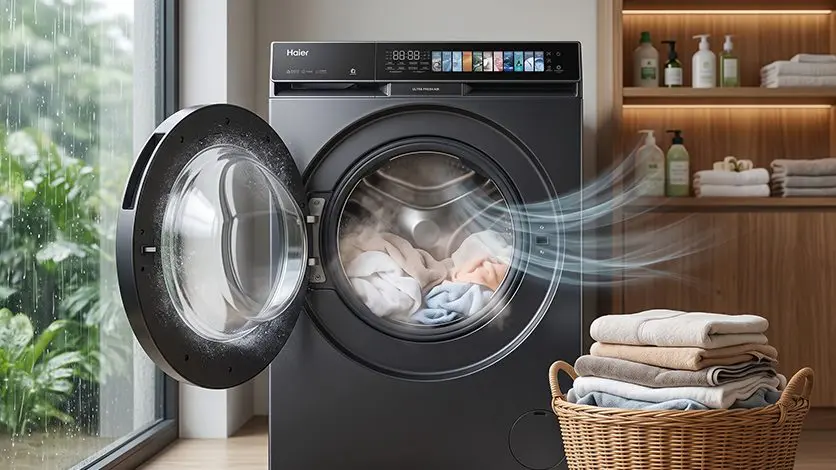
At Haier, we build our washing machines knowing Indian households deal with genuinely unpredictable power, particularly through the monsoon months. Managing the power fluctuations washing machine motors encounter each season shapes how we engineer, rather than leaning only on external stabilisers to do the job. Across our front load range, including models such as the Haier 12 Kg F11 Front Load Washer and the Haier 12 Kg F9 Front Load Washing Machine, we use a Direct Motion Motor that connects straight to the drum. No belt, no pulley. That cuts mechanical friction and gives the machine steadier, quieter operation, along with a build engineered to hold up over years of regular use. We also fit an Auto Restart function across several ranges, one of our core washing machine stabilization features. When a machine stops mid-cycle due to a power failure, it resumes from that exact point rather than losing the progress altogether.
Our top load range follows the same thinking. Many of our top load machines, including the Haier 9 Kg Anti Scaling Technology Top Load Washing Machine and the Haier 8 Kg Advance In-Built Heater Top Load Washing Machine, come with Anti-Scaling Technology and an advanced in-built heater built for consistent heating, alongside Auto Restart for continuity through power interruptions. These machines are built to stay dependable through exactly the kind of irregular power monsoon tends to bring.
For households that rely on our semi-automatic range, the focus shifts to rugged, no-frills construction. Models such as the Haier Semi Automatic Washing Machine 11 KG 178FLN come with anti-rat mesh protection for internal wiring, toughened glass lids,and a reinforced pulsator design. All of it aimed at long-term reliability in places where power supply tends to be less predictable, particularly semi-urban and rural areas.
Want to know more about how the right motor keeps your laundry routine running smoothly, monsoon or not?
Read this blog: Direct Motion Motor Explained: How Haier Keeps Your Wash Cycle Steady
Across all three ranges, the objective stays the same. We want our machines to keep performing consistently, no matter what the monsoon does to the power lines outside a customer’s home.
Across all three ranges, the objective stays the same. We want our machines to keep performing consistently, no matter what the monsoon does to the power lines outside a customer’s home.
| Power Issue | Effect on the Machine | Protective Design Response |
| Sudden power cut mid-cycle | Wash cycle stops abruptly | Auto Restart resumes from the interruption point |
| Voltage sag or spike | Motor strain, uneven performance | Direct-drive motor construction, reinforced build |
| Frequent power cycling | Gradual wear on internal components | Sturdy drum welding and robust housing design |
Simple Care Tips for Monsoon Season
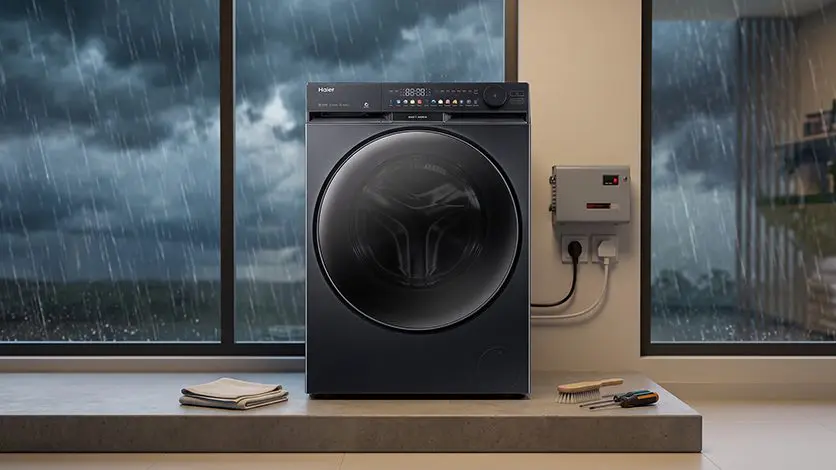
A few household habits can reduce the risk unstable power poses to a washing machine.
- Use an external stabilizer alongside a machine’s built-in washing machine stabilization features, especially where power quality is known to be inconsistent
- Avoid starting a heavy wash load during active storm conditions, when outages are more likely
- Keep the machine on a dry, slightly elevated, well-ventilated surface, away from standing water or dampness
- Run periodic maintenance checks, both before and after monsoon, to catch early signs of wear that irregular power may have caused
Conclusion
Monsoon-related power fluctuations aren’t going away. But their effect on a washing machine’s motor doesn’t have to be severe. Understanding how voltage sags, spikes, and outages affect motor performance helps households make better choices, both in how they use their machines and what they look for when buying one. Stable motor design, auto-restart functionality, and resilient internal construction genuinely make a difference through this season. At Haier, these are the considerations that shape how we build across front load, top load, and semi-automatic ranges. Reliable performance, regardless of what the weather outside decides to do.
FAQs
Which motor is best for a washing machine?
A direct-drive or inverter motor generally performs best, since it connects straight to the drum without a belt. This reduces mechanical friction, lowers noise, and handles variable power conditions more smoothly than older belt-and-pulley motor designs.
Can I use a stabiliser on a washing machine?
Yes, a voltage stabiliser can be used with a washing machine, particularly in areas with inconsistent power supply. It regulates incoming voltage before it reaches the machine, reducing strain on the motor and other electrical components during fluctuations.
Why is using an external voltage stabilizer or built-in protection essential?
Unstable power can strain a motor, disrupt wash cycles, and affect sensitive electronics over time. An external stabilizer or built-in protection features help maintain consistent voltage, reducing wear and supporting more reliable performance through the monsoon season.
How do Haier washing machines protect against electrical surges and voltage fluctuations?
Haier washing machines use Direct Motion Motor technology to reduce mechanical strain, along with an Auto Restart function that resumes a wash cycle after a power failure. Sturdy internal construction further supports reliable performance during unstable power conditions.