


Buying an AC feels simple at first. You check the tonnage, star rating, cooling speed, features, and of course, the price. But the part many people forget is what comes after the purchase, the AC’s monthly electricity bill.
An AC that looks affordable today may not feel that way later if it consumes too much power. That’s why it helps to understand air conditioner electricity consumption before you buy. And you don’t have to get very technical here. Just check the power consumption of the AC, the number of hours you plan to run it every day, and your electricity rate per unit.
Now, let’s get a good understanding of why it is essential to understand the running costs of an AC before you invest, so you can make wiser decisions in the future.
Why You Should Calculate AC Running Cost Before Buying?
An AC is something you will use again and again, especially during peak summer. So, it is worth looking beyond the showroom details and thinking about how it will perform in your home:
- You get a better idea of the real cost: When you start running the AC every day, the electricity bill is the higher long-term cost.
- Avoid bill shocks later: An AC may seem cheap when you buy it, but using a lot of power can turn out to be expensive in the long run.
- You can compare two ACs better: Even if two ACs are alike in tonnage and cooling features, their power consumption may vary.
- The AC you choose will depend on your usage: If you use the AC for only a few hours, your needs will be different from someone who runs it all night.
- You will save more in the long run: An energy-efficient AC (which will cost you a little more) can cut down your monthly electricity bill.
How to Check an AC’s Power Consumption Before Purchase?
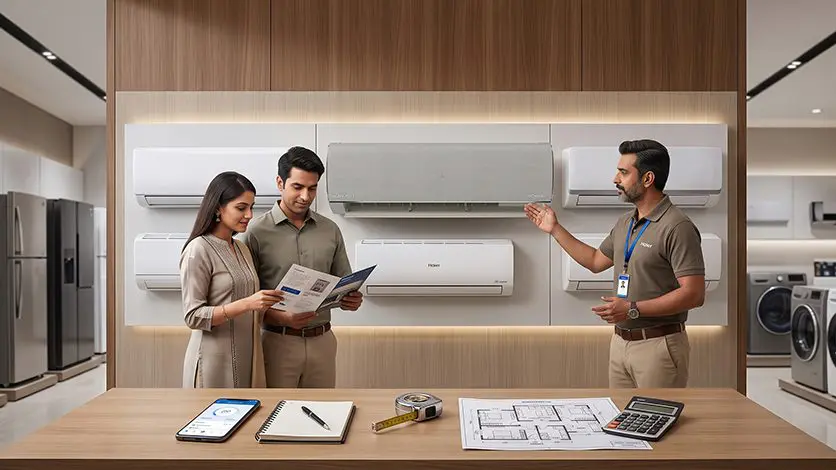
Don’t just look at price or star rating before buying an AC. Spend a few minutes and see how much electricity it might use. Following are the essential checks that you could easily track:
- Look at the “Power Input” in the product details: Normally, this is indicated in watts (1200W, 1500W, etc). The higher the wattage, the more electricity the AC could use while operating.
- Compare the ISEER and star rating: The higher the star rating and ISEER value, the better the energy efficiency usually is. So choose the one that cools better with less power consumption if two ACs are of the same tonnage.
- Is it an inverter AC: An inverter AC does not run at full load all the time. Once the room is cool, it slows down the compressor and uses less electrical current.
- Look for smart controls or energy saving modes: Some of the features like Eco mode, convertible mode, electricity monitoring, etc. help in better control of the AC power consumption. On the Haismart App, Haier’s AI Eco and electricity monitoring features show power consumption in kWh and INR.
- Choose the right AC size for your room: A small AC in a large room will run all the time and use more power. An AC that is too large for a small room can also be inefficient. So, select the tonnage depending on your room size, sunlight, floor level and daily usage.
(Wish to know how on/off cycles affect your billing?
Read: Does Turning AC On & Off Multiple Times Increase Electricity Consumption?)
How to Calculate AC Electricity Cost per Hour?
To find the cost of AC electricity per hour, just use this simple formula:
Cost/hour = (Power input watts/1000) x electricity cost/unit
If your AC has an input power of 1500 watts and your electricity rate is ₹8 per unit.
1500/1000 = 1.5 kw
₹12 per hour = 1.5 x ₹8
So, at that power level, the AC might cost you around ₹12 per hour.
An Example in Practice
Let’s take an inverter AC into account. Say it starts at 1500 watts, but when it cools the room, it’s more like 600 watts part of the time.
600 ÷ 1000 = 0.6 kW
0.6 x ₹8 = ₹4.80 per hr
This is why it is more practical to estimate the inverter AC running cost as a range rather than a fixed number. Consumption may be higher in the first 20 to 30 minutes as the room is hot. Once the room reaches the desired temperature, the compressor slows down and uses less power.
How to Estimate Your AC Monthly Electricity Bill?

To estimate your AC bill, it is mostly a quick, practical calculation. You do not have to know what the final amount will be in advance, as real use can vary from month to month. Some of the major pointers that you should always follow are:
- Check the power consumption of AC: Check the power input of the AC in watts. It is usually printed on the product label, spec sheet or catalogue.
- Convert watts into units: Electricity bills are in units (also called kWh ). Convert watts to units. To convert watts to units, divide the wattage by 1000. So, 1200 watts / 1000 = 1.2 units/ per hour.
- Figure out how many hours you’ll use the AC daily: Be realistic. If you are primarily using AC at night, then your daily use could be 7-8 hours. But the usage may be different when it is for a living room or office.
- Multiply that by 30 days: Be sure of your daily usage, make a note of it, then multiply by 30 to estimate a month’s usage. That will give you a ballpark figure of how many units your AC can add to your bill in a month.
- Multiply your units by your electricity price: Check the rate you pay for electricity per unit. It can vary from city to city and by usage category. Multiply the monthly units by your per unit rate to get an estimate of your AC’s monthly electric bill.
An Example in Practice
Suppose your AC uses 1200 watts and you run it for 8 hours every day. Your electricity bill comes out to be ₹8/ per unit.
First, convert watts to units:
1200/1000 = 1.2 units/hr
Now calculate the daily use:
1.2 x 8 hours = 9.6 units/ per day
Now calculate monthly use:
9.6 x 30 days = 288 units/month
Now, do the maths for the monthly cost:
288 x ₹8 = ₹2,304
So your AC may add about ₹2,300 per month to your electricity bill in this case.
(Disclaimer: This calculation is just an example. Your actual AC monthly electricity bill may be different based on your usage hours, temperature setting, room size, outdoor weather, insulation, and the electricity rate in your area.)
Tips To Reduce AC Power Consumption After Installation
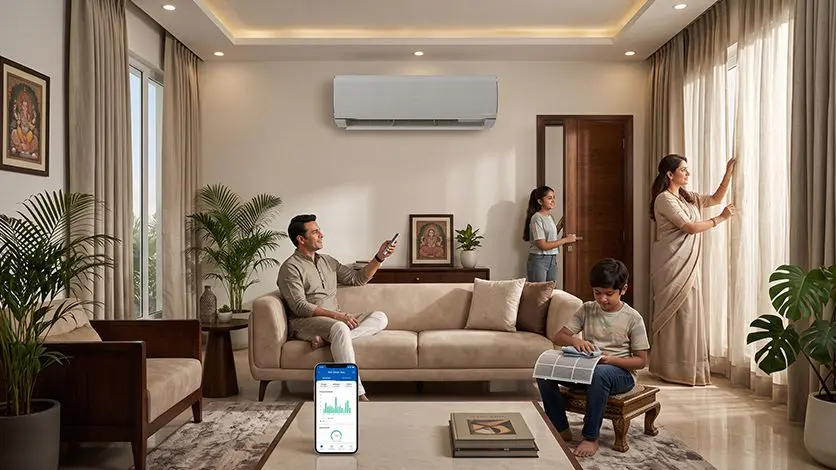
Once you have the AC in place, there are a lot of ways that your daily habits can change your electricity bill. There are a few little tweaks to the way you use it that can help reduce AC power consumption and cool the room more efficiently:
- Use smarter cooling with Haier’s AI Eco mode: If your Haier AC has an AI Eco mode, use that instead of running the AC on full power all the time. It can switch between different levels of capacity and can modulate cooling to the needs of the room.
- Track your electricity consumption through the Haismart App: Most people only get to know the AC consumption is high when the electricity bill comes. The electricity monitoring feature of Haier ACs with the Haismart App allows you to monitor daily and monthly power consumption.
- Let AI Climate Control take care of comfort automatically: Constantly adjusting the temperature manually can make the AC work harder than it should. Haier’s AI Climate Control learns usage patterns and studies room conditions such as temperature and humidity.
- Use smart features when the room is not occupied: In select Haier AC models, features like AI Human Detection can help regulate cooling when people are not present in the room.
- Self-cleaning features to keep the AC cleaner: Dust on the indoor or outdoor unit can lower the cooling performance. Haier’s IDU Frost Self Clean and ODU Cyclone Clean features help reduce dust accumulation and promote better airflow.
(Searching through best energy-saving ACs lately?
Check out Haier Galaxy Slate Gravity Series and Haier Gold Decco Desert Rose Series)
Conclusion
AC Running Cost Calculation before Buying It helps you look beyond the price tag and understand the monthly electricity impact. Check the power input, star rating, ISEER value, inverter technology, energy saving modes and right tonnage for your room. Then calculate the cost based on power use, hours used per day, and your electricity cost.
Once installed, habits such as setting the temperature between 24°C and 26°C, cleaning filters, using Eco/sleep mode and tracking usage can help reduce AC power consumption.
FAQs
What information do you need to estimate an AC’s monthly electricity cost?
To calculate this, you need to determine the power input of the AC, the number of hours you use it each day, the number of days you use it each month, and your rate per unit of electricity.
How much electricity does a 1 Ton, 1.5 Ton, and 2 Ton AC typically consume?
A 1 ton AC may consume around 0.8-1.2 units per hour, a 1.5 Tonne AC may consume 1.2-1.7 units per hour, and a 2 Tonne AC may consume 1.8-2.5 units per hour. The actual number depends upon star rating, inverter technology, temperature setting, and room conditions.
Can you calculate an AC’s running cost using the BEE energy label?
Yes, the BEE label will tell you how energy efficient the AC is and how much electricity it will consume in a year. You can multiply that by your electricity rate to get an estimate of the cost of running it.
How many units of electricity does an AC consume per hour?
Depends on how many watts the AC is drawing. So a 1000 W AC can consume around 1 unit per hour, and a 1500 W AC can consume around 1.5 units per hour at full load.
Can room size and AC capacity affect your monthly electricity bill?
Yes, if the AC is undersized for the room, it will run longer and consume more power. If it’s too big, it could cool unevenly. Selecting the right capacity will help to regulate AC power consumption and keep the room comfortable.