
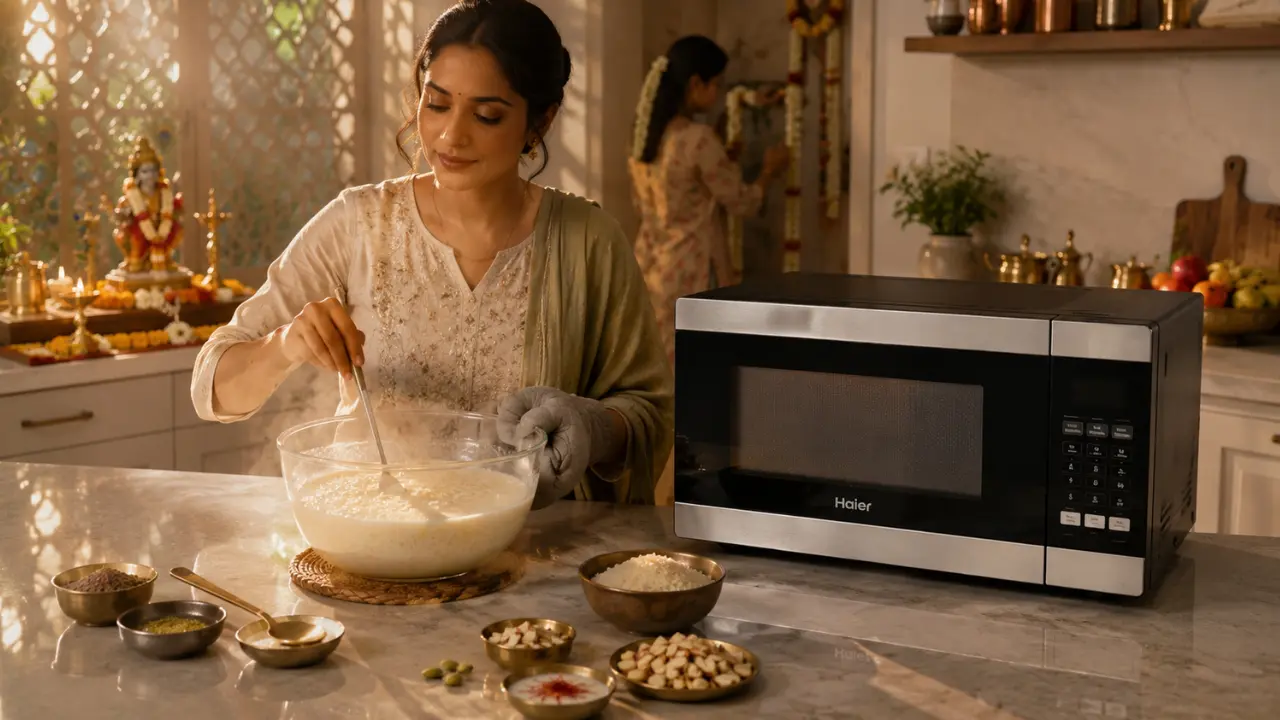

Kheer has a funny way of making a kitchen feel festive before the celebration has even properly begun. Milk warming, cardamom opening up, nuts going in at the end that familiar aroma is closely tied to Indian festivals, and Janmashtami is certainly no exception.
The difficult part? Traditional kheer asks for attention. Milk needs watching, stirring cannot be ignored for too long, and on a morning when there may already be fruits to prepare, decorations to finish and other dishes competing for space on the hob, that one saucepan can demand more supervision than expected.
A microwave offers another route.
Janmashtami kheer can now be made in a bowl with just a bit of stirring in between the cooking times and in the right vessel with sensible power settings without being stationed at the wooden stove all day long. A good microwave oven like Haier 30L Convection Microwave with In-Built Air Fryer (HIL3001ARSB) can prove to be extremely handy much beyond the festive dish and can be of great service in households where the same machine is used for every day cooking as well.
First, Decide What Kind of Kheer You Want
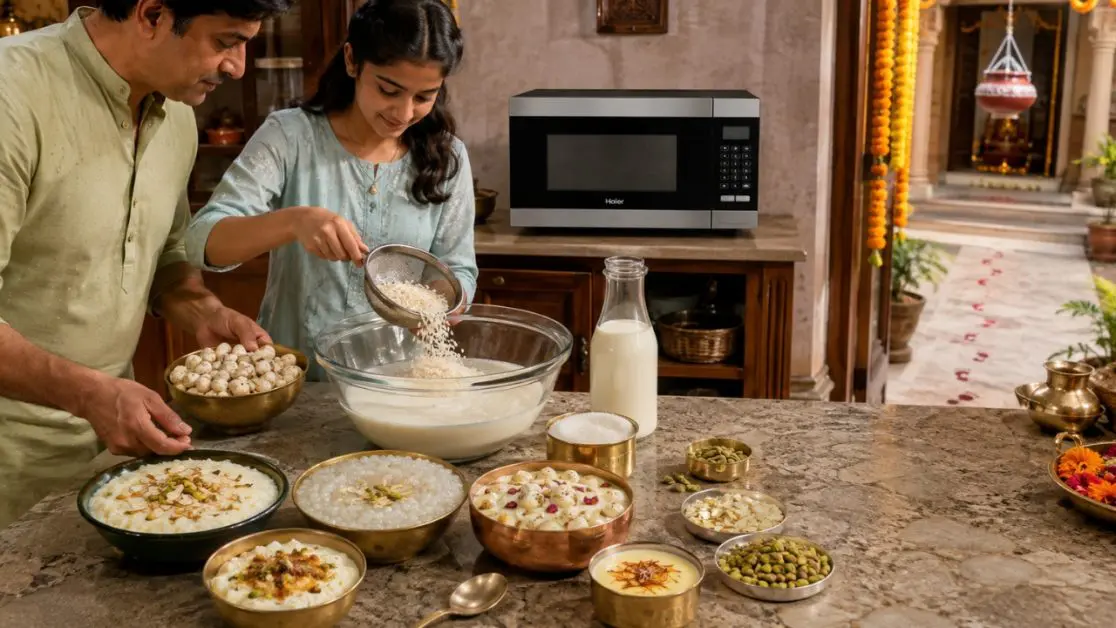
Kheer does not have a standard home recipe from home to home in India. Rice kheer is a popular kheer for many families, makhana kheer for others, sabudana kheer or any kheer based on regional and family preferences.
This tutorial is a simple version of the kheer, which is a milk pudding made with milk, rice, sugar, cardamom and nuts.
Ingredients for a Simple Microwave Rice Kheer
For approximately 4 servings, keep ready:
- 1 litre full-fat milk
- 3 tablespoons rice
- 4 to 5 tablespoons sugar, or according to taste
- 4 green cardamom pods, powdered
- 8 to 10 almonds, sliced
- 8 to 10 cashews, chopped
- A few pistachios for garnish, if preferred
- A small pinch of saffron soaked in warm milk, optional
Wash the rice thoroughly and soak it for around 20–30 minutes before cooking. Drain it before adding it to the milk.
A small detail, but an important one: use a large, deep microwave-safe bowl rather than choosing a vessel that appears merely large enough to hold the milk. Heated milk rises quickly. Extra headroom gives it somewhere to go and reduces the chance of a messy boil-over.
Microwave Kheer at a Glance
| Stage | What You Are Doing | What to Watch |
| 1 | Heating the milk | Stop before it boils over |
| 2 | Adding soaked rice | Mix thoroughly |
| 3 | Cooking in intervals | Stir between intervals |
| 4 | Adding sugar and flavouring | Adjust sweetness carefully |
| 5 | Final thickening | Remember kheer thickens as it cools |
| 6 | Garnishing | Add nuts and saffron before serving |
Microwave timings can vary with quantity, vessel shape, starting temperature and appliance power, so the clock should guide you rather than control you. Check the kheer physically between stages.
Step 1: Begin With the Milk
Pour the milk into your deep microwave-safe bowl.
Heat it using the microwave function in short stages rather than setting a long timer and walking away. For a 1-litre quantity, an initial heating period of a few minutes can bring the milk towards a hot, steaming stage.
Pause and check.
That pause matters. Milk has very little respect for your kitchen-cleaning schedule.
The Haier HIL3001ARSB offers five microwave power levels, which gives you the flexibility to adjust heat according to what is being cooked. Its microwave output is rated at 900 W, so selecting a suitable power setting and checking food at regular intervals is preferable to treating every recipe as a full-power job.
Step 2: Add the Rice and Start Building the Texture
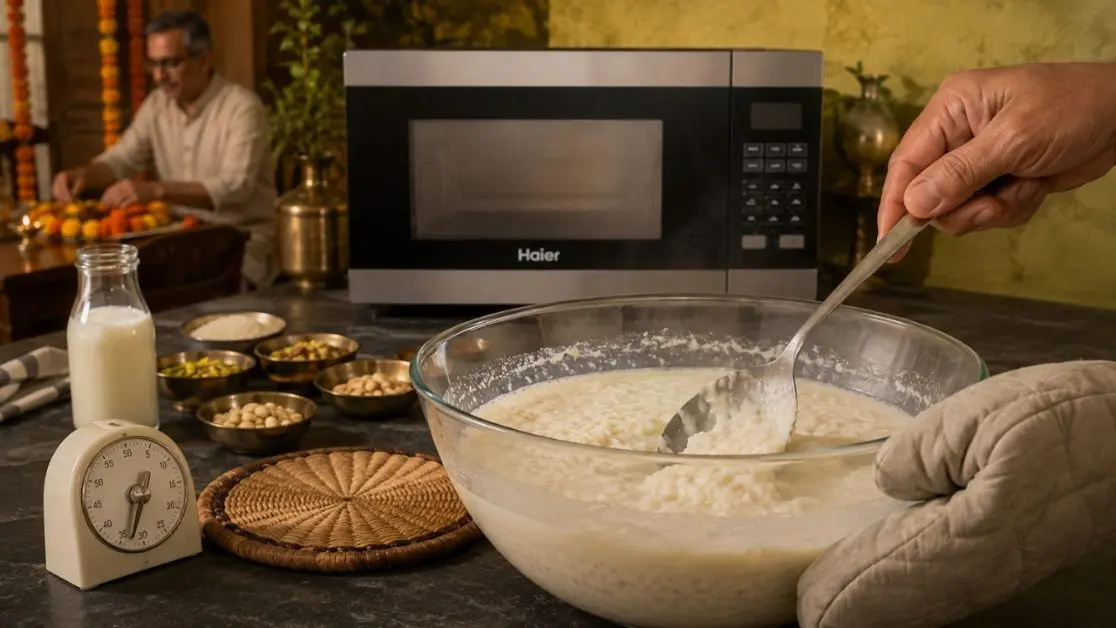
Credits: Haier India, Make kheer in Microwave
Once the milk is hot, carefully remove the bowl and stir in the drained rice.
Return it to the microwave.
Cooking the mixture in shorter intervals around 4 to 5 minutes at a time can be a sensible starting approach, stirring thoroughly after each interval. As the rice cooks, it begins releasing starch into the milk, gradually giving kheer its familiar body.
Do not rush this stage.
Kheer is supposed to become creamy, not simply hot.
Stir from the bottom as well as around the sides of the bowl. This redistributes the rice and helps you judge how quickly the mixture is thickening.
What Should You Look For?
Rather than relying only on minutes, check three things:
- The rice should be completely soft.
- The milk should visibly reduce and become creamier.
- The mixture should remain slightly looser than your preferred final consistency.
Why lose? Because rice kheer continues thickening while it rests and cools.
Step 3: Sweeten It Towards the End
Once the rice is properly cooked, add sugar and stir until it dissolves.
Then add powdered cardamom and, if you are using it, saffron-infused milk.
Microwave again briefly, checking and stirring as required, until everything is well incorporated.
Adding sugar later gives you a chance to first judge how much the milk has reduced. It also makes adjusting sweetness easier, especially useful when the kheer will be accompanied by other festive sweets.
Taste only if that fits your family’s Janmashtami practices. In homes where the dish is being prepared specifically as bhog or prasad and is traditionally not tasted before offering, follow the custom observed by your family.
Step 4: Finish With Nuts, Then Stop
Add almonds, cashews and pistachios towards the end.
You can keep a little garnish aside for serving.
And then stop cooking.
It is tempting to continue because the kheer may look marginally thin while hot. Give it a few minutes. The consistency settles noticeably as both the milk and rice cool.
If it later becomes thicker than you prefer, a little warm milk can be mixed in before serving.
Where a Well-Equipped Microwave Changes the Festive Kitchen
Making kheer does not require a complicated appliance. What becomes valuable during festivals, however, is having one appliance capable of handling substantially more than a single bowl of dessert.
The Haier 30L Convection Microwave with In-Built Air Fryer (HIL3001ARSB) combines microwave, grill, convection, air-fryer and rotisserie functionality in one appliance. That 5-in-1 approach is particularly practical when a festive menu moves rapidly from reheating to cooking and then to snacks or accompaniments.
Its features include:
- 30-litre capacity
- 900 W microwave output
- Five microwave power levels
- 305 preset auto-cook menus
- In-built air fryer with 36 dedicated air-fryer menus
- Motorised rotisserie
- Grill and convection functionality
- Stainless-steel cavity
- Touch control panel
- Express Cooking for quick-start heating
- Child Lock to help prevent accidental usage
The point is not to use every function while preparing kheer. You won’t. For this recipe, controlled microwave heating is the important part.
The wider value becomes clearer when kheer is only one item on a longer Janmashtami menu.
A Microwave Can Take Pressure Off More Than the Kheer
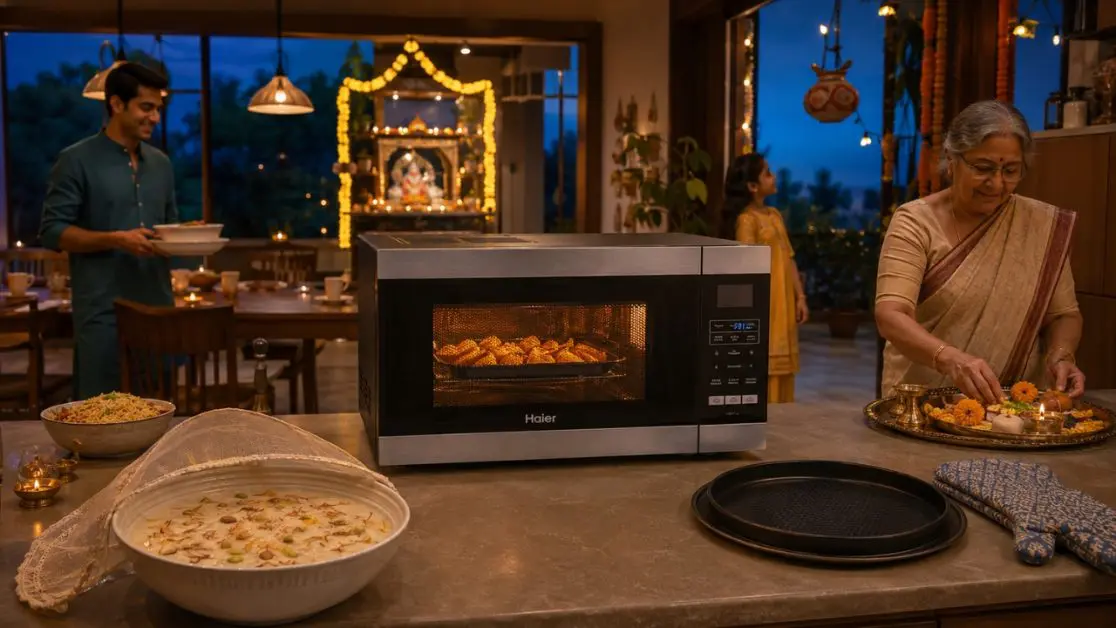
Imagine the usual festive sequence.
The dessert is cooling. Someone wants an earlier batch of food reheated. Another dish needs warming before serving. Later, the family wants a snack with tea. The kitchen suddenly has three different jobs happening at once.
This is where the versatility of the Haier microwave becomes more relevant.
Its 305 auto-cook menus are designed to provide preset time and power combinations for easier operation, while the in-built air fryer extends the appliance into another category of cooking altogether. Haier lists 36 dedicated air-fryer menus, giving households more options when they want crisp preparations with less oil.
The motorised rotisserie, meanwhile, automatically rotates food for more uniform grilling. These features may not belong inside your kheer bowl, obviously, but they make the appliance more useful once festival cooking moves beyond dessert.
Small Details That Make Microwave Kheer Better
A microwave reduces active supervision, but technique still matters.
Use a Wide, Deep Bowl
Too shallow and milk can spill. Too small and stirring becomes awkward. Leave generous empty space above the liquid.
Never Skip the Stirring Intervals
Microwave cooking is convenient, not magical. Stirring helps distribute heat and prevents rice from settling into one dense patch.
Add Sugar After the Rice Softens
You gain better control over both sweetness and final consistency.
Keep the Final Texture Slightly Loose
Hot kheer thickens as it rests. If you wait until it looks very thick inside the microwave, you may end up with something considerably denser later.
Handle the Bowl Carefully
The vessel and steam can become extremely hot. Use proper oven gloves or heat-resistant protection when removing it.
Follow the Appliance Instructions
Use cookware appropriate for microwave mode, and follow the manufacturer’s operating guidance when switching between microwave, grill, convection, air-fryer or combination functions.
One Appliance, More Room to Enjoy the Festival
Janmashtami cooking does not need to lose its traditional character simply because the method becomes more convenient. The ingredients remain familiar. The aroma of cardamom still reaches the next room. The bowl of kheer still takes its place in the celebration.
What changes is the amount of constant supervision required.
The Haier 30L Convection Microwave with In-Built Air Fryer brings together microwave cooking with convection, grilling, air frying and rotisserie capabilities, giving Indian households an appliance that can move from everyday heating to broader festive cooking requirements without needing a separate machine for every task.
And on Janmashtami, when one less saucepan needs your undivided attention, that convenience can feel particularly worthwhile.
Frequently Asked Questions
1. Can I make kheer completely in a microwave?
Yes. Rice kheer can be prepared in a microwave by heating the milk and cooking the soaked rice in intervals. Regular stirring is important because it helps distribute heat, cooks the rice evenly and lets you monitor the consistency.
2. How do I stop milk from overflowing while making microwave kheer?
Use a deep, generously sized microwave-safe bowl with plenty of empty space above the milk. Cook in shorter intervals rather than continuously, and check and stir the mixture between each interval.
3. How do I know when microwave rice kheer is ready?
The rice should be completely soft and the milk should have developed a creamy consistency. Keep the kheer slightly looser than your preferred serving texture because it will continue to thicken as it cools.
4. When should sugar be added to the microwave?
It is better to add sugar after the rice has softened and the milk has begun to reduce. This makes it easier to judge the sweetness and final consistency of the kheer.
5. Can the Haier 30L Convection Microwave with In-Built Air Fryer be used for more than festive desserts?
Yes. The Haier 30L Convection Microwave with In-Built Air Fryer (HIL3001ARSB) combines microwave, grill, convection, air-fryer and rotisserie functions. It also features five microwave power levels, 305 auto-cook menus and 36 dedicated air-fryer menus, making it useful for a wider variety of everyday and festive cooking requirements.