
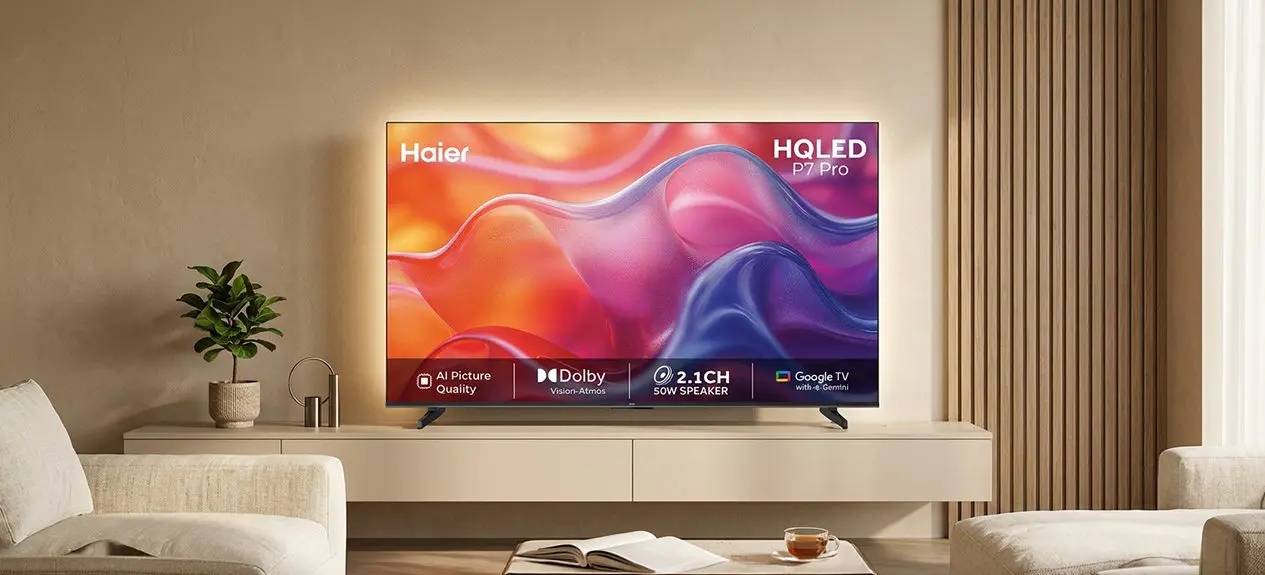

“LED TV” is printed on almost every TV label today. Yet many buyers still ask whether it differs from an LCD TV. Others wonder what terms like edge-lit and full-array actually mean.
The short answer is simple. An LED TV is an LCD TV that uses LED backlighting. The real differences lie in how those LEDs are arranged behind the screen. That layout shapes contrast, brightness, and thickness.
This guide explains how LED and LCD TVs differ, which types exist, and how Haier’s current range fits into the picture.
What Is an LED TV?
An LED TV has a liquid crystal display (LCD) panel lit from behind by light-emitting diodes. The panel does not make light on its own. It filters the light to form the picture, and the LEDs supply that light.
So the LED TV meaning is about the backlight, not the screen. Brands shortened “LED-backlit LCD” to “LED TV” because it is easier to say.
Most TVs sold today follow this design. That includes QLED and Mini LED models. OLED is the main exception, since its pixels make their own light.
LED vs LCD: How They Differ
Older LCD TVs used cold cathode fluorescent lamps (CCFLs) as the backlight. LEDs replaced them, and that change brought a few clear gains:
- Slimmer build: LEDs are far smaller than tubes
- Better brightness: highlights can look more vivid
- Lower power use: LEDs generally draw less energy
- Longer life: LEDs typically outlast fluorescent tubes
- Better contrast: especially when the backlight can dim in zones
So the LED vs LCD TV question is really about two backlights. Fluorescent-lit sets are now rare, which means a new TV is almost certainly LED-backlit.
Types of LED TVs
Three backlight layouts are common. They look alike from the front, but they behave differently. Knowing the types of LED TVs helps you read a spec sheet with confidence.
Edge-Lit LED
Here, the LEDs sit along the edges of the screen. A light guide spreads the glow across the panel. An edge-lit LED TV can be very slim and is usually the most affordable. Contrast is more limited, and dark scenes may look slightly uneven.
Direct-Lit LED
In this layout, the LEDs sit directly behind the panel in rows. Brightness spreads more evenly. The TV is a little thicker. Without dimming zones, blacks can still look greyish.
Full-Array LED with Local Dimming
A full-array LED TV places LEDs behind the whole panel and groups them into zones. Each zone can dim independently. Dark areas stay darker, while bright areas stay bright. This gives the best contrast of the three, though it usually costs more.
Mini LED and QLED: LED TVs, Upgraded
QLED and Mini LED are still LED-backlit LCD TVs. Each one improves a different part of the picture.
- QLED: adds a quantum-dot layer for richer colour and a brighter image
- Mini LED: uses much smaller LEDs and far more dimming zones for stronger contrast
OLED works differently. Each pixel lights itself, so there is no backlight at all.
Haier’s TV Range at a Glance
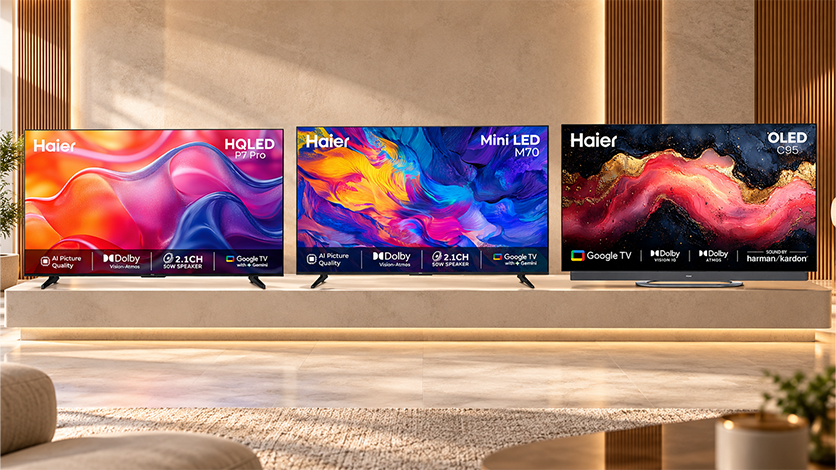
Haier groups its televisions into seven ranges. Every range runs Google TV on most models. Here is how they line up, with price bands in rupees:
| Haier range | Sizes | What it suits | Price band |
| HD | 32-inch | Bedrooms, kitchens, study rooms | Between ₹17,000 and ₹19,000 |
| Full HD | 40 and 43-inch | Small living rooms and bedrooms | Between ₹26,000 and ₹29,000 |
| 4K UHD | 43 to 75-inch | Everyday family viewing | Between ₹31,000 and ₹87,000 |
| QLED | 32 to 100-inch | Bright rooms and richer colour | Between ₹19,000 and ₹3,25,000 |
| Mini LED | 43 to 100-inch | Strong contrast in mixed lighting | Between ₹40,000 and ₹4,25,000 |
| OLED | 55 to 77-inch | Movie viewing in dim rooms | Between ₹1,15,000 and ₹3,50,000 |
| Big Screens | 77 to 100-inch | Large living rooms and home theatres | Between ₹1,65,000 and ₹4,25,000 |
A few details help you narrow the choice:
- HD range: the 32-inch K85, K82 and K82G models come with a three-year warranty and a 20W speaker on the K82 series
- Full HD range: the K85 series adds HDR, Dolby Audio and Chromecast at 40 and 43 inches
- 4K UHD range: a 4K LED TV search lands here, with the A9UG, P7GT, K85 and K85G series across five sizes
- QLED range: the P7 Pro and Q7 Pro models add Gemini, HDR10+ and a subwoofer
- Mini LED range: the M70, M80F, M92 and M96 series run from 43 inches up to 100 inches
- OLED range: the C90 and C95 series offer high refresh rates, with Harman Kardon sound on the C95
You can see every size in the Haier Google TV lineup in India. Price bands are indicative, so check each product page for current offers.
Are LED TVs Still Worth Buying?
For most households, yes. A smart LED TV offers a wide choice of sizes, steady brightness and good value. It handles daytime viewing well, which suits Indian living rooms with plenty of light.
If you watch mostly films in a dim room, OLED may give you deeper blacks. For everyday viewing, an LED-backlit TV is usually the practical choice. For more buying explainers, you can browse the Haier blog.
How to Choose the Right LED TV
Run through this short checklist before you buy:
- Pick the screen size based on your seating distance
- Match the resolution to the size: HD for 32-inch, Full HD for 40 to 43-inch, 4K for larger screens
- Check the backlight type, since full-array and Mini LED give better contrast
- Confirm the smart platform runs the apps you use
- Look at the sound output and the number of HDMI ports
- Read the warranty terms
Conclusion
An LED TV is simply an LCD TV with a better backlight. The LED layout, any panel upgrade and the resolution decide how the picture looks in your room.
Choose the size and resolution that suit your space first. Then pick the backlight type that fits your lighting and budget.
FAQs
What is an LED TV?
An LED TV is a television with an LCD panel lit by light-emitting diodes. The LEDs form the backlight, and the panel creates the picture.
Is an LED TV the same as an LCD TV?
An LED TV is a type of LCD TV. Both use a liquid crystal panel. LED models use LED backlighting instead of fluorescent tubes.
What types of LED TV are available?
The main types are edge-lit, direct-lit and full-array with local dimming. QLED and Mini LED are upgraded versions of the LED-backlit design.
Which is better, edge-lit or full-array LED?
Full-array LED usually gives deeper blacks and better contrast. Edge-lit models are slimmer and often more affordable.
Is a smart TV an LED TV?
Usually yes. “Smart” describes the software and app support, while “LED” describes the backlight. Most smart TVs sold today are LED-backlit.
Is OLED an LED TV?
Not in the usual sense. OLED pixels make their own light, so there is no LED backlight behind the screen.