
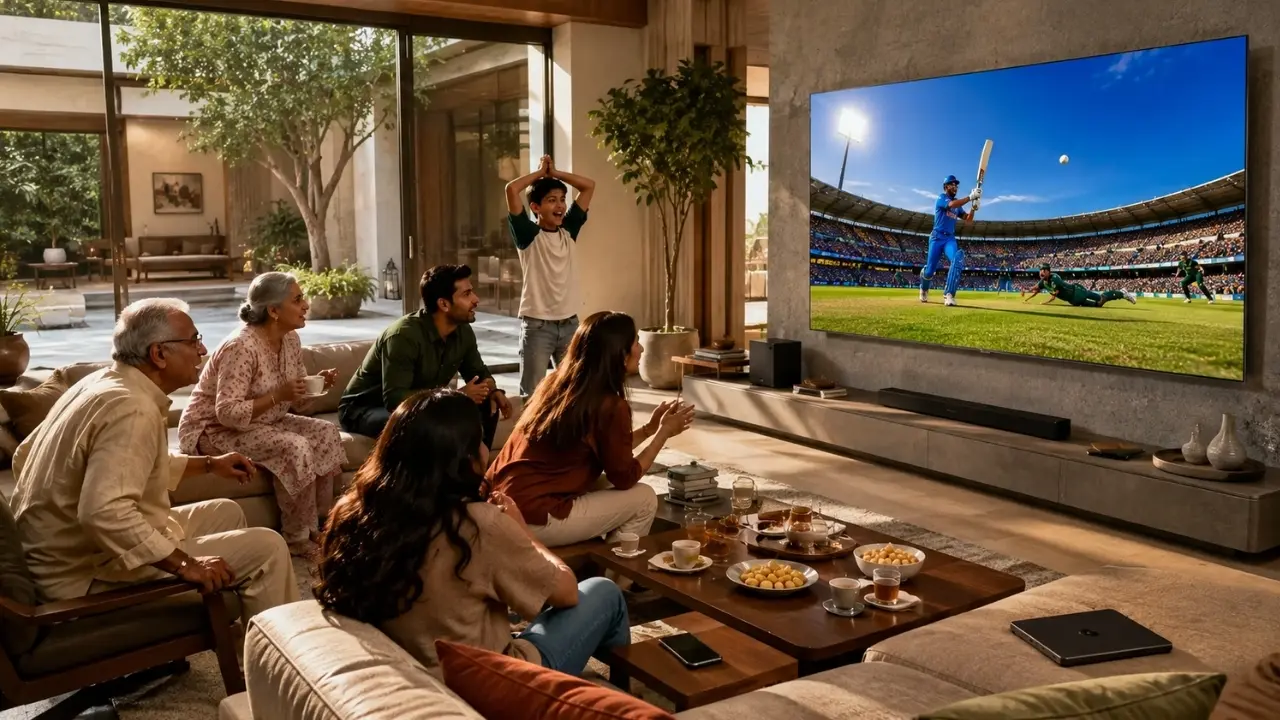

The match has entered its final over. Someone has already claimed the best seat on the sofa, dinner has quietly moved to the coffee table, and even the family member who said, “I’m not really watching,” is now arguing about the previous ball.
That scene says quite a lot about the modern Indian living room.
For a while, personal screens seemed ready to make the television secondary. Movies moved to laptops, short-form videos lived on phones and gaming became increasingly personal. Yet the living room has not disappeared from the entertainment equation. Quite the opposite. It is becoming relevant again because entertainment itself is becoming more visual, connected, interactive and, importantly, worth sharing.
A modern living room can host a film night on Friday, a cricket match on Sunday, a gaming session later that evening and a family streaming marathon during the holidays. The television sitting at its centre therefore has a much bigger job than simply displaying channels.
And this is precisely where large-screen premium televisions such as the Haier M92 and M96 QD-Mini LED AI Smart Google TV Series begin to make sense.
Why Are Living Rooms Becoming Entertainment Spaces Again?
Living rooms are returning as entertainment hubs because people increasingly want a larger, more immersive and shared experience for movies, sports, streaming, music and gaming.
The shift is being supported by televisions that combine:
- Large-screen viewing
- Advanced picture processing
- High refresh rates for motion
- Integrated premium audio
- Gaming-focused technologies
- Personalised smart-TV platforms
- Voice control and casting
- Connected-home capabilities
It is no longer simply about making the television bigger. The experience surrounding that screen has changed.
The Living Room Is Doing More Than It Used To
Think about what happened around the family television twenty years ago. Everyone generally watched whatever happened to be broadcast at that particular time.
Now? Completely different.
One person wants an OTT series. Someone else wants a football match. Children may want animated content. Gamers expect a responsive display. Music gets streamed through the TV. Phones are cast onto the big screen. Search is increasingly voice-led.
That variety is one reason the television is becoming the anchor again.
The Haier New M92 Series 164 cm (65) QD-Mini LED AI Smart Google TV H65M92FUX and Haier New M92 Series 189 cm (75) QD-Mini LED Smart AI Google TV H75M92FUX, for example, bring Google TV, QD-Mini LED display technology, AI-powered picture processing, enhanced audio and gaming features into one platform.
For homes where the screen itself is intended to become a major visual feature, Haier takes the concept considerably further with the New M96 Series 254 cm (100) QD-Mini LED AI Smart Google TV H100M96FUX.
A 254 cm (100) television does not exactly disappear into the furniture. Nor is it supposed to.
Bigger Screens Change the Social Side of Entertainment
Watching a two-hour film on a phone can be convenient. Watching the same film with family or friends is another kind of experience altogether.
That difference matters.
When the screen becomes large enough for everyone in the room to comfortably follow what is happening, viewing naturally becomes communal again. Sports arguably makes this even more obvious. A boundary, goal or last-lap overtake feels different when several people react to it simultaneously.
The same principle extends to:
Movie nights: A large display helps cinematic content command the room rather than merely occupy one corner of it.
Live sport: Smooth motion becomes particularly important when following fast-moving players, balls or vehicles.
Gaming: The living room can become a console-gaming area rather than simply a passive viewing space.
Family streaming: Content discovery and recommendations make it easier for different household members to find something to watch.
Casting: Photos, videos and compatible mobile content can move from an individual device to a shared screen.
The living room, in other words, becomes flexible. It can change personality depending on who picks up the remote or, increasingly, who speaks first.
Picture Quality Is What Makes a Large Screen Worth Having
There is a catch with large TVs: increasing screen size also makes picture weaknesses easier to notice.
So, size alone cannot create immersion.
QD-Mini LED Brings More Control to the Picture
Haier’s M92 Series uses QD-Mini LED display technology, combining a large-screen format with local dimming technology designed to deliver stronger contrast and deeper blacks.
The 164 cm (65) H65M92FUX features 448 dimming zones, while the 189 cm (75) H75M92FUX increases that figure to 576 dimming zones.
For the 254 cm (100) H100M96FUX, Haier moves substantially further with 2,160 dimming zones alongside QD-Mini LED technology.
Why does that matter to somebody sitting on a sofa?
Because a premium large-screen experience depends on the television handling bright and dark sections of an image convincingly. Movie scenes containing bright highlights against dark backgrounds, for example, benefit from more precise light control.
The M96 also supports HDR10+ and is specified with up to 2,100 nits peak brightness, while Haier lists 99% DCI-P3 colour gamut coverage for the 254 cm (100) model.
These specifications are not there merely to decorate a product sheet. They address the fundamentals of large-format viewing: brightness, colour, contrast and image detail.
AI Is Quietly Becoming Part of the Viewing Experience
Most viewers do not want to stop a film every few minutes and manually adjust colour, motion or contrast.
That would get old rather quickly.
Haier AI Ultra Sense Processor. The television uses AI-driven technologies for aspects of picture, sound, gaming and entertainment, while the picture processor supports scene recognition and intelligent adjustments involving motion, colour, contrast and depth.
The feature set includes functions such as:
- AI Scene Detection
- AI Colour Boost Pro
- AI Super Resolution
- AI HDR Enhancer Pro
- AI Depth
- AI Motion
For the household, the underlying idea is simple: technology should do more of the optimisation in the background.
That becomes increasingly useful when the same television goes from a brightly shot cricket match in the afternoon to a dark cinematic sequence at night.
From Afternoon Cricket to Late-Night Cinema
Lighting is another practical issue in Indian living rooms.
Many are bright during the day, especially where large windows or balconies face the seating area. At night, the same room may become considerably darker.
The M92 and M96 Series include Dolby Vision IQ, which can adapt picture presentation according to ambient lighting conditions. Haier also provides AI Ambient Sense, designed to adjust brightness and colour temperature depending on whether the environment is bright or dark.
The M96 introduces another particularly relevant feature for large living spaces: a low-reflection screen designed to reduce glare and mirror-like reflections.
That addresses something buyers occasionally overlook while comparing specifications online. A television does not live in a blacked-out showroom. It lives opposite windows, lamps, balconies and ceiling lights.
Real rooms are messy like that.
Sound Is Bringing the “Room” Back Into Living-Room Entertainment
Picture quality may grab attention first, but weak sound can quickly flatten a premium viewing experience.
Haier has therefore paired the M92 Series with Sound by KEF, Dolby Atmos, Total Sonics and a 2.1-channel speaker system with subwoofer. The 164 cm (65) and 189 cm (75) M92 models provide 50W audio output.
The 254 cm (100) M96 pushes the sound system considerably further. Haier specifies a 6.2.2-channel speaker configuration for the H100M96FUX, alongside Sound by KEF, Dolby Atmos and Total Sonics, with 90W audio output.
For a living room designed around entertainment, integrated audio of this kind matters because the screen and soundscape begin working as one system rather than as two unrelated pieces of hardware.
Gaming Has Claimed Its Place on the Sofa Too
Modern family TV cannot assume every evening involves movies.
Sometimes someone connects a console and suddenly the living room becomes a racetrack.
The Haier M92 and M96 models feature a native 144Hz refresh rate, together with gaming technologies including VRR, ALLM and AMD FreeSync Premium Pro. Haier also provides Game Mode, with gaming refresh capability listed at up to 240Hz when the relevant mode is enabled.
For fast-moving games, these technologies are designed around smoother motion, lower latency and reduced tearing.
That makes these TVs considerably more versatile than televisions built purely around conventional viewing.
| Living-room activity | Haier technology supporting it |
| Films and OTT streaming | QD-Mini LED, Dolby Vision IQ, HDR10+, Google TV |
| Live sport | 144Hz refresh rate, AI Motion, MEMC |
| Console gaming | VRR, ALLM, AMD FreeSync Premium Pro, Game Mode |
| Music and cinematic audio | Sound by KEF, Dolby Atmos, Total Sonics |
| Family content discovery | Google TV personalised recommendations |
| Mobile to TV sharing | Haicast and built-in casting capabilities |
| Hands-free operation | Google Assistant-enabled voice control |
The point is not that every household will use every feature every day. It is that television no longer has one job.
The Remote Is No Longer the Only Way In
Content abundance created another problem: finding something worth watching.
Google TV on the Haier M92 and M96 Series brings streaming content together and supports personalized recommendations, search and watchlists. Hands-free voice control also allows compatible commands without relying entirely on conventional remote navigation.
Then there is Haicast, designed to support content projection and multimedia sharing between mobile devices and the television.
For connected homes, HaiSmart adds another dimension, positioning the television as part of a broader smart-home environment rather than an isolated screen.
That evolution is important. The entertainment hub of the house increasingly needs to communicate with the devices around it.
Which Haier QD-Mini LED TV Fits the Entertainment Space?
There is no sensible reason to recommend the biggest television to every household. Room dimensions, viewing distance, furniture and how heavily the television will be used all matter.
Haier’s current QD-Mini LED line-up gives households different routes into this premium living-room experience.
Haier H65M92FUX 164 cm (65)
A strong option for households looking to move into premium large-screen entertainment without making the television completely dominate the room. It combines QD-Mini LED, 448 dimming zones, 144Hz refresh rate, Sound by KEF and Google TV.
Haier H75M92FUX 189 cm (75)
For a larger entertainment wall or viewing area, the 189 cm (75) M92 expands the screen and provides 576 dimming zones while retaining the M92 Series’ AI picture, audio, smart-TV and gaming technologies.
Haier H100M96FUX 254 cm (100)
This is the statement option.
With its 254 cm screen, 2,160 dimming zones, up to 2,100 nits peak brightness, low-reflection display, 144Hz refresh rate and 6.2.2-channel sound system, the M96 is designed for homes where television viewing is intended to become a genuinely large-format experience.
Perhaps the Living Room Never Really Went Away
Personal devices are not going anywhere. Nor should they.
Phones are unbeatable for convenience. Tablets work wonderfully for individual viewing. Laptops have their place.
But shared entertainment asks for something else: scale, sound, presence and the simple pleasure of experiencing the same moment together.
That is why the living room is finding its entertainment identity again.
And as that happens, the television at its centre is changing too. Products such as the Haier M92 and M96 QD-Mini LED AI Smart Google TV Series show how the TV is evolving from a screen for programmes into a platform for films, sport, gaming, streaming, music, casting and connected-home experiences.
Maybe that is the real comeback story here.
Not the return of television.
The return of everyone to the same sofa.
Frequently Asked Questions
1. Why are living rooms becoming entertainment spaces again?
Living rooms are becoming entertainment hubs because home entertainment now goes well beyond conventional television viewing. Families use the same screen for OTT content, movies, live sports, console gaming, music and mobile casting. Large-screen smart TVs make these experiences easier to enjoy together rather than individually on smaller personal devices.
2. What should you look for in a TV for a modern entertainment-focused living room?
Screen size is only one consideration. Picture quality, contrast, brightness, motion handling, sound, smart features and gaming capabilities also matter. Technologies such as QD-Mini LED, local dimming, HDR, high refresh rates and advanced audio can make a noticeable difference when a television is used for several types of entertainment.
3. What makes the Haier M92 Series suitable for home entertainment?
The Haier M92 QD-Mini LED AI Smart Google TV Series combines QD-Mini LED display technology with the AI Ultra Sense Processor, 144Hz refresh rate, Dolby Vision IQ, HDR10+, Sound by KEF, Dolby Atmos and Google TV. The series also includes gaming technologies such as VRR, ALLM and AMD FreeSync Premium Pro, making it suitable for movies, sports, streaming and gaming.
4. Is a 100-inch TV practical for a living-room entertainment setup?
It can be, provided the room has sufficient space and an appropriate viewing arrangement. The Haier New M96 Series 254 cm (100) QD-Mini LED AI Smart Google TV H100M96FUX is designed for a large-format viewing experience. It features a 100-inch QD-Mini LED display, 2,160 dimming zones, 144Hz refresh rate, low-reflection screen and a 6.2.2-channel audio system, among other premium entertainment features.
5. Are Haier M92 and M96 TVs suitable for gaming?
Yes. The M92 and M96 models include a native 144Hz refresh rate and gaming-focused features such as VRR, ALLM, Game Mode and AMD FreeSync Premium Pro. Haier also lists gaming refresh capability of up to 240Hz when the applicable Game Mode is enabled. These technologies are designed to support smoother motion and more responsive gameplay.
6. How does Google TV improve a shared living-room experience?
Google TV brings content discovery and personalized recommendations into one smart-TV interface, helping different household members find movies, shows and other entertainment more conveniently. Haier’s M92 and M96 models also support voice-based operation and casting capabilities, helping the television function as a broader entertainment platform rather than simply a display.