
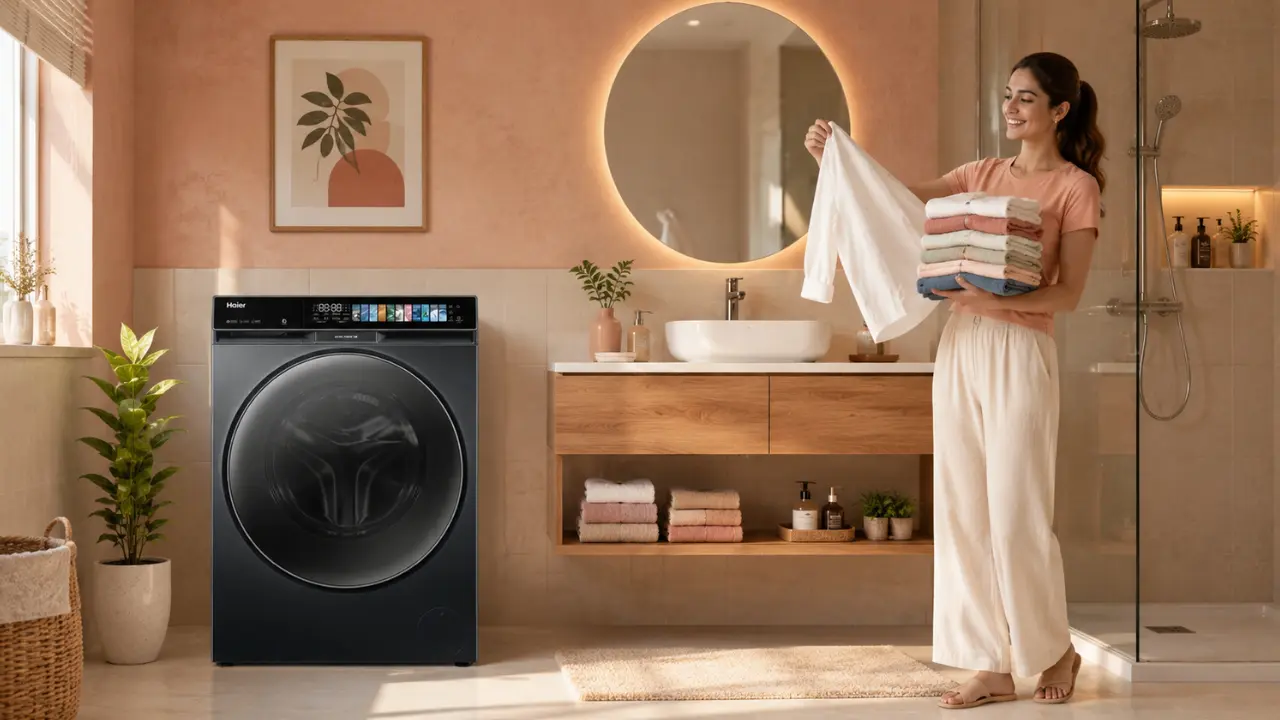

Smart laundry technology is not about washing clothes faster. It is about reducing the number of decisions your day demands from you.
Modern washing machines simplify everyday laundry through AI-powered wash cycles, fabric-sensitive cleaning, moisture control, energy optimisation, and automation that adapts to real Indian households.
The biggest shift is invisible: technology now removes friction before people even notice it. Laundry becomes quieter, cleaner, and easier to manage around real life.
A washing machine used to be a weekend appliance.
Now it behaves more like household infrastructure.
It runs between office meetings. After school drop-offs. During monsoon emergencies. Before a wedding function. After gym sessions. Late at night when electricity demand drops.
The appliance changed because Indian life changed.
And technology followed.
Laundry was never really about clothes
Most people think laundry is a cleaning problem.
It is not.
It is a time-management problem disguised as a cleaning task.
Think about a modern Indian household for a moment.
One person works hybrid. Another leaves early for office. School uniforms pile up midweek. Bedsheets wait until Sunday. Gym clothes cannot sit for long during humid weather. During festivals, guest linens suddenly matter. During the monsoon, drying becomes unpredictable.
Laundry is no longer a weekly event.
It is a continuous system.
That changes what technology needs to solve.
Older washing machines focused on mechanical power.
Modern washing machines focus on decision fatigue.
That distinction matters.
The smartest appliances remove invisible effort
Good technology does not feel dramatic.
It feels natural.
Like autocorrect. Or UPI payments. Or GPS navigation.
You stop noticing the technology because the friction disappears.
Laundry technology works the same way now.
What modern laundry systems actually simplify
- Load detection reduces guesswork
- AI wash cycles adjust water and detergent usage
- Fabric-sensitive programs reduce clothing damage
- Fresh air circulation reduces odour buildup
- Faster spin cycles improve drying during humid weather
- Smart reminders prevent forgotten laundry
- Energy-efficient motors reduce electricity usage over time
Small changes individually.
Massive changes collectively.
A household is not transformed by one giant innovation.
It changes through hundreds of tiny moments becoming easier.
That is how systems evolve.
Indian homes create different laundry problems
Most global appliance conversations ignore climate.
India cannot.
Heat changes fabric wear.
Humidity changes odour retention.
Hard water affects detergent performance.
Frequent washing increases machine usage dramatically.
A bachelor in Bengaluru has different laundry behaviour than a family in Delhi or a couple in Mumbai apartments during monsoon.
Technology that works in one environment may fail in another.
That is why modern laundry innovation increasingly focuses on adaptability instead of just raw washing power.
Three invisible pressures modern laundry technology solves
1. Moisture management
Damp washing machines create odours faster in humid regions.
That is why technologies like Fresh Air circulation matter.
Models like the Haier 12 Kg F11 Front Load Washer (HW120-DM14F11BKU1) and Haier 12 Kg F11 Front Load Washer & Dryer (HWD120-DM14F11BKU1) use airflow systems that help reduce trapped moisture inside the drum after wash cycles.
It sounds small.
Until someone forgets clothes overnight.
Then it becomes very important.
2. Time compression
People no longer “set aside time” for laundry.
Laundry must fit inside life.
One-touch controls, AI cycles, and washer-dryer combinations reduce transitions between tasks. That matters in smaller apartments where drying space is limited.
Especially during the monsoon.
Especially for working professionals.
3. Fabric preservation
Indian households wash aggressively.
Heavy cotton.
Daily uniforms.
Bedsheets.
Ethnic wear.
Sportswear.
Frequent overwashing damages fabrics faster than most people realise.
Smart wash systems now optimize movement, temperature, and cycle intensity automatically.
Because cleaning harder is not always cleaning smarter.
The washing machine became a climate-management device
That sounds exaggerated.
It is not.
Think about what laundry actually affects:
- Indoor freshness
- Humidity levels
- Fabric longevity
- Skin comfort
- Sleep quality
- Household routines
- Electricity usage
Laundry systems quietly shape how homes feel.
A fresh towel changes the morning mood.
Dry bedsheets improve sleep.
Odour-free gym clothes reduce discomfort during long workdays.
Technology influences emotional experience more than people admit.
The best appliances understand this.
Convenience is no longer laziness
Older generations often treated convenience as luxury.
Modern households treat it as resource management.
That shift changes appliance design.
A family does not want to spend cognitive energy deciding:
- Which cycle to use
- How much water is enough
- Whether fabrics need special handling
- If the machine is overloaded
- How to reduce damp smell during humid weather
Technology simplifies these decisions because modern life already consumes attention elsewhere.
Work does.
Traffic does.
Phones do.
Notifications do.
Laundry should not compete for mental bandwidth too.
What modern buyers actually value now
One option is raw capacity.
Large families prioritise bigger drums and higher load handling.
The second option is automation.
Young professionals prefer machines that reduce manual intervention.
The third option is hygiene and freshness.
Parents increasingly prioritise cleaner drum systems and fabric care.
The fourth option is integrated living.
People want appliances that fit seamlessly into home aesthetics and routines.
Different priorities.
Same underlying principle.
Reduce friction.
Why AI in laundry feels different from AI everywhere else
Most AI conversations sound abstract.
Laundry AI feels practical.
Because the feedback loop is immediate.
Clothes either smell fresh or they do not.
Fabrics either survive repeated washing or they fade early.
Electricity bills either remain stable or rise unexpectedly.
There is nowhere for bad technology to hide.
That is why appliance intelligence is becoming more subtle.
The goal is not to impress users.
The goal is to disappear into routine.
Examples of where smart laundry systems matter most
- Late-night washing after office hours
- Monsoon laundry management
- Quick refresh cycles before events
- Delicate ethnic wear cleaning
- Child clothing hygiene
- Small apartment drying limitations
- Gym and sportswear freshness
Technology succeeds when it understands context.
Not when it adds unnecessary complexity.
The real innovation is emotional
People rarely buy washing machines because they love laundry.
They buy them because they want less stress.
That is the hidden system underneath every appliance decision.
A quieter machine reduces irritation.
A faster drying cycle reduces anxiety during rainy weeks.
An AI-powered wash reduces second-guessing.
A clean-smelling drum changes how a utility area feels.
Technology is emotional long before it becomes technical.
That is why appliance design increasingly blends engineering with behavioural understanding.
The shift from “features” to “living systems”
Old appliance marketing focused on specifications:
- RPM
- Capacity
- Water usage
- Motor type
Important? Yes.
Sufficient? No.
Modern households increasingly evaluate appliances based on lifestyle integration.
Does the appliance reduce chaos?
Does it simplify routines?
Does it quietly solve recurring frustrations?
That is the real benchmark now.
And it explains why brands like Haier India increasingly focus on technologies built around everyday use patterns instead of showroom demonstrations.
Because showroom logic and household logic are different systems entirely.
Laundry technology is slowly becoming invisible infrastructure
The best household systems fade into the background.
Electricity.
WiFi.
Running water.
You only notice them when they fail.
Laundry technology is moving toward the same category.
Reliable. Quiet. Predictable.
That is the future modern homes are actually building toward.
Not smarter appliances for the sake of novelty.
Smarter homes with fewer interruptions.
A few practical shifts modern households are already making
- Washing smaller loads more frequently
- Prioritising fabric care over aggressive cleaning
- Choosing washer-dryer combinations for compact homes
- Looking for hygiene-focused features during humid seasons
- Preferring energy-efficient systems for long-term savings
- Integrating appliances into modular kitchen and utility aesthetics
These are not trends.
They are behavioural adaptations to changing urban life.
And technology follows behaviour faster than most industries realise.
The future of laundry is not more controlled. It is a better system.
People once believed good appliances required constant adjustment.
Buttons.
Knobs.
Manual choices.
Now the opposite is happening.
The best systems reduce the need for intervention entirely.
Because simplicity is not the absence of technology.
It is technology working quietly in the right place.
That may be the biggest shift modern laundry systems teach us.
A well-designed home does not ask for attention all day.
It gives attention back to the people living inside it.
And increasingly, that starts in the laundry room.
Frequently Asked Questions
Can smart washing machines decide the right wash cycle automatically?
Yes. AI-powered wash cycles can adjust water, motion, and cycle intensity based on the load, reducing daily guesswork.
Is waiting until the weekend to do laundry outdated now?
Modern laundry works better as a continuous routine, especially for Indian homes with uniforms, gym clothes, bedsheets, and monsoon laundry.
Do smart washing machines help reduce decision fatigue?
Exactly. The main benefit is not speed alone, but reducing small repeated decisions like choosing water level, detergent amount, and fabric mode.
Should I buy a bigger washing machine or a smarter one?
Large families may need capacity first, while working professionals may benefit more from automation and one-touch cycles.
Do clothes need rewashing if left overnight in the washer?
In humid weather, yes especially if clothes smell damp or musty. Fresh air circulation features can help reduce odour buildup, but they do not replace rewashing when clothes already smell.
Why does a washing machine smell more during the monsoon?
Moisture gets trapped inside the drum, creating odour. Airflow, drum drying, and keeping the door open after use can help.