
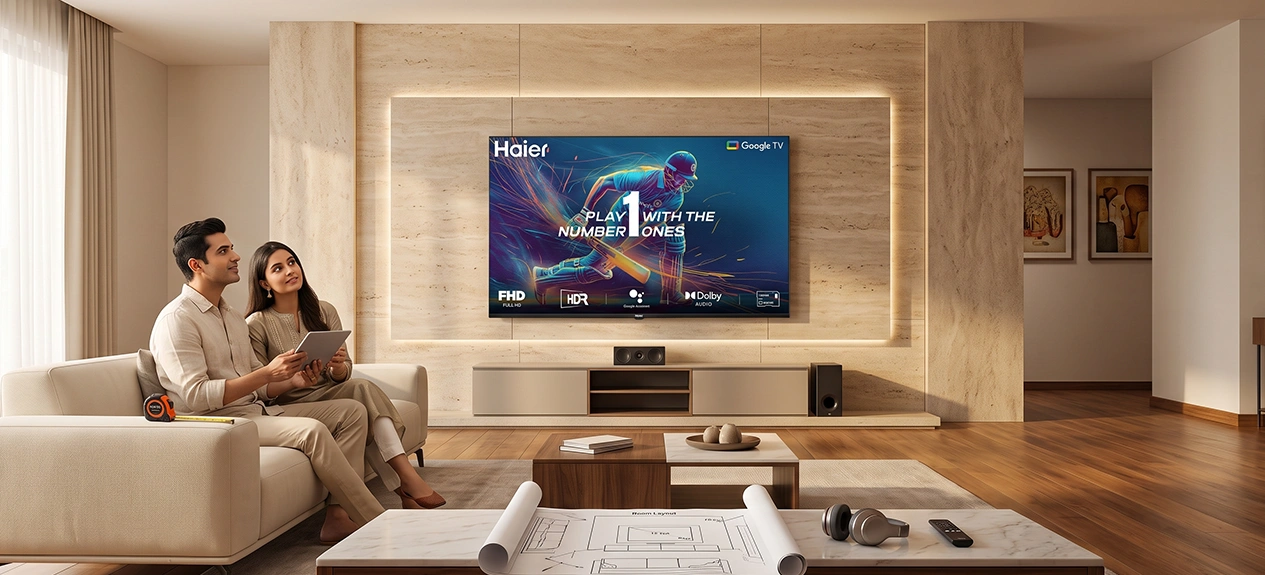

Buying a smart tv has become genuinely complicated. A few years ago, the main question was size. Now there are display technologies, resolution formats, refresh rates, and HDR standards to sort through, and each one affects the viewing experience differently.
Getting these decisions right matters because a television is not a short-term purchase. Most households keep theirs for eight to ten years. This smart tv buying guide covers the core decisions: what display types actually deliver, how to size a screen to your room, which specs are worth checking, and how Haier’s range maps to different household needs.
What Is a Smart TV?
A smart TV is a television with built-in internet access and its own operating system. It runs streaming apps like Netflix, Prime Video, and YouTube without needing any external device. Connect it to your home Wi-Fi, pair Bluetooth accessories if needed, and it can also work with voice assistants like Google Assistant or Alexa.
The practical difference from a standard television is straightforward. A regular TV only displays content from an external source. A smart TV in India handles content on its own. It has an internal processor, storage, and software, which for most households means fewer devices to manage and a cleaner setup overall. The rest of this tv buying guide covers how to choose the right one for your room and budget.
Google TV vs Android TV: What Is the Difference?
Most people assume these are the same thing. They are not.
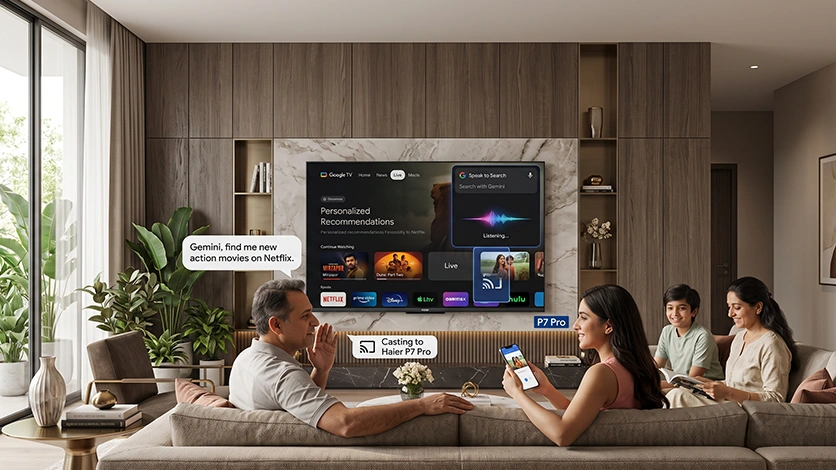
Android TV runs apps and streaming services through the Google Play Store. Google TV is built on top of Android TV but adds a unified home screen that pulls content recommendations from multiple apps, offers personalised suggestions, and delivers a more intuitive browsing experience overall. In simple terms, Android TV is the underlying platform. Google TV is a more refined version of it.
The Haier New P7 Pro Series HQLED 109 cm (43) is one example of this in practice. Running on Google TV with Gemini, it combines an intuitive interface with features like hands-free voice control and Chromecast built-in for a more connected viewing experience. Alongside AI Picture Quality, HDR10+, Dolby Vision, Dolby Atmos, and MEMC, it pairs Google’s latest smart TV platform with premium picture and sound technologies.
Display Technologies: What Each One Means in Practice
This is where most buyers lose confidence, and understandably so. The terminology is dense. But the actual differences between display types come down to a few practical factors: contrast, brightness, colour range, and how well the panel performs in your specific room.
| Display Type | How It Works | Best Suited For | Ideal For |
| OLED | Each pixel self-illuminates and switches off individually | True blacks, high contrast | Movie and OTT enthusiasts |
| Mini LED | Thousands of tiny LEDs offer precise backlighting | Bright rooms, HDR content | Viewers in well-lit rooms |
| QLED | Nano Crystals adds colour depth and brightness | Everyday viewing, natural light rooms | Family living rooms |
| 4K UHD | 3840 x 2160 resolution | Screens 43 inches and above | Detail-focused viewers |
| Full HD | 1920 x 1080 resolution | 32 to 50 inch screens | Bedrooms, secondary spaces |
| HD | 1280 x 720 resolution | Compact setups | Secondary room use |
OLED’s advantage is that pixels producing no image switch off entirely, giving you genuine blacks rather than backlit dark grey. The contrast difference is visible on any good film or series. Mini LED close the brightness gap at a lower price. QLED adds colour richness over standard LED at a more practical cost. For most Indian living rooms, 4K QLED or 4K Mini LED covers both picture quality and value well.
How to Choose the Right Screen Size
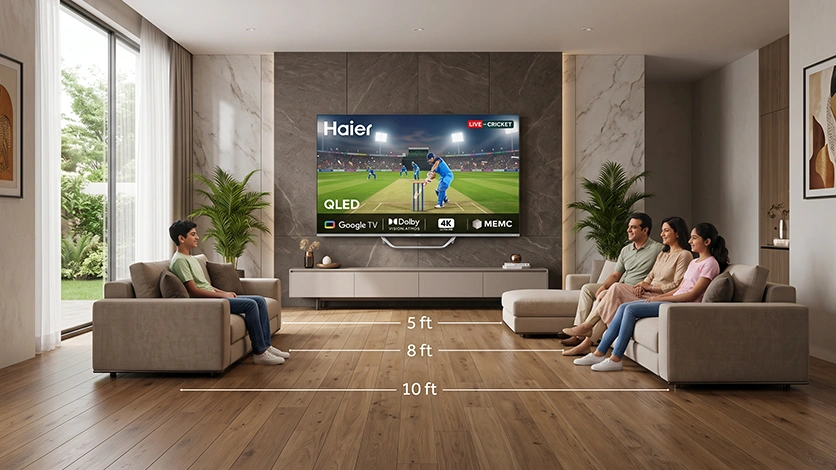
Bigger is not always better. The right screen size depends on how far you sit from it. Too large in a small room and the experience becomes uncomfortable. Too small in a large room and people seated further away lose the detail.
| Viewing Distance | Recommended Screen Size |
| Under 5 feet | 32 to 40 inches |
| 5 to 8 feet | 43 to 55 inches |
| 8 to 10 feet | 55 to 65 inches |
| 10 feet and above | 65 inches and above |
The 43-inch smart TV is one of the most popular sizes in India for a practical reason. It fits most bedroom layouts, works at typical viewing distances in smaller living rooms, and delivers clear Full HD or 4K content without needing a particularly large wall. In a shared family living room where seating spreads across different spots, 55 inches or above is a better fit.
Want to know why a bigger screen can completely transform match day?
Read this blog: How Large Screen TVs Make Every Match More Exciting
Specifications Worth Checking
No tv buying guide is complete without covering specifications. Here is what actually affects daily viewing.
Resolution: On any screen 43 inch smart TV or larger, 4K UHD is the right call. Streaming libraries on Netflix, Prime Video, and YouTube have grown substantially in 4K, and the detail improvement on a larger panel is noticeable in everyday use.
Refresh rate: 60Hz or 120Hz delivers smoother motion during cricket, football, action content, and gaming. 60Hz handles general viewing fine but shows blur on fast scenes once you have seen the difference side by side.
HDR: High Dynamic Range improves how a panel handles bright highlights and dark shadows simultaneously. Dolby Vision and HDR10+ are the two main formats. A television supporting both processes more streaming content correctly across platforms.
Gaming: For gaming, prioritise low input lag (under 20ms), a high refresh rate (120Hz or above), and HDMI 2.1 support. HDMI 2.1 enables 4K at 60fps and 1080p at 120fps, which matters for current-generation console gaming.
Connectivity. Three HDMI ports is a practical minimum for a fully connected setup. Also check the USB port count, Wi-Fi standard (Wi-Fi 5 or 6), and Bluetooth support for soundbars and other accessories.
Energy efficiency: A BEE 4-star or 5-star rated television consumes less power annually. On a television running four to six hours daily, this difference adds up noticeably over years of use. Check the annual kWh figure on the energy label rather than relying on the star count alone.
Warranty: Haier provides product warranty with after-sales support across India. Check the coverage terms for the specific model at the point of purchase.
Audio: Most mid-range panels benefit from an external soundbar for a fuller audio experience. If that is not part of the plan, check the onboard wattage output before deciding.
Which TV Is Best in India?
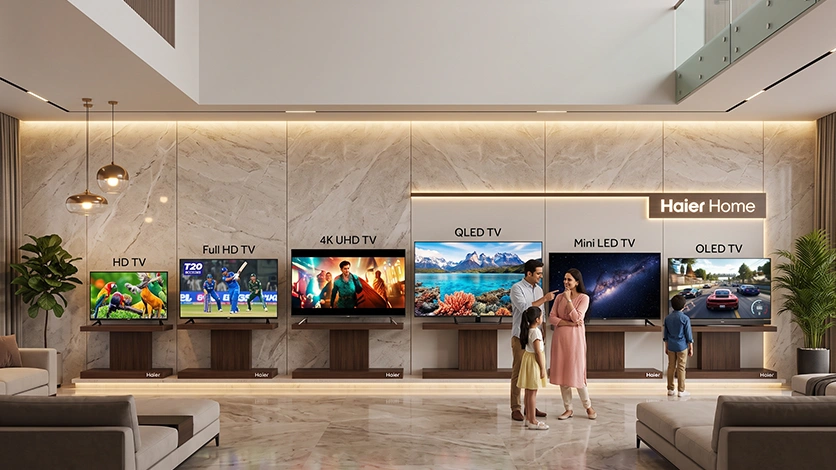
That depends on what you are weighing. Picture quality, after-sales support, range across price segments, and build quality suited to local conditions all sit in different priority orders for different buyers.
Haier has held the number one position in major appliances globally for 14 consecutive years. The India television range covers HD to OLED, built with conditions like voltage instability and high ambient temperatures factored into the engineering.
OLED is for buyers where picture quality is the primary consideration. Self-illuminating pixels, accurate colour, and contrast that backlit panels cannot replicate. Best suited for a room dedicated to viewing.
Mini LED work well in rooms with more ambient light. Precise local dimming zones give bright scenes genuine impact without losing shadow detail.
QLED is the practical living room choice, with better colour range than standard LED, strong brightness, and a price point that suits most households.
4K UHD brings native resolution to these formats and works across a growing library of streaming and broadcast content.
Full HD remains a solid option for bedrooms and secondary spaces where the screen is not the centrepiece of the room.
HD covers compact setups where size and cost are the deciding factors.
Across the range, Haier TVs include voice assistant support, multiple HDMI inputs, and direct streaming app access built in, without requiring additional devices.
Want to see how Haier compares with other brands in the large-screen TV segment?
Read this blog: Haier vs Competitors in Large Screen Category
Two Common Questions
How do you convert a normal TV into a smart TV?
Plug a streaming device into the HDMI port. Amazon Fire Stick, Google Chromecast, and Mi Box are widely available in India and add app access and voice control to most standard televisions with a free HDMI input.
How do you connect a phone to a smart TV?
Most smart TVs support wireless mirroring via Google Cast, AirPlay, or Miracast. For a stable wired option, an HDMI adapter cable from the phone to the TV’s HDMI input handles video content and presentations without connectivity issues.
Conclusion
A television purchase is not something most households revisit for nearly a decade. The display type you choose today shapes how content looks every evening for years. The screen size either fits the room or it does not, and that does not change. Getting the core decisions right before buying removes years of small daily frustrations.
Haier’s range across HD, Full HD, QLED, Mini LED, and OLED gives buyers an option at every level, built for Indian viewing conditions, backed by after-sales support, and available through Google TV on select models for a more connected viewing experience. Whether the priority is picture quality, gaming performance, energy efficiency, or value at a given budget, there is a model in the lineup built for it. Save this tv buying guide and refer back to it before making your final call.
Browse Haier TVs on the HaiSmart App
The HaiSmart app transforms your Haier Smart TV into the hub of your connected home. Beyond controlling your TV, it lets you manage compatible Haier appliances, including air conditioners, refrigerators, and robot vacuums, all from a single app. As you add more smart devices to your home over time, HaiSmart keeps everything connected through one seamless ecosystem, ensuring your TV remains at the centre of your smart home experience rather than functioning as a standalone screen.
Download HaiSmart:
iOS – Search HaiSmart on the App Store
Android – Search HaiSmart on Google Play
FAQs
What is a smart TV and how does it work?
A smart TV has built-in Wi-Fi and an operating system that lets it run streaming apps, connect to voice assistants, and access online content without any external device.
Which TV brand is best in India?
For range across display technologies, build quality suited to Indian conditions, and after-sales support, Haier is a strong option. The lineup covers HD to OLED with warranty terms that reflect long-term product confidence.
What size smart TV should I buy for my room?
Base the decision on your viewing distance. At 5 to 8 feet, a 43 to 55-inch screen is the right fit. At 10 feet or more, 65 inches and above is appropriate.
How do you convert a normal TV into a smart TV?
Connect a streaming stick or media box such as Amazon Fire Stick or Google Chromecast to an available HDMI port.
How do you connect a mobile phone to a smart TV?
Use Google Cast, AirPlay, or Miracast for wireless mirroring, or connect via an HDMI adapter cable for a direct wired connection.