
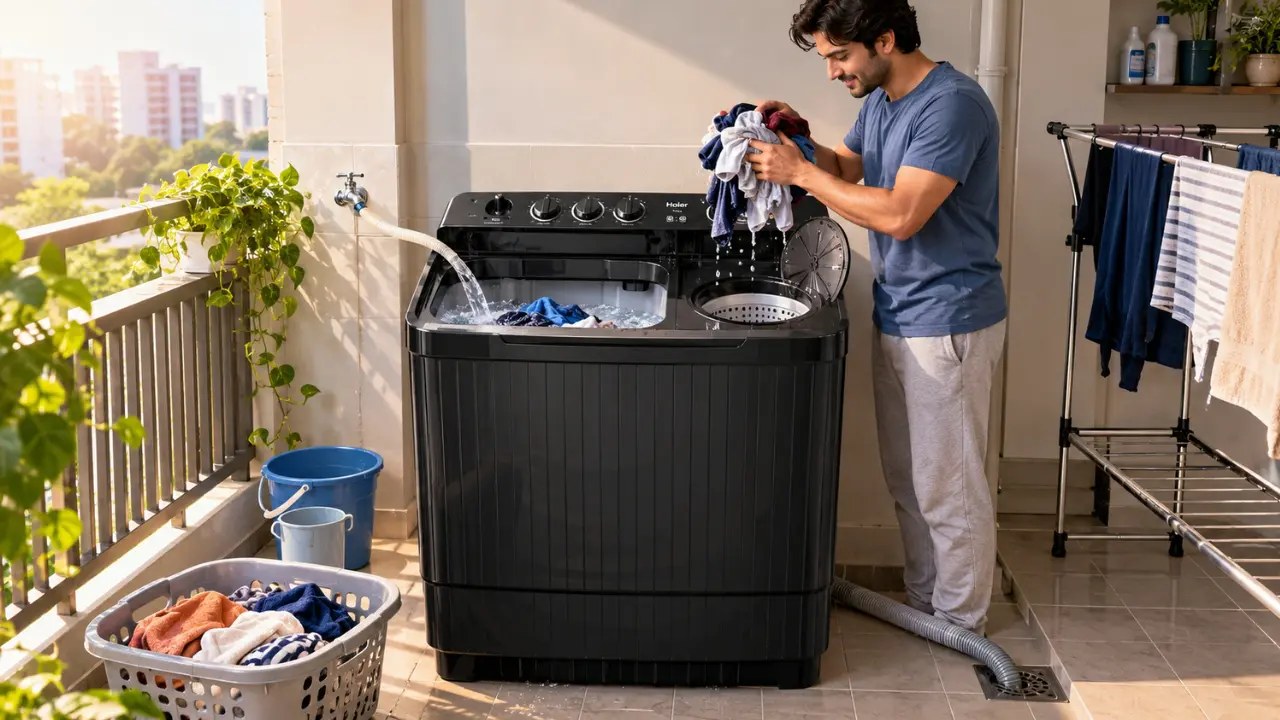

There is one small but important difference between a semi-automatic washing machine and a fully automatic one: you stay involved in the wash.
You decide how much water goes in, select the wash setting, drain the used water and move the clothes from the wash tub to the spin tub. That may sound like extra work, but it also gives you something many households value greater hands-on control over each load.
If you have just bought one, the controls can look slightly confusing at first. They aren’t. Once you understand the wash drain rinse spin sequence, using a semi-automatic washing machine becomes fairly straightforward.
Here is how to do it properly.
What Is a Semi-Automatic Washing Machine?
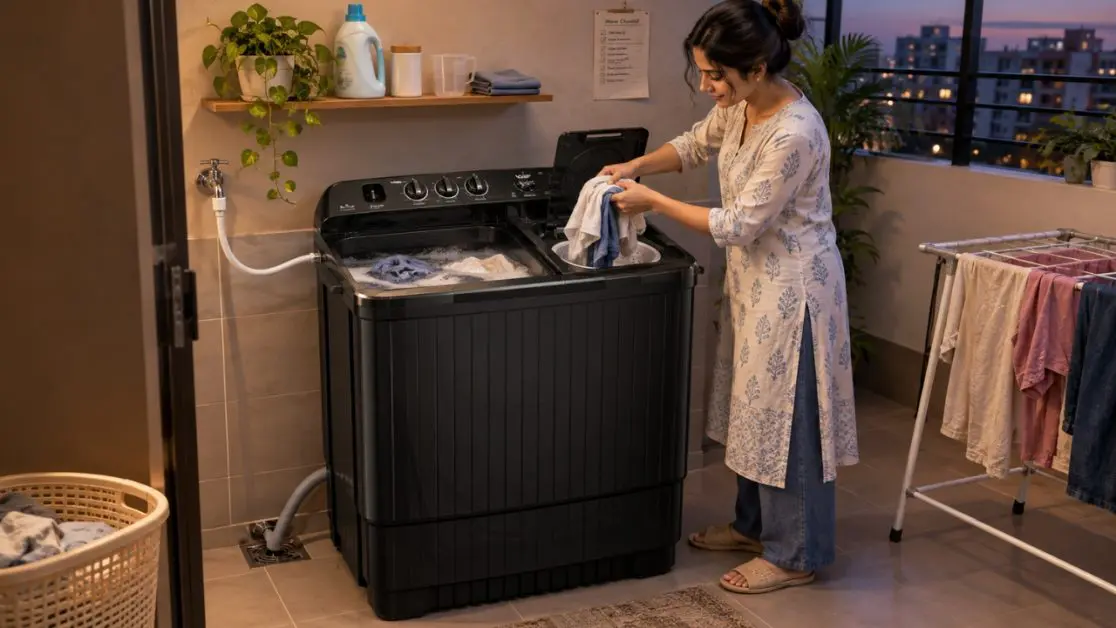
A semi-automatic washing machine is a washing machine that requires some manual intervention during the laundry cycle. Twin-tub models typically have a larger tub for washing and rinsing and a separate tub for spinning.
Unlike a fully automatic machine, it does not independently take the laundry through every stage from washing to final spinning. Depending on the model and your setup, you manage tasks such as water filling, draining and transferring the clothes.
This arrangement can be useful when you want more direct control over:
- The amount of water used
- Washing and soaking time
- When the water is drained
- How many times clothes are rinsed
- Which garments go through another wash or rinse
- When clothes are transferred for spinning
The exact controls and operation can vary between models, so the appliance’s user instructions should always take priority.
Before You Start: Sort the Laundry First
Good washing starts before you touch the machine controls.
Empty pockets and remove anything that should not enter the tub, coins, tissues, keys and those mysterious bits of paper that somehow survive in trouser pockets until laundry day.
Then separate clothes where appropriate.
A sensible sorting routine includes:
- Whites and light colours
- Dark or colour-sensitive clothes
- Delicate garments
- Heavily soiled clothes
- Towels and heavier fabrics
Check garment care labels as well. Not every fabric should receive the same treatment.
Most importantly, do not overload the wash tub. Washing capacity is a maximum rated load, not a target that needs to be reached every time. Clothes need enough room to move during washing.
How to Use a Semi-Automatic Washing Machine in 7 Steps
The simplest way to remember the process is:
- Fill
- Wash
- Drain
- Rinse
- Transfer
- Spin
- Dry
Now, the details.
Step 1: Position the Machine and Connect the Water Supply
Place the washing machine on a stable, level surface with suitable access to water and drainage.
Connect the inlet hose as directed for your particular machine. Position the drain hose correctly before beginning the cycle, and keep the electrical connection safely away from standing or splashing water.
If you regularly move the machine between storage and washing areas, mobility matters. Selected Haier semi-automatic washing machines include built-in castor wheels to make repositioning easier.
Step 2: Add Water, Detergent and Laundry
Fill the wash tub according to the load and the instructions for your machine. Avoid the instinct to use more detergent simply because the clothes look particularly dirty. Too much detergent can mean more foam and more rinsing later.
Add the recommended amount of detergent and place the sorted laundry into the wash tub.
If clothes are heavily soiled, soaking may help where the machine and fabric-care instructions permit it.
Step 3: Choose the Appropriate Wash Setting
Set the wash programme and timer according to the laundry being cleaned.
A light everyday load will not necessarily need the same treatment as bedsheets, towels or heavily soiled clothes. Longer and stronger washing is not automatically better; excessive agitation can be unnecessary for lightly soiled or delicate fabrics.
This is where knowing your particular machine pays off. Check the control panel and product instructions rather than assuming every semi-automatic model uses identical settings.
Step 4: Drain the Dirty Water
Once washing finishes, select or operate the drain function according to the machine instructions.
Make sure the drain hose is correctly positioned so that wastewater can flow into an appropriate outlet without spilling onto the floor.
Wait until the wash tub has drained adequately before proceeding.
Simple step. Easy to rush.
Don’t.
Step 5: Rinse the Clothes Properly
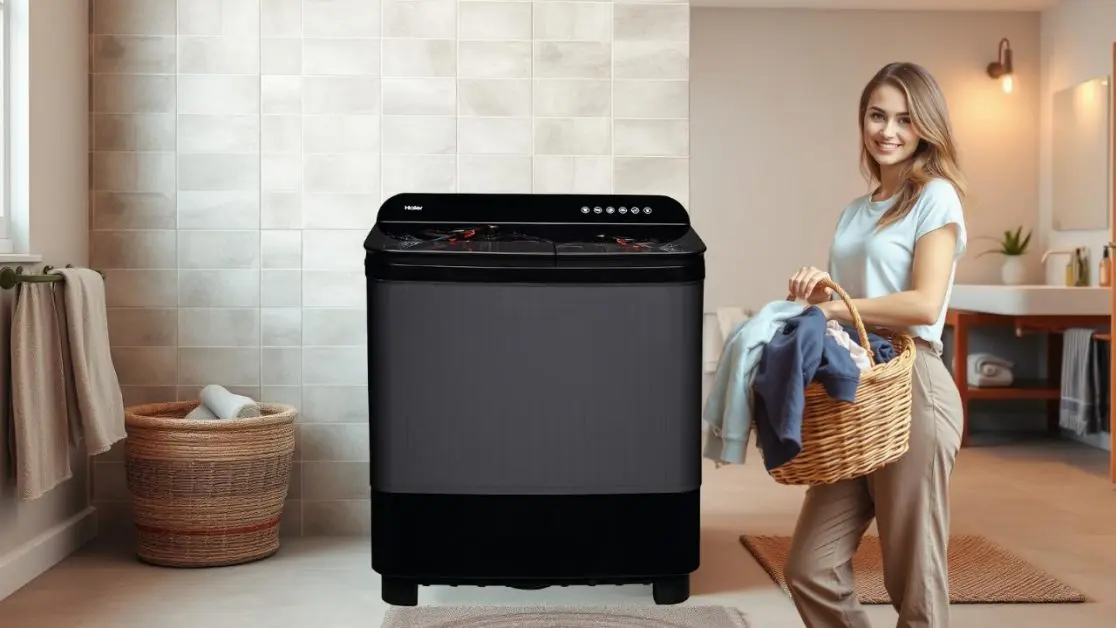
Fresh water is then used to rinse detergent and loosened dirt from the clothes.
Depending on the laundry and detergent quantity, more than one rinse may be appropriate. The objective is straightforward: remove remaining detergent without wasting water unnecessarily.
Some Haier semi-automatic models feature a Spray system designed to support thorough rinsing and help remove detergent residue from clothes and the inner tub. Their Magic Filter is designed to capture lint, threads and other debris during washing, which can be particularly useful with mixed household laundry.
Step 6: Move the Clothes to the Spin Tub
Now comes the part that makes a twin-tub semi-automatic machine unmistakably semi-automatic.
Transfer the rinsed clothes from the wash tub into the spin tub by hand.
Spread the garments as evenly as possible rather than pushing one heavy bundle to one side. An uneven load can make the machine vibrate excessively during spinning.
Also remember that wash capacity and spin capacity may be different. For example, Haier’s 12 kg HTW120-196BK has a 12 kg washing capacity but a 9 kg spin capacity, while its 10 kg HTW100-196BK has a 6 kg spin capacity. So a full wash load may sometimes need to be spun in batches.
Step 7: Spin and Remove the Laundry
Close the spin-tub lid correctly and set the spin timer according to the load and machine instructions.
Spinning extracts much of the retained water, so clothes should come out considerably less wet than they were after rinsing. They can then be transferred to your regular drying area.
Selected Haier semi-automatic models use Oxyi Dry, an advanced spin technology designed to reduce moisture content and support quicker subsequent drying. The 9 kg, 10 kg, 11 kg and 12 kg models for this guide list spin speeds of 1300 RPM.
A Few Habits That Make Semi-Automatic Washing Easier
You don’t need a complicated laundry system. A few habits make a bigger difference.
- Avoid stuffing the tub. Movement inside the wash tub is part of the cleaning process.
- Balance the spin load. If the machine starts shaking unusually, stop it and redistribute the clothes.
- Use detergent sensibly. More foam does not necessarily mean cleaner clothes.
- Check pockets every time. Coins and other objects have no business being inside a wash tub.
- Clean the lint filter regularly. A filter can only collect debris effectively when it is maintained.
- Leave the tubs to dry after use. Once washing is finished and it is safe to do so, avoid leaving residual water sitting unnecessarily inside the appliance.
- Follow garment labels. Delicates, embellished clothing and special fabrics may require different care.
Where Haier’s Semi-Automatic Range Fits In

For households considering this format, Haier India offers semi-automatic twin-tub models across multiple capacities, including 9 kg, 10 kg, 11 kg and 12 kg options in the products for this guide.
Capacity is only one part of the story, though.
The Haier models featured here bring together practical laundry features such as Magic Filter, Spray, Oxyi Dry, castor wheels and Anti Rat Mesh. The 10 kg and 12 kg 196BK models also specify a Thunder Pulsator, engineered to generate strong multi-directional water flow for effective cleaning.
The Anti Rat Mesh is a particularly practical detail for Indian homes: it provides a protective mesh at the machine base to help prevent rats and other pests from entering and damaging internal components.
Haier’s 9 kg and 11 kg 178FLN variants add a toughened-glass lid, while their product presentation also highlights the Vortex Pulsator. The 9 kg model, for example, offers a 9 kg washing capacity and 6 kg spinning capacity.
In other words, choosing between them should not simply come down to buying the largest number on the label. Think about your usual laundry volume, the space available for the appliance and, importantly, the separate spin capacity.
Is a Semi-Automatic Washing Machine Worth It?
It can be if its way of working suits your household.
A semi-automatic machine makes sense for someone comfortable managing water, transferring clothes between tubs and staying somewhat involved in the washing process. That manual involvement gives you direct control over washing, rinsing and spinning.
On the other hand, if your priority is putting clothes into a machine and returning when the entire cycle has finished, a fully automatic washing machine is likely to suit that expectation better.
Neither format is universally the right answer. The better choice is the one that matches how you actually do laundry.
For households that prefer the twin-tub approach, Haier’s semi-automatic range offers several capacity choices with features designed around cleaning, lint management, rinsing, mobility and moisture removal.
Frequently Asked Questions
1. How to use a semi-automatic washing machine?
Fill the wash tub with the required water, add detergent and clothes, choose the appropriate wash setting, drain the dirty water and rinse the clothes. Then transfer the laundry to the separate spin tub, distribute it evenly and run the spin cycle according to the machine instructions.
2. What is a semi-automatic washing machine?
It is a washing machine that automates washing and spinning functions but still requires manual involvement at certain stages. In a twin-tub machine, you normally transfer clothes from the wash tub to the spin tub yourself.
3. Do I need to rinse clothes before putting them in the spin tub?
The normal sequence is to wash and rinse the laundry before the final spin. Follow your machine’s instructions for the precise rinse and spin procedure.
4. Why does a semi-automatic washing machine shake during spinning?
An unbalanced load is one possible reason. Stop the machine safely and redistribute the clothes evenly inside the spin tub. Overloading can also create problems, so stay within the specified spin capacity.
5. Can the entire wash load go into the spin tub at once?
Not necessarily. Wash capacity and spin capacity can differ. Haier’s 11 kg HTW110-178FLN, for instance, specifies an 11 kg washing capacity and a 6 kg spin capacity. Check the specification of your individual model and split the load when required.
6. How do I choose the right Haier semi-automatic washing machine?
Start with the amount of laundry your household typically generates rather than capacity alone. Compare washing capacity, spin capacity, dimensions and model-specific features. Haier’s range includes 9 kg, 10 kg, 11 kg and 12 kg semi-automatic options, allowing households to choose a configuration that better matches their regular laundry needs.