
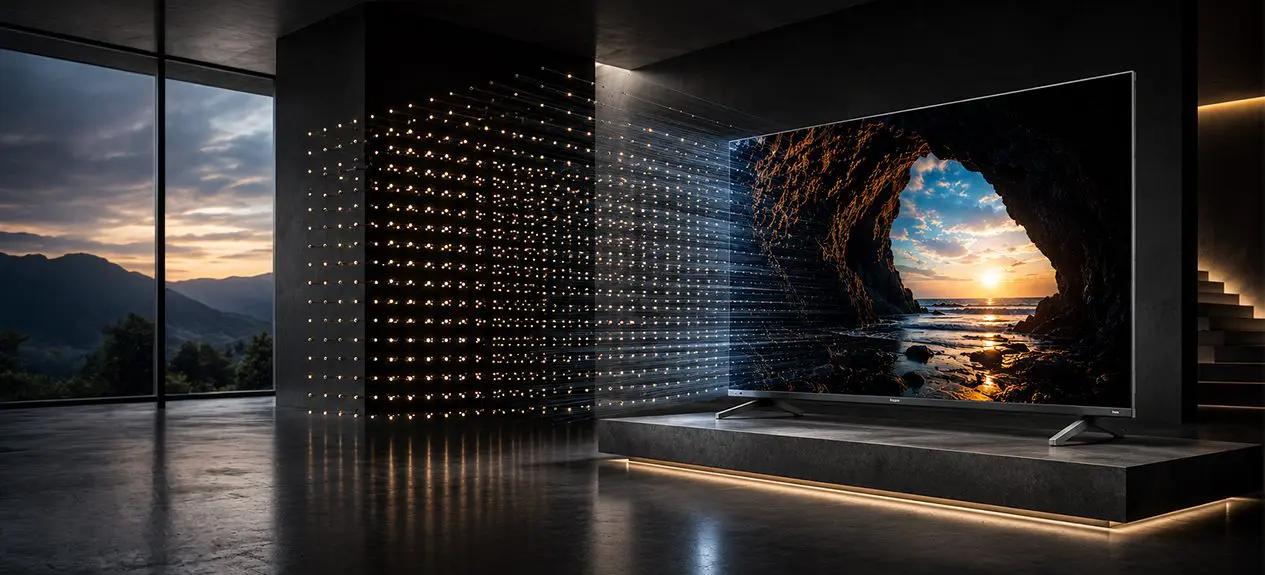

A mini LED TV looks similar to any other television on the shelf, but what sits behind the screen is genuinely different. This guide explains what is mini LED TV technology in simple terms, how it actually works, how it compares to OLED and QLED, and what to expect in terms of lifespan and screen sizes before buying one.
How Mini LED Technology Actually Works
A mini LED TV uses thousands of tiny LED lights behind the screen instead of a handful of larger ones. Each of these lights is roughly the size of a grain of rice, small enough that a single TV can pack in thousands of them, compared to just a few hundred in a standard LED panel.
Think of a regular LED TV’s backlight like one large room light, it lights the whole space evenly, whether one corner needs to be dark or not. Mini LED replaces that single light with thousands of small, individually controlled ones, more like a room full of dimmable spotlights, each one grouped into a local dimming zone that adjusts its brightness on its own.
Here is what that actually means on screen:
- Dark areas dim down for deeper black levels, while bright areas stay lit for sharp highlights, both at the same time on the same screen
- This happens in real time, scene by scene, without the viewer noticing the adjustment
- More dimming zones generally means more precise control, and fewer visible “halos” of light bleeding around bright objects on a dark background
Mini LED vs OLED: The Key Differences
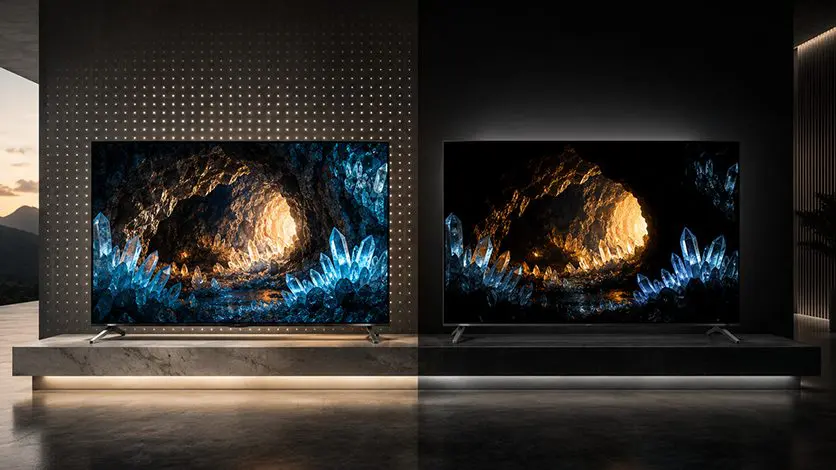
Mini LED vs OLED comparisons usually come down to the same core question: deep blacks and strong contrast, achieved in different ways.
| Specifications | Mini LED | OLED |
| How it works | Thousands of small LEDs behind an LCD panel, grouped in dimming zones | Each pixel lights up individually, no separate backlight |
| Black levels | Very good, though a slight halo can appear around bright objects | True black, since pixels switch off completely |
| Peak brightness | Higher, better suited to bright rooms | Lower, better suited to darker rooms |
| Burn-in risk | None | Low, but a longstanding OLED consideration with static images |
Neither is universally better, brighter rooms tend to favour Mini LED, while consistently dark viewing environments often suit OLED.
For a deeper side-by-side on this, including energy use and gaming performance:
Read this blog: Mini LED vs OLED vs QLED: Which TV is Best for You?
Mini LED vs QLED: Where They Actually Differ
QLED and Mini LED often get grouped together, but they solve different parts of the picture. QLED is about colour, a quantum dot layer that widens the colour range. Mini LED is about backlighting, more precise control over brightness and contrast. Many modern TVs, including several of ours, actually combine both technologies in the same panel, using Mini LED backlighting with a QLED colour layer on top.
How Long Do Mini LED TVs Last?
LED backlights, including Mini LED, are generally rated for tens of thousands of hours of use before any noticeable dimming occurs, commonly cited in the range of 30,000 to 60,000 hours depending on usage and settings. At an average of 4 to 5 hours of daily viewing, that translates to well over a decade of regular use. Since Mini LED has no organic pixel material like OLED, it also carries no burn-in risk from static images left on screen for long periods.
What Sizes Do Mini LED TVs Come In?
Mini LED technology isn’t limited to one screen size. Across our range, it spans:
- 43″ and 55″ for bedrooms and smaller living rooms
- 65″ and 75″ for mid-size to larger living rooms
- 85″ and 100″ for dedicated home theatre setups
This range means Mini LED isn’t only a flagship, large-screen technology, it’s increasingly available at more accessible sizes too.
Two of Our Best Mini LED TVs in India
Choosing the best Mini LED TV really comes down to the room and the budget, but here are two standouts from our best mini LED TV picks:
- Haier M80F Mini LED 189cm(75″) Google TV | Sound By KEF: a strong mid-to-large size pick, with a 94% DCI-P3 colour gamut and 360 local dimming zones for genuinely deep contrast
- Haier M96 Series 254cm(100″) QD-Mini LED AI Smart Google TV: our flagship pick, built for dedicated home theatre spaces with 2200 nits peak brightness and 144Hz refresh rate
For gamers specifically weighing the best mini led tv for competitive play:
Read this blog: Why Mini LED TVs Are a Game Changer for Gamers
Conclusion
Mini LED works by replacing a single backlight with thousands of individually controlled ones, giving the screen far more precise control over brightness and contrast than a standard LED panel. It holds up well over long-term use and is now available across a wide range of screen sizes, not just flagship models. Whether Mini LED, OLED, or QLED ends up being the right fit really comes down to the room it’s watched in and how bright that room usually is.
FAQs
Is mini LED better than OLED?
Not universally, Mini LED offers higher peak brightness, better suited to bright rooms, while OLED offers true blacks, better suited to darker viewing environments.
Is mini LED better than QLED?
They solve different problems, Mini LED improves backlighting and contrast, while QLED improves colour range. Many TVs, including several of ours, combine both.
How long do mini LED TVs last?
Mini LED backlights are typically rated for 30,000 to 60,000 hours, translating to well over a decade of regular daily use, with no burn-in risk.
What sizes do mini LED TVs come in?
Mini LED spans a wide range, from 43-inch models for bedrooms up to 100-inch flagship screens for home theatre setups.
Which is the best mini LED TV in India?
It depends on room size and budget, but our M80F and M96 Series are strong picks across mid-size and flagship price points respectively.