
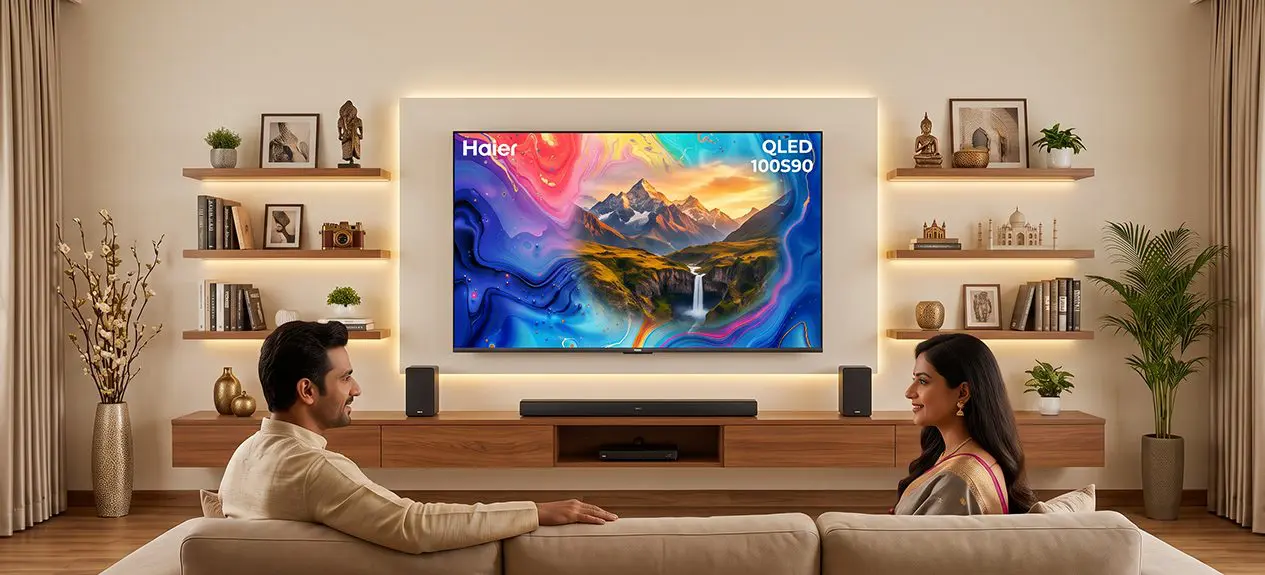

Walk into any showroom and the biggest screen usually looks the most impressive. what looks impressive on a showroom wall isn’t always the right choice for your home. . This TV size guide breaks down how to actually measure a TV, how size interacts with viewing distance, and whether a bigger screen is genuinely the better choice or just the more expensive one. At Haier, we build across nearly every size point on this spectrum, so this guide focuses on getting the decision right first, not just steering toward the biggest option available.
How to Measure a TV’s Screen Size
Before comparing sizes, it helps to know what that size number actually means. Here is how to measure a TV correctly:
- TV size is always measured diagonally, from one corner of the screen to the opposite corner
- The measurement covers only the visible picture, not the bezel or frame around it
- A “55-inch TV” means a 55-inch diagonal screen, not 55 inches of width
- To measure an existing TV, use a tape measure from the bottom-left corner of the visible screen to the top-right corner, or vice versa
- If measuring the space where a TV will go instead, measure the available wall or unit width first, then work backwards to figure out the largest diagonal size that comfortably fits
Knowing how to measure TV size properly matters most when replacing an existing TV or checking that a new one will actually fit an entertainment unit, since two TVs from different brands at the “same” size can have slightly different bezel widths and overall dimensions.
TV Size Chart: What Actually Fits Which Room
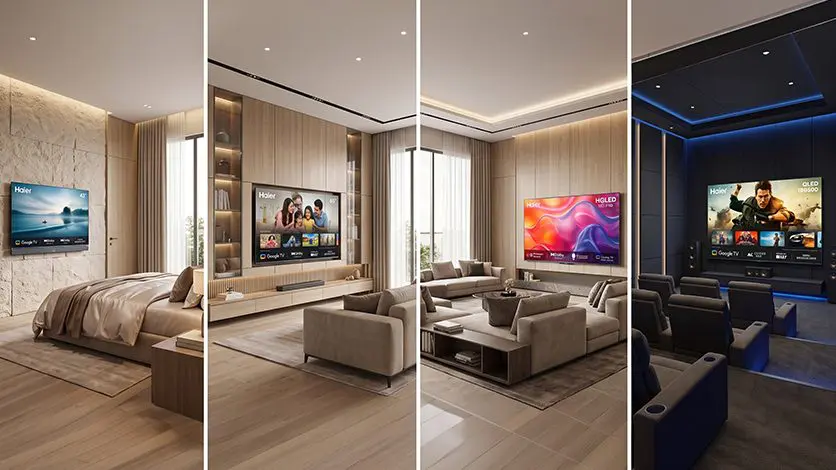
Room type is the first practical filter before viewing distance even comes into the picture. Here is a TV size chart based on common Indian room types:
| Room Type | Typical Size Range | Example |
| Bedroom | 40″ to 55″ | Haier A9UG 4K Ultra HD 108cm(43″) Google TV | MEMC, Haier New P7 Pro Series HQLED |
| Mid-size living room | 55″ to 65″ | Haier K85 4K Ultra HD 164cm(65″) Google TV | Google Assistant |
| Large living room | 75″ to 85″ | Haier M80F Mini LED 189cm(75″) Google TV | Sound By KEF |
| Dedicated home theatre | 85″ and above | Haier S90 QLED 254cm(100″) Google TV, Haier M96 Series 254cm(100″) QD-Mini LED AI Smart Google TV |
This range spans nearly the full size spectrum, so the right choice usually comes down to two things: how far the seating is from the wall, and how the room gets used day to day. Keeping a TV size chart like this on hand makes it far easier to shortlist sizes before even stepping into a showroom.
TV Size and Viewing Distance: The Real Calculation
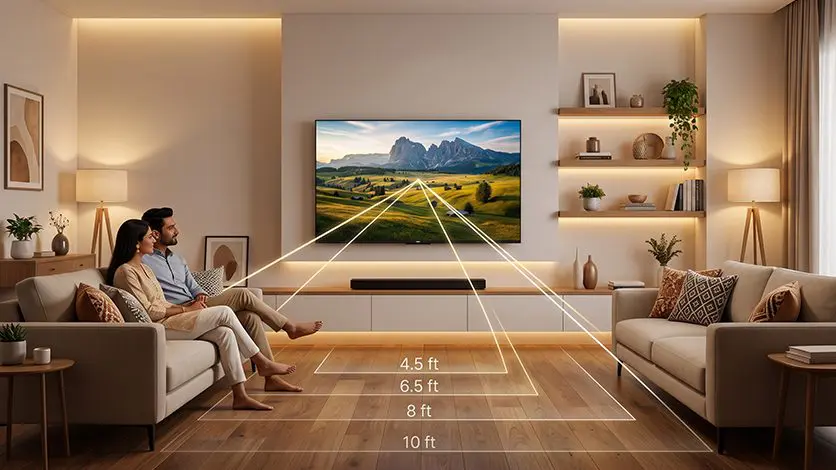
Room type gives a starting point, but viewing distance is what actually confirms whether a size works. Use this as a straightforward TV size calculator:
| Screen Size | Comfortable Viewing Distance (4K) |
| 43 inches | 4.5 to 6.5 feet |
| 55 inches | 5.5 to 8 feet |
| 65 inches | 6.5 to 9.5 feet |
| 75 inches | 7.5 to 11 feet |
| 85 inches | 8.5 to 12.5 feet |
| 100 inches | 10 to 15 feet |
The real test for TV size viewing distance is whether the whole screen fills your field of view naturally without forcing your eyes to dart around, or your head to move to catch what’s happening at the edges. Get the distance wrong in either direction, and even a well-specced panel stops delivering the experience it’s actually capable of.
Is a Bigger TV Always Better? The Honest Answer
Not always, and it is worth saying that plainly rather than defaulting to “bigger is better” as a rule. A few real downsides of sizing up without checking the fundamentals first:
- Lower-resolution content looks worse on a bigger screen, since the same pixel count gets stretched across more physical space.
- Incorrect mounting height on a large screen causes neck strain, especially when a big TV gets placed too high just to make room for furniture underneath.
- Price-per-inch has diminishing returns at the top end, where the jump from 75″ to 100″ often costs disproportionately more than the jump from 55″ to 75″.
- A screen too large for the room can feel overwhelming rather than immersive, particularly in smaller living rooms where seating cannot move back far enough.
None of this means larger TVs are a poor choice, a well-matched 85-inch or 100-inch screen in a genuinely large room delivers a real step up in immersion. The honest answer is that “bigger” only becomes “better” once distance, resolution, and room size are actually accounted for, not before.
Bedroom vs Living Room: Different Rules Apply
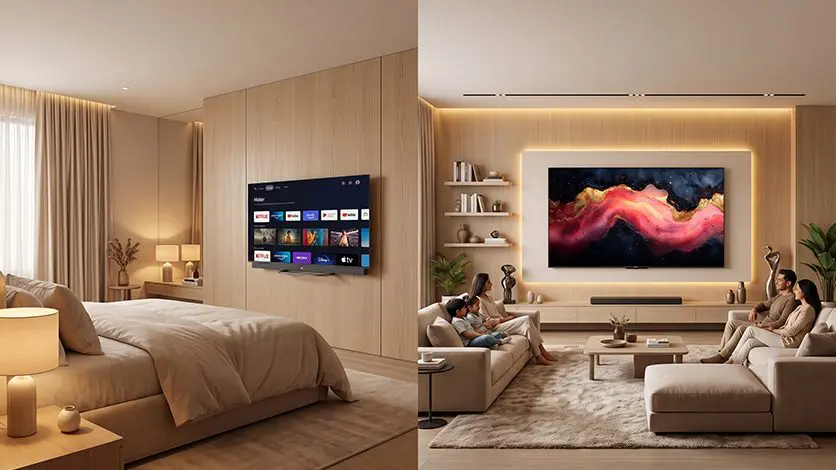
A bedroom and a living room are rarely furnished with the same intent, and TV size should follow that logic rather than a single fixed number:
- Bedrooms typically involve closer, more casual viewing, often from a bed rather than a fixed seating distance, which keeps the comfortable size range noticeably smaller than a living room
- Living rooms usually have fixed seating at a set distance, multiple viewers spread across a wider angle, and higher expectations for shared, sports, or movie-night viewing, which naturally pushes the ideal size upward
- A screen sized right for a living room can feel like too much in a bedroom, not because the room is smaller, but because a bed usually sits much closer to the wall than a living room sofa ever would
Curious how screen size expectations have shifted over the years, from compact bedroom sets to today’s cinematic living rooms?
Read this blog: Evolution of TV Sizes Over the Years: From Compact Screens to Cinematic Living Rooms
Conclusion
A bigger screen is not automatically the better choice, it earns that label only once the room and the viewer’s habits genuinely call for it. Measuring the space correctly, checking viewing distance honestly, and matching the room’s actual use, rather than its aspirational size, is what separates a TV that feels immersive from one that just feels oversized. Whichever size ends up being right, our range spans HD through flagship QLED and Mini LED, so getting that size correct never means settling for a lesser panel to reach it. This TV size guide should make that decision considerably easier the next time a showroom floor tempts toward the biggest screen in the room.
FAQs
What size TV do I need for my room?
It depends on both room type and viewing distance. As a general guide, bedrooms suit 40″ to 55″ screens, mid-size living rooms suit 55″ to 65″, and larger living rooms or dedicated theatre spaces suit 75″ and above.
What size TV is best for a bedroom vs. a living room?
Bedrooms generally work best with 40″ to 55″ screens given closer viewing distances, while living rooms can comfortably support 55″ to 85″ or larger, depending on room size and seating distance.
How far should I sit from my TV?
For 4K screens, sit roughly 1 to 1.5 times the screen size in inches, converted to feet. A 65-inch screen suits a viewing distance of around 6.5 to 9.5 feet.
How do I measure a TV’s size?
Measure diagonally from one corner of the visible screen to the opposite corner, excluding the bezel. This diagonal measurement is what the size number, like “55-inch,” actually refers to.