
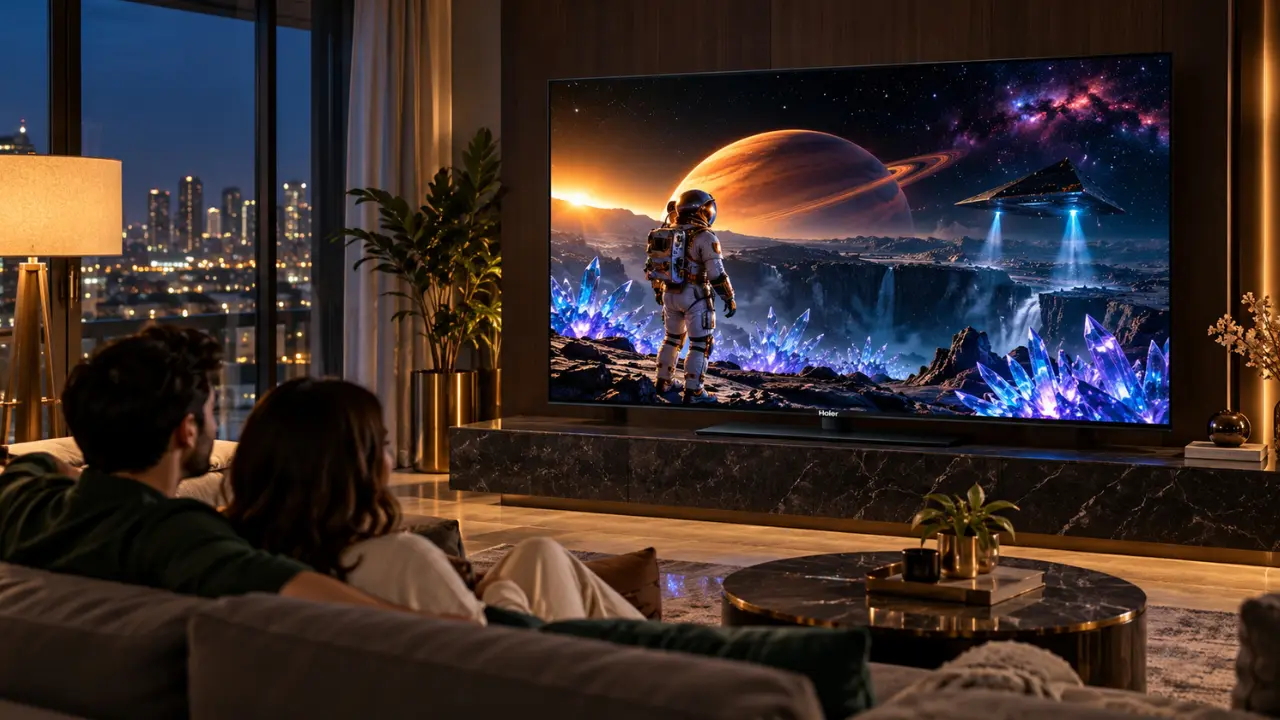

Imagine a situation from your favourite thriller. The room is in darkness, with a small lamp radiating light next to the window. The light can be seen, the shadows around it, and you can even see very faint details of the furnishings. No washed out looks here!
The performance of OLED technology is meant to produce that sort of image.
Unlike standard LED TVs, an OLED screen has some distinct advantages for Indian homes looking for an upscale TV set. Rather than having to have a separate backlight, it has millions of self-lit pixels that emit light.
The result? Films, sports and daily entertainment can become more interesting and engaging, due to the deep blacks, impressive contrast and visuals that films can give.
What is really going on inside the computer? And is the use of OLED worth considering over LED or QLED? Before we delve into how Haier’s OLED televisions have made the technology a reality in Indian living rooms, let’s get to know the technology first.
So what is an OLED TV? How does it work?
The OLED is an Organic Light-Emitting Diode. It’s a display that emits light as a result of an electric current flowing through an organic light source.
An OLED television doesn’t need an extra backlight to light up the picture like traditional LED TVs.
All pixels can individually become brighter, fade or turn off.
Imagine the night sky with stars. In an OLED display, the pixels that make up the stars are also able to turn on, but the areas of darkness can turn off completely.
Contrast is the attribute of OLED that is provided by this independent control.
What is the Difference between Self Lit Pixels?
The 4K OLED TV comes with a resolution of 3840 × 2160 and has around 8.3 million pixels. These pixels combine into images, and are what you see.
Independent pixel illumination is put to practice, as follows:
- Individual pixel light: These are the individual pixels that are controlled by the light themselves instead of the backlight shared by them.
- True blacks: Pixels can all be turned off when displaying black.
- Accurate contrast: The high and low picture elements can be side by side without the limitations of the backlight of a traditional LED TV.
- Fast pixel response: OLED pixels can change quickly, which helps to minimize the smearing that can be caused by motion.
- Good wide viewing angles: Clarity in the pictures is maintained throughout a wide range of viewing angles.
The differences are more apparent when you watch high quality movies, documentaries and HDR content.
Why is the OLED Picture Quality so different?
Attractive colours are not the only benefit of using OLED displays. It’s all about how they handle light.
1.Purchasing Black Looks Black, Not Dark Grey
Conventional LED TVs use a backlight to light up the LCD display. Although there are advanced dimming systems, it is possible that there will still be light visible in darker spaces.
OLED works differently.
If a pixel must be “black”, it is turned off.
In a suspense film, for instance, this effect can make things look deeper in the dark areas while it keeps them bright and well-defined in the lighted ones.
2. Colours Have More Visual Depth
There are multiple factors that influence the accuracy of colours, such as panel calibration and content quality. OLED on the other hand can produce a more contrasty image of coloured objects when displayed against dark backgrounds at the level of each individual pixel.
Suppose you were watching a nature program with a bright coloured bird in the sun and a shadowed forest behind it.Suppose you were seeing a nature show with a bright coloured bird in the sun and a shadowed forest behind it.
A subject in isolation from its context can be especially dramatic on an OLED screen.
3. Every Person Sees an improved Viewing Angle
It is hard to find all the occupants of the living room sitting right in front of the TV.
There is a person sitting on the middle sofa. A person is observing from the dining area. A handful of relatives take their places in corner seats.
In general, OLED screens are more colour and contrast accurate at wider angles than many LCD screens.
This is particularly good for family viewing.
What is the better Display technology between OLED, LED or QLED?
The three technologies are frequently mentioned at the same time but they function differently.
LED TVs
The majority of LED TVs feature a backlit LCD panel.
They come in a wide range of prices and can provide high levels of brightness, which can be useful in many common viewing situations.
QLED TVs
Most QLED TVs are based on a LCD display with LED backlights and quantum-dot technology.
The range of colours produced is due to the use of quantum dots, whereas the contrast is determined by the backlight and dimming system.
OLED TVs
OLED televisions do not require a backlight.
They have the greatest advantage in the precise control of dark and bright picture elements.
So which one to select?
If you’re looking to watch TV most of the time and cost is your top priority, opt for LED.
If you are looking for highly bright and vivid colors, especially in a well-lit space, you should consider QLED.
When deep blacks, cinematic contrast and wide viewing angles are most important, think OLED.
OLED isn’t better in all cases. For example, premium Mini LED TVs can be brighter in some situations.
The lighting in your room and what you do in it should be considered.
How Haier is introducing OLED Technology to the living room?
Knowing how to use a display is another. Another is discovering a TV that will provide it in addition to a variety of interesting activities.
Haier India’s OLED series comes with C90 and C95 which have 4K picture quality with smart entertainment features.
Three models that are worth looking into are the 55 inch OLED screen of Haier C90, Haier C95 55 inch OLED and Haier C95 65 inch OLED.
The Haier C90 55-Inch OLED Google TV delivers cinematic entertainment at home.
The Haier C90 OLED 140 cm (55) Google TV (H55C90EUX) features the Google TV platform and self-lit OLED display technology along with a 4K resolution of 3840 × 2160 pixels.
It’s not just the panel that makes it appealing.
Key features include:
- Dolby Vision IQ: adjusts compatible HDR visuals in line with the lighting environment.
- HDR10+: Allows dynamic HDR picture adjustments on HDR content.
- 120Hz refresh rate: Improves smoothness, especially in action-packed movie scenes.
- 2.1 channel 50W audio: Contains 2 woofers for more full-bodied audio.
- Dolby Atmos: Provides immersive audio experiences when content is available.
- Google TV: Stream entertainment recommendations and content in one place.
- AMD FreeSync Premium: Supports screen tearing prevention when playing games that are compatible with FreeSync.
The C90 provides a blend of OLED technology with entertainment-centric features for households that enjoy weekend movies, binge-worthy series and the occasional gaming.
The hands-free voice control and solar remote also makes it extra convenient to use.
The Haier C95 55-Inch OLED Google TV :Sound and picture quality
The sound of a beautiful picture can be diminished by a flat sound.
That’s where the Haier C95 OLED 140 cm (55) Google TV (H55C95EUX) brings another element into consideration.
The C95 also has 50W Sound by Harman Kardon as its built-in speaker system to provide balanced sound, an improvement over the standard 10W speaker pair that delivers clear highs and richer lows.
The television also includes:
- For smoother motion, 144Hz refresh rate.
- Dolby Vision IQ and HDR10+ are supported.
- Dolby Atmos sound.
- Google TV with personalised content recommendations.
- Hands-free voice control.
- AMD FreeSync is an extension of the technology that allows users to enjoy fast frame rates with compatible games.
- Solar remote for convenient operation.
For those who are into high frame-rate gaming, the 144Hz refresh rate is a significant feature to consider, especially if their devices and content can handle it.
Families will want to consider the C95 for a larger built-in audio system, while still enjoying high-quality visuals.
Haier C95 65-Inch OLED Google TV: Larger Screen for Entertainment.
In some cases, the whole experience is different due to screens.
The experience of watching a cricket match on a 65″ TV screen from an appropriate distance is not the same as watching the same match on a smaller screen.
Haier C95 OLED Google TV 165cm (65) features the same high-end entertainment features of the C95 series, but with the larger screen of the Haier C95 OLED 65cm (65) Google TV (H65C95EUX).
Its specifications include:
- 65″ 4K OLED screen.
- 144Hz refresh rate.
- This is a 50W Sound by Harman Kardon.
- Dolby Atmos.
- Dolby Vision IQ and HDR10+.
- Google TV and hands-free voice control.
- AMD FreeSync Premium.
If you have a large living room, you may want to consider this model because it can accommodate a larger screen and a larger seating capacity.
Is OLED the Difference for Cricket, Gaming and OTT Streaming?
The content does not suit the use of OLED for every type of content.
For Films and OTT Series
The OLED’s black depths and sharp contrast are especially important for movies.
High contrast images, night-time scenes, and dark landscapes may look sharper.
Additionally, Haier’s C90 and C95 televisions offer support for Dolby Vision IQ and HDR10+ to enable viewers to watch compatible HDR content with more advanced picture processing.
For Cricket and Other Sports
Good motion handling is required when a cricket ball is thrown at high speed, a football rolls down the pitch or a Formula 1 car takes a corner.
Refresh rate is one of the crucial factors here.
The Haier C90 has 120Hz panels, and the C95 models have 144Hz panels.
Be aware, though, that the final smoothness is also influenced by the broadcast frame rate used and the motion controls of the TV.
For Gaming
During gaming, OLED’s quick response time helps to prevent rapid movements from appearing blurry.
Haier’s OLED models listed are also compatible with AMD FreeSync Premium, which synchronises compatible gaming setups and displays to prevent tearing.
If you are looking for serious gaming, make sure to look for the HDMI supported features, resolutions and refresh rate of your console or PC prior to buying.
Things Indian Buyers Must Take into Account Before Buying an OLED TV?
Despite the many advantages of OLED, there are a few points to consider.
Room Brightness Matters
If your living room gets a lot of sunlight in the afternoon, look at OLED and high brightness LED or QLED television sets in the same amount of light.
In a controlled or moderately lit environment, OLED can often be seen to be quite impressive.
Determine the Risk of Burn-In.Account for Risk of Burn-In.
When static images appear on an OLED panel for long periods of time, image retention or burn-in can occur.
This is different from temporary image retention.
To reduce the risk:
- Do not have unnecessary static news feeds or game interface.
- Evaluate and use screen protection and maintenance features.
- Do not over-illuminate when not necessary.
- Use manufacturer’s care instructions.
Compared with a household that consumes diverse entertainment products, OLED may be a sensible option but, as with all products, there are factors of use to consider.
Choose the Right Screen Size
Consider the size of the TV you are looking at: In medium-sized living rooms, a 55-inch TV might be a better fit, but in bigger rooms, a 65-inch TV will likely provide a more immersive experience.
Take into account the amount of space around your wall or TV unit and your typical viewing distance before you make a decision.
Should you get a Haier OLED television for your home?
For those who want to see the pictures, OLED is a contender for their shortlist.
Haier’s C90 and C95 series bring together self-lit 4K OLED displays, HDR support and Google TV functionality. The C90 has a 120Hz motion performance with 2.1-channel 50W sound, and the C95 is equipped with 144Hz panels and 50W Sound by Harman Kardon.
It’s really up to you and the way you use the television.
You might be able to use a 55” size display in your regular entertainment system. If you’re on the lookout for a bigger picture on which to enjoy your film, the 65-inch C95 might be a more attractive option.
Compare Haier India OLED TV C90 with C95, check their specifications and look for the television that can be a fit for your home.
Frequently Asked Questions
1. What is the main advantage of an OLED TV?
The biggest advantage is pixel-level light control. OLED pixels can switch off individually, producing true blacks and excellent contrast without requiring a separate backlight.
2. Is OLED better than 4K LED?
OLED and 4K describe different things. OLED refers to display technology, while 4K refers to resolution. A 4K OLED TV generally provides better black levels than a conventional 4K LED TV, although brightness and other picture characteristics vary by model.
3. Does Haier offer 4K OLED televisions in India?
Yes. Haier India’s C90 and C95 OLED models include 55-inch and 65-inch options with 3840 × 2160 resolution, Google TV and compatible HDR technologies.
4. Are OLED TVs good for gaming?
Yes. OLED’s fast pixel response can benefit gaming. Haier’s C90 and C95 OLED models also feature high refresh rates and AMD FreeSync Premium, although actual performance depends on the connected gaming device and supported settings.
5. Can OLED TVs be used in bright living rooms?
Yes, although picture visibility depends on ambient light, screen reflections and panel brightness. In very bright rooms, comparing OLED with a high-brightness LED or QLED television is advisable.
6. What is the difference between Haier C90 and C95 OLED TVs?
The Haier C90 55-inch model features a 120Hz refresh rate and 2.1-channel 50W sound. The C95 models offer a 144Hz refresh rate and 50W Sound by Harman Kardon, with 55-inch and 65-inch screen options available.