


AI TVs are the future of home entertainment because they do more than display content. They analyse, adapt, and enhance every scene in real time.
From intelligent picture tuning to immersive sound and personalised content, AI turns a TV into a system that quietly improves every viewing moment.
The moment that reveals everything.
It is 9:30 pm.
Dinner is done. Lights are dim. Someone presses play.
The picture feels too bright. Voices feel unclear. Fast scenes blur.
You reach for the remote. Adjust. Try again.
That is the old way.
Traditional TVs demand attention. AI TVs remove the need for it.
That shift feels small. It changes everything.
AI TVs are not about features. They are about decisions made for you
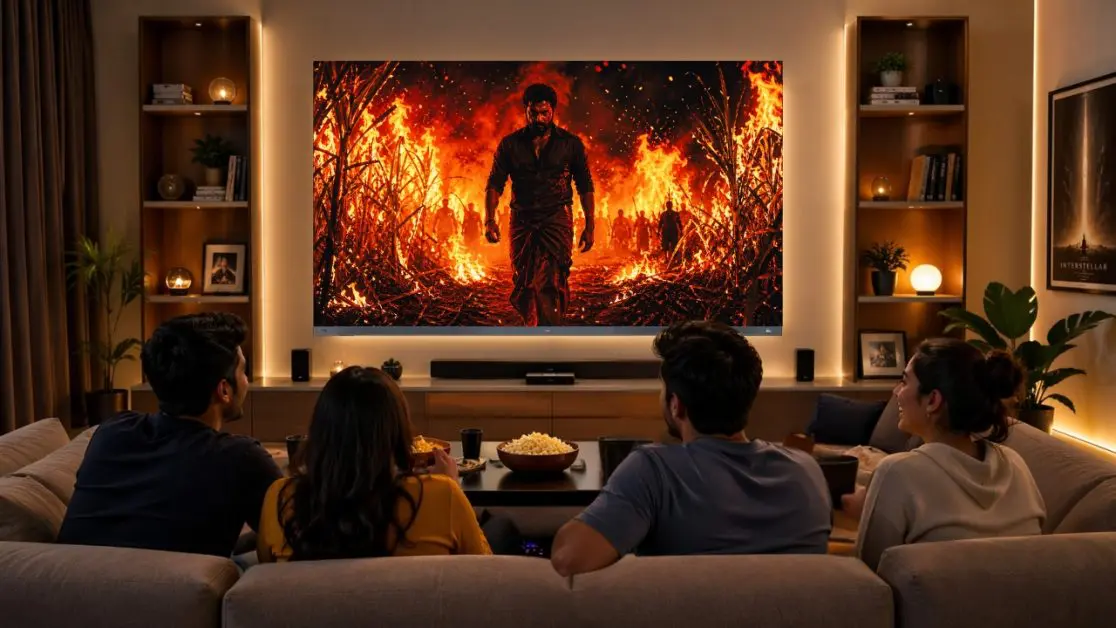
Most people compare TVs using specs.
Resolution. Refresh rate. HDR.
But the real difference lives somewhere else.
AI TVs make hundreds of micro-decisions every second.
- They recognise what you are watching
- They adjust brightness based on your room
- They enhance motion when action speeds up
- They balance sound so dialogue stands out
For example, AI processors can detect scenes instantly and adjust contrast, colour, and depth for sharper visuals
You are not tweaking settings anymore.
The system is doing it for you.
The hidden system: AI turns passive screens into adaptive experiences
A regular TV show.
An AI TV responds.
Think about something as basic as lighting.
Three ways TVs behave in your living room
- Fixed display TVs
- Same brightness all day
- Looks washed out in daylight
- Feels harsh at night
- Cost: Constant manual adjustment
- Basic smart TVs
- Preset modes like movie or sports
- Limited adaptability
- You still switch settings
- Cost: Effort and inconsistency
- AI-powered TVs
- Detect ambient light automatically
- Adjust brightness and tone instantly
- Keep visuals comfortable in any condition
- Benefit: Zero effort, consistent experience
AI Ambient Sense adjusts brightness and colour temperature based on your surroundings
Convenience is not a feature. It is a system working in the background.
Picture quality is no longer fixed. It evolves scene by scene

Picture quality used to be static.
Now it is fluid.
Think about a cricket match.
The ball moves fast. Cameras pan quickly. Stadium lights shift.
Traditional TV struggles to keep up.
An AI TV tracks motion, sharpens detail, and balances light instantly.
What AI picture engines actually do
- Identify scene types in real time
- Reduce motion blur in fast sequences
- Enhance colour accuracy dynamically
- Improve depth and contrast automatically
Technologies like Dolby Vision IQ and HDR10+ further optimize brightness and contrast scene by scene
A normal screen displays frames.
An AI screen interprets them.
Sound finally becomes part of the experience
For years, sound lagged behind visuals.
AI closes that gap.
Now audio adapts just like video.
How AI changes sound
- Voices become clearer in dialogue-heavy scenes
- Background noise is balanced, not overpowering
- Sound feels spatial, not flat
- Audio adjusts based on what you are watching
With Dolby Atmos and multi-channel speaker systems, sound surrounds you in three dimensions
Add KEF-tuned audio, and you get deeper bass and clearer highs
You stop increasing volume.
You start hearing layers.
AI TVs understand how Indian homes actually function
Homes are not theatres.
They are dynamic spaces.
Morning news. Afternoon cartoons. Weekend cricket. Late-night movies.
AI TVs adapt to this rhythm.
How AI fits everyday viewing habits
| Situation | What AI does | Result |
| Bright afternoon | Boosts brightness automatically | Clear visuals |
| Night-time viewing | Reduces glare and adjusts contrast | Eye comfort |
| Sports viewing | Smoothens motion | Better clarity |
| OTT binge | Recommends content | Less searching |
Google TV further personalises content recommendations, making discovery easier
The TV starts understanding patterns, not just commands.
Gaming changed expectations. AI TVs kept up
Gaming is no longer secondary.
It is a core use case.
And it demands precision.
What modern gaming needs
- High refresh rates
- Low latency
- Smooth visuals
- No tearing
AI TVs deliver with:
- 144Hz refresh rates for fluid motion
- AMD FreeSync Premium Pro for tear-free gameplay
- Real-time motion optimisation
TVs are no longer just for watching.
They are built for interaction.
The smartest feature is the one you stop noticing

Voice control. Smart suggestions. Device connectivity.
These feel impressive at first.
Then they become invisible.
Three layers of intelligence
- Voice interaction
- Control without remote
- Search instantly
- Operate devices
- Benefit: Ease
- Content intelligence
- Personalised recommendations
- Unified interface
- Benefit: Less decision fatigue
- Smart ecosystem
- Connect appliances
- Act as a home hub
- Benefit: Central control
Hands-free voice control lets you operate the TV and connected devices without lifting a remote.
The best systems disappear into your routine.
What modern AI TVs actually offer
Here is a clear breakdown of what defines an AI TV today:
| Feature | What it does | Why it matters |
| AI Processor | Analyses scenes in real time | Better visuals automatically |
| AI Sound | Enhances clarity and depth | Improved audio |
| AI Ambient Sense | Adjusts brightness | Comfortable viewing |
| High Refresh Rate | Smooth motion | Ideal for sports and gaming |
| Smart OS | Personalised content | Saves time |
A strong example is the Haier New M96 Series 254cm (100) QD-Mini LED AI Smart Google TV (H100M96FUX), which combines AI processing, 144Hz refresh rate, Dolby Vision IQ, and immersive KEF-powered sound into one integrated experience
For those looking at a more compact setup, the Haier New M92 Series 164cm (65) QD-Mini LED AI Smart Google TV (H65M92FUX) delivers the same AI ecosystem in a versatile size for modern homes
Another strong option is the Haier New M92 Series 189cm (75) QD-Mini LED Smart AI Google TV (H75M92FUX), which balances immersive viewing with intelligent performance for larger living spaces
So what actually makes AI TVs the future
It comes down to one idea.
Shift from control to intelligence.
Earlier, you controlled the TV.
Now, the TV understands context and responds instantly.
Why this matters long term
- Time becomes valuable
Less adjusting. More watching. - Experience becomes consistent
Same quality across content and conditions. - Technology becomes invisible
You stop managing settings.
The bigger pattern most people miss
Every appliance is becoming intelligent.
ACs adjust cooling.
Fridges manage freshness.
TVs are evolving faster because content keeps changing.
AI TVs are not just improving entertainment.
They are redefining how homes interact with technology.
What this means for your next decision
Choosing a TV is no longer about size or resolution alone.
It is about choosing how much effort you want to spend.
Your three choices
- A TV that needs constant adjustment
- A TV with preset convenience
- A TV that adapts automatically
Only one of these grows with your lifestyle.
The final thought
A good TV show’s content.
A great TV pulls you into it.
An AI TV removes the distance between you and the experience.
And once that distance disappears, everything feels effortless.
Frequently Asked Questions
Why do I feel like I’m constantly adjusting my TV settings?
Traditional TVs rely on fixed settings. Lighting, content type, and motion change constantly, so you end up manually correcting what the TV cannot adapt to.
Will an AI TV really reduce how much I have to think about settings?
Yes. AI TVs continuously analyze scenes and surroundings, automatically adjusting brightness, contrast, and sound so you rarely need to intervene.
Is buying an AI TV worth it if I just want something simple?
If simplicity means “set it and forget it,” then yes. AI TVs remove complexity rather than add to it.
Why does my TV look too bright at night but dull during the day?
Because traditional TVs don’t adapt to ambient light. AI TVs use sensors to dynamically balance brightness and color temperature.
Will an AI TV help reduce eye strain?
Yes. Features like ambient light detection automatically soften brightness at night and enhance clarity during the day, making viewing more comfortable.
Do AI TVs actually understand real home environments?
They’re built for exactly that changing light, mixed usage (news, OTT, sports), and unpredictable conditions.
Why does it take me so long to find something to watch?
Because traditional systems rely on manual browsing. AI TVs learn your preferences and recommend content instantly.
Does an AI TV actually learn what I like?
Yes. Platforms like Google TV track viewing habits to personalize suggestions.
Can I control everything without a remote?
Yes. Voice assistants allow hands-free control for search, playback, and even smart home devices.