
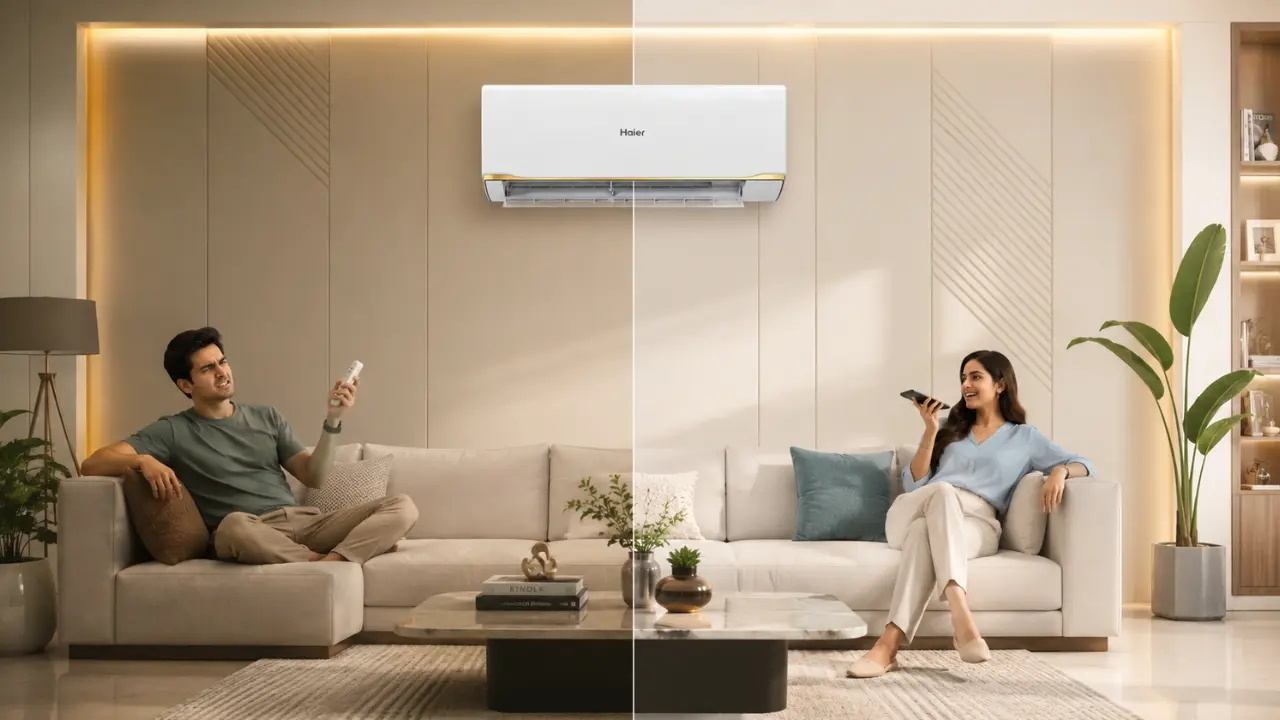

Traditional ACs are not becoming outdated because they stopped cooling. They are becoming outdated because modern Indian homes now expect air conditioners to think, adapt, and respond.
A few years ago, buying an AC was simple. Pick the tonnage. Compare the price. I hope the electricity bill stays manageable.
That logic no longer works.
Today, cooling is connected to how people sleep, work, save energy, manage routines, and handle increasingly unpredictable Indian summers. Modern households want comfort that feels effortless, not mechanical.
And traditional air conditioners struggle to keep up with that shift.
The biggest problem with traditional ACs is invisible.
Most people think an AC’s job is to lower room temperature.
That is only partially true.
The real job of a modern air conditioner is to create consistent comfort across changing human behaviour.
That is where older systems begin to fail.
At 1 PM, sunlight turns the room into an oven.
At 7 PM, five family members gather in the same space.
At midnight, the room feels cooler naturally.
At 3 AM, someone wakes up feeling too cold and searches for the remote half asleep.
Traditional ACs treat all four moments exactly the same.
Modern homes do not.
A fixed machine inside a dynamic household creates friction
That friction appears in small ways:
- Uneven cooling
- Constant temperature adjustments
- Higher electricity bills
- Overcooling at night
- Wasted power in empty rooms
- Inconsistent airflow during extreme summers
Most people normalise these problems because they have lived with them for years.
But “normal” does not always mean efficient.
Sometimes it simply means outdated.
Indian summers changed faster than traditional AC technology
Heat patterns across India are shifting aggressively.
Cities like Delhi, Jaipur, Nagpur, and Ahmedabad now regularly experience extreme heat waves crossing 45°C.
Urban apartments trap heat longer because of dense construction.
Work-from-home culture means ACs run for longer hours than before.
And electricity costs continue rising.
Older cooling systems were designed for a different era.
An era where ACs operated for a few evening hours.
Not entire workdays.
Not hybrid lifestyles.
Not climate unpredictability.
The old cooling model was reactive
Traditional ACs work like switches.
You feel uncomfortable.
You manually adjust settings.
You feel cold.
You adjust them again.
The system reacts only after discomfort appears.
Modern smart cooling systems are shifting toward anticipation instead of reaction.
That difference matters more than most consumers realise.
Because comfort is not about temperature alone.
It is about timing.
Modern cooling systems are becoming behaviour-aware
The future of air conditioning is not colder air.
It is contextual intelligence.
That sounds technical. But the idea is simple.
The AC starts understanding patterns instead of waiting for commands.
For example, the Haier 1.7 Ton 5 Star Desert Rose Air Conditioner (HSA20DSD-NAI5NB-I) uses AI-ATMOX technology that analyses environmental conditions and user habits to deliver adaptive cooling experiences.
That changes how cooling feels inside a home.
Good appliances remove tiny frustrations before you notice them
Think about modern smartphones.
Brightness adjusts automatically.
Battery optimization runs silently.
Apps remember behaviour patterns.
Nobody wants to manually manage every small decision anymore.
Air conditioners are evolving in the same direction.
Features like AI Human Detection now help systems identify occupancy and reduce unnecessary energy consumption.
That is not just a fancy feature.
It reflects a deeper change in appliance philosophy.
Old systems demand attention.
Smart systems reduce attention.
And consumers increasingly prefer the second category.
Electricity bills changed how Indians evaluate ACs
Ten years ago, people mostly compared upfront prices.
Today, families calculate long-term operating costs.
Because summer electricity bills are no longer small household expenses.
They shape buying decisions.
Cheap cooling often becomes expensive cooling
This is where traditional ACs begin losing relevance.
Fixed-speed systems frequently consume more power because they operate without adapting to real-time room conditions.
Modern inverter and AI-enabled systems attempt to optimize energy use dynamically.
The Haier 1.7 Ton 5 Star Gold Desert Rose Air Conditioner (HSA20DSD-GAI5NB-I), for instance, includes AI for Savings technology that monitors energy consumption patterns and automatically shifts to AI ECO mode to reduce wastage.
That matters because cooling is no longer seasonal luxury spending.
For many households, it has become an everyday operational cost.
And operational costs always change consumer behaviour.
People are no longer buying ACs only for cooling
They are buying:
- Predictable monthly electricity bills
- Better sleep quality
- Faster cooling after long commutes
- Lower maintenance stress
- Consistent comfort during extreme weather
- Smarter control during long usage hours
That is a completely different decision framework.
Traditional ACs were not designed for these expectations.
The remote-control era is quietly ending
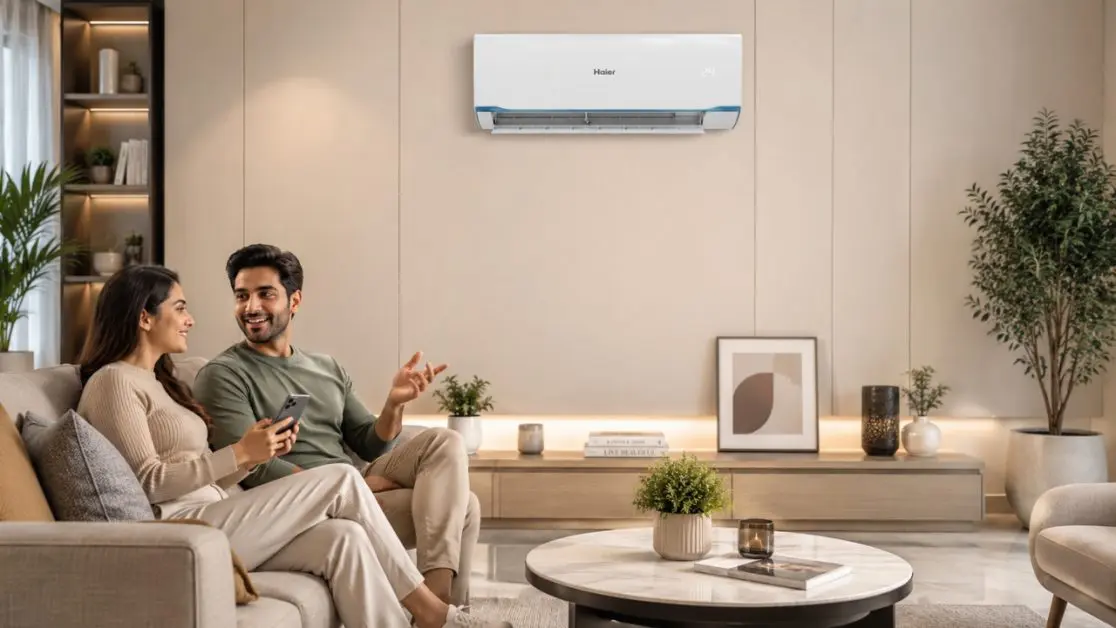
For years, the remote defined the air conditioning experience.
Now smartphones increasingly do.
That transition changes user expectations immediately.
Convenience compounds faster than people expect
Switching on cooling before reaching home once felt futuristic.
Now it feels practical.
Especially in Indian summers.
Modern smart AC ecosystems increasingly integrate app-based controls, scheduling, monitoring, and voice compatibility.
The Haier 1.7 Ton 5 Star Desert Rose Air Conditioner (HSA20DSD-NAI5NB-I) supports smart control through the Hai Smart App along with Alexa and Google Assistant compatibility.
This is not about showing off technology.
It is about reducing friction.
And once consumers experience lower-friction systems, traditional appliances start feeling slower and less responsive.
The same thing happened with televisions.
The same thing happened with phones.
Now it is happening with cooling.
Cooling capacity alone no longer defines a good AC
Traditional air conditioners often marketed one thing aggressively: power.
But modern consumers increasingly care about adaptability instead of raw output.
Because different situations require different cooling intensity.
One room can behave like three different environments in a single day
Morning sunlight changes room temperature.
Afternoon occupancy changes humidity.
Night-time sleeping conditions require gentler airflow.
Traditional ACs typically handle these shifts inefficiently.
Modern convertible systems attempt to adapt dynamically.
For example, the Haier 1.7 Ton 5 Star Desert Rose Air Conditioner (HSA20DSD-NAI5NB-I) includes a 7-in-1 Convertible mode that allows cooling adjustment between 40% and 110% capacity based on changing needs.
That reflects a broader systems-thinking principle:
Efficiency comes from adaptation, not excess.
The future belongs to appliances that understand variability.
Not appliances designed around maximum output alone.
Traditional ACs also struggle with the “always-on lifestyle”
Indian homes no longer operate in predictable patterns.
Somebody works night shifts.
Somebody studies late.
Somebody attends video calls all afternoon.
Someone else sleeps early.
Cooling demand became fragmented.
Older systems were built for uniform routines.
Modern life is not uniform anymore.
The smartest systems work quietly in the background
Nobody celebrates an AC when it works properly.
That is the point.
The best appliance experience feels invisible.
Fast cooling during peak heat.
Lower noise during sleep.
Cleaner airflow over time.
Stable operation during voltage fluctuations.
Minimal maintenance interruptions.
Modern systems increasingly focus on this invisible reliability layer.
The Haier Desert Rose series also includes features like ODU Cyclone Clean, Supersonic Cooling in 10 seconds, Hexa Inverter technology, and cooling support even at 60°C ambient temperatures.
Those features matter because Indian weather is becoming less forgiving every year.
And consumers increasingly want systems built for real conditions, not showroom demonstrations.
Traditional ACs are becoming outdated for the same reason people stopped using feature phones
Feature phones still worked.
Traditional ACs still cool rooms.
But expectations evolved faster than the technology itself.
Modern consumers now expect appliances to adapt, optimise, learn, and simplify life quietly in the background.
That shift changes industries permanently.
The future of cooling is not about colder rooms.
It is about creating homes that feel calmer, smarter, and easier to live in.
And once people experience that difference, going back starts feeling surprisingly difficult.
Frequently Asked Questions
How do I know if my current AC is outdated?
If you’re constantly adjusting temperatures, dealing with uneven cooling, experiencing high electricity bills, or lacking smart controls and energy optimization, your AC may no longer match modern household needs.
My AC still cools properly. Do I really need a smarter one?
Not necessarily. However, newer systems focus on comfort, energy efficiency, automation, and convenience, not just cooling. The value comes from reducing daily friction and long-term operating costs.
Is a smart AC worth the extra money in India?
For households that run ACs for long hours, work from home, or experience extreme summers, smart and AI-enabled features can improve comfort while helping reduce energy waste over time.
Should I prioritize cooling capacity or smart features?
Both matter, but modern buyers increasingly look for adaptability alongside capacity. A powerful AC that cannot adjust to changing conditions may consume more energy and provide inconsistent comfort.
Why are people comparing electricity costs more than purchase prices now?
Rising power tariffs and longer AC usage hours have made monthly operating costs a major factor in buying decisions.