
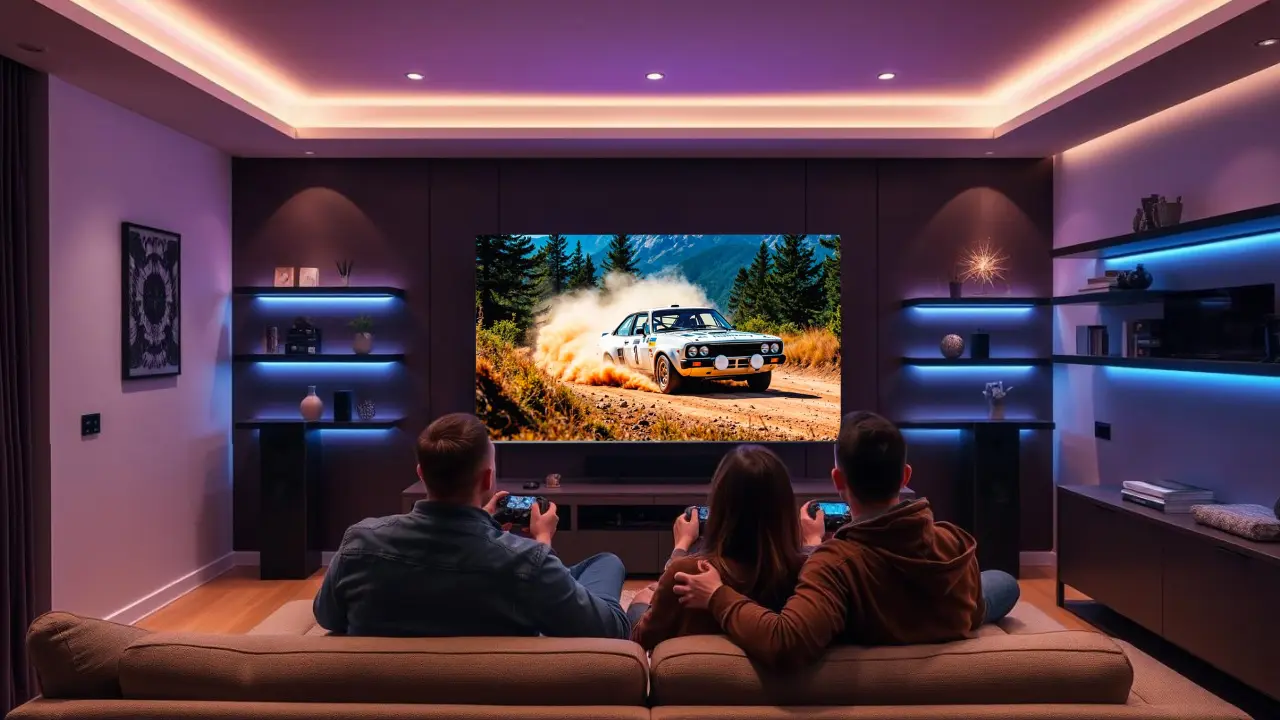

No, a higher refresh rate is not always better. It improves motion clarity, but only when your content, usage, and environment actually demand it.
The real value comes from balance, not extremes. A well-optimised 120Hz or 144Hz experience often beats chasing the highest number on paper.
Why does this question even matter in real homes?
You’re watching an IPL match.
The ball flies. Camera pans. The crowd roars.
But something feels off.
The motion isn’t smooth. The ball looks slightly blurred. The moment loses its edge.
Now imagine the same scene on a Haier New M96 Series 254cm (100) QD-Mini LED AI Smart Google TV (H100M96FUX).
The ball stays sharp. Movement feels real. The experience changes.
This is where the refresh rate enters your life.
Quietly. Invisibly. Powerfully.
What Is Refresh Rate, Really?

The refresh rate is simple.
It’s how many times your TV updates the image per second.
- 60Hz = 60 updates per second
- 120Hz = 120 updates per second
- 144Hz = 144 updates per second
More updates mean smoother motion.
But here’s the part most people miss.
Smoothness is only valuable when the content can keep up.
A fast road with no traffic is pointless if your car can’t accelerate.
The Hidden System: Where Refresh Rate Actually Works
Refresh rate does not operate alone. It depends on three moving parts:
- Content frame rate
- Display processing
- Viewer sensitivity
Miss one, and the benefit drops.
Let’s break this with real examples
- IPL broadcast: ~50 to 60 frames per second
- Movies: ~24 frames per second
- Gaming consoles: 60 to 120 fps depending on the game
Now ask the real question.
If your content runs at 24 fps, what exactly is a 144Hz display improving?
When Higher Refresh Rate Actually Makes a Difference
1. Sports and Live Events Feel Sharper
Cricket. Football. F1.
Fast motion defines the experience.
A higher refresh rate helps:
- Reduce motion blur
- Keep objects sharp during movement
- Improve camera pan smoothness
This is why TVs like the Haier New M92 Series 164cm (65) QD-Mini LED AI Smart Google TV (H65M92FUX) and Haier New M92 Series 189cm (75) QD-Mini LED Smart AI Google TV (H75M92FUX) come with a 144Hz refresh rate designed for fast-paced content
Because motion clarity is not a luxury in sports. It’s an experience.
2. Gaming Becomes More Responsive
Gaming is where the refresh rate shines the most.
- Lower input lag
- Faster response time
- Smoother camera movement
With features like AMD FreeSync Premium Pro and high refresh rates, gaming becomes fluid instead of jittery
Insight:
In gaming, smoothness is not visual. It is competitive.
3. Scrolling and UI Feel Effortless
Even basic actions change:
- Scrolling through apps
- Navigating menus
- Switching content
Higher refresh rates make everything feel lighter.
Not faster.
Lighter.
When Higher Refresh Rate Stops Adding Value
This is where the myth breaks.
1. Movies Don’t Need It
Most films are shot at 24 fps.
A higher refresh rate does not improve cinematic storytelling.
In fact, it can create the “soap opera effect”.
Cost: Visual authenticity
Benefit: Minimal
2. Regular OTT Content Doesn’t Fully Use It
Most streaming platforms:
- Netflix
- YouTube
- Prime Video
Operate at 30 to 60 fps.
A 144Hz panel can’t invent new frames. It can only optimize motion.
3. Power Consumption and Processing Load Increase
Higher refresh rates demand:
- More processing power
- Better panel technology
- Efficient optimisation
Without smart processing, performance can become inconsistent.
That’s why systems like the AI Ultra Sense Processor in the Haier New M96 Series (H100M96FUX) intelligently tune motion, contrast, and depth in real time
The Three Ways People Approach Refresh Rate
One option is chasing the highest number
You buy based on specs.
- 144Hz sounds better than 120Hz
- Bigger number feels future-ready
Cost: You may overpay
Benefit: Future confidence
The second option is settling for standard
You choose 60Hz.
- Works for daily viewing
- Lower cost
Cost: Limited motion clarity
Benefit: Budget efficiency
The third option is choosing based on usage
You match the refresh rate with your lifestyle.
- Sports lover? Go higher
- Gamer? Go highest possible
- Movie watcher? Focus elsewhere
Cost: Requires clarity
Benefit: Maximum real-world value
What Actually Matters More Than Just Refresh Rate
Refresh rate is one piece.
The real experience comes from the system around it.
Key factors that shape viewing quality
- AI Motion Processing
- MEMC technology
- HDR formats like Dolby Vision IQ and HDR10+
- Local dimming zones
- Ambient light sensing
For instance, Haier’s Ultrasense AI integrates visual, sound, and motion algorithms to optimise the experience across different scenarios
Insight:
Refresh rate shows motion. Intelligence refines it.
A Simple Way to Decide
Ask one question.
What do I watch the most?
Then follow this:
- Sports and gaming
→ 120Hz to 144Hz makes sense - Mixed usage
→ Balanced performance wins - Movies and OTT
→ Focus on picture quality and sound
A Quick Comparison That Clarifies Everything
60Hz vs 120Hz vs 144Hz
- 60Hz
- Works for everyday content
- Lower cost
- Limited motion smoothness
- 120Hz
- Noticeably smoother
- Ideal for sports and casual gaming
- Balanced choice
- 144Hz
- Best for fast motion and gaming
- Premium experience
- Needs proper content to shine
The Bigger Insight Most People Miss
People don’t buy refresh rates.
They buy moments.
- The tension of a last over
- The thrill of a racing game
- The calm of a late-night film
Refresh rate matters only when it protects these moments.
Where Smart TVs Are Changing the Game
Modern TVs are shifting the focus.
From specs to intelligence.
Instead of asking, “What is the refresh rate?”
Ask:
How does the TV adapt to what I’m watching?
With AI-driven systems, TVs now:
- Detect scenes in real time
- Adjust motion dynamically
- Optimise brightness and contrast
This is why platforms like AI Ultra Sense exist. They don’t just display content. They understand it.
So, Is Higher Refresh Rate Always Better?
No.
Better is contextual.
Better is intentional.
Better is choosing what fits your life.
The One Insight to Remember
The best screen is not the fastest. It is the one that disappears.
When motion feels natural,
When visuals feel effortless,
When experience feels right,
Specs stop mattering.
What This Means for Your Next Decision
Don’t chase numbers.
Build your experience.
- Love sports? Prioritise motion clarity
- Love gaming? Prioritise responsiveness
- Love cinema? Prioritise depth and colour
And if you want balance, choose a system like the Haier New M96 Series 254cm (100) QD-Mini LED AI Smart Google TV (H100M96FUX) that combines high refresh rate with intelligent processing.
Because in the end, clarity is not about speed.
It’s about harmony.
Frequently Asked Questions
Do I really need a 144Hz TV, or am I just getting influenced by specs?
You likely don’t need 144Hz unless you watch fast sports or play high-frame-rate games. For most mixed usage, 120Hz already delivers a noticeably smooth experience.
I mostly watch Netflix and YouTube. Should I still care about refresh rate?
Not as much. Most OTT content runs at 24–60 fps, so a high refresh rate won’t dramatically change your experience.
Is 120Hz the sweet spot for my kind of daily viewing?
Yes. 120Hz is often the best balance between smoothness, cost, and real-world usability.
Am I wasting money if I buy a 144Hz TV but don’t play games?
Potentially, yes. Without high-frame-rate content, you won’t fully utilize the panel.
How do I decide between 60Hz, 120Hz, and 144Hz without overthinking it?
Match it to your habits:
Movies/OTT → 60Hz is fine
Sports/mixed → 120Hz
What actually matters more than refresh rate when buying a TV?
Processing, HDR, local dimming, and AI optimization often have a bigger impact on overall quality.
How does AI processing improve motion beyond refresh rate?
It analyzes scenes in real time and adjusts motion, contrast, and clarity dynamically.
Why do some 120Hz TVs feel better than 144Hz ones?
Better processing and optimization can outperform higher raw specs.
What does AI Ultra Sense actually do in TVs like Haier New M96 Series 254cm (100) QD-Mini LED AI Smart Google TV (H100M96FUX)?
It intelligently enhances motion, brightness, and depth based on what you’re watching.
Is refresh rate becoming less important with smarter TVs?
Yes. Intelligence is starting to matter more than raw numbers.