
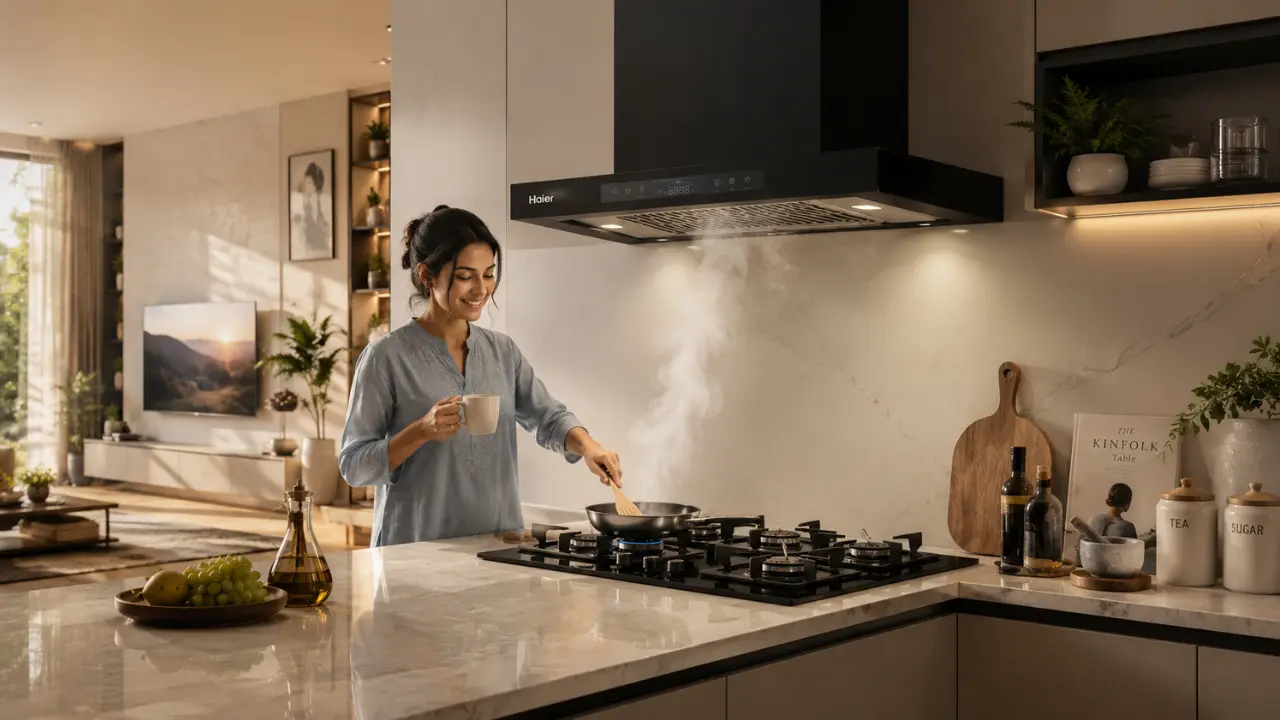

A quiet kitchen is no longer a luxury. It is part of modern living.
Most people notice chimney suction first. They notice chimney noise later.
Usually during a dinner conversation.
Or while attending a work call from the dining table.
Or when the kitchen sounds louder than the television in the living room.
That is when the realisation hits.
A kitchen chimney does more than remove smoke. It shapes the emotional rhythm of a home.
And in modern Indian households, that matters more than ever.
The Indian kitchen has changed completely.
The kitchen used to be separate from the rest of the house.
Today, it sits at the centre of daily life.
Open kitchen layouts dominate urban apartments. Families cook while talking, watching OTT shows, helping children with homework, or catching up after work. In many homes, the kitchen and living room are visually connected.
Which means one loud appliance affects the entire space.
A noisy chimney does not stay in the kitchen. It spills into conversations, focus, and comfort.
That is why low noise kitchen chimneys have become an important consideration for Indian households.
The problem is not sound alone. It is an interruption.

People can tolerate temporary noise.
What they struggle with is repeated interruption.
A loud chimney changes behaviour inside the home:
- Conversations pause mid-sentence
- People raise their voices
- Phone calls move to another room
- Cooking feels more tiring
- The kitchen becomes less inviting
These are invisible lifestyle costs.
Nobody mentions them during appliance shopping. Yet people experience them every single day.
Good appliances solve problems quietly. Great appliances disappear into daily life.
Why chimney noise becomes more noticeable in Indian cooking
Indian kitchens demand more from chimneys than many global cooking environments.
Think about the intensity involved:
- Deep frying pakoras during monsoon evenings
- Tadka with mustard seeds and curry leaves
- Heavy onion-tomato gravies
- Weekend biryani preparation
- Festival cooking involving multiple burners together
All of this generates dense smoke, grease, heat, and aroma.
That requires strong suction power.
But stronger suction without thoughtful engineering often creates excessive noise. The motor works harder. Airflow becomes more turbulent. Vibration increases.
This is why low noise chimney technology matters. It is not only about comfort. It is about maintaining performance without overwhelming the space around it.
The hidden role of motor technology
Most buyers compare chimney size and suction numbers.
Fewer look at the motor system powering it.
That is a mistake.
The motor decides three important things:
- Operational efficiency
- Long-term durability
- Noise levels during daily use
Modern BLDC motor technology is changing expectations in this category.
For example, the Haier 1600 M³H Suction Power Heat Auto Clean Filterless Chimney (HIH-T1900-BLDC-IN) uses a BLDC motor system designed for lower maintenance and lower operational noise while supporting strong suction performance.
Its listed noise level is below 48 dB.
That difference becomes noticeable in open kitchens where sound travels freely.
Low noise does not mean low power
This is where many buyers get confused.
They assume quieter chimneys are weaker.
But modern appliance engineering is moving toward efficiency, not aggression.
One option is maximum suction with constant loud operation.
The second option is moderate suction with inconsistent smoke removal.
The third option is intelligent airflow design that balances power, efficiency, and quieter performance.
The third option is where premium kitchen experiences are heading.
Models like the Haier Coloured User Panel With 1600 M³H Suction Power Heat Auto Clean Filterless Chimney (HIH-T1600-BLDC-IN) combine high suction capacity with BLDC motor efficiency and lower noise operation.
That balance matters in real homes.
Because nobody wants a smoke-free kitchen that sounds like industrial machinery.
Why filterless chimneys feel different over time

Noise is not only created by motors.
Maintenance plays a major role too.
Traditional filter systems gradually collect grease and residue. Over time, blocked airflow forces the motor to work harder. Harder motors create more strain and more noise.
This is one reason filterless chimney systems are becoming popular in Indian homes.
The Haier Filterless 1500 M³H Suction Power Heat Auto Clean Chimney (HIH-G1750-IN) uses a filterless setup combined with Heat Auto Clean technology designed to reduce grease accumulation and simplify maintenance.
That affects more than convenience.
It affects consistency.
Because appliances that remain cleaner internally often maintain smoother airflow and more stable performance over time.
The psychology of quieter kitchens
Here is something interesting.
People rarely describe their dream home by appliance specifications.
They describe emotional outcomes instead:
- Calm
- Peaceful
- Comfortable
- Spacious
- Relaxing
Sound influences every one of those feelings.
A quieter kitchen changes the atmosphere of the home without anyone consciously noticing why.
That matters in Indian households where kitchens remain active throughout the day:
- Morning tea preparation
- Lunch packing before school
- Evening snacks
- Late-night reheating
- Weekend cooking marathons
The kitchen is not just functional space anymore. It is an emotional space.
Small smart features matter more than people realise
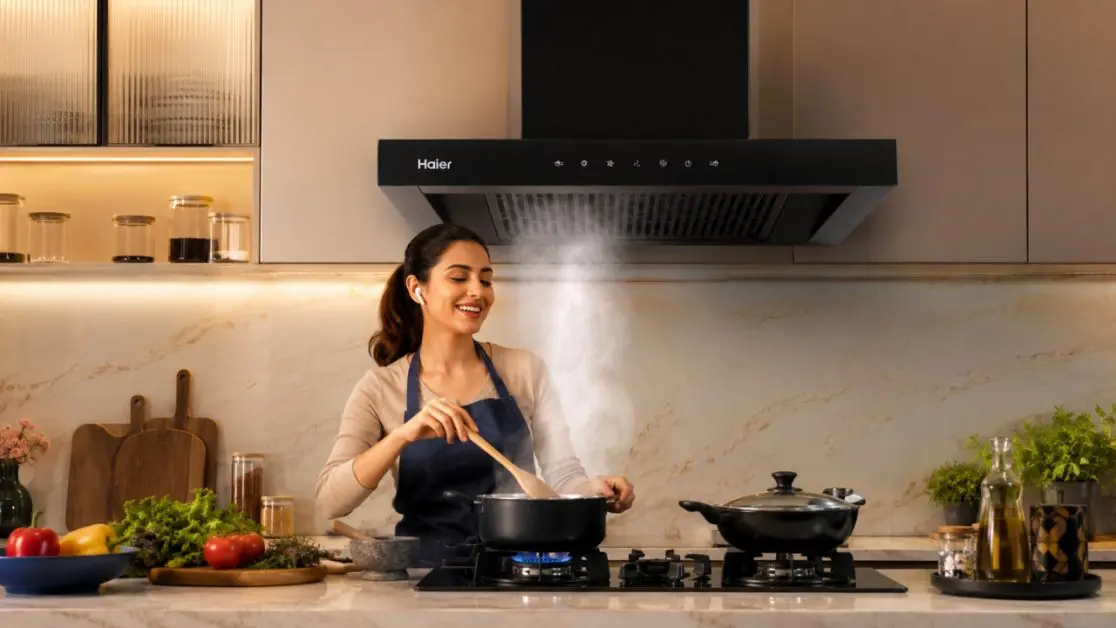
Good appliance experiences are built from tiny conveniences repeated daily.
Gesture controls are one example.
The Haier 1500 M³H Suction Power Heat Auto Clean Filterless Chimney (HIH-T1600-IN) includes Touch & Gesture controls for hands-free operation.
That sounds minor on paper.
Until your hands are covered in oil, dough, or masala.
Then it suddenly feels thoughtful.
Similarly, delay-off functions allow the chimney to continue clearing residual smoke after cooking ends. Auto-clean reminders help maintain long-term performance. Multiple speed controls adapt airflow intensity to different cooking styles.
None of these features individually transform a kitchen.
Together, they reduce friction.
Modern appliances are becoming quieter by design
Older appliances announced themselves loudly.
Modern appliances aim to blend into life naturally.
That is the broader shift happening across home technology.
A refrigerator quietly preserves freshness.
An inverter AC maintains cooling stability silently.
A washing machine reduces vibration during late-night cycles.
And increasingly, kitchen chimneys are following the same philosophy.
The best appliance experiences often feel invisible.
You notice the comfort.
You notice the convenience.
You notice the absence of stress.
But you barely notice the machine itself.
What should buyers actually prioritise?
Most buyers compare only price and suction power.
A smarter framework looks at the complete daily experience.
Things worth evaluating before buying a kitchen chimney
- Noise levels during regular operation
- Motor technology used
- Filterless vs traditional filter systems
- Ease of cleaning
- Gesture or touch functionality
- Delay-off features
- Suction capacity based on cooking style
- Long-term maintenance requirements
Because the real test of a chimney is not showroom performance.
It is an everyday life performance.
A peaceful kitchen changes more than cooking
There is a deeper idea hidden inside all this.
Homes are emotional systems.
Small irritations accumulate.
Small comforts accumulate too.
A low noise kitchen chimney may seem like a technical feature. But its impact is deeply human.
It allows conversations to continue naturally.
It keeps the kitchen feeling social.
It reduces sensory fatigue.
It supports calmer routines.
And in busy modern homes, calm is becoming one of the most valuable design features of all.
Not dramatic calm.
Not a luxury-hotel calm.
Just everyday ease.
The kind people feel without needing to explain it.
Frequently Asked Questions
I’m comparing two chimneys with the same suction power. Why should I care about noise levels?
Suction power affects smoke removal, but noise affects your daily living experience. In open kitchens, a loud chimney can disrupt conversations, TV viewing, work calls, and family time even if it performs well.
Is a low-noise chimney worth paying extra for?
If your kitchen is connected to your living or dining area, the long-term comfort benefits can easily outweigh the upfront cost difference. You interact with the sound every day, not just during installation.
I cook heavily every day. Should I prioritize suction power or low noise?
Ideally, both. Modern chimneys with efficient motor technology can deliver strong suction without excessive noise. The goal is balance rather than sacrificing one feature for the other.
How much chimney noise is considered comfortable for daily use?
Many buyers find lower noise levels significantly more comfortable, especially in open kitchens where sound travels throughout the home.
My family spends a lot of time in the kitchen. Does chimney noise really make a difference?
Yes. Continuous background noise contributes to fatigue, interrupted conversations, and a less relaxed atmosphere over time.