
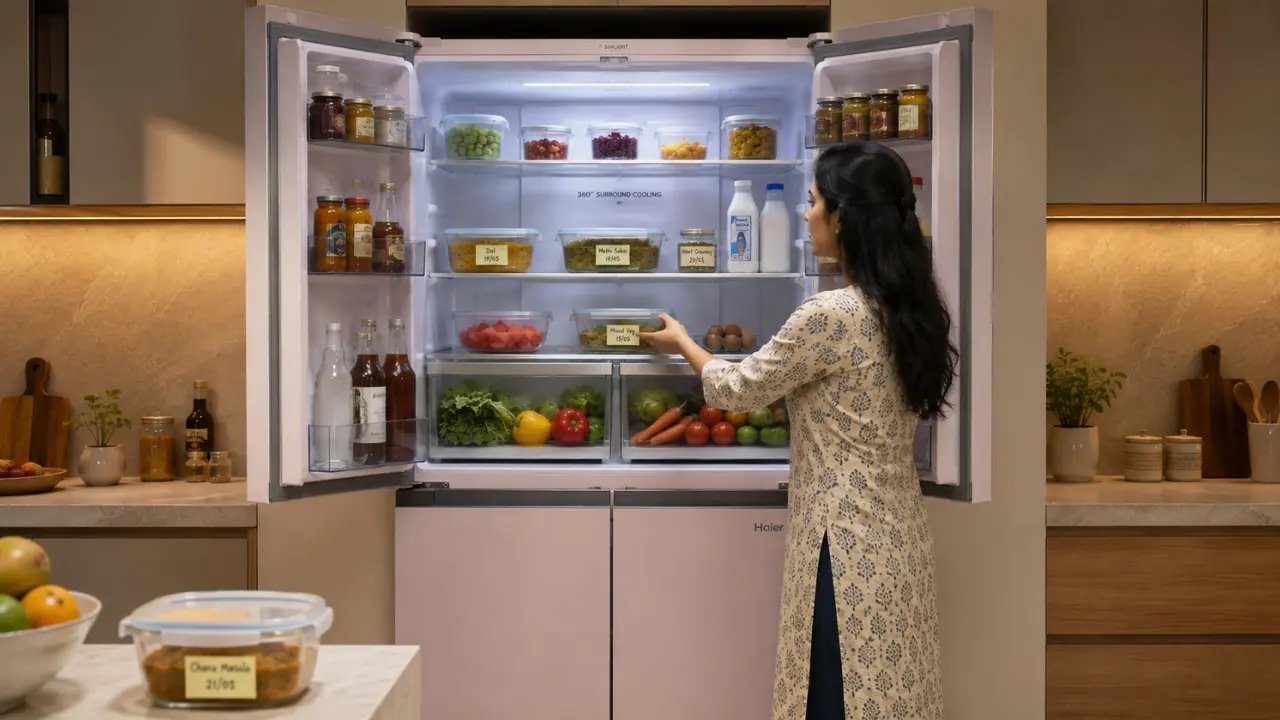

That dal that you ate on Tuesday. The part of the watermelon behind the milk. On the weekend, Coriander was bought for big cooking jobs. And, somewhere in the back, a receptacle not remembered by anyone.
A refrigerator slows down the rate of food spoilage, but it doesn’t stop it! The shelf life of the food in a refrigerator will vary with the type of food, the rate of refrigeration, the temperature at which the food is stored and its location within the refrigerator.
When it comes to an Indian household, a refrigerator can not only keep cooked curries, but milk, vegetables, chutneys and raw ingredients as well, which is why it is important to understand these differences.
But more importantly, freshness and food safety are not synonymous.
First, Fresh Does Not Automatically Mean Safe
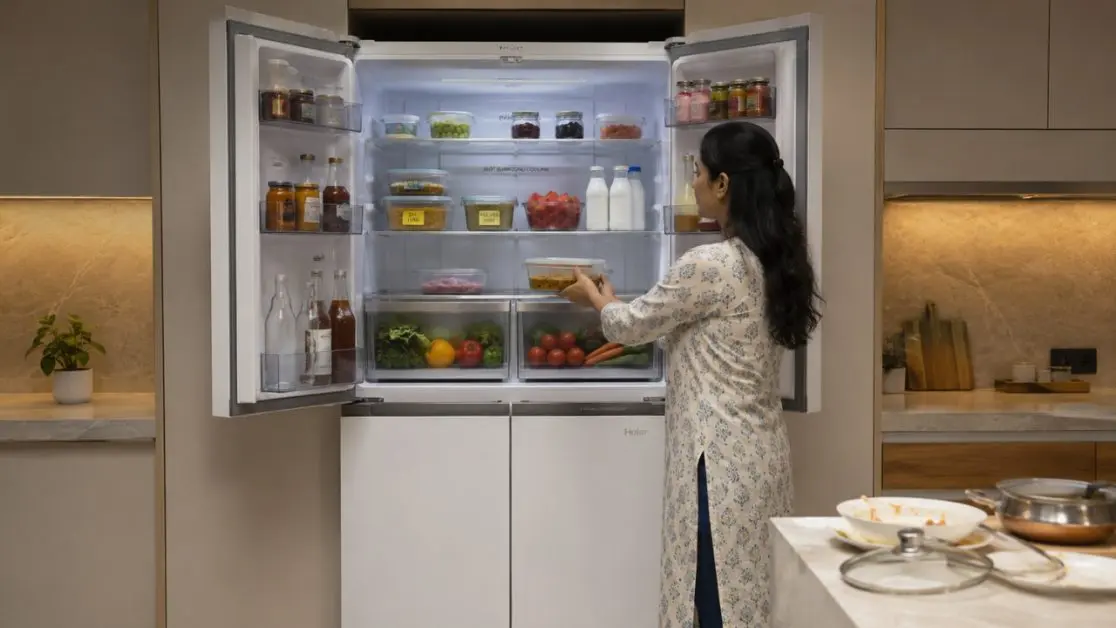
Smell and appearance can tell you when certain foods have obviously deteriorated. They cannot reliably tell you whether every food is safe to consume.
Perishable cooked food should therefore be refrigerated promptly rather than being left on the dining table for hours. Covered containers are preferable, and cooked food should be kept separate from raw meat or poultry to reduce the possibility of cross-contamination.
As a practical habit:
- Refrigerate perishable leftovers promptly after meals.
- Use clean, covered containers.
- Keep raw foods properly wrapped and separated from ready-to-eat items.
- Label containers with the cooking or opening date when necessary.
- Do not depend entirely on a smell test for questionable food.
- Follow storage instructions printed on packaged foods.
A little discipline here saves considerably more trouble later.
Refrigerator Food Storage: A Quick Reference
There is no single expiry timer for everything inside your refrigerator. Still, commonly followed refrigerated-storage guidance gives households a useful starting point.
| Food | Typical Refrigerator Storage Guidance |
| Cooked leftovers | Around is d 3–4 days |
| Cooked meat or poultry | Around 3–4 days |
| Raw chicken or poultry | Around 1–2 days |
| Raw minced meat | Around 1–2 days |
| Fresh whole cuts of meat | Around 3–5 days |
| Egg-, chicken- or similar prepared salads | Around 3–4 days |
| Opened deli-style cooked meats | Around 3–5 days |
These are general safety-oriented ranges rather than promises of freshness. Packaging instructions, refrigerator temperature and how a food was handled before refrigeration remain important.
Fruits and vegetables are trickier. A leafy vegetable and an apple clearly cannot be given the same storage window.
Why Your Palak Wilts Before Your Apples Do
Fresh produce loses quality differently.
Leafy vegetables contain plenty of moisture and can deteriorate relatively quickly when improperly stored. Hardier produce generally lasts longer. Cut fruits also behave differently from whole fruits because cutting exposes more surface area to air, moisture loss and contamination.
A few everyday habits make a noticeable difference.
For leafy vegetables
Remove obviously damaged leaves and store greens appropriately without crushing them under heavy containers. Excess moisture can also encourage deterioration, so throwing dripping-wet greens straight into storage is rarely helpful.
For cut fruits and vegetables
Keep them covered in clean containers and refrigerate them promptly. Once something has been cut, it deserves more attention than the untouched fruit sitting beside it.
For whole produce
Avoid overcrowding storage areas. A giant weekly vegetable haul is useful only if air can circulate and you can actually see what you bought.
Which brings us to an underrated refrigerator feature: organisation.
A Better Refrigerator Can Make Food Management Easier
The usefulness of a refrigerator is not defined only by its capacity number. What matters is whether that space helps a household separate different types of food, find ingredients quickly and adapt storage when requirements change.
That is where the Haier Lumiere 520L 3 Star French Door Refrigerator becomes relevant for larger, storage-heavy Indian kitchens.
The Lumiere offers 520 litres of total capacity and a configuration that can provide up to 440 litres of refrigerator space, along with a 90-litre Magic Convertible Zone. Instead of forcing every week’s groceries into one fixed arrangement, the convertible section can be adjusted across a temperature range from -20°C to 5°C, depending on the storage requirement.
The flexibility is good as food storage is seldom in a fixed state.
After a big grocery shopping trip, a family might require more refrigerator space, before a party more freezer space, or a different zone configuration when the type of food stored in the freezer changes.
Cooling Must be Consistent, It Matters More than People Think
Whether it be the best of containers and the finest of organizations for every shelf, refrigeration still requires proper cooling.
The Lumiere range features 360° Surround Cooling, which is complemented by Magic Cooling to spread the cooling around the refrigerator. Its Triple Inverter technology supports temperature management while also focusing on efficient operation.
Then there is Deo Fresh Technology, which is designed to absorb odour and impurities while helping maintain freshness.
This becomes particularly relevant in an Indian refrigerator.
Strongly aromatic foods are common: garlic chutney, leftover biryani, marinated ingredients, curries, pickles and cut onions can all be sharing space with milk, fruit and desserts. Properly sealing food remains important, of course. Technology should support good storage habits, not replace them.
The “Where Did I Put It?” Problem Is a Freshness Problem Too
Food often gets wasted not because the refrigerator failed to cool it, but because somebody forgot it existed.
One container moves behind another. The coriander disappears beneath a packet. By the time it resurfaces, its best days are behind it.
The Haier Lumiere addresses storage visibility with 10 storage zones across its spacious four-door layout. The range also provides dedicated fruit and vegetable storage, movable shelving arrangements and toughened glass shelves.
There is a practical advantage here: categorising food becomes easier.
You might keep:
- Frequently used dairy products within easy reach
- Fresh fruits and vegetables together
- Prepared foods in clearly visible containers
- Raw ingredients properly separated
- Beverages in a designated area
- Frozen foods grouped rather than scattered
Not glamorous advice, admittedly. But it works.
One Habit That Changes Everything: First In, First Out
Professional kitchens have used versions of this principle for years, and it works just as well at home.
Put newly purchased or newly prepared foods behind older ones where practical. Use the older batch first.
Bought another packet of paneer? Do not automatically place it in front of the one already there.
Prepared fresh dal while yesterday’s dal remains? Make the older container more visible.
Even a small piece of masking tape with the date can help when you batch-cook food for a busy week.
Try a simple weekly refrigerator reset
Once or twice a week:
- Check leftovers before cooking another large batch.
- Look for vegetables that should be used soon.
- Wipe spills before they become sticky mysteries.
- Check use-by instructions on opened packaged foods.
- Rearrange items so older food remains visible.
- Discard food when its safety is genuinely doubtful.
Five minutes can prevent both waste and refrigerator chaos.
What About Freezing?
Freezing is useful when food will not be consumed within its normal refrigerated storage period.
It is particularly practical for households that cook ahead, buy selected foods in larger quantities or want flexibility between busy weekdays and weekends.
The key is deciding early. Leaving leftovers in the refrigerator until they are already close to the end of their recommended storage window and then remembering the freezer is not the ideal approach.
With the Lumiere’s 90L Magic Convertible Zone, households have additional flexibility to adapt storage according to changing requirements instead of working around a completely fixed compartment.
Freshness Starts With the Way You Use Your Refrigerator
No refrigerator can make food last forever. Nor should anyone treat a storage-time chart like an absolute guarantee.
Freshness comes from several things working together: prompt refrigeration, appropriate temperatures, clean containers, separation of raw and cooked food, sensible organisation and knowing when an item has simply been stored too long.
A refrigerator designed around flexible storage can make those habits considerably easier to maintain.
With its 350L dedicated fridge space, 90L Magic Convertible Zone that expands usable fridge capacity to up to 440L, and 80L dedicated freezer space, the Haier Lumiere 520L 3 Star French Door Refrigerator is built for households that expect their refrigerator to do more than simply provide cold space.
With 360° Surround Cooling, Deo Fresh Technology and organised multi-zone storage, it is designed to make everyday food storage more flexible and practical.
Because in a busy Indian kitchen, the real question is not merely, “Will everything fit?”
It is, “Can everything be stored in a way that actually makes sense?”
Frequently Asked Questions
1. How long does food stay fresh in a refrigerator?
There is no single storage period for every food. Shelf life depends on the type of food, how quickly it was refrigerated, refrigerator temperature, packaging and storage conditions. Perishable leftovers are commonly kept refrigerated for around 3–4 days, while different raw meats and prepared foods have their own recommended storage windows.
2. Does refrigeration stop food from spoiling?
No. Refrigeration slows the growth of many microorganisms and other processes that cause food to deteriorate, but it does not stop them completely. Food still needs to be stored properly and consumed within appropriate timeframes.
3. Can I tell whether food is safe by its smell or appearance?
Not always. Some foods can look or smell normal even when they are no longer safe to eat. For questionable food, do not rely solely on a smell or appearance test. Follow appropriate storage guidance and the instructions on packaged foods.
4. How long can cooked leftovers stay in the refrigerator?
A commonly followed refrigerated-storage guideline is around 3–4 days for cooked leftovers. Store them promptly in clean, covered containers and maintain proper refrigeration.
5. How should cooked food be stored in the refrigerator?
Refrigerate perishable cooked food promptly, use clean covered containers and keep cooked food separated from raw meat or poultry. Labelling containers with the cooking date can also make it easier to follow a first-in, first-out routine.