

Most kitchen chimney buying guides focus on suction power and motor speed. The filter type, which is the part that determines how often you clean the chimney and how difficult that cleaning actually is, usually gets one line. That is worth fixing before you install something you will regret every few weeks.
The three types you will encounter most in India are baffle filter, filterless, and auto-clean chimneys. The names overlap in confusing ways, and some are used interchangeably when they should not be. Here is what each means in practice for chimney maintenance.
Why Chimney Filter Type Decides Maintenance
The filter captures grease, smoke, and oil particles from cooking vapours before they reach the motor or get released back into the kitchen. How effectively it traps them, and how easy it is to clean, is what separates a low-maintenance chimney from one that gradually loses suction because upkeep has been skipped.
Every chimney type handles kitchen chimney filters differently. Some use a physical mesh or baffle. Others skip the filter entirely and use centrifugal or thermal systems to collect oil. Understanding which approach suits your cooking habits helps you pick the right chimney rather than simply the highest suction number.
Baffle Filter Chimneys
A baffle filter chimney uses multiple curved metal plates arranged so that air must change direction multiple times as it passes through. As the direction changes, grease and oil particles lose momentum and fall into a collection tray. The plates themselves accumulate grease over time and need to be cleaned at regular intervals.
How They Work & Cleaning Needs
What is a baffle filter used for? It separates oil and grease from cooking vapours through a series of physical deflections rather than a mesh screen. The air passes around curved baffles, heavy oil particles settle on the plates, and cleaner air continues to the motor.
The cleaning routine involves removing the plates, soaking them in hot soapy water or a degreaser, scrubbing them, and reinstalling them. For regular Indian cooking, which involves higher oil content than most European or East Asian food, baffle plates need this treatment every four to six weeks. The process is not complicated, but it needs to happen consistently or suction drops off.
Baffle filter chimneys hold up well under heavy daily use and work reliably for years when maintained on schedule.
Filterless (Auto-Clean) Chimneys
The phrase auto clean vs filterless chimney causes real confusion because many chimneys labelled filterless also carry an auto-clean function, and some auto-clean models still use a filter of some kind. The cleaner way to understand them is by the oil collection method rather than the marketing label.
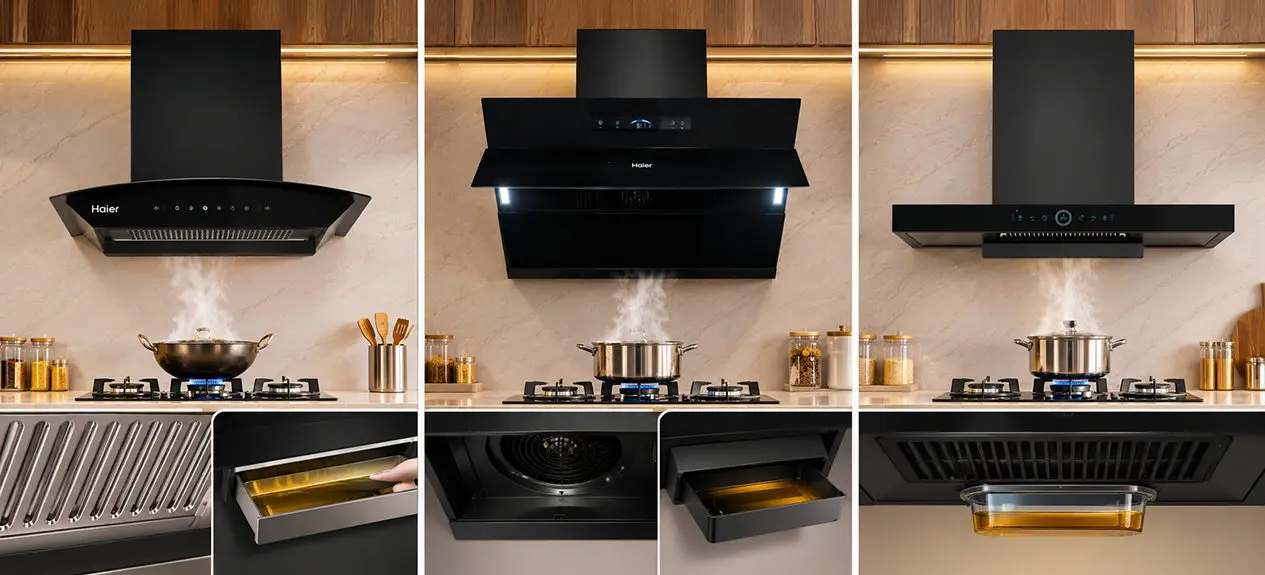
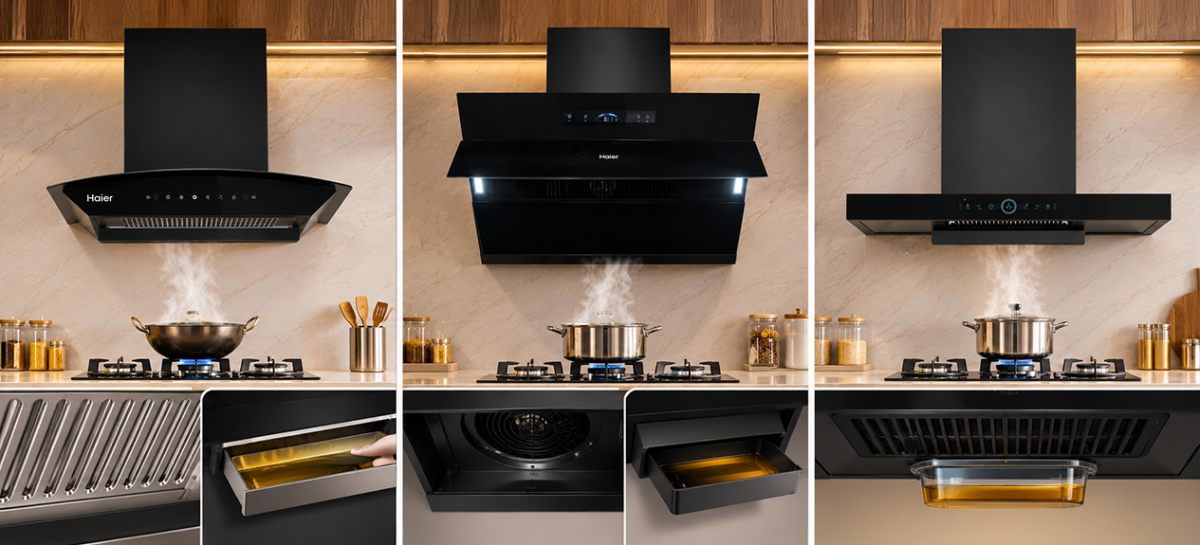
A filterless chimney has no physical mesh or baffle plates for grease to settle on. The design uses centrifugal force or heat to collect oil before it reaches the motor, draining it into a removable oil collector cup that gets emptied periodically.
How Oil Collection & Auto-Clean Work
Two main systems handle this in filterless chimneys. The first is heat auto-clean: a heating element raises the temperature inside the chimney, liquefying any oil deposits on internal walls so they drip down into the collector cup. The process runs in a few minutes and is triggered by pressing a dedicated button on the control panel.
The second is spin clean, also called centrifugal clean: a high-speed spinning disc or impeller uses centrifugal force to throw oil particles outward to the walls, where they slide down into the collector. In both cases, the chimney maintenance routine reduces to emptying and rinsing the oil collector cup every few weeks, far less involved than cleaning baffle plates.
Ducted vs Ductless: What Changes Maintenance
This is a separate question from filter type, but it affects long-term maintenance meaningfully.
What are ductless chimneys?
They are chimneys that do not expel air outside through a duct or pipe. Instead, they filter the air and recirculate it back into the kitchen. A carbon or charcoal filter absorbs odours before the air is released. Is there any chimney without pipe? Yes, ductless models are designed specifically for kitchens where running an external duct is not possible, such as apartments with internal kitchen layouts or rental properties where wall penetration is not an option.
How to know chimney is ductless?
The product specification will state recirculation mode or ductless operation. The chimney will have a charcoal filter compartment and no external duct pipe outlet. If the air exits back into the kitchen rather than through a wall or ceiling pipe, the unit is operating in ductless mode.
Are ductless chimneys good or bad?
For kitchens where ducting is genuinely not possible, they serve a practical purpose. The carbon filters need replacing every six to twelve months depending on cooking frequency, which adds to the ongoing maintenance cost. Ducted chimneys extract fumes and grease completely outside, making them more effective at keeping kitchen air clean. For heavy Indian cooking, ducted models generally deliver better long-term performance.
Which ductless chimney is best for a specific kitchen depends on the layout, the cooking frequency, and whether the kitchen can support a duct in future. If ducting is available, that is the better long-term choice.
Which Is Easiest to Clean & Maintain?
Which chimney is easy to clean? Across filter types, filterless auto-clean chimneys require the least regular effort. The oil collector cup takes a few minutes to empty and rinse. Heat auto-clean models reduce this further by partially automating the process. Baffle filter chimneys need more hands-on cleaning every four to six weeks.
| Type | Cleaning Task | Frequency | Effort |
| Baffle Filter | Remove, soak, scrub, replace plates | Every 4-6 weeks | Moderate |
| Filterless (Spin Clean) | Empty oil collector cup | Every 3-4 weeks | Low |
| Heat Auto-Clean | Run auto-clean cycle, empty collector | Every 3-4 weeks | Very low |
| Ductless (any type) | Replace carbon filter | Every 6-12 months | Low, but recurring |
Suction, Size & What Else to Check
Filter type answers the maintenance question. Suction, size, and motor type answer the performance questions.
Suction power is measured in m³/h (cubic metres per hour). For a standard Indian kitchen of 100 to 150 square feet, 1500 to 1700 m³/h handles everyday cooking reliably. Larger kitchens or high-volume cooking benefit from 1800 m³/h and above. The chimney should be at least as wide as the cooking hob, with slightly wider being preferable for complete coverage.
- BLDC motors use less electricity and run quieter than conventional motors at the same suction capacity
- Most quality chimneys operate below 65 dB; this matters if the kitchen opens into a living or dining space
- Touch controls and colour display panels help with day-to-day operation but do not affect suction or maintenance
- Warranty coverage on the motor is as important as the product warranty since the motor is the most expensive component
Haier’s Chimney Range
At Haier, our entire chimney range is built on filterless technology. We offer both Heat Auto-Clean and Spin Clean models across T-Shape, Arc Glass, and Vertical formats so buyers can choose the design that fits their kitchen without changing the maintenance experience.
The Haier 1700 m³/h Heat Auto Clean Filterless Chimney (HIH-G60HM-N) is a solid starting point for most kitchens, with strong suction and a 4-year product, 10-year motor warranty. For buyers who want Spin Clean technology with a BLDC motor, the Haier BLDC Chimney 1650 m³/h Spin Clean Filterless (HIH-C1900-BLDC-IN) delivers lower energy consumption and quieter operation, backed by a 4-year product and 12-year motor warranty.
For maximum suction, the Haier Unique Pyramid Filter 2000 m³/h Heat Auto Clean Chimney (HIH-T5905) uses a pyramid-shaped oil collector for more efficient grease separation alongside 2000 m³/h suction, with a 4-year product and 12-year motor warranty. At the more accessible end, the Haier 1500 m³/h Heat Auto Clean Filterless Chimney (HIH-T1600-IN) covers standard kitchen sizes reliably, reducing the entire chimney maintenance routine to emptying an oil cup.
Conclusion
The chimney filter type is not a minor specification. It determines how much time you spend on maintenance over five or ten years of daily cooking. Baffle filter chimneys are effective and durable but need regular hands-on cleaning. Filterless auto-clean chimneys reduce that routine considerably, particularly for households that cook daily with high heat and oil. Ductless models solve the installation problem where external ducting is not an option, though they carry an ongoing filter replacement requirement. Matching the type to your actual cooking habits and kitchen layout is what leads to a chimney that performs consistently rather than one that gradually becomes a problem.
FAQs
Which chimney is easiest to clean?
Heat auto-clean filterless chimneys require the least regular effort. Running the auto-clean cycle every few weeks and emptying the oil collector cup covers most maintenance. Baffle filter models need hands-on plate removal and scrubbing every four to six weeks, which takes more time and effort.
What is a baffle filter used for?
A baffle filter uses curved metal plates to separate grease from cooking vapours through repeated direction changes. Oil settles on the plates and needs to be cleaned off regularly. It is effective for heavy Indian cooking but requires consistent manual maintenance to keep suction performance steady.
What is a filterless / auto-clean chimney?
A filterless chimney has no physical mesh or baffle plates. It uses heat or centrifugal spin to collect oil, which drains into a removable cup. Auto-clean refers specifically to a thermal cycle where a heating element liquefies internal oil deposits so they drain automatically into the collector.
What are ductless chimneys and are they good?
Ductless chimneys recirculate kitchen air through carbon filters rather than expelling it outside through a duct pipe. They suit kitchens where external ducting is not possible. The carbon filters need periodic replacement, and odour removal is less complete than in ducted models for high-volume Indian cooking.
How do I know if a chimney is ductless?
Check the product specification for terms like recirculation mode or ductless operation. The chimney will have a charcoal filter compartment and no external duct pipe connection. Air will exit back into the kitchen rather than through a wall or ceiling pipe if the unit is in ductless mode.
Which chimney is best for a modular kitchen?
For a modular kitchen, a T-shaped or arc glass filterless auto-clean chimney in a ducted configuration suits most layouts. Match the width to your hob, choose suction capacity based on kitchen size and cooking frequency, and consider a BLDC motor model for lower noise and better energy efficiency over the long term.