
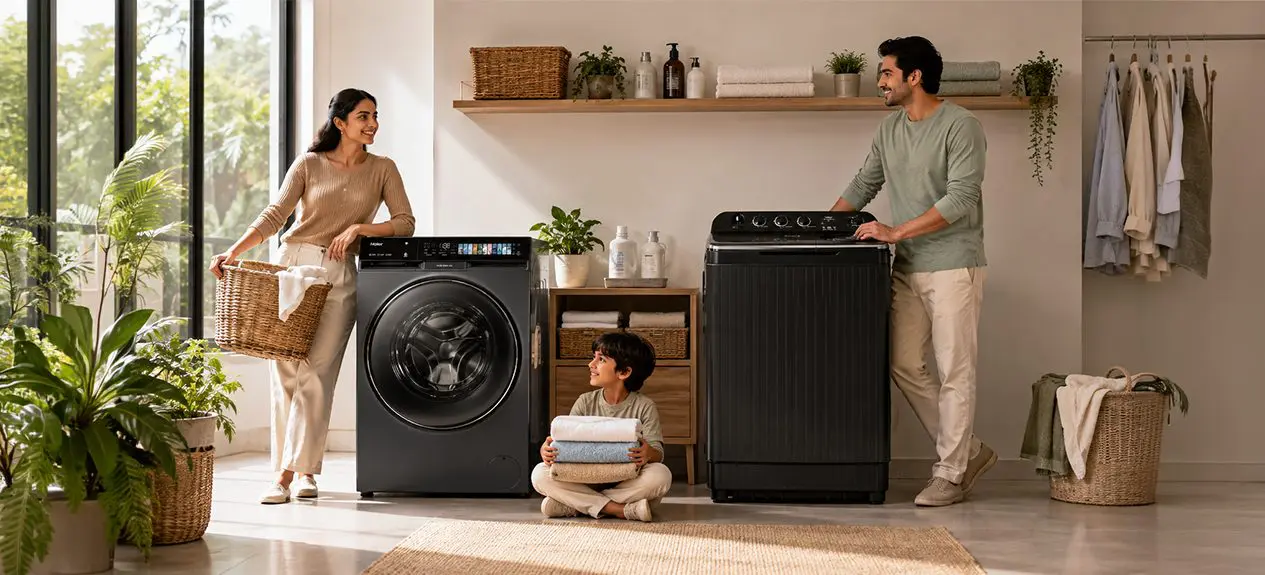

Picking a washing machine isn’t just about what fits your utility space. Every household does laundry a little differently. Some wash small loads daily, others save it all for the weekend. This is where the difference between front-load and top-load washing machines starts to matter. Both machine types clean clothes well, but they get there in separate ways. That changes water use, wash time, and how your fabric holds up over time.
This blog looks at the comparison in plain terms, using real product data, so you can pick what works best for your family.
What Is the Difference Between Front Load and Top Load Washing Machines?
Here’s the basic mechanical difference between front load and top load washing machine designs, laid out simply:
| Aspect | Front Load | Top Load |
| Door position | On the front | On the top |
| How clothes load | Placed in horizontally | Dropped in vertically |
| Drum movement | Turns sideways, tumbles clothes through water | Stands upright, pulsator or wave drum agitates from the base |
| Water level per load | Lower, clothes fall through it | Higher, drum fills up more |
| Typical cycle speed | Slower, thorough tumbling | Often faster |
| Fabric handling | Gentle tumbling motion | Pulsator or wave drum agitation |
| Noise level | Quieter, steadier motor | Slightly louder during spin |
| Space needed | Fits under counters, stackable | Needs top clearance to open lid |
| Loading posture | Requires a bend to load | Upright loading, no bending |
This one design choice changes almost everything else that follows. Neither design is really wrong here, they just solve laundry in two different ways, and that’s what shapes every other comparison in this piece.
Front Loader vs Top Loader: Performance and Efficiency Compared
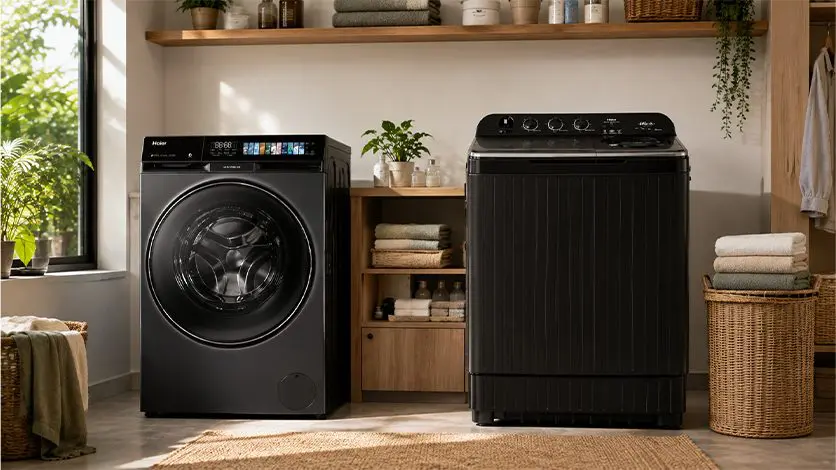
Once the basics are clear, the real front loader vs top loader question is which machine performs better on your laundry, and which one costs less to run each month.
- Which Handles Bulky Items Such as Blankets and Comforters Better?
Front-load machines use gravity and tumbling instead of hard agitation, so clothes take less strain. They wrinkle less, and the fabric lasts longer over time. Bulky items such as blankets and comforters usually do better in a front-load drum, since there’s enough room to move freely instead of twisting around a pulsator.
Top-load machines work faster on everyday, lightly soiled clothes, and the wave drum keeps fabric moving without needing extra water to cover a full load. Stain removal modes, steam functions, and settings for sarees or denim are common in both types now. The wash quality gap has narrowed a lot in recent years.
- Which Uses Less Water and Electricity?
Water and electricity use is where the two designs really separate. Front load machines usually use less water per kg of laundry, since clothes tumble through water instead of sitting fully soaked, and that cuts detergent use too. Internal testing on Haier’s front load range recorded water use as low as 4.17 litres per kg per cycle, well under most top load numbers.
Top load machines have closed this gap. Newer models built with anti-scaling technology, wave drum design, and inbuilt heaters now reach close to 10 to 12 litres per kg per cycle, a solid jump from older pulsator-only machines. Energy use follows a similar pattern, with front load units drawing less power. For families who wash often, that difference adds up across months, and it’s worth checking exact numbers for a specific model instead of assuming one type always wins.
Front Load vs Top Load: Which Fits Small Spaces and Busy Homes Better?
A few practical things often decide a purchase more than any spec sheet does, especially when comparing front load vs top load setups for a small home:
- Front load machines need clearance in front for the door, plus room to bend and load clothes.
- Top load machines need clear space above the lid, so they don’t sit well under low counters.
- Front loaders stack neatly with dryers, useful in tight utility areas.
- Top loaders often install faster, needing less plumbing work and lower water pressure.
- Back control panels, castors, and child lock features on newer top load models add real convenience for homes with kids or older family members.
Which One Should Your Family Buy?
A young couple with a lighter laundry load often leans toward a top load machine. It’s quicker, and loading is easier in a small apartment. A larger family generating heavier loads, including bedsheets, towels, and jackets, usually finds a front load washing machine more practical, since savings grow with heavier use. Homes with elderly members sometimes prefer top load for the upright loading position. Homes that care more about fabric life and quiet washing tend to pick front load instead.
There isn’t one universal answer to the front load vs top load washer decision. It depends on how your household handles laundry, week to week.
Want to know which washing machine suits a large family best?
Read this blog: Best Washing Machine for Large Families
Why Haier Washing Machines Stand Out
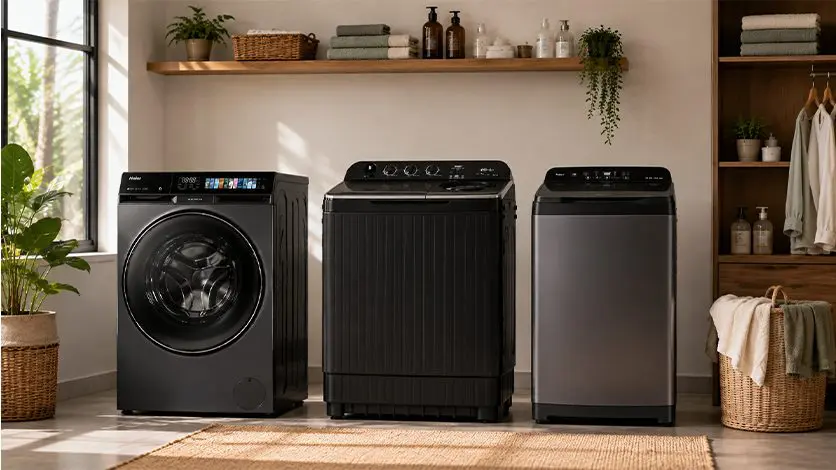
At Haier, we build both our front load and top load ranges around real laundry problems Indian households deal with every day. Our front load series, including F9, F11, and F5, uses a 525mm Super Drum paired with a Direct Motion Motor, Dual Spray, and Ultra Fresh Air technology that keeps the drum smelling clean even if clothes stay inside a bit longer than planned. Our Essence Wash sprays pre-mixed detergent right onto clothes for deeper cleaning, cutting both wash time and water use. On the top load side, our Oceanus Wave Drum and Butterfly Heater work together for a genuinely strong hot wash, backed by anti-scaling technology that protects the heater from hard water damage over years of use.
Features such as back control panels, toughened glass lids, auto restart, and anti-rat mesh come from feedback we gather directly from Indian homes, not just lab testing. We keep refining both ranges because laundry needs shift as families grow, and our machines are built to keep up.
Conclusion
Both front load and top load washing machines can serve a family well. It’s not about one being better than the other, it’s about space, how much laundry you do, and your daily habits. If saving water and energy is your number one priority, front load tech has a natural edge. If speed, upright loading, and easier installation are more important, top load is a solid choice.
Whichever way you lean, check out the model’s drum technology, hygiene features, and warranty coverage before making a decision. These details matter more than the category label alone, in the end.